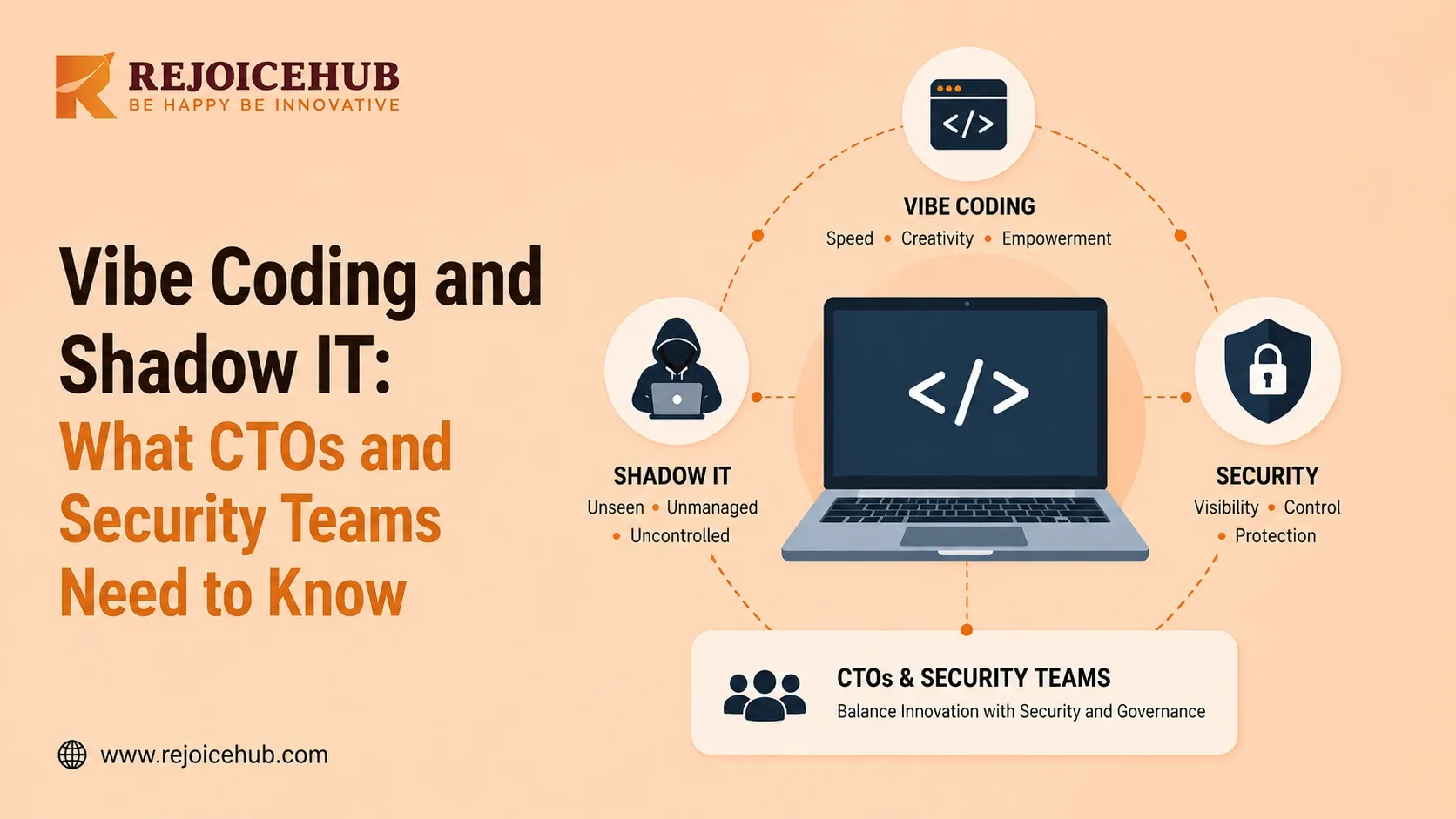
Someone on your marketing team just built an internal app using an AI coding assistant over the weekend. It works. And nobody in IT even knows about it. This is vibe coding and shadow IT colliding, and it may become one of the fastest-growing blind spots in enterprise security.
If you're a CTO, CISO, or founder, this probably isn't hypothetical. It's happening inside your organization right now, lurking in the shadows, one committed prompt at a time. Understanding what vibe coding actually is is the first step toward governing it properly.
This guide covers what vibe coding is, why it's contributing to a sharp rise in shadow IT, the risks it poses to enterprise security, and how to govern it in a way that enables innovation without exposing your organization to avoidable risk.
Search Intent Snapshot
Primary intent: Understand the security and governance risks of vibe coding combined with shadow IT
Secondary intent: Find practical steps to detect, control, and secure AI-generated internal tools
Pain points: No visibility into AI-built apps, rising breach risk, compliance exposure, developer pushback against restrictions
Desired outcome: A governance framework that enables safe AI adoption instead of blanket bans
What Is Vibe Coding?
Vibe Coding refers to coding in which, instead of writing programs in traditional ways, one describes in natural language what they want to achieve and an AI produces the actual working code.
Vibe coding is an AI-driven software development approach in which a person uses natural-language prompts to delegate a substantial portion of the implementation to an AI system. Unlike traditional AI-assisted coding, where developers actively review and modify generated code, vibe coding can involve relying heavily on AI to build applications with limited understanding of the underlying implementation.
The concept of Vibe coding recognizes a paradigm shift in the development of software. A Sales Ops Manager, a marketing director, or a founder with no technical know-how can now describe how the system should work, and an AI will create an application for them in a matter of minutes.
Key Takeaway Box Vibe coding removes the traditional gatekeeper, a trained developer reviewing every line before it ships. When that gatekeeper disappears, so does a lot of the quality and security review that used to happen by default.
What Is Shadow IT, and How Does Vibe Coding Make It Worse?
Shadow IT is any software, tool, or system used within an organization unauthorized, uncatalogued, or unreviewed by the company's IT/security teams.
Vibe coding can significantly expand the scope of shadow IT by removing much of the technical friction involved in building software. Employees can now create applications with databases, APIs, authentication, and integrations without going through a traditional development process.
Gone are the days when shadow IT consisted solely of an employee signing up for an unauthorized SaaS application. Now shadow IT can involve the creation of an entire end-to-end application, with a database, API, and login page, with little to no oversight from enterprise IT. If you want a deeper look at how these tools are creeping into company workflows, this breakdown of enterprise AI coding tools and the security risks they carry is worth a read.
The scale of this problem was already egregious before the advent of AI. Enterprise customers typically have many more cloud services that are not officially sanctioned than are sanctioned, and shadow IT can consume a substantial percentage of enterprise IT budgets.
This trend is poised to accelerate wildly with the addition of AI fuelled, self-service software development.
Shadow IT vs. Vibe-Coding-Driven Shadow IT: What's Different
| Factor | Traditional Shadow IT | Vibe-Coding-Driven Shadow IT |
|---|---|---|
| Who creates it | Employees signing up for SaaS tools | Any employee "building" a full app via prompts |
| Skill required | Low (sign-up form) | Near-zero (natural language prompt) |
| What's exposed | Third-party vendor risk | Custom code, data access, and infrastructure risk |
| Visibility | Sometimes shows up in expense reports or SSO logs | Often invisible until an incident occurs |
| Review process | May go through basic vendor security review | Usually none |
If you're weighing whether internal tools should be built ad hoc or through a managed process, our team's take on building internal AI tools the right way covers how to get the speed benefit without the exposure.
Why Is Vibe Coding Such a Big Security Risk in 2026?
Recent research is beginning to document security weaknesses in AI-generated and vibe-coded applications. A 2026 study examining vibe-coded applications identified recurring issues including placeholder logic, unfiltered input, and secret exposure. These findings suggest that an application appearing functional does not necessarily mean its implementation is secure.
Here's what the data actually shows, and why each finding matters for a business building or tolerating vibe-coded apps.
AI-Generated Code Has a Documented Vulnerability Problem
Recent security research indicates that AI-generated applications can contain vulnerabilities even when their core functionality appears to work correctly. The risks identified in research include insecure input handling, exposed secrets, weak authorization logic, and other implementation flaws. This reinforces the need for human review and automated security testing before AI-generated applications reach production, a process outlined in more depth in this guide on how to review AI-generated code.
Broken Access Control Is a Recurring Failure Mode
A common vulnerability in audited vibe-coded applications is incorrect access control logic, which allows unauthorized users to access or modify information. One notable example involved a consumer application that exposed user messages due to improperly implemented artificial intelligence access control policies. Locking this down usually starts with the kind of zero trust access model enterprises already apply to their sanctioned systems.
Common Implementation Mistake: Teams assume that because the app "works" in testing, the permissions layer is correct. Functional testing checks whether a feature does what it's supposed to; it rarely checks whether it also blocks what it's not supposed to allow.
Hardcoded Secrets and Slopsquatting Are New Attack Surfaces
AI coding tools can sometimes suggest nonexistent or incorrect package names. This creates a potential supply-chain risk known as slopsquatting, where an attacker registers a package using a name that an AI system may incorrectly suggest and waits for developers to install it. Teams should therefore verify AI-suggested dependencies before adding them to a project, a risk that plays out in real incidents like the one detailed in this AI supply-chain attack explainer.
Expert Tip: Never let an AI coding assistant write credentials directly into a file. Secrets belong in environment variables or a secrets manager, full stop, regardless of who, or what, is writing the code.
Bigger, Harder-to-Review Pull Requests
These pull requests also tend to be substantially larger, often involving more files and services, which can make security review more difficult. Teams struggling with this scale problem often benefit from a structured process for reviewing AI-generated pull requests rather than relying on the same checklist used for human-written code.
Key Takeaway Box Vibe coding doesn't just introduce more vulnerabilities, it introduces different kinds of vulnerabilities (access control, secrets exposure, phantom dependencies) that traditional code review checklists weren't built to catch.
Why Do Employees Turn to Vibe Coding and Shadow AI in the First Place?
Employees often build shadow tools because official channels do not provide suitable or timely solutions to the problems they need to solve. This is not necessarily malicious behavior; it is often a response to an urgent business need, slow internal processes, or a lack of approved self-service development options.
Most organizations are now realizing there is a gap between the adoption of artificial intelligence technologies and official governance of these technologies. In other words, most of the workforce is now using AI on a regular basis at work, with limited understanding of how to safely apply these tools, and with a considerable number of employees admitting they do not research if the tools they use comply with company regulations. Understanding where your organization sits on the enterprise AI adoption roadmap can help explain why this gap exists in the first place.
Common reasons teams go around IT:
- IT ticket queues take weeks; the business problem needs a fix today
- No approved internal-tool-building process exists
- Employees don't realize a "quick app" carries the same risk as a full software project
- Leadership rewards speed and results, not process compliance
- Nobody explained why review matters, only that it's required
If you're seeing this pattern, it's worth reading our breakdown on building a company-wide AI governance and verification framework that addresses the root cause instead of just policing the symptom.
The Business Cost of Ungoverned Vibe Coding and Shadow IT
Incidents of Shadow IT and Shadow AI could have a significantly larger financial and compliance impact on the company, particularly in terms of incident response and management, compared to breaches and risks associated with the officially sanctioned and monitored systems. In other words, "it will be taken care of if something goes wrong" is, more often than not, a costly affair. This accumulating exposure is part of what's now being called AI security debt, and it compounds the longer it goes unaddressed.
Consider the exposure across a few dimensions:
- Breach cost: Incidents tied to shadow IT and shadow AI consistently show higher-than-average remediation costs compared to breaches in approved, monitored environments.
- Compliance risk: A significant share of shadow AI incidents involve exposure of personally identifiable information, and a smaller but meaningful share involve intellectual property exposure, both of which can trigger regulatory reporting obligations.
- Wasted spend: Duplicate, unmonitored, or abandoned tools quietly drain IT budgets, often without anyone realizing it until an audit.
- Investigation difficulty: When IT doesn't know a tool exists, incident response takes longer and costs more, because the first step becomes finding the exposure rather than fixing it.
If you're building a business case for governance investment, our guide on measuring AI ROI walks through how to frame the cost-avoidance side of that conversation for leadership.
Accelerate Your Workflows with Custom AI
Book a free consultation session with RejoiceHub. We'll map out a tailored automation roadmap for your company.
How Can CTOs and Security Teams Govern Vibe Coding Without Killing Innovation?
The goal should not be to eliminate vibe coding. It should be to create a controlled path for its safe use. Organizations can allow low-risk experimentation while requiring stronger security and engineering controls for applications that access sensitive data, production systems, or critical business processes.
Here's a practical framework we recommend to clients moving from reactive to proactive:
- Create an approved fast lane, not just a "no." Give teams a sanctioned way to prototype with AI tools that includes lightweight review; this satisfies the urgency that drives shadow IT in the first place, and it's the same principle behind running AI agents safely in production.
- Treat all AI-generated code like unreviewed third-party code. Run static analysis, dependency checks, and access-control testing before anything touches production data, regardless of who or what wrote it, including checks for risks like AI sandbox escapes.
- Build an internal AI tool inventory. You can't govern what you can't see. Start with a simple, low-friction way for teams to register the tools and internal apps they're using or building, which starts with knowing your non-human identities across the org.
- Set clear rules on data and secrets. Prohibit pasting credentials, customer data, or proprietary architecture details into any AI prompt, and enforce secrets management by default, following the same standards laid out in this AI agent authentication guide.
- Train, don't just restrict. Organizations with clear AI training and policies see measurably fewer security incidents than those relying on policy documents nobody reads, especially when the training covers AI and data privacy for executives.
- Route serious internal tools through professional development. Reserve vibe coding for prototypes and low-stakes internal utilities. Anything touching customer data, payments, or core business logic should go through custom AI agent development with proper architecture and security review from the start, a decision this custom vs off-the-shelf AI software comparison can help you think through.
For teams further along, our piece on AI agent security best practices goes deeper into the technical controls worth putting in place before scaling any AI-built system.
Vibe Coding Best Practices Checklist
Quick reference for teams that want to keep building fast, safely:
- Never hardcode secrets, use environment variables or a secrets manager
- Require human review before any AI-generated code touches production
- Run automated security scanning (SAST) in the CI/CD pipeline, even for "small" internal tools
- Verify every third-party package name, don't trust AI-suggested dependencies blindly
- Limit AI-built tools to sandboxed environments until reviewed, following the same discipline covered in this sandboxed execution guide
- Document what the tool does, who owns it, and what data it touches
- Set a clear escalation path for tools that grow beyond "quick prototype" scope
If you're looking to build a custom AI agent the right way from day one, RejoiceHub can help design, secure, and scale it properly without the shadow IT sprawl. Our AI agent development services are built specifically for teams that want speed and governance.
Conclusion
Vibe coding is changing how quickly teams can build internal software, but speed without governance can create serious security and compliance risks. AI-generated applications may contain broken access controls, exposed secrets, unsafe dependencies, or other vulnerabilities that are easy to miss when traditional development reviews are skipped.
The answer is not to ban vibe coding, but to create a controlled path for using it safely. With approved workflows, human code review, automated security testing, tool inventories, secrets management, and proper training, organizations can support innovation while keeping shadow IT under control.
Frequently Asked Questions
What is vibe coding in simple words?
Vibe coding means telling an AI tool what you want in plain language, and it writes the code for you. No programming background is needed, which is why non-technical employees can now build full apps in minutes.
How is vibe coding connected to shadow IT?
Vibe coding makes it easy for anyone to build apps without IT approval. Since these tools are built fast and outside official channels, they often go unnoticed, which directly feeds shadow IT growth inside companies.
Why is vibe coding risky for businesses?
Vibe coded apps often skip proper security checks. They can have weak access controls, exposed secrets, or fake package names, all of which can lead to data leaks or breaches without anyone realizing it.
Can vibe coding cause a data breach?
Yes, it can. If access controls or secrets aren't handled properly, a vibe coded app can expose sensitive company or customer data. Since IT doesn't know the app exists, breaches often go undetected for longer.
Should companies completely ban vibe coding?
No, banning it usually backfires. Employees just build in secret instead. A better approach is creating an approved, reviewed way to use vibe coding so speed and security work together.
What is slopsquatting in AI coding?
Slopsquatting happens when an AI tool suggests a fake or nonexistent software package name. Attackers register that exact name in advance, so when developers install it, they unknowingly install malicious code.
How can IT teams detect shadow IT apps?
IT teams can use network monitoring, cloud access security brokers, and SaaS management tools to spot unapproved apps. Combining this with a simple tool registration process makes detection much faster and more reliable.
Is vibe coding safe for enterprise use?
It can be, but only with proper guardrails. Mandatory code review, automated security scanning, secrets management, and clear rules on what needs professional development make vibe coding safe for enterprise environments.
What should a vibe coding policy include?
A good policy should state which use cases are allowed, require security review before launch, mandate secrets management, ban pasting sensitive data into prompts, and include a simple app inventory process.
Why do employees use vibe coding instead of asking IT?
Employees often turn to vibe coding because IT requests take too long. When there's no fast, approved way to build small tools, people find their own workaround, even if it means skipping security checks.