Cyberattacks aren't slowing down; they're multiplying. Ransomware, credential theft, and AI-powered phishing hit businesses of every size, and the average cost of a data breach in the U.S. now runs into the millions.
For decades, security teams relied on a simple idea: build a strong perimeter firewalls, VPNs, a locked network edge and trust everything inside it. That model is breaking down fast.
Cloud computing, remote and hybrid work, SaaS sprawl, and now autonomous AI agents have erased the traditional network edge. Employees log in from anywhere. Data lives across dozens of cloud services. AI agents access systems on behalf of humans, often with standing credentials. There is no longer a clear "inside" to defend.
This is where Zero Trust comes in a security model built on one core assumption: never trust, always verify, no matter where a request comes from.
In this guide, you'll learn what Zero Trust is, how Zero Trust Architecture works, the core principles behind the framework, its business benefits, real-world use cases (including Zero Trust for AI agents), and the best practices to adopt it without disrupting your operations.
What Is Zero Trust?
Zero Trust is a cybersecurity model that assumes no user, device, or application should be trusted by default even if it's already inside the network. Every access request must be verified, authenticated, and continuously monitored based on identity, device health, and context before access is granted.
What is Zero Trust?
Zero Trust replaces the old "trust but verify" mindset with "never trust, always verify." Instead of granting broad access once someone is inside the network, Zero Trust checks every single request every time, regardless of location.
Why is it important?
Modern businesses no longer operate inside a single network perimeter. Employees work remotely, apps run in the cloud, and AI agents execute tasks autonomously. Zero Trust matters because:
-
It limits the damage a single compromised credential can cause.
-
It protects distributed, cloud-first, and hybrid environments.
-
It addresses new risks introduced by AI agents and non-human identities.
-
It supports compliance requirements (HIPAA, SOC 2, PCI-DSS, GDPR).
How Zero Trust differs from traditional security
| Aspect | Traditional Perimeter Security | Zero Trust Security |
|---|---|---|
| Trust model | Trust everything inside the network | Trust nothing by default |
| Access | Broad, once inside | Granular, per-request |
| Verification | One-time login | Continuous verification |
| Network design | Flat network | Segmented, micro-perimeters |
| Best fit for | On-prem, fixed offices | Cloud, remote work, AI agents |
Traditional security protects the edge. Zero Trust protects every identity, device, and transaction regardless of where they sit.
What Is Zero Trust Architecture?
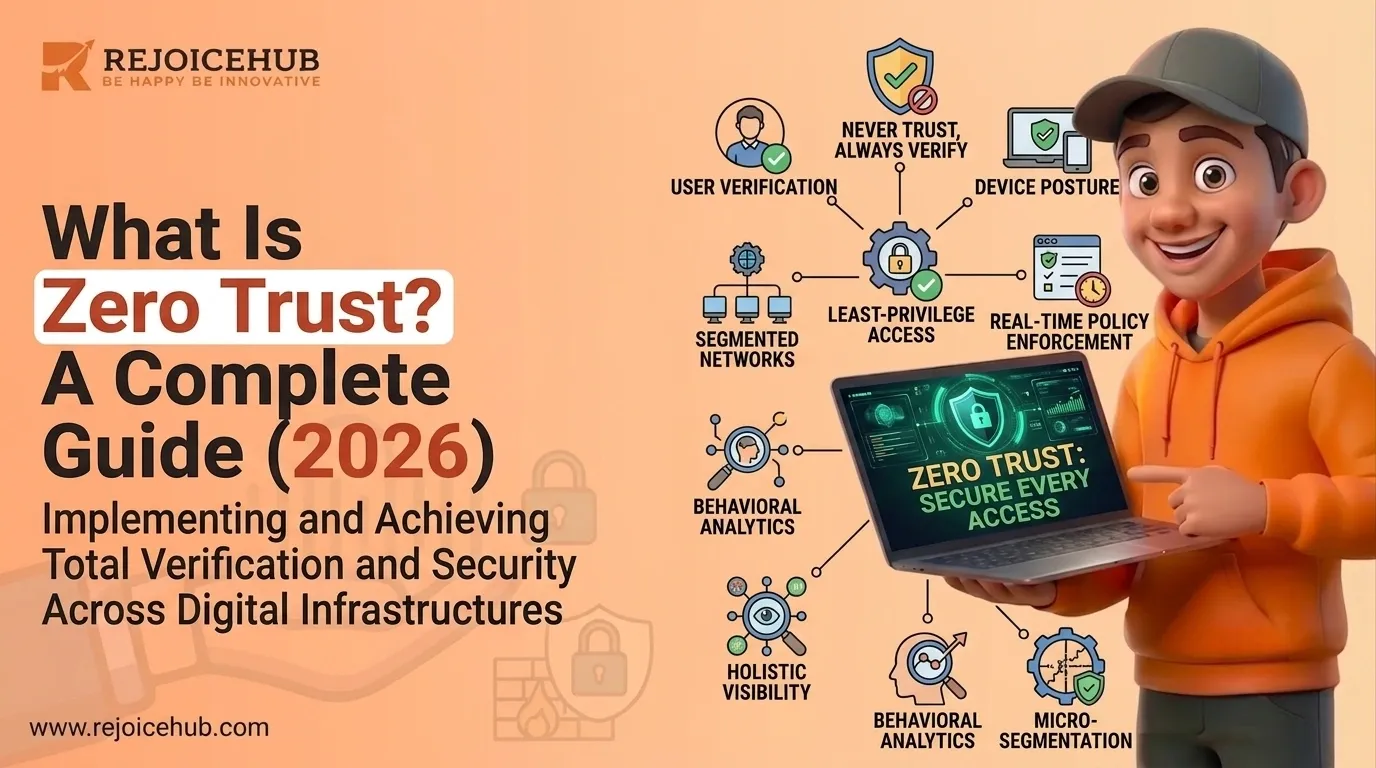
Zero Trust Architecture (ZTA) is the technical framework that puts Zero Trust principles into practice. It combines identity verification, device security, least privilege access, continuous authentication, network segmentation, and policy enforcement into one integrated security model, as formalized by the NIST Zero Trust Architecture (SP 800-207).
Here's how each component works together:
-
Identity verification: Every user and service must prove who they are, typically through multi-factor authentication (MFA) and strong identity providers, before any access is granted.
-
Device security: Access decisions factor in device health: is the device patched, encrypted, and free of known malware?
-
Least privilege: Users and applications get only the minimum access required to do their job nothing more.
-
Continuous authentication: Trust isn't permanent. Sessions are re-evaluated based on behavior, location, and risk signals throughout their lifecycle.
-
Network segmentation: The network is broken into smaller zones (micro-segments), so a breach in one area can't spread freely to others.
-
Policy enforcement: A central policy engine evaluates every access request in real time against identity, device, and context data before allowing it through.
The NIST Zero Trust Architecture (SP 800-207) is the widely referenced U.S. government standard that many enterprises and vendors design their Zero Trust implementations around. It defines the core logical components the Policy Engine, Policy Administrator, and Policy Enforcement Point that decide and enforce access in real time.
Key Takeaway: Zero Trust Architecture isn't a single product you buy it's an operating model built from identity, device, network, and policy controls working together continuously.
Common mistake: Many teams buy a "Zero Trust" tool and assume they're done. In reality, ZTA requires connecting identity providers, device management, network controls, and policy engines into one coherent system.
Core Zero Trust Principles & Framework
The Zero Trust Framework rests on five core principles: never trust always verify, least privilege access, assume breach, continuous monitoring, and strong identity verification. Together, these principles form the Zero Trust Model that guides how organizations design and operate secure systems.
-
Never Trust, Always Verify: No user, device, or system is trusted automatically, regardless of network location. Every request is authenticated and authorized.
-
Least Privilege Access: Access rights are scoped tightly to what's needed for a specific task, reducing the blast radius of any compromised account.
-
Assume Breach: Security is designed as if an attacker is already inside. This mindset drives segmentation, monitoring, and rapid containment.
-
Continuous Monitoring: User and system behavior is tracked in real time to detect anomalies, unusual access patterns, or lateral movement.
-
Strong Identity Verification: MFA, single sign-on (SSO), and risk-based authentication confirm that users and services are who they claim to be, every time.
These Zero Trust Principles aren't theoretical they translate directly into daily practices: enforcing MFA everywhere, segmenting sensitive systems, logging every access event, and reviewing permissions regularly.
Expert insight: Organizations that treat Zero Trust as a continuous program not a one-time project see far better long-term security outcomes. Identity and access reviews should happen quarterly, not annually.
If your team is deploying AI agents that call internal tools or APIs, these same principles apply directly to machine identities. Our guide on AI agent authentication for enterprise breaks down how to extend Zero Trust to non-human identities.
Accelerate Your Workflows with Custom AI
Book a free consultation session with RejoiceHub. We'll map out a tailored automation roadmap for your company.
Benefits of Zero Trust in Cybersecurity
Zero Trust in cybersecurity reduces attack surface, strengthens identity security, secures remote and hybrid work, improves cloud and AI protection, supports regulatory compliance, and enables faster incident response making it a foundational strategy for modern, distributed businesses.
| Benefit | Business Impact |
|---|---|
| Reduced attack surface | Fewer standing privileges means fewer exploitable paths |
| Better compliance | Aligns with HIPAA, SOC 2, PCI-DSS, and GDPR requirements |
| Stronger identity security | MFA and continuous verification cut credential-based breaches |
| Secure remote work | Protects distributed teams without relying on VPNs alone |
| Better cloud protection | Secures multi-cloud and SaaS environments consistently |
| AI security | Governs how AI agents and models access sensitive data |
| Faster incident response | Segmentation and monitoring shrink detection-to-containment time |
Real business example: A mid-size SaaS company migrating to a multi-cloud setup adopted Zero Trust network access instead of a traditional VPN. When one employee's laptop was compromised via phishing, the attacker could only reach the single application the employee was authorized for not the entire customer database. That's the practical value of least privilege in action.
If you're evaluating cloud strategy alongside your security model, our comparison of multi-cloud vs. hybrid cloud is a useful next read.
Zero Trust Access & Real-World Use Cases
Zero Trust Network Access (ZTNA) replaces traditional VPNs by granting access to specific applications not the whole network based on verified identity, device posture, and context. It's used across healthcare, finance, manufacturing, SaaS, and increasingly, AI applications.
What is Zero Trust Network Access (ZTNA)?
ZTNA creates a secure, identity-based connection between a user (or AI agent) and a specific application, rather than placing them "inside" the corporate network. Nothing else on the network is visible or reachable unless explicitly authorized.
Industry use cases
-
Healthcare: Protects electronic health records (EHR) and patient data while supporting telehealth and remote clinician access, in line with HIPAA requirements.
-
Finance: Secures transaction systems, core banking platforms, and customer financial data against credential-based fraud.
-
Manufacturing: Segments OT (operational technology) and IoT devices from IT networks to prevent industrial sabotage.
-
SaaS: Protects multi-tenant platforms and customer data with per-tenant, per-user access controls.
-
AI applications: Restricts what AI models and agents can read, write, or call, reducing the risk of data leakage or unauthorized actions.
-
Enterprise cloud: Enforces consistent access policy across AWS, Azure, GCP, and SaaS tools.
-
Hybrid work: Secures employees moving between home, office, and co-working environments without relying on legacy VPNs.
Zero Trust for AI agents
AI agents are a new category of identity they act autonomously, call APIs, and access sensitive systems, often faster than a human can review. Applying Zero Trust to AI agents means:
-
Issuing agents scoped, short-lived credentials instead of standing access.
-
Logging and monitoring every tool call an agent makes.
-
Sandboxing agent execution to prevent unintended actions.
-
Requiring human approval for high-risk or irreversible actions.
This is a fast-emerging risk area we cover it in depth in AI Agent Security: A Guide to Securing AI Agents in Production and What Is the Lethal Trifecta in AI Agents?.
Key Takeaway: If your business is building or deploying AI agents, treat them as identities requiring the same Zero Trust scrutiny as employees scoped access, continuous monitoring, and sandboxed execution.
For teams building agentic systems, our guide to sandboxed execution for AI agents walks through practical implementation patterns.
Challenges & Best Practices
The biggest Zero Trust adoption challenges are legacy systems, user resistance, cost, and implementation complexity. Best practices to overcome them include enforcing MFA, verifying every device, monitoring continuously, adopting identity-first security, and segmenting networks incrementally.
Challenges
-
Legacy systems: Older applications often weren't built for granular, identity-based access controls.
-
User adoption: Employees may resist additional authentication steps unless the experience is streamlined.
-
Cost Full Zero Trust rollouts require investment in identity providers, monitoring tools, and integration work.
-
Complexity: Coordinating identity, device, network, and policy layers across cloud and on-prem systems takes real engineering effort.
Best Practices
-
Enforce MFA everywhere: On every account, every application, with no exceptions for "trusted" internal tools.
-
Verify every device: Check device health and compliance before granting access, not just user identity.
-
Monitor continuously: Use behavioral analytics to catch anomalies in real time, not after the fact.
-
Adopt identity-first security: Make identity, not network location, the primary access control.
-
Segment your network Start with your most sensitive systems and expand segmentation gradually.
Common mistake: Rolling out Zero Trust everywhere at once. Start with your highest-risk assets customer data, financial systems, admin accounts then expand.
Teams securing AI-driven infrastructure should also review common failure points in our guide on AI security debt and autonomous agents as a breach vector.
Conclusion
Zero Trust is quickly becoming the default cybersecurity standard not a niche best practice. As businesses move deeper into cloud infrastructure, hybrid work, and AI-driven automation, the old idea of a trusted network perimeter no longer holds up.
What is Zero Trust, at its core? A model built on continuous verification, least privilege, and the assumption that breaches will happen so systems are designed to contain them.
You don't need to implement Zero Trust overnight. Start with identity and MFA, expand into device verification and segmentation, and build toward continuous monitoring across your cloud and AI systems.
If your business is building secure AI applications, enterprise software, or cloud platforms, RejoiceHub can help you design and implement modern security architectures tailored to your needs. From Zero Trust network access to secure AI agent deployment, our team helps startups and enterprises reduce risk while accelerating automation and ROI.
book a call to discuss your Zero Trust and AI security roadmap.
Frequently Asked Questions
1. What is Zero Trust in simple terms?
Zero Trust is a security approach where no user, device, or application is automatically trusted — even inside the network. Every access request is verified based on identity, device health, and context before it's granted, reducing the risk of a single compromised account causing widespread damage.
2. What is Zero Trust Architecture?
Zero Trust Architecture (ZTA) is the technical framework that implements Zero Trust principles using identity verification, device checks, least privilege access, network segmentation, and centralized policy enforcement. NIST SP 800-207 is the most widely referenced standard defining its core components.
3. What is the Zero Trust model?
The Zero Trust model is a security philosophy built around "never trust, always verify." Instead of relying on network location to grant access, it continuously evaluates identity, device posture, and behavior for every request, regardless of where it originates.
4. What is Zero Trust Network Access (ZTNA)?
ZTNA is a technology that grants users access to specific applications, not the entire network, based on verified identity and context. It's often used to replace traditional VPNs, especially for remote and hybrid workforces.
5. What is Zero Trust in cybersecurity, and why does it matter?
In cybersecurity, Zero Trust minimizes the damage a breach can cause by limiting access, verifying every request, and monitoring continuously. It matters because cloud adoption, remote work, and AI agents have eliminated the traditional network perimeter that older security models relied on.
6. What are the core Zero Trust principles?
The core Zero Trust principles are: never trust, always verify; least privilege access; assume breach, continuous monitoring, and strong identity verification. Together, they guide how organizations design secure, resilient systems.
7. How is Zero Trust applied to AI agents?
Zero Trust extends to AI agents by treating them as identities that require scoped, short-lived credentials, continuous monitoring of their actions, sandboxed execution environments, and human approval for high-risk tasks, thereby preventing autonomous agents from becoming an unmonitored attack surface.