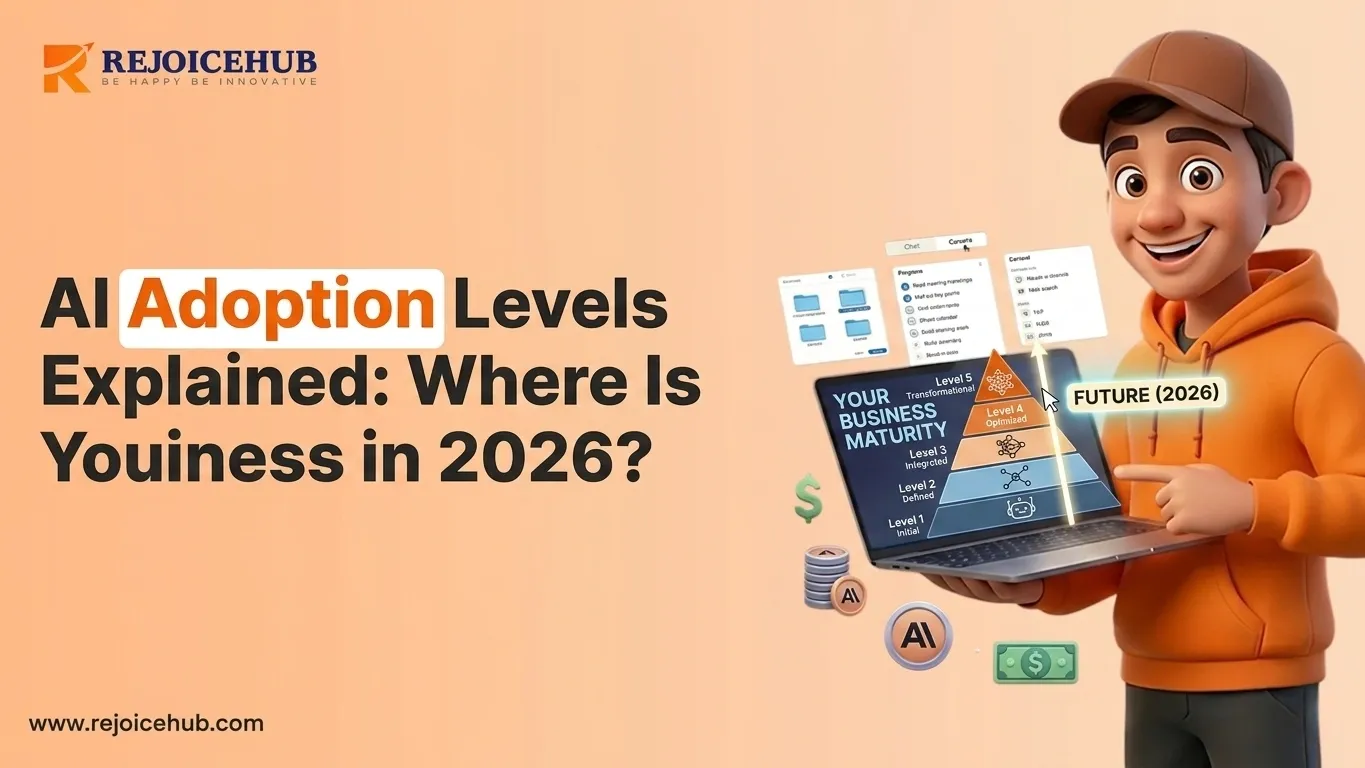
Businesses across the globe have spent more than 1 billion dollars on artificial intelligence research and development work. The boardrooms of 2026 still show the same unpleasant reality that exists today. Companies use AI technology; however, they do not implement it across their entire operations.
The findings indicate that success is possible. Yet the findings also show that their results do not generate significant effects.
The organization needs a strategic plan to implement existing technology. The majority of businesses are at AI adoption Level 1 because they conduct separate tests without establishing any future direction. The small group of innovative companies that operate their entire business through automation has achieved Level 3 enabling them to outperform all other businesses in their market.
What characteristics distinguish successful companies from their less competent competitors? This guide provides an explanation of AI adoption levels while describing why businesses remain in their testing phase, and it offers an effective method for implementing AI throughout your business operations in 2026.
What Are AI Adoption Levels? (Definition + Framework)
AI Adoption Stages Explained
The company uses artificial intelligence throughout its operations to the point of complete implementation. The maturity model serves as a measurement system that allows you to assess your current position while showing you the requirements for advancing to higher levels of achievement.
Most organizations don't jump from zero to enterprise-wide AI overnight. Organizations need to complete three different stages of development, which require them to build particular infrastructure, develop specific skills, and obtain full backing from their leaders.
Overview: The 3 AI Maturity Levels
Here's a quick-reference breakdown of the three core AI adoption stages:
- Level 1 – Experimentation: AI is being tested in isolated pockets. Think: a marketing chatbot here, a recommendation engine there. No unified strategy. High enthusiasm, low impact.
- Level 2 – Operational AI: AI is embedded into specific departments. Workflows are partially automated. ROI is measurable. But AI is still siloed — it hasn't connected the whole organization.
- Level 3 – Scaled AI: AI is woven into the enterprise fabric. Cross-functional AI agents drive decisions, automate complex workflows, and generate competitive advantage at scale.
| Level | Stage | Who's Here | AI Usage |
|---|---|---|---|
| Level 1 | Experimentation | ~60% of companies | Pilot projects, chatbots |
| Level 2 | Operational AI | ~30% of companies | Dept-level automation |
| Level 3 | Scaled AI | ~10% of companies | Enterprise-wide AI agents |
The first step to creating effective AI strategies is understanding where your company falls within the continuum.
AI Maturity Levels in 2026 (With Real-World Examples)
Level 1: Isolated AI Use Cases
At Level 1, AI exists as a series of disconnected experiments. The sales team employs AI technology to assess potential customers. The marketing department operates an AI-based email system. The customer service department uses a simple chatbot system. The current systems lack integration with each other and an organization-wide strategy that would support their implementation.
Real-world example: A mid-size SaaS company deploys an AI chatbot on their website. It handles FAQs and books demos. The team is excited, but the chatbot isn't connected to their CRM, so every lead still requires manual follow-up. The AI saves some time, but doesn't transform the business.
- Typical tools: ChatGPT plugins, standalone AI writing tools, basic automation
- Key challenge: Lack of integration and no scalable data infrastructure
- Estimated share of companies: ~60% globally
Level 2: Department-Level AI
At Level 2, AI has advanced beyond its experimental stage. The system functions through its integration into three operational areas which include marketing automation, AI analytics, and predictive customer service. Teams use AI technology to improve their work performance and complete tasks more efficiently.
Real-world example: An e-commerce brand uses AI in retail to personalize product recommendations across its website and email campaigns. Their marketing team saves 15 hours per week. Revenue from personalized emails increases by 22%. This is measurable, repeatable AI but it's still limited to one department.
- Typical tools: HubSpot AI, Salesforce Einstein, department-specific ML models
- Key challenge: AI is siloed by team; no cross-functional value chain
- Estimated share of companies: ~30% globally
Level 3: Enterprise-Wide AI
Organizations achieve their maximum AI capabilities because they can develop AI systems that operate as their total enterprise system. The organization deploys AI agents for business to work throughout all departments including sales, operations, and financial services. The systems enable uninterrupted data exchange between different applications. Decision support operates in real time through its ability to enhance and fully automate decision-making processes.
Real-world example: A Series B SaaS company deploys a network of AI agents: one qualifies inbound leads and updates the CRM, another monitors customer health scores and triggers retention workflows, and a third generates weekly revenue reports for the CFO. The entire customer lifecycle is AI-assisted with humans focusing only on high-value decisions.
- Typical tools: Custom AI agents, multi-model orchestration, enterprise data platforms
- Key challenge: Requires significant upfront infrastructure and governance investment
- Estimated share of companies: ~10% globally
If you're ready to move beyond Level 1, RejoiceHub builds custom AI agents that integrate with your existing stack. Let's talk about your use case.
Why Most Companies Are Still at Level 1 AI Adoption
The Real Reasons Enterprises Are Stuck
The existence of AI as a powerful technology should not create a situation where 60 percent of businesses remain in their testing stage. The businesses face operational challenges because their current situation has established technology limitations which they require to solve their strategic needs and develop essential infrastructure and build necessary organizational values.
1. Lack of Data Infrastructure
AI systems achieve their best performance through training with high-quality data. Most organizations possess data assets but their data remains unorganized, stored in separate locations, and lacks uniformity. Customer data exists across five distinct software applications. Marketing data does not share information with sales data. There is no unified database that serves as the organization-wide authoritative reference point.
AI models create unreliable results because organizations lack a data system that allows them to handle data correctly. The technology loses credibility with teams before they have an opportunity to evaluate its performance.
2. No Clear AI Strategy
Many companies adopt AI tools for business because they see their competitors using these tools instead of solving particular business problems. This leads to scattered implementations which do not produce any measurable return on investment.
Business goals should drive real AI strategies starting from this point instead of beginning with technological solutions. The organization needs to answer three key questions to drive its AI implementation: What are its most significant operational bottlenecks? Which workflows consume excessive time? Which manual processes require automation through AI technology?
3. Talent and Skill Gaps
Scaling AI requires more than buying software. It requires people who understand machine learning, prompt engineering, data architecture, and change management. Most companies lack these skills because they require time and money to develop.
Your organization will achieve Level 3 progress more rapidly through collaboration with RejoiceHub because this partnership eliminates the need to create an internal AI team from the ground up.
4. Leadership Resistance and Risk Aversion
AI adoption isn't just a technology challenge — it's a people challenge. Many senior leaders are cautious about AI: concerned about job displacement, regulatory risk, or simply uncertain about the ROI.
Without executive buy-in, AI projects get underfunded, deprioritized, or shut down after the first failed pilot. Scaling AI requires leadership that champions the technology and creates psychological safety for teams to experiment and iterate.
- 55% of AI initiatives fail due to poor organizational alignment (McKinsey, 2024)
- Only 1 in 4 AI pilots ever move beyond the proof-of-concept stage
- Companies with a dedicated AI strategy are 3x more likely to achieve measurable ROI
AI Adoption Roadmap for Enterprises (2026)
The pathway to scaled AI implementation requires direct execution. Here is our recommended enterprise AI adoption strategy for 2026:
| Step | Action | Focus Area |
|---|---|---|
| Step 1 | Define Business-First AI Goals | Align AI to KPIs: revenue, cost, CSAT |
| Step 2 | Build Your Data Foundation | Clean data pipelines, governance, APIs |
| Step 3 | Start With High-ROI Use Cases | AI chatbots, lead scoring, email automation |
| Step 4 | Scale With AI Agents & Automation | Multi-agent workflows, cross-dept rollout |
| Step 5 | Governance & Monitoring | Audit trails, model drift checks, compliance |
Step 1: Define Business-First AI Goals
Before you touch a single tool, get clear on what problems you're solving. Your business needs AI to function properly not the other way around. The first step requires you to find your three most important operational bottlenecks and then establish success criteria which include time savings, income increases, and expense reductions.
Step 2: Build Your Data Foundation
The structure of AI projects depends on their ability to process untainted data that exists within interconnected systems. You need to review all your existing data sources, remove data silos, and develop data pipelines which will provide your AI models with dependable input throughout their operational lifetime. This unappealing task is the fundamental reason most AI projects fail because of their uncompleted execution.
Step 3: Start With High-ROI Use Cases
Don't try to automate everything at once. Pick 2–3 high-impact, low-complexity use cases to start:
- AI customer support automation (reduces ticket volume by 30–40%)
- AI-powered lead scoring (increases sales conversion rates)
- Automated email personalization (drives 20–35% higher engagement)
Prove ROI at the departmental level before expanding company-wide.
Step 4: Scale With AI Agents and Automation
You must establish connections between the validated use cases after you finish their validation process. The AI agents reach their most impactful stage when they handle complete operational processes including multiple tasks across different systems without needing human intervention. Think: an AI agent that qualifies leads, updates your CRM, sends a personalized follow-up, and flags high-value prospects all without human input.
Understanding how AI agents can automate your workflows is essential before committing to a full-scale rollout. RejoiceHub specializes in building custom AI agents that connect your tools, automate your workflows, and scale with your business. Book a free strategy call today.
Step 5: Governance and Monitoring
Scaled AI requires implementation of safety measures. The governance framework needs to establish model performance monitoring, bias detection, audit trails, and compliance checks. Your organization needs to establish trust in artificial intelligence systems through both risk management and trust-building activities.
How Companies Scale AI Adoption Successfully
-
What the Top 10% Do Differently
The organizations that achieve Level 3 AI adoption use advanced technology together with improved business procedures. The following elements differentiate organizations that excel at AI implementation from others.
-
Centralized AI Teams (Center of Excellence)
Top AI organizations establish an AI Center of Excellence (CoE) which functions as a multi-disciplinary team that develops AI standards. The system blocks partial implementation and guarantees uniform execution throughout the process.
Example: A Fortune 500 retailer built an AI CoE of 12 people. Within 18 months, they deployed AI across 8 departments, reducing operational costs by $4.2M annually.
-
Cross-Functional AI Integration
AI operates at Level 3 because it serves all teams not just IT and data science departments. All departments, including sales, marketing, finance, and operations, utilize agentic AI workflows that operate together as interconnected systems. These systems enable unrestricted data movement, which supports instant decision-making across all organizational levels.
-
Continuous Model Improvement
AI requires ongoing maintenance because it does not function as a permanent solution. The companies that scale successfully treat AI as a living system which they must maintain through ongoing data input and output improvement and business outcome assessment.
- They run A/B tests on AI-generated content and decisions
- They retrain models quarterly based on new data
- They maintain feedback loops between AI outputs and human reviewers
This culture of continuous improvement is what separates AI that delivers sustainable ROI from AI that stagnates.
Benefits of Reaching Level 3 AI Adoption
The documented returns on investment from extensive artificial intelligence implementations prove their value. Organizations operating at Level 3 experience these results:
-
Total Process Automation: Companies implement complete process automation which requires no human assistance. The system handles automated sales follow-up processes, customer onboarding, financial reporting, and inventory control operations. Teams direct their efforts towards strategic planning instead of executing tasks.
-
Cost Efficiency: Companies that implement artificial intelligence according to McKinsey research achieve operational cost reductions ranging from 20 percent to 30 percent during their first three years after reaching full enterprise-scale implementation. The amount constitutes a structural advantage not an insignificant rounding variation.
-
Faster Decision-Making: AI agents analyze data within milliseconds to deliver usable insights in real time. Executives make fast decisions because they receive improved information through live, real-time systems.
-
Competitive Advantage: AI will become the primary factor defining market competition in 2026. Level 3 organizations achieve faster operations with improved customer service while creating innovative solutions at a higher speed than rivals who depend on manual operations. Studying real-world use cases of AI agents in business can help leaders visualize what this advantage looks like in practice.
-
Revenue Scalability: AI technology enables revenue expansion without needing to increase employee numbers. One AI agent can handle the workload of multiple FTEs 24/7, without sick days or burnout.
Conclusion
Organizations who need to implement AI technology face obstacles because they require a complete solution that includes strategic planning, operational facilities, and proper team organization. The gap between AI leaders and AI laggards grows larger with each passing quarter. Level 3 companies achieve automatic processes which allow them to reduce expenses and outpace their market rivals. Level 1 organizations continue their two-year-old pilot projects.
The path forward is clear: define your AI goals, build your data foundation, start with high-ROI use cases, scale with AI agents, and govern with intention.
If you're planning to scale AI in your business, start building your adoption roadmap today.
RejoiceHub helps startups and enterprises move from AI experimentation to enterprise-scale automation fast. Whether you need a custom AI agent, a full automation strategy, or a technical partner to execute your roadmap, we're here to help. Visit rejoicehub.com to schedule your free strategy session.
Frequently Asked Questions
1. What are AI adoption levels?
AI adoption levels are stages that show how deeply a business uses artificial intelligence. Level 1 is basic testing, Level 2 is department-level use, and Level 3 is full enterprise-wide AI. Knowing your level helps you plan the right next steps for growth.
2. What are the 3 AI maturity levels in 2026?
The three AI maturity levels are Experimentation, Operational AI, and Scaled AI. Most companies are still at Level 1, running small pilots. Only around 10% have reached Level 3, where AI runs across every department and drives real business decisions automatically.
3. Why are most companies still at Level 1 AI adoption?
Most companies stay at Level 1 because they lack a clear strategy, have messy data, and face leadership resistance. They test AI tools without connecting them to business goals. Without a solid data foundation and executive support, AI projects rarely move beyond the pilot stage.
4. How do AI adoption stages work in enterprises?
In enterprises, AI adoption stages work like a ladder. You start by testing small use cases, then move to automating department-level tasks, and finally connect AI across the whole business. Each stage needs better data, stronger skills, and more leadership commitment than the last one.
5. What is an AI adoption roadmap for enterprises in 2026?
An enterprise AI adoption roadmap outlines five steps: set business-first goals, build a clean data foundation, start with high-ROI use cases, scale with AI agents, and add governance. This structured approach helps businesses move from Level 1 experiments to full enterprise AI without wasting time or budget.
6. What are real-world examples of AI maturity levels?
A Level 1 example is a company using a chatbot that is not connected to its CRM. A Level 2 example is an e-commerce brand using AI to personalize emails and save 15 hours weekly. A Level 3 example is a SaaS company using AI agents to manage the full customer lifecycle automatically.
7. How can companies scale AI adoption successfully?
Companies scale AI successfully by creating an AI Center of Excellence, connecting AI across all departments, and treating AI as a living system that needs regular updates. They run A/B tests, retrain models with new data, and keep feedback loops between AI outputs and human teams active.
8. What steps help businesses reach advanced AI adoption?
To reach advanced AI adoption, businesses should first define clear goals tied to revenue or cost savings. Then clean up data systems, prove ROI with two or three use cases, build multi-agent workflows, and set up monitoring. Taking it step by step makes enterprise-scale AI much more achievable.
9. What are the benefits of reaching Level 3 AI adoption?
At Level 3, businesses automate full processes, cut operational costs by 20 to 30 percent, and make faster decisions using real-time AI insights. They also grow revenue without hiring more staff, since AI agents work around the clock, handling tasks that would otherwise take multiple full-time employees.
10. How does AI adoption in enterprises differ from small business AI use?
Enterprises deal with more complex data systems, larger teams, and stricter compliance needs. Their AI adoption requires cross-department coordination and strong governance frameworks. Small businesses can move faster with simpler tools, but enterprises need a structured roadmap and often a dedicated AI team to scale effectively.