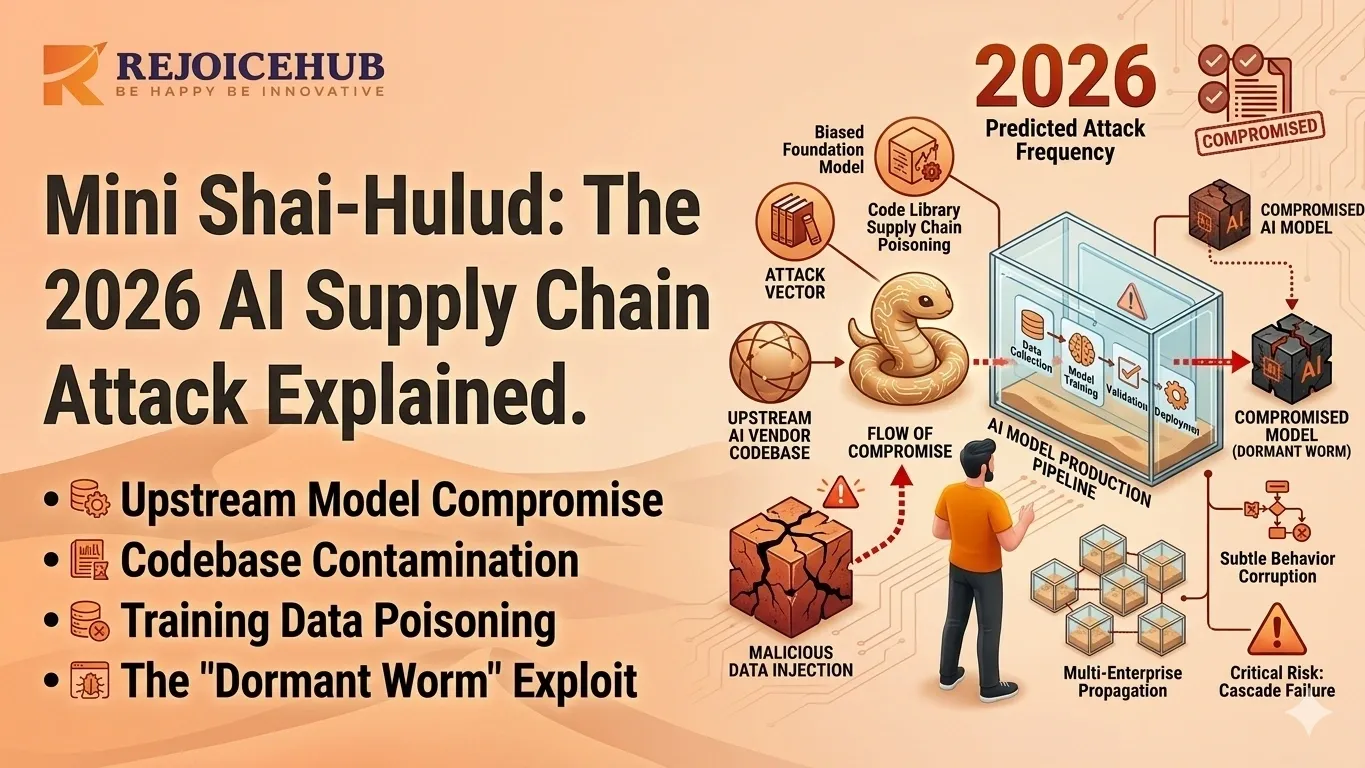
A new threat became active in early 2026 because it began to affect AI development processes that engineers worldwide conducted. The attack did not use phishing emails or brute-force methods to gain access. The attack used trusted developer tools, which they use every day to access their packages and configuration files.
Mini Shai-Hulud operates as an advanced supply chain attack that targets AI development environments the essential systems that support contemporary artificial intelligence development. Anyone who develops artificial intelligence agents should learn about this security threat, which affects their work with coding assistants and automation pipeline management.
This article explains Mini Shai-Hulud malware through a detailed examination of its operation and provides essential security measures that your team must implement to maintain safety.
What Is Mini Shai-Hulud?
Mini Shai-Hulud is a supply chain malware strain that infiltrates AI development environments by exploiting compromised npm packages, misconfigured AI tool settings, and developer trust assumptions baked into modern AI-assisted coding workflows.
The Shai-Hulud attack uses its name to reference Dune's massive sandworms, which move silently underground until they make their attack.
The system operates stealthily through dependency paths while it establishes itself in configuration documents and continues to exist in AI-powered programming environments after the first contamination.
The operating system and network defense system of your system remain safe from Mini Shai-Hulud attacks, which actually target these specific areas. The attack specifically targets your AI development environment, which includes all of your installed packages and AI assistant settings, as well as all files that contain Claude's settings.json document.
The risk exists as a real threat. An AI malware attack pattern actively targets the specific ecosystems that most successful developers use, which include npm, AI coding assistants, MCP servers, and automated build pipelines.
Featured Snippet Definition: Mini Shai-Hulud is a 2026 AI supply chain attack that targets developer environments by injecting malicious code into npm packages and manipulating AI assistant configuration files (such as Claude's settings.json) to alter AI tool behavior, steal data, and achieve persistent access across AI-assisted workflows.
How Mini Shai-Hulud Works
The first step to developing effective defense measures against the Shai-Hulud attack requires the study of its operational mechanisms. The attack unfolds in four stages.
Stage 1: Malicious Package Injection
The open-source ecosystem serves as the starting point for the process.
Attackers publish or compromise npm packages that appear legitimate — often mimicking popular AI utility libraries or development helpers. Developers (or their automated CI/CD pipelines) install these packages without realizing they contain hidden payloads.
The malicious package executes itself through installation or build-time execution after it enters the project. This serves as the initial access point.
Why it works: Developers routinely install dozens of packages per project. Package names are easy to spoof. Automated workflows install dependencies without human review.
Stage 2: settings.json Manipulation
This is where Mini Shai-Hulud gets clever.
The malware initiates its attack by first establishing control over the system. Afterward, it proceeds to target AI assistant configuration files. The specific files that the malware targets include Claude's settings.json file and the config files that AI coding tools use. The files that AI assistants use to operate within a development environment specify which tools they can access, which servers they can connect to, and which instructions they should execute.
By injecting malicious instructions into these config files, attackers can:
- Redirect AI tool behavior to exfiltrate code or credentials
- Modify what the AI assistant "sees" or suggests during coding sessions
- Enable unauthorized MCP server connections
- Suppress security warnings or audit logs
The Claude settings.json malware angle is particularly concerning because developers rarely audit these configuration files. They're set once and forgotten.
Stage 3: AI Workflow Persistence
The malware establishes permanent presence through the AI workflow after its initial access to the system configuration.
The compromised settings.json file automatically loads whenever the developer activates their AI coding assistant. The AI tool maintains its modified operation patterns which occur without detection and affect all projects using identical settings.
Mini Shai-Hulud operates with deceptive sophistication because it can maintain control without needing to establish new infections. The AI tool serves as the mechanism that enables persistent operation.
Stage 4: Lateral Spread
In team environments, shared configuration files, synced dotfiles, or committed settings can spread the compromised config to other developers on the same project. One infected machine becomes many.
Why AI Developer Tools Are Vulnerable
The traditional security models of today exist because their developers created them without considering AI-native security tools. Most teams fail to recognize the actual size of their attack surface because they do not understand its complete dimensions.
-
Ecosystems with heavy dependencies: An AI development project requires a developer to install hundreds of npm packages as dependencies. Every dependency serves as a risk point that hackers can exploit. The automated installation process hides all installed dependencies from human inspection.
-
Developer trust assumptions: Developers trust their tools without any doubt. Developers will usually trust AI coding assistant suggestions. Mini Shai-Hulud exploits this trust by operating through the trusted tool.
-
AI coding environments use plugins that connect to MCP servers: and provide access to external APIs. Each integration creates a trust boundary that serves as an opportunity for attackers to exploit. Hackers who control MCP server connections can extract information from your system without creating clear warning signs.
-
Workflows operate automatically because they do not require evaluations: The system executes continuous integration and delivery through automated software installations and AI-powered code development. Security systems prioritize rapid performance because their operators need to detect threats without spending extra time.
-
Developers consider configuration files to be low-risk components of their systems: Developers view settings files such as settings.json as separate entities that exist outside of their main codebase. The files do not qualify as code, so they receive different types of examinations. Mini Shai-Hulud exploits exactly this blind spot.
-
AI coding assistant risks go beyond autocomplete. When an AI assistant has persistent memory, file access, and the ability to execute commands, a compromised configuration isn't just annoying it's a full attack vector into your development environment.
How AI Supply Chain Attacks Happen
The Mini Shai-Hulud attack demonstrates one type of attack from a larger collection of attacks. The ecosystem shows its AI supply chain weaknesses through various types of vulnerabilities, including these specific supply chain weaknesses.
1. Dependency Poisoning
Attackers use a technique called typosquatting to publish their harmful packages through names that closely match authentic software. The package named ai-utils-helper operates as a shadow product of the real ai-utils software. The poisoned version gets installed by developers who mistype while using automated tools that resolve their input incorrectly.
Some attacks extend their scope beyond existing packages by taking control of valid software through maintainer account hijacking and malicious pull request submissions, which attackers manage to merge.
2. Open-Source Ecosystem Exploitation
The open-source ecosystem runs on trust and contribution velocity. Security review doesn't always keep pace. Attackers exploit:
- Abandoned packages that still get downloaded
- Packages with a single maintainer (single point of failure)
- Transitive dependencies (packages your packages depend on)
Your code may be clean. Your direct dependencies may be clean. But three layers deep, an attacker may already be waiting.
3. Configuration Hijacking
Attackers conduct their attacks beyond package systems by using configuration systems as their primary target. The Claude settings.json malware approach in Mini Shai-Hulud demonstrates that AI tool configuration files serve as valuable targets for attacks.
- They control AI tool behavior at a fundamental level
- They're rarely monitored or version-controlled with the same rigor as source code
- Compromising them doesn't require exploit code just file write access
| Attack Vector | Entry Point | Impact |
|---|---|---|
| Malicious npm package | Install / CI pipeline | Code execution, data theft |
| settings.json manipulation | File system access | AI tool behavior alteration |
| Network/config misconfiguration | Network layer | Data exfiltration, persistence |
| Typosquatting | Developer error | Dependency poisoning |
| Transitive dependency | Indirect install | Hidden payload execution |
How Developers Can Protect Against Mini Shai-Hulud
The AI development environment needs protection through multiple security measures. The current security measures require your team to start implementing its first security solution.
1. Verify and Audit Every Package Before Installation
You need to verify the publisher information, the download statistics, and the most recent updates and existing problems of all packages before you can proceed with installation. The project needs to use npm audit and Socket.dev tools to identify any packages that show signs of suspicious activity.
2. Lock Your Dependencies
You should use package-lock.json or yarn.lock and proceed to commit these files into the version control system. The lock files establish conditions that enable exact installation replication, and they stop hidden dependency updates that might introduce insecure package versions.
3. Monitor AI Tool Configuration Files
You should handle settings.json and similar AI config files as if they were source code. You need to commit these files to version control. You must establish file integrity monitoring (FIM) to send alerts when files change without authorization. Users can use tools such as Tripwire and OSSEC to monitor their essential configuration files.
4. Use Signed Packages Where Available
The package provenance features of npm, together with its Sigstore-based signing system, enable you to confirm that a package originates from an audited source. The system should give priority to packages whose origin has been confirmed through verified provenance.
5. Audit AI Tool Permissions Regularly
The AI coding assistant needs access to four types of resources: file systems, external APIs, MCP servers, and shell commands. The AI tools should receive access to only those resources that they require for their current work.
6. Implement Runtime Monitoring
You need to track your development environment's outbound network connections. Unusual API calls, unexpected data uploads, and unknown MCP server connections serve as warning signs. The combination of Falco container monitoring tools and endpoint monitoring tools can detect suspicious activities.
7. Separate AI Tool Environments
AI coding assistants should be operated in restricted environments including containers, virtual machines, and sandboxed profiles because these environments prevent access to production credentials, sensitive repositories, and internal networks.
8. Establish a Security Review Process for AI Configurations
All AI tool configuration changes, which include settings.json plugin configs, and the MCP server list, require peer review before the system can be deployed. The process of review needs another person because one individual overlooks certain details.
Why This Attack Matters for the Future of AI Development
The Mini Shai-Hulud malware attack requires more than simple repair because it shows essential changes to cybersecurity threats that all AI startups and developers must comprehend.
-
AI tooling ecosystems will become bigger targets: The software development process uses AI coding assistants and AI agents, and automation pipelines as essential components which create value for organizations. Attackers go where developers go. The current development trend shows developers are fully committing to using AI tools.
-
AI agents introduce new trust boundaries: AI agents operate independently from conventional software systems. They have the ability to read files, call APIs, write code, and execute commands. An AI agent breach creates active problems for your system because it functions as a direct threat. The trust boundary problem becomes more difficult when a trusted party possesses the ability to perform actions.
-
The number of configuration-layer attacks will increase: The success of Claude settings.json malware-style attacks demonstrates that the configuration layer is underdefended. The attackers who use this playbook will extend their operations to other AI tools, IDEs, and automation platforms.
-
The default security-by-design standard needs to become standard practice: The AI development community has moved fast. The organization now needs to establish secure operations. Threat modeling, dependency review, configuration auditing, and least-privilege design exist as essential elements that all AI products need to handle actual data processing.
-
Upcoming regulatory and compliance requirements will create pressure for organizations: Regulators will pay attention to AI supply chain vulnerabilities as organizations start to understand them better. The organization should establish security requirements before mandates arrive because doing so will provide both essential protection and competitive benefits.
Conclusion
The Mini Shai-Hulud threat demonstrates its new danger, which spreads through AI systems that people trust instead of attacking computer systems. The threat enters through weak AI tool settings and unsafe configuration files, which now require equal protection to source code.
AI agents have the ability to operate independently, which means that even minor security problems can develop into major security threats. The good news is that security improves through simple steps, which include package checks, dependency locking, and AI tool permission reviews. Organizations that develop secure AI practices from the start will gain better security protection for their future operations.
Frequently Asked Questions
1. What is Mini Shai-Hulud malware, and why is it dangerous?
Mini Shai-Hulud is a 2026 supply chain attack that sneaks into AI developer environments using infected npm packages and manipulated config files. It is dangerous because it hides inside tools that developers already trust, making it hard to spot until real damage has been done.
2. How does the Shai-Hulud attack actually work step by step?
The Shai-Hulud attack starts with a fake or compromised npm package. Once installed, it edits AI tool config files, changes how your AI assistant behaves, and spreads silently across your whole team all without triggering normal security alerts or antivirus tools.
3. What is Claude settings.json malware and how does it affect developers?
Claude settings.json malware refers to attackers injecting bad instructions into Claude's config file. This changes how the AI assistant behaves it can steal code, connect to unauthorized servers, or hide security warnings. Most developers never check this file, making it an easy target.
4. How do AI supply chain attacks happen in developer environments?
AI supply chain attacks happen when attackers sneak harmful code into packages or config files that developers use daily. Since most installs are automated and dependencies are rarely checked, the bad code runs without anyone noticing, giving attackers full access to your dev environment.
5. Can Mini Shai-Hulud spread from one developer to another on a team?
Yes, it can. If infected settings files are shared, synced, or committed to a shared repo, the malware spreads to every team member using those same configs. One affected machine is often all it takes to compromise an entire development team's environment quickly.
6. What are the best ways to protect against the Mini Shai-Hulud attack?
Start by auditing npm packages before installing them. Lock your dependencies using package-lock.json. Treat settings.json like source code track changes and review them. Limit what your AI tools can access, and use runtime monitoring to catch unusual network activity early.
7. Why are AI developer tools being targeted more by supply chain attacks in 2026?
AI tools now have file access, API connections, and command execution abilities. That makes them high-value targets. Attackers know developers trust their AI assistants without much questioning. As AI tooling grows, it becomes a bigger attack surface and most teams are not fully prepared yet.