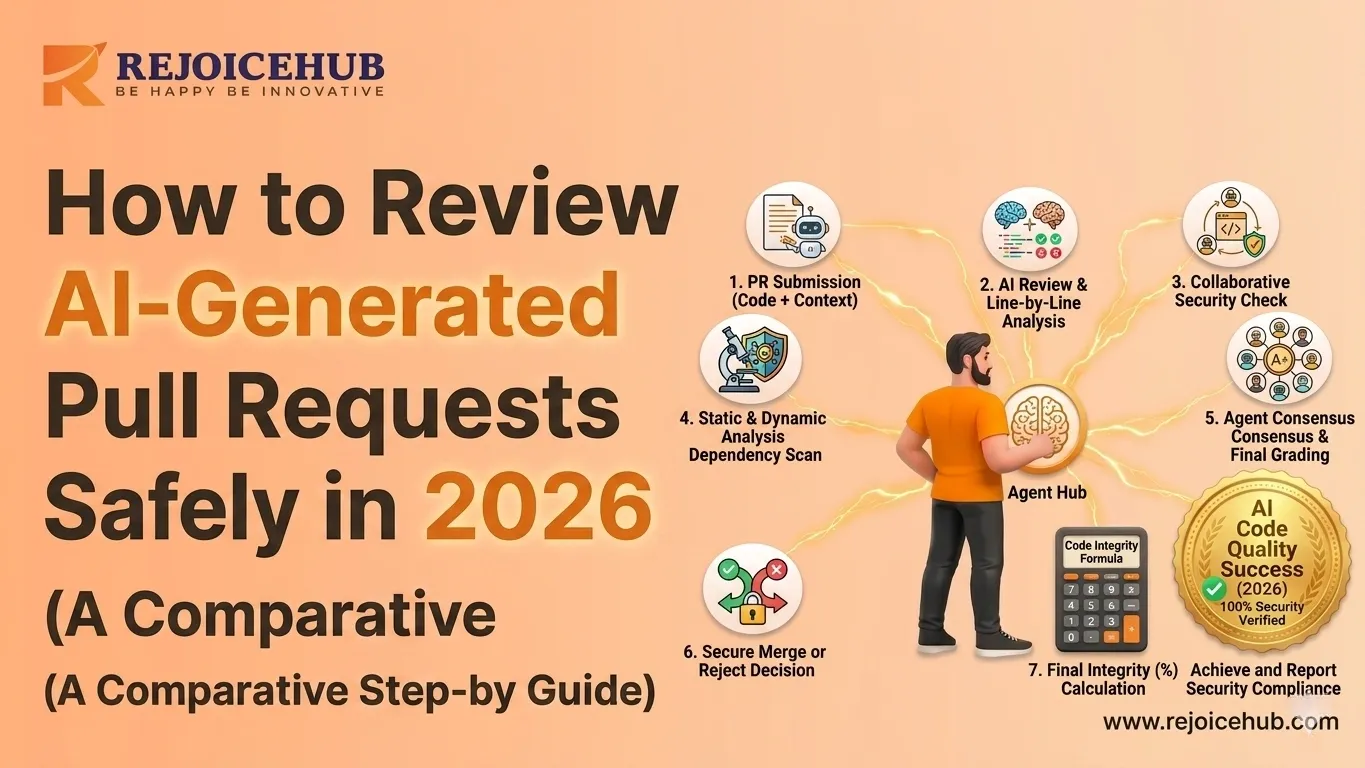
AI coding agents are writing code faster than human engineers can even really read it. Tools such as GitHub Copilot, Cursor, Devin, and that larger wave of autonomous coding agents are pushing AI-generated pull requests out at a pace that would've felt totally off the map just two years ago. If you're trying to understand the broader shift happening here, it helps to first get a clear picture of what AI agents actually are and how they operate.
For engineering leaders at startups and SaaS companies, this is kind of a gift but also a liability. Yeah, the speed is up. Yet the risk is up too, somehow.
Honestly, reviewing AI-generated code isn't only about catching bugs. It's also about catching the right sort of bugs, not just the usual kind. Things like hallucinated APIs, insecure dependencies, silent logic flaws, and architectural drift that the old style review processes were never really built to detect in the first place.
This playbook gives your engineering team a complete framework for reviewing AI-generated pull requests safely in 2026. You'll learn:
- Why AI coding agent pull requests require different review standards
- A step-by-step safe review workflow built for high-volume AI output
- Red flags and security warning signs your team must recognize
- Best practices and governance policies for AI-generated code
- How leading engineering teams are operationalizing AI code review today
Why AI-Generated Pull Requests Need Different Review Standards
Traditional code review kind of assumes there's a human author, they get the intent, they know the codebase well enough, and they're reasoning about side effects like it's normal. But AI coding agents optimize for a different thing, more like completion, not correctness as such.
An AI coding agent doesn't know your company's architectural standards. It doesn't really grok why one legacy endpoint is load-bearing, you know, structurally crucial. And it won't reliably flag when the function it's generating clashes with the business logic you discussed in some conversation three months ago, even if that logic is basically still sitting there.
Worse part… the AI-generated code can look right. It's syntactically clean, well formatted, and it often drops in comments. It also passes the basic linting, so everything seems fine on the surface. That kind of face value confidence is exactly why reviewing AI-generated code is dangerous. Reviewers get primed to approve it without doing the deeper check.
AI-generated PRs commonly contain:
- Insecure or outdated dependencies pulled from training data that predates known CVEs
- Unnecessary abstraction layers that over-engineer simple problems
- Hallucinated APIs that look correct but don't exist or behave differently at runtime
- Duplicated logic copied from elsewhere in the codebase without awareness of existing utilities
- Missing context for edge cases the AI had no way of knowing about
Enterprise Reality: At scale, one AI code agent can crank out dozens of pull requests per day. And if there isn't a more structured kind of review process, even that 5% error rate turns into a pretty big wellspring of production incidents, security gaps, and technical debt like it quietly stacks up.
Common Risks in AI-Generated Code
| Risk Type | Potential Impact | Severity |
|---|---|---|
| Logic Hallucinations | Silent regressions, wrong outputs | Critical |
| Insecure Dependencies | CVE exposure, supply chain attacks | High |
| Hardcoded Secrets | Credential leaks, data breaches | Critical |
| Hallucinated APIs | Runtime crashes, broken integrations | High |
| Dead / Duplicated Code | Tech debt, performance degradation | Medium |
| Missing Edge Cases | Production failures under load | High |
A Safe Workflow for Reviewing AI-Generated Pull Requests
Reviewing AI coding agent pull requests safely really needs a kind of structured, repeatable process not that ad hoc eyeballing thing. The four-step framework below is for engineering teams who deal with high volumes of AI-generated code and want some consistent checks, without constantly second-guessing every diff. It's meant to be practical, methodical, and easy to rerun whenever new changes show up.
Step 1 — Verify the Problem Context
Before you read a single line of code, ask yourself: does this PR solve the right problem? AI coding agents generate code from the prompt they were given. If the requirements were vague, incomplete, or somehow misframed, the resulting code will be as well and it might look totally reasonable on the surface, even though it misses the point.
- Confirm the PR is linked to a specific, well-defined issue or ticket
- Verify the AI was given accurate, complete requirements, not a one-liner
- Check whether the PR scope matches the issue scope (AI often over-builds)
- Validate that the AI had access to relevant context, like existing APIs, data models, and constraints
Pro Tip: Require AI-generated PRs to include a "Problem Statement" section in the description that mirrors the original prompt. This creates a paper trail for reviewers and supports audit logging.
Step 2 — Review Architecture & Logic
AI models kind of excel at generating local code solutions, but they often get stuck when it comes to system-level thinking like how a change can ripple through the broader architecture. Understanding how AI agents actually automate workflows can help reviewers anticipate where that system-level blindness tends to show up.
- Check scalability: will this approach hold under 10x the current load?
- Evaluate maintainability: can a new engineer understand this in six months?
- Look for unnecessary complexity AI frequently over-engineers simple problems
- Verify that the logic path handles all known business rules, not just the happy path
- Check for implicit assumptions baked into the AI's implementation choices
Step 3 — Run Security & Dependency Checks
This is the highest-stakes step. AI coding agents don't really track CVE databases in real time. A dependency that was safe in the 2023 training data may be a known vulnerability today. This is also where generative AI's role in cybersecurity becomes directly relevant the same techniques used to detect threats can be applied as scanning layers in your review pipeline.
- Run automated dependency scanning (Dependabot, Snyk, OWASP Dependency-Check)
- Validate all authentication and authorization logic manually; never trust AI on auth
- Check every external API call: does the endpoint exist? Is the usage correct?
- Scan for hardcoded credentials, API keys, or environment-specific values
- Review permission scopes AI frequently requests broader permissions than necessary
Step 4 — Validate Testing Coverage
AI-generated tests often end up running the same routes the AI used when it built the feature. So what you get is mostly checking what the AI already assumed, not the real requirements that you actually meant. In other words, it can feel like the tests are confirming the AI's own logic, not validating the path you really needed.
- Verify unit tests cover the specific acceptance criteria from the original ticket
- Check that edge cases are explicitly tested: empty inputs, null values, rate limits, and timeouts
- Require regression tests for any code touching existing production functionality
- Confirm CI/CD pipelines execute the full test suite before merge approval
How to Review AI-Generated Pull Requests Safely: Quick Reference
- Verify Problem Context: confirm the PR solves the right problem with accurate requirements
- Review Architecture & Logic: check scalability, maintainability, and unnecessary complexity
- Run Security & Dependency Checks: scan dependencies, validate auth logic, check API usage
- Validate Testing Coverage: unit tests, edge cases, regression testing against real requirements
Red Flags Engineering Teams Should Watch For
Experienced reviewers build that kind of intuition for when something is off like wrong in a subtle way. But when you're looking at AI-generated code, that intuition has to get turned into patterns that your entire team actually watches for, not just one person's "gut feel," because the sheer volume of AI-generated PRs means you can't really depend on a single senior engineer only.
Suspicious Patterns in AI-Generated PRs
Flag for manual deep-dive if you see any of the following:
- Massive PRs with unrelated changes: AI often bundles adjacent changes it "thought were related"
- Fake function or method names: that reference non-existent modules or APIs
- Unused imports and variables: left over from AI exploration during generation
- Inconsistent naming conventions: that break from the rest of the codebase
- Auto-generated block comments: that describe what the code does, but not why
- Sudden architecture shifts:, e.g., switching from REST to GraphQL mid-feature
- Logic that handles the happy path perfectly: but has no error handling
Security Warning Signs in AI-Generated Code
These patterns require immediate escalation. Never approve a PR containing any of the following without a dedicated security review:
- Hardcoded API keys, tokens, or passwords anywhere in the diff
- SQL queries built via string concatenation (SQL injection risk)
- Authentication checks that can be bypassed by altering request parameters
- Overly permissive IAM roles, OAuth scopes, or CORS configurations
- User input passed directly to system commands or shell executions
- Weak or absent input validation on public-facing endpoints
- Dependencies pinned to specific versions with known published CVEs
- JWT validation logic that doesn't verify signature, expiry, or issuer
Best Practices for AI-Generated Pull Requests
The teams getting the most out of AI coding agents in 2026 are not really the ones reviewing the fastest it's more like they're reviewing the smartest. With clear policies and the right tools, plus a kind of culture that makes AI help sustainable at scale, you know, it keeps working over time.
- Require human approval on 100% of AI-generated PRs before merge, no exceptions
- Limit AI-generated PR size: enforce a maximum diff threshold (e.g., 400 lines) to keep reviews tractable
- Enforce coding standards via linters and formatters configured in CI, making compliance non-negotiable
- Use mandatory testing pipelines: no PR merges without a passing test suite
- Label all AI-generated commits (e.g., ai-generated tag) to enable audit trails and analytics
- Create AI-specific review checklists and make them a required PR template section
- Require architecture review for any AI-generated change touching core systems, auth, or data models
- Run dedicated security scanning on every AI-generated PR as a CI gate, not an optional check
Create an AI Governance Policy
This is the step most engineering teams find the most challenging, which causes the most long-term risk. An AI governance policy doesn't have to be some bureaucratic doc it can be pretty lean, but it should still answer three questions. A good starting point is understanding how agentic AI workflows introduce new ownership and accountability challenges that traditional software governance policies simply weren't designed to handle.
- Ownership: Who is responsible when AI-generated code causes a production incident? Establish clear ownership at the PR level.
- Accountability: What is the review and approval chain for AI-generated changes to critical systems?
- Audit Logging: How are AI-generated PRs tracked, stored, and retrievable for compliance or post-incident review?
Competitive Differentiator: Organizations with formal AI governance policies for engineering are materially ahead of peers on compliance readiness, security posture, and investor due diligence. If you're raising a Series A or B in 2026, expect this question in technical due diligence.
How Leading Engineering Teams Review AI-Generated Code
The most mature engineering organizations in 2026 aren't treating AI code review as a one-off problem. They're building systems around it combining human judgment with tooling, process, and culture.
Five patterns are emerging across high-performing teams:
1. Human-in-the-Loop Workflows
Every AI-generated PR requires a named human approver who is accountable for the merged code. The human isn't just rubber-stamping — they're specifically checking the areas where AI is weakest: context accuracy, security, and architectural fit.
2. AI-Assisted Code Review Tools
Teams are deploying AI review layers (CodeRabbit, Qodo Merge, Sourcery) on top of human review not as a replacement, but to surface anomalies, flag known vulnerability patterns, and summarize large diffs before the human reviewer even opens the PR. This pairs well with choosing the right AI tools for engineers based on your team's actual workflow and stack.
3. Pair-Review Systems
High-stakes changes from AI agents go through two-human review one reviewer focused on logic and correctness, one focused on security and dependency risk. This specialization catches more issues than a generalist review.
4. Security-First Pipelines
Security scanning runs before code review, not after. Teams configure CI gates that block PRs containing hardcoded secrets, flagged dependencies, or failed SAST results. Reviewers never see a PR that hasn't cleared these automated bars first.
5. Review Automation & Analytics
Leading teams track AI PR metrics: review cycle time, defect escape rate by AI tool, security finding frequency, and reviewer workload per agent. This data drives continuous improvement of both the AI tooling and the review process itself. Teams serious about this level of operational maturity are increasingly looking at how to build a full AI agent stack for their business rather than stitching together point solutions.
Conclusion
AI coding agents are kind of a real step change in engineering productivity. Teams that deploy them well can ship quicker, reduce toil, and tackle more ambitious backlogs with the same headcount.
But that speed also brings in a brand new kind of risk one that the usual review processes were never really built for. So, in 2026, reviewing AI-generated pull requests safely means you need structured workflows, security-first pipelines, and a whole team-level awareness of the AI failure modes. On top of that, you need governance policies too, so there is clear ownership and accountability.
The engineering teams that are winning with AI aren't simply the ones moving the fastest. They are the ones constructing systems that let them move fast, but sustainably with guardrails that catch what the AI misses, even when nobody expects it.
Frequently Asked Questions
1. What makes AI-generated pull requests different from regular ones?
AI-generated pull requests are written by coding agents, not humans. They can look clean and well-formatted, but they often miss business logic, architectural context, and edge cases. That's why reviewing AI-generated code needs a stricter, more structured process than your usual code review.
2. How do you review AI-generated pull requests safely?
Start by confirming the PR solves the right problem. Then check the architecture and logic, run security and dependency scans, and validate test coverage. These four steps give your team a repeatable, safe workflow for handling high volumes of AI coding agent pull requests without missing critical issues.
3. What are the biggest risks in AI-generated code?
The most common risks include hallucinated APIs, insecure or outdated dependencies, hardcoded secrets, and missing edge case handling. Logic that looks correct on the surface but breaks under real conditions is especially tricky, which is why best practices for AI-generated pull requests always include manual security checks.
4. How do engineering teams catch security issues in AI-generated code?
Teams run automated tools like Snyk or Dependabot before code review even starts. They also manually check authentication logic, scan for hardcoded credentials, and verify every external API call. Security scanning works best as a CI gate, meaning the PR gets blocked automatically if it fails, before any human reviews it.
5. Should every AI-generated pull request require a human review?
Yes, absolutely. No AI-generated PR should merge without human approval. The human reviewer is responsible for checking the areas AI handles poorly, like context accuracy, security fit, and architectural decisions. Even if the code looks perfect, a named human approver must be accountable for what gets merged.
6. What red flags should I watch for in AI-generated pull requests?
Watch for oversized PRs with unrelated changes, fake function names, unused imports, missing error handling, and auto-generated comments that explain what the code does but never explain why. These patterns often signal that the AI was generating code without fully understanding your system's actual needs.
7. What is an AI governance policy for engineering teams?
It's a simple internal policy that answers three things: who owns an AI-generated PR if it causes a production issue, what the approval chain looks like for critical system changes, and how AI-generated commits are tracked for audits. It doesn't have to be long, but having one puts your team ahead on compliance and security.