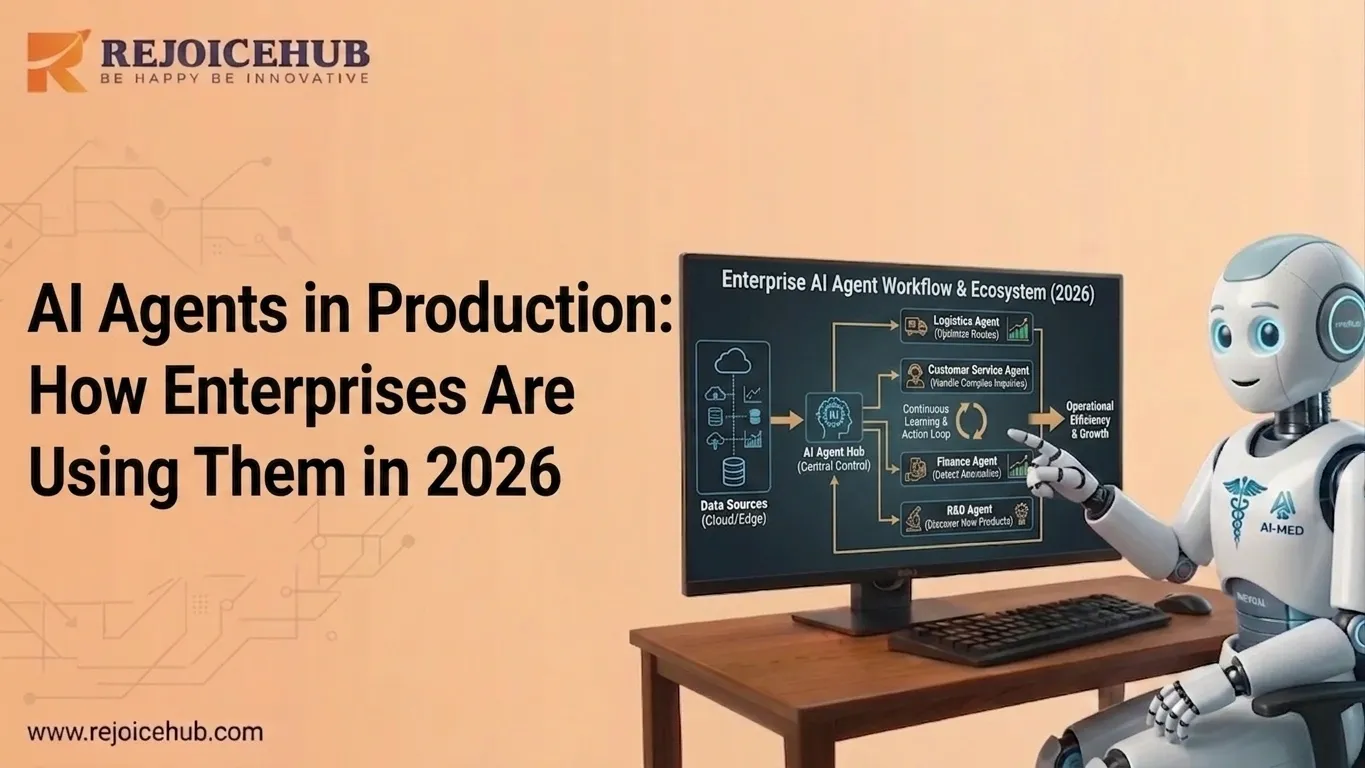
Everyone is going on about AI agents. But here's the truth most vendors won't say out loud: building a demo is pretty easy. Getting those AI agents into production is where companies start having real trouble, and yeah, the timelines stretch.
HSBC, Deloitte, Microsoft, and a few other pretty forward-leaning enterprises have seemingly figured it out. They took AI agents out of the sandbox, into actual workflows, and in turn, they've been saving millions of dollars, plus thousands of hours each year. If you're still figuring out the basics, it helps to first understand what AI agents actually are and how they work before jumping into production strategy.
So what is it that separates those success stories from the whole pile of failed pilots? That's what this post unpacks.
No matter if you're a startup founder, a CTO, or a product leader, this guide will lay out what production-ready AI agents really look like and how your organization can get there without falling into the usual traps.
What Are AI Agents in Production?
Before we talk strategy, let's get clear on what "AI agents in production" actually means.
Definition of Production AI Agents
An AI agent in production is not a demo. It's not a chatbot answering FAQs on a staging server. It's an autonomous AI system that:
- Makes decisions based on real business data
- Executes multi-step tasks without human intervention at every step
- Integrates with live business systems (CRMs, ERPs, databases, APIs)
- Operates reliably at scale meaning hundreds or thousands of tasks per day
AI agents in production 2026 are now running in live environments, dealing with real workloads, and they are producing measurable business outcomes. Sometimes it feels like they just handle what needs doing and then, in the end, you can actually measure the result, right?
Characteristics of Production-Ready AI Agents
Not every AI agent is ready for the real world. Production-ready systems share a specific set of traits:
| Characteristic | What It Means |
|---|---|
| Reliability | Consistent performance under real-world load |
| Security | Data governance, access controls, and audit trails |
| Scalability | Can handle growing task volume without breaking |
| Monitoring | Real-time observability and error alerting |
| Human Oversight | Escalation paths when the agent hits uncertainty |
| Compliance | Meets industry regulations (HIPAA, SOC 2, GDPR, etc.) |
Featured Snippet Answer: AI agents in production are autonomous AI systems deployed in live business environments to execute real workflows, make decisions, and integrate with existing enterprise tools as opposed to experimental demos or prototypes.
Accelerate Your Workflows with Custom AI
Book a free consultation session with RejoiceHub. We'll map out a tailored automation roadmap for your company.
Why Enterprises Are Investing in AI Agents
The investment in AI agents isn't exactly hype-driven. It's ROI-driven, you know? And what really moves the needle for businesses is a mix of practical results, not buzz. Here's what's happening, in real terms.
1. Operational Efficiency
AI agents don't take breaks, don't get distracted, and don't really slow down after lunch either. They just run processes 24/7, with a steady pace and accuracy, no drama or anything.
AI agents in production 2026 can juggle hundreds of customer support tickets, compliance checks, or internal knowledge questions at the same time things that normally would need a whole group of people. This is one of the clearest benefits of AI for business that enterprises are seeing right now.
2. Cost Reduction
The benefits of deploying AI agents in business are most visible in cost savings. Enterprises are reporting:
- 40–70% reduction in manual processing time for repetitive tasks
- 30–50% lower operational costs in workflows like invoice processing and document review
- Significant savings in customer support, where agent-first resolution avoids expensive human escalation
3. Faster Decision Making
AI agents can scan data, grab from multiple sources, and then bring up recommendations in just a few seconds. In fields like finance, insurance, and logistics, that quick turnaround turns directly into competitive edge.
4. Enhanced Customer Experiences
When AI agents handle tier-1 customer inquiries intelligently with full context, no wait times, and accurate information customer satisfaction scores go up. Also, these agents enable hyper-personalization at scale, which human teams can't match, not in the same way.
AI Agents in Production: Real Enterprise Case Studies
Let's look at how top enterprises are actually doing this.
1. HSBC: AI Agents for Risk, Compliance, and Customer Support
HSBC has been one of the most aggressive adopters of AI agents in production in financial services. Their deployments span multiple functions:
- Customer Support Automation: HSBC rolled out AI-powered agents to deal with the routine banking stuff like checking balances, looking up transaction history, sending out fraud alerts, and similar matters so the human agents can focus on the trickier cases.
- Compliance Monitoring: In financial services, compliance is everything. HSBC uses AI agents to continuously monitor transactions and flag anomalies for regulatory review. This reduces manual audit effort while improving detection accuracy.
- Risk Management: AI agents analyze market signals, customer risk profiles, and portfolio data in real time enabling faster, more consistent risk decisions.
The key takeaway from HSBC's approach: they didn't try to automate everything at once. They started with high-volume, rules-heavy workflows where agent reliability was easiest to validate.
2. Deloitte: Internal Knowledge Assistants and Research Automation
Deloitte's AI agent strategy is focused on making internal productivity better. It's about how they put these agent systems in place to improve day-to-day work and keep things moving faster.
- Knowledge Assistants: Deloitte deployed internal AI agents that help consultants find relevant case studies, compliance documents, and research reports across their massive knowledge base. What used to take hours now takes minutes.
- Research Automation: AI agents in production case studies now handle initial research synthesis for client engagements pulling from public data sources, internal databases, and proprietary research to create first-draft briefs.
- Employee Productivity: Agents manage meeting summarization, project tracking updates, and document generation giving consultants more time for high-value client work.
Deloitte's lesson: the biggest ROI came from internal use cases first, not client-facing deployments. Internal tools had lower risk and faster feedback loops.
3. Other Enterprise Examples
Microsoft has embedded AI agents (via Copilot) into Office 365, Teams, and GitHub enabling autonomous coding assistance, email drafting, and meeting summarization at enterprise scale.
IBM uses agents in IT operations to autonomously detect, diagnose, and resolve infrastructure incidents before humans even see them.
Salesforce has launched autonomous AI agents (Einstein Agents) that handle CRM workflows from lead qualification to case resolution without manual trigger.
Moving AI Agents From Demo to Production
That's basically where most orgs stumble. There's this real gap between an "impressive demo" and a "production-ready system," and it isn't just about better prompts or whatever. It's more complicated than people think, in practice.
1. Governance and Compliance
Before any agent touches live data or executes real tasks, you need a governance framework. This means:
- Defining what decisions the agent can make autonomously
- Establishing approval workflows for high-risk actions
- Creating audit logs for every agent decision
- Ensuring the system meets your industry's regulatory requirements
2. Security Controls
Production AI agents interact with your core systems. That makes security non-negotiable:
- Role-based access control: agents only access what they need
- Data encryption: at rest and in transit
- Prompt injection protections: preventing manipulation through malicious inputs
- API security: authenticated, rate-limited connections to integrated tools
3. Integration With Existing Systems
One reason demos fail in production: they don't connect to real systems cleanly. Moving AI agents from demo to production requires robust integrations with your CRM (Salesforce, HubSpot), your ERP (SAP, Oracle), internal databases and document repositories, and communication tools (Slack, Teams, email).
This integration layer is often the hardest part and where experienced AI agent development partners for business add the most value.
4. Human-in-the-Loop Validation
Not every agent decision should be fully autonomous, at least not at first. Smart deployments include human validation points little checkpoint moments where people can review and accept the next step before anything runs too far ahead.
- Agents handle routine decisions autonomously
- Edge cases or high-stakes actions escalate to a human reviewer
- Over time, as trust builds, more tasks get automated
This graduated approach dramatically reduces risk and builds organizational confidence in the system.
5. Monitoring and Continuous Improvement
Production AI agents need observability infrastructure:
- Performance dashboards tracking task completion rates and error rates
- Latency monitoring to catch degradation early
- Feedback loops that capture user corrections and feed them back into improvement cycles
- Alerting when an agent goes off the rails
Set this up before go-live. Monitoring is not optional it's how you catch problems before they become incidents.
If you're ready to move from demo to production, RejoiceHub specializes in building enterprise-grade AI agents with security, compliance, and scalability built in from day one.
Common Challenges Enterprises Face
Even the best-planned deployments hit friction. Here's what to watch for.
-
Hallucinations
AI agents can sound really sure but still give the wrong answer. When you use them in production, that becomes a very real risk especially in healthcare, legal, and financial situations. To help reduce that, you can ground the agents in verified data sources, use RAG, set confidence thresholds, and then route anything uncertain to human review. That's why "confident" wrongness has less room to slip through.
-
Data Privacy
AI agents need data to work, but that data sometimes includes sensitive customer or employee information — and it gets messy if you don't set rules. You really need clear policies on what the agent can access, how the data is stored, and whether it gets used for model training later. Also, double-check where the records go and who can actually view them. Understanding how AI agents can automate workflows safely starts with getting these data boundaries right from the beginning.
-
Integration Complexity
Linking AI agents to legacy systems is hard. Those older ERP setups weren't built with APIs in mind, so you end up doing this extra integration slog. Plan for the connecting part to last longer than the AI development, and budget well for it too.
-
Employee Adoption
Even the best AI agent fails if people simply don't use it. Change management matters a lot. Teams have to understand what the agent really does, build some trust in its outputs, and also know when they should override it. Otherwise, it just sits there doing nothing helpful, you know.
The Future of AI Agents in Production in 2026
The AI agents in production 2026 landscape are evolving fast. Here's what's coming:
- Multi-Agent Systems: Single agents are giving way to networks of specialized agents that collaborate on more complex tasks. One agent does the researching, another handles the writing, yet another reviews and checks all of it autonomously orchestrated.
- Autonomous Workflows: We're moving toward agents that can plan and execute multi-day workflows without human handoffs. Think of an agent that manages a full procurement cycle from identifying vendors to executing contracts.
- Agent Orchestration Platforms: Tools like LangGraph, CrewAI, and Microsoft's AutoGen are maturing rapidly, making it easier to build, deploy, and manage multi-agent systems at enterprise scale.
- Enterprise Copilots: Every major enterprise software vendor is embedding AI agents into their products. By 2027, most enterprise software will have agentic capabilities built in but organizations that build custom agents for their unique workflows will have a significant competitive edge.
Conclusion
AI agents are no longer just some future-tech idea. HSBC, Deloitte, Microsoft, and IBM aren't messing around in sandboxes anymore they're producing measurable ROI from agents running in production right now.
Still, getting to that point isn't only a technical thing. It's also a governance headache, an integration problem, and a real organizational shift challenge.
The companies that actually win here aren't the ones with the flashiest demos. They're the ones who put money behind the correct architecture, the proper safeguards, and the right implementation partner all at the same time.
Frequently Asked Questions
1. What are AI agents in production?
AI agents in production are AI systems that run inside real business environments, not test servers. They connect to live tools like CRMs and databases, make decisions on their own, and handle hundreds of tasks daily without someone manually stepping in every single time.
2. How are enterprises using AI agents in production right now?
Big companies like HSBC, Deloitte, and Microsoft are using AI agents to handle customer support, compliance checks, research tasks, and coding help. These agents run inside their actual systems and save thousands of hours each year — not just in demos, but in daily operations.
3. What are the real benefits of deploying AI agents in business?
The biggest wins are cost savings and speed. Companies report 40–70% less manual processing time and 30–50% lower operational costs in areas like document review and customer support. Agents also run 24/7, which means no slowdowns, no breaks, and faster decisions.
4. What makes an AI agent production-ready?
A production-ready AI agent needs to be reliable, secure, and scalable. It also needs monitoring tools, clear human escalation paths, and compliance with regulations like GDPR or HIPAA. If those pieces aren't in place, the agent might work in testing but break down fast in the real world.
5. How does Deloitte implement AI agents in its workflow?
Deloitte built internal AI agents that help consultants find documents, summarize meetings, and write first-draft research briefs. Their biggest ROI actually came from these internal tools, not client-facing ones, because they were easier to test, fix, and improve with quick feedback from daily users.
6. What are the biggest challenges when moving AI agents from demo to production?
The hardest parts are connecting agents to older systems, keeping data private, and getting employees to actually trust and use the tool. Integration with legacy ERPs often takes longer than building the AI itself. Change management, helping teams understand what the agent does, matters just as much as the tech.
7. What do the AI agents in the production landscape look like in 2026?
In 2026, companies are moving toward multi-agent systems where different agents handle research, writing, and review, all working together. Platforms like LangGraph and CrewAI are making this easier to manage at scale. Businesses building custom agents for their specific workflows are gaining a real competitive edge over those using generic tools.