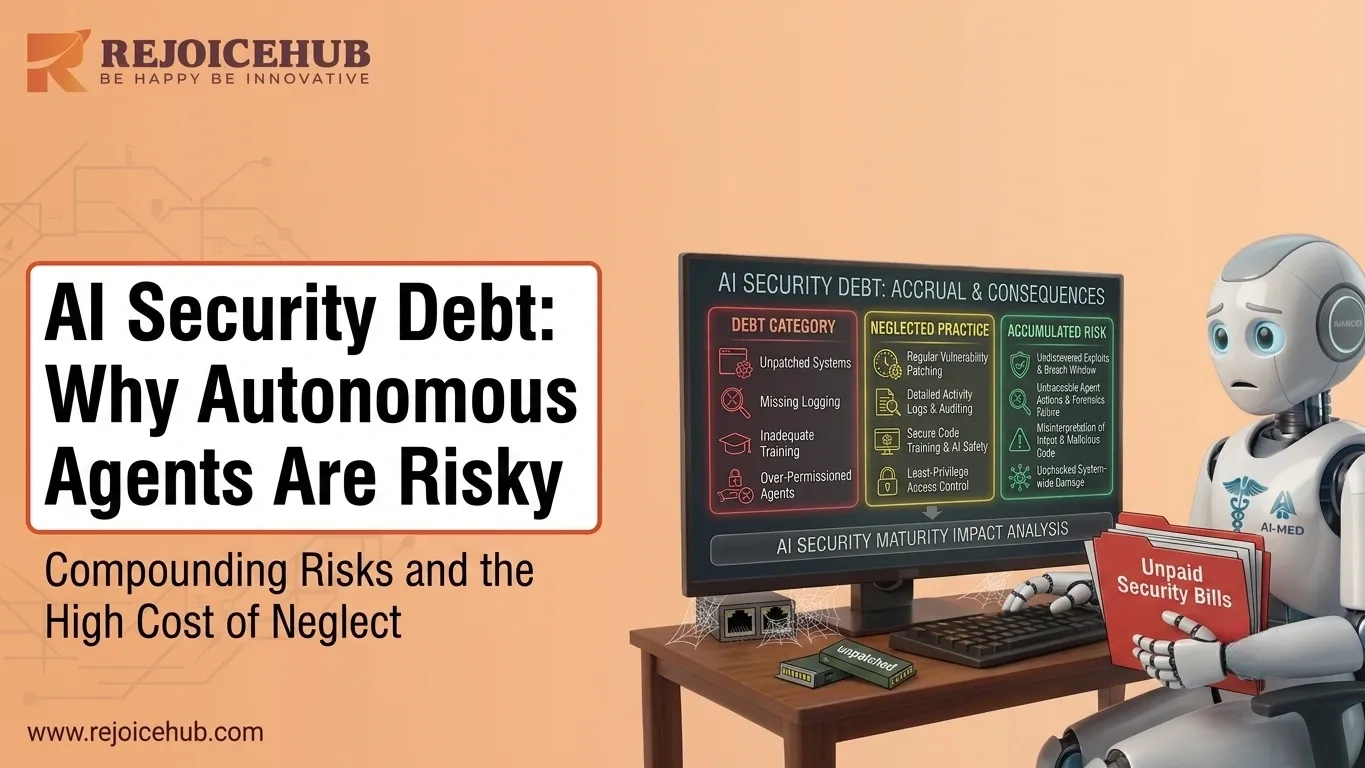
AI adoption is outpacing understanding and control by most security teams. Firms are racing to adopt autonomous AI agents that can handle tasks such as scheduling meetings, processing refunds, querying databases, and responding to other systems on their own.
Such rapid adoption of autonomous agents creates significant AI security debt for companies, which is the widening gap between the speed of AI capabilities and how well enterprises understand their risks and controls.
This debt manifests at an inopportune time and with severe consequences, such as a data breach or a regulatory penalty.
This article discusses what AI security debt is, how autonomous AI agents create security debt, and what enterprises can do to reduce the risks.
What Is AI Security Debt?
AI security debt is the risk that arises when adopting AI systems, especially autonomous agents, faster than security, governance, and oversight processes can reasonably keep up with. Explain like I'm 5: The technical debt equivalent for AI systems, especially autonomous agents, where the risks and challenges outweigh the development and technical debt. Technical debt is when you take shortcuts in development that provide short-term gains but make future development and maintenance harder and more expensive.
On the other hand, security debt is when you make design or implementation decisions that create short-term wins but increase system risk and attack surface.
The two concepts are similar and frequently overlap, but while technical debt is primarily a development and maintenance headache, security debt has potentially more severe consequences, such as data breaches, financial losses, and damage to the organization's reputation.
AI security debt is the same as technical and security debt but applied to AI systems, which presents unique challenges due to their complexity and autonomy. These challenges include the ability of AI systems to make decisions independently, use external APIs, and have a direct impact on the organization's operations and data.
Why AI Creates New Forms of Security Debt
Traditional software follows instructions, while an AI agent understands instructions, acts accordingly and takes into account contextual information to perform an action based on a probabilistic model and not a binary model.
The flexibility that different types of AI agents offer is precisely the characteristic that makes them so desirable for automating processes.
However, it simultaneously makes them hard to reason about in terms of safety.
Why Traditional Security Models Fail for AI
Most enterprise security models were built around a simple assumption: humans make the decisions, and systems just execute them.
Autonomous AI agents break that assumption.
Firewalls and access controls were designed for predictable, rule-based systems, not agents that generate their own next steps.
Traditional threat models don't account for an AI system being manipulated via natural-language input (prompt injection).
Legacy monitoring tools weren't built to flag "this agent just called an API it's never called before."
If you're only applying traditional IT security thinking to your AI agents, you're already behind.
If you're looking to build a custom AI agent with security baked in from the start, RejoiceHub can help you design an architecture that doesn't create these blind spots in the first place.
How Autonomous AI Agents Create Security Risks
Autonomous agents are not simple chatbots, capable only of responding politely to every request. They can plan complex actions, perform and coordinate API calls, maintain internal state between turns, and interact with external systems beyond just responding to natural language queries a distinction that becomes clearer when you compare an AI agent to a traditional chatbot.
Each of those capabilities is also a new risk vector:
| Capability | What It Enables | The Hidden Risk |
|---|---|---|
| Autonomous decision-making | Agent chooses its own next action | Unpredictable or unintended actions |
| Tool calling | Agent triggers real-world functions | Malicious or accidental tool misuse |
| API permissions | Agent accesses internal/external systems | Over-privileged access becomes an easy target |
| Memory storage | Agent retains context over time | Sensitive data can persist and leak |
| Long-running workflows | Agent operates over hours/days | Small errors compound before anyone notices |
| External integrations | Agent connects to third-party tools | Your security is now only as strong as theirs |
-
Expanded Attack Surface
Every tool, API, and integration you attach to an AI agent can be exploited against you, and therefore, constitute an attack surface on your own systems.
Consider a customer-facing AI agent that can process returns, modify the CRM, and send out emails. A compromised input to the AI agent would not only lead to bad outputs, but also provide access to whatever systems the agent has access to, in this case, 3 or 4 different systems. This is part of a broader set of enterprise infrastructure gaps around AI agents that organizations tend to overlook during rollout.
-
Prompt Injection & Tool Exploitation
Prompt injection is quickly becoming one of the most common AI-specific attack methods, targeting the very thing that makes agents useful: their ability to follow instructions.
Attackers can hide malicious instructions inside:
- Emails an agent is asked to summarize
- Web pages that an agent is asked to browse
- Documents uploaded by users
- Even customer support tickets
If the agent can't distinguish between "instructions from my developer" and "instructions hidden in this webpage," it may execute the attacker's commands, including calling tools it shouldn't. This is one of many areas where generative AI is being applied to cybersecurity itself, both as a risk and as a defense mechanism.
-
Data Leakage Through Agent Memory
Memory is the source of the intelligence of AI agents. It is also where sensitive data is stored in many cases.
Agents that perform searches based on previous conversations, customer data, or internal documentation can inadvertently expose this information.
- Surface one customer's data to another session
- Retain PII longer than compliance policies allow
- Expose internal business logic through conversational context
Without clear memory retention policies, your agent's "helpful context" can become a data privacy liability. This risk also extends to the growing category of non-human identities in enterprise AI, which need their own access and lifecycle controls, distinct from human user accounts.
How Security Debt Accumulates in Enterprise AI Applications
AI security debt doesn't happen all at once. It builds up through small, understandable shortcuts usually made under deadline pressure.
Common poor practices that quietly stack up debt include:
- Hardcoded credentials: API keys and secrets embedded directly in agent code or prompts
- Excessive permissions: agents given admin-level access "just to be safe" during development, and never scaled back
- No monitoring: no visibility into what actions an agent actually takes in production
- Missing audit logs: no record of decisions, tool calls, or data access for compliance or incident response
- Insecure APIs: internal APIs built quickly for AI integration without proper authentication
- Unvalidated prompts: no filtering or sanitization of user input before it reaches the agent
- Lack of governance: no clear policy for what agents are allowed to do, and who's accountable if something goes wrong
Real-world pattern:
A midsize SaaS shop decides on an internal demo of the new AI agent. Agent is granted read/write access to the ticketing system "for quick setup," and subsequently disappears into the corporate network. Six months later, it turns out that the same AI tool is used in three other departments and has not had its access rights changed since deployment. No one remembers why.
This is a realistic scenario of security debt accumulation that takes place in most of the enterprise software projects – not on a systemic level, and not in one go, but in dozens of small steps. It's also a common outcome when teams try to deploy AI agents without a dedicated ML team to own the process end-to-end.
Accelerate Your Workflows with Custom AI
Book a free consultation session with RejoiceHub. We'll map out a tailored automation roadmap for your company.
The Hidden Cost of AI Security Debt
Security debt is expensive to deal with, primarily because the costs are rarely apparent until they are not. There are five types of costs associated with breaches involving AI:
- Financial loss: Security breaches involving AI can be expensive to respond to, investigate, and disclose, especially if there is a risk of financial gain on the part of the agent or agents responsible for the breach.
- Compliance costs: In many industries, regulations like GDPR, HIPAA, SOC 2, ISO 27001, and others ("an AI agent did it.") apply to how data is handled by autonomous systems like AI.
- Loss of customer trust: Customers are becoming more and more aware of how their data is being used, and a security incident could derail years of hard-earned goodwill with little more than an unscrupulous agent or employees misusing company resources.
- Reputational damage: Incidents involving AI security breaches can be newsworthy, so negative publicity can be hard to avoid. "AI agent leaked customer data."
- Operational interruption: AI security breaches typically require the agent or agents responsible to be taken offline, which interrupts any automation functions they were performing, an especially costly outcome for businesses that have gone all-in on replacing traditional SaaS workflows with AI agents.
Best Practices to Reduce AI Security Debt
The good news: AI security debt is manageable if you address it deliberately, rather than treating security as an afterthought.
-
Implement Zero Trust AI
Don't assume any agent action is safe by default. Every tool call, API request, and data access attempt should be verified not just at deployment, but continuously.
-
Least Privilege Access
Give agents access only to the specific tools, data, and systems they need for their defined task — nothing more. Review and tighten permissions regularly as agent usage evolves, particularly as your AI agent infrastructure grows more complex.
-
Prompt Validation
Sanitize and validate inputs before they reach your agent, especially content pulled from external sources like emails, documents, or web pages. Treat all external content as potentially untrusted.
-
Runtime Monitoring
You need visibility into what your agents are actually doing in production, not just what they're supposed to do. Real-time monitoring helps catch unusual tool calls or access patterns before they become incidents.
-
Continuous AI Security Testing
Security testing for AI can't be a one-time checkbox. Regularly test for prompt injection vulnerabilities, permission creep, and tool misuse as your agents and integrations evolve, an approach worth benchmarking against how Claude's security posture compares to Copilot's for enterprise use.
-
AI Governance Framework
Establish clear, written policies for:
- What tasks agents are authorized to perform
- Who owns and reviews agent permissions
- How incidents involving AI agents are reported and handled
- How long agent memory and logs are retained
A well-documented enterprise AI adoption roadmap can help formalize these policies rather than leaving them ad hoc.
Practical recommendations enterprises can adopt today:
- Audit all current AI agent permissions this quarter
- Remove hardcoded credentials from agent configurations
- Set up centralized logging for all agent tool calls
- Define a memory retention policy for every agent in production
- Assign clear ownership for AI security within your team
Conclusion
AI agents are genuinely changing the game in terms of processes, accelerating response times, and enabling businesses to focus on more important issues.
On the other hand, each step that is taken to make an AI agent autonomous use cases and tools, the use of memory, and so on presents additional security challenges, which require a separate approach and consideration.
The companies that will be most successful in the shortest possible time will be those that have invested heavily in securing their AI agent deployments, building in governance and monitoring from the start, rather than trying to retrofit it later and, more importantly, understand the value of security as an investment rather than an expense.
Frequently Asked Questions
1. What is AI security debt?
AI security debt is the risk that builds up when a company uses AI agents faster than it secures them. Teams often skip proper checks, permissions, or monitoring while rushing to launch new AI tools, and that gap becomes a real problem later.
2. What is autonomous agent security?
Autonomous agent security means putting safety controls around AI agents that act on their own. Since these agents can call tools, access data, and make decisions without asking a person first, they need clear limits, monitoring, and permission rules to stay safe.
3. How do autonomous AI agents create security risks?
Autonomous AI agents create risk because they can make decisions, call outside tools, and connect to other systems on their own. If someone tricks the agent with bad input or it gets too much access, it can take harmful actions without anyone noticing right away.
4. What is AI security debt in enterprise applications?
In enterprise apps, AI security debt builds up through small shortcuts like hardcoded passwords, agents with too much access, or no logs of what the AI actually did. Over time, these small gaps add up into a much bigger security problem for the whole company.
5. What is the hidden cost of AI security debt?
The hidden cost of AI security debt shows up as money lost to breaches, fines for breaking rules like GDPR or HIPAA, unhappy customers, damage to brand name, and downtime while teams fix the problem. Most of these costs stay invisible until something actually goes wrong.
6. How does security debt accumulate in AI systems?
Security debt builds up slowly through everyday shortcuts, not one big mistake. Things like skipping permission reviews, giving agents more access than needed, or not tracking what tools an AI is calling all pile up quietly until a small issue turns into a real breach.
7. How are AI and security debt connected?
AI and security debt are connected because every new AI feature adds more ways for things to go wrong if it isn't secured properly. The faster a business adds AI agents without proper checks, the faster its security debt grows in the background.