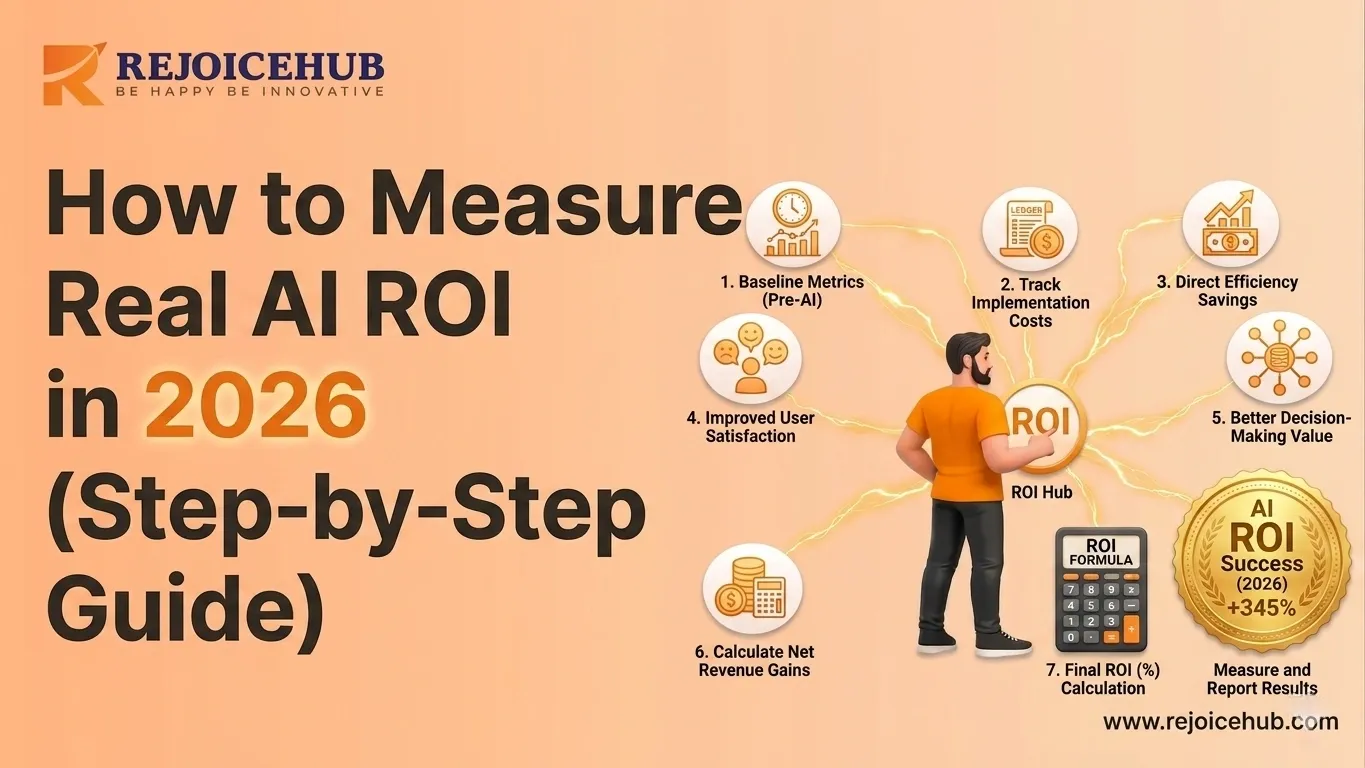
Businesses understand how to allocate artificial intelligence expenditure. Only a small number of organizations possess the capability to measure their artificial intelligence effectiveness.
Research conducted by IBM indicates that only 25% of artificial intelligence projects achieve their anticipated return on investment.
The primary cause of this problem originates from incorrect measurement techniques rather than insufficient technological solutions. If you're exploring how AI is transforming your business, this guide presents a comprehensive framework that enables organizations to calculate authentic artificial intelligence return on investment through baseline establishment, business function metric tracking, and AI agent ROI assessment, which most teams overlook.
Why Most AI ROI Measurements Fail (And What to Track Instead)
The most common error happens when people enter the "token spend trap."
Teams evaluate their AI performance through API expenses, computational resources, modeling effectiveness, and system response times instead of measuring actual business results. The terms used here represent operational metrics that businesses should measure to assess their performance.
Here are three examples of misleading AI measurements:
- "We reduced average AI response time by 40%" but did it increase revenue or reduce support costs?
- "We processed 500,000 AI queries this quarter" but what problem did that solve for the business?
- "Our model accuracy improved by 12%." Impressive, but is it connected to any KPI leadership cares about?
The shift you need to make is from activity metrics to outcome metrics. Understanding the two types of ROI leads to better results for your organization.
Hard ROI: What You Can Put a Dollar Sign On
Hard ROI is a directly measurable financial impact. Think:
- Cost reduction: fewer hours spent on manual tasks, reduced headcount requirements
- Revenue growth: higher conversion rates, faster deal cycles, and increased upsell
- Headcount optimization: achieve the same output with fewer resources (not always layoffs often redeployment to higher-value work)
These are the numbers your CFO and board want to see on a slide.
Soft ROI: The Strategic Value Most CFOs Overlook
Soft ROI is real, but harder to quantify. It includes:
- Faster decision-making across teams
- Improved customer experience and satisfaction scores
- Higher employee satisfaction (less tedious work)
- Competitive differentiation through speed-to-market
Soft ROI doesn't show up on a P&L, but over 12–18 months, it becomes hard ROI. Track it early so you can draw the line.
The AI ROI Measurement Framework (Step-by-Step)
Here's the four-step framework we recommend at RejoiceHub for any AI implementation whether you're deploying a simple automation or an entire AI agent for business.
Step 1: Set Your Baselines
You cannot measure improvement without a starting point. Before you go live with any AI tool, document:
- Cost per task (in labor hours × hourly rate)
- Time per process (how long does this take manually?)
- Error or rework rate (what % of outputs need correction?)
- Headcount involved (how many people touch this process?)
This baseline is your "before" snapshot. Without it, any ROI claim is just a guess.
Pro tip: Even if you've already deployed AI, it's not too late. Pull historical data from three to six months prior. Use it as your retroactive baseline.
Step 2: Choose Your 90-Day Window
The return on investment from artificial intelligence implementation will not become visible during the first week. Organizations need time to establish new processes, develop new work procedures, and improve their systems.
The industry standard is a 90-day measurement window structured like this:
| Month | Focus |
|---|---|
| Month 1 | Deployment, onboarding, initial data collection |
| Month 2 | Optimization, identify friction points, track leading indicators |
| Month 3 | Full ROI measurement, compare against baseline |
Monthly check-ins help you catch problems early, before you're locked into a tool that isn't delivering.
Step 3: The ROI Formula (With Real Numbers)
Here's the core formula for AI ROI:
AI ROI (%) = (Net Benefits − Total AI Costs) / Total AI Costs × 100
Net Benefits include:
- Labor savings (hours saved × fully-loaded hourly cost)
- Revenue uplift (additional revenue attributable to AI-assisted work)
- Error reduction value (cost of errors prevented × error rate improvement)
Total AI Costs include:
- Licensing/subscription fees
- Implementation and integration costs
- Internal team time (project management, IT setup)
- Training and change management
- Ongoing maintenance
Example: A customer support team invests $80,000 each month to pay their agents. After implementing an AI customer support automation solution, the team achieved a 35% increase in ticket handling with no additional staff, generating approximately $28,000 in monthly labor savings. The AI solution costs $4,500/month total (license + maintenance).
- Net Benefits = $28,000
- Total AI Costs = $4,500
- AI ROI = ($28,000 − $4,500) / $4,500 × 100 = 522%
That's the kind of number that gets budget approved.
Step 4: Function-by-Function Metrics
| Business Function | Key AI ROI Metrics |
|---|---|
| Sales | Lead conversion rate lift, revenue per rep, deal velocity |
| Customer Support | Ticket deflection rate, handle time reduction, CSAT score |
| Operations | Process cycle time, error/rework rate, FTE hours saved |
| Marketing | Content output vs. headcount, campaign launch speed, A/B test velocity |
Key AI ROI Metrics by Business Function
Here's a closer look at the metrics that matter most and why.
1. Sales & Revenue
- AI-qualified lead conversion rate vs. baseline: Are AI-scored leads closing at a higher rate than before?
- Revenue per sales rep (pre/post AI assist): Is each rep generating more pipeline with AI writing support or prioritization?
- Time to close (deal velocity): Faster cycles mean more revenue per quarter with the same team
2. Customer Support
- Ticket deflection rate: What percentage of inbound tickets are fully resolved without a human agent? Best-in-class teams hit 40–60% deflection.
- Average handle time (AHT) reduction: Even when humans handle tickets, AI-assisted suggestions should cut time per ticket.
- CSAT score change: Are customers happier or less happy? AI support can go both ways. Track it.
3. Operations & Automation
Understanding what is AI automation helps contextualize these metrics:
- Process cycle time reduction (%): How much faster does the same process run?
- Error/rework rate drop: Fewer mistakes mean less time fixing them.
- FTE hours saved per week: The most direct proxy for labor cost savings
4. Content & Marketing
- Content output volume vs. headcount: Can your team publish 3x more without hiring?
- Campaign launch speed: How many days from brief to live?
- A/B test iteration rate: More tests per month = faster optimization = more revenue
AI Agent ROI: A Special Case
Most ROI frameworks are built to assess basic AI applications chatbots, writing assistants, and summarizers. The measurement method needs to change because AI agents operate on a fundamentally different basis.
AI agents complete tasks through multiple steps browsing, writing, sending, analyzing, and executing all without needing human supervision at any point. The system generates value through a different method because it functions as more than a simple prompt-response system.
2026 benchmarks show companies achieve an average 171% ROI from AI agent programs, rising to 192% for U.S. enterprises. These results will only occur when organizations establish their measurement procedures with strict standards from the very beginning.
How to measure AI agent ROI specifically:
- Treat AI agents as digital staff members who require performance benchmarks established before their actual work begins.
- Perform evaluations of operations at least three times each year.
- Monitor agent productivity using the same method used to assess employee work output.
Attribution presents the most difficult challenge determining how much of an agent's work output should be designated as their personal achievement when others take part in the same task.
The solution is A/B deployment testing. Run a 30-day test by operating the system both with and without the agent. Assess output volume, quality, time, and cost. The agent's contribution is the difference between the two measurements.
If you're building or evaluating AI agents to automate your workflows, RejoiceHub's team specializes in AI agent development with measurable ROI built into the design from day one. Talk to our team →
Common AI ROI Mistakes to Avoid
These errors occur even in teams with high levels of expertise. Here are the primary dangers to recognize:
-
No pre-measurement baseline exists. You cannot support ROI claims without documenting the initial condition. Record it at all times.
-
Measuring too early. Evaluating a program after only a week or two is premature. Expected AI ROI growth periods last between 60 and 90 days. Patience is required.
-
Underestimating total costs. The license fee is only the beginning. Total expenses include implementation, integration, internal team hours, training, and ongoing maintenance. Estimating the denominator too low inflates ROI results and creates false expectations.
-
Celebrating vanity metrics. "We processed 10 million tokens this month" does not generate revenue. Every AI metric needs to link directly to a business outcome or it should not be tracked.
-
No executive alignment. If your operational KPIs track measurement but remain unlinked to board-level priorities, the effort is incomplete. Connect AI benefits for business metrics with existing leadership goals.
Conclusion
The real return on investment from artificial intelligence exists when executives link AI performance to business results that their organization values.
To recap: establish your baselines before deployment, use a 90-day measurement window, apply the core ROI formula with full cost accounting, and map your metrics to specific business functions. Manage AI agents as digital staff members who need performance evaluations and quarterly assessments.
The organizations that will succeed through artificial intelligence in 2026 will not depend on their spending alone. The ones that win will be those which establish the most effective measurement systems.
Frequently Asked Questions
1. How to measure AI ROI for my business?
Start by setting a clear baseline before you launch any AI tool. Track time per task, labor cost, and error rate. After 90 days, compare results using this formula: (Net Benefits − Total AI Costs) / Total AI Costs × 100. That gives you your real AI ROI percentage.
2. How to calculate AI ROI with a simple formula?
Use this: AI ROI (%) = (Net Benefits − Total Costs) / Total Costs × 100. Net benefits include labor savings, revenue uplift, and error reduction. Total costs cover licensing, setup, training, and maintenance. Always count every cost, not just the monthly subscription fee.
3. What are the most important real AI ROI metrics to track?
It depends on your team. Sales teams track lead conversion and deal speed. Support teams track ticket deflection and handle time. Operations teams track hours saved and error rates. Pick metrics that connect directly to a business outcome your leadership team already cares about.
4. What is an AI ROI measurement framework, and how does it work?
It's a four-step process: set your baseline, pick a 90-day window, apply the ROI formula, and track metrics by business function. This framework helps you move from guessing to actually proving that your AI tools are working and worth the investment.
5. How does AI agent ROI measurement differ from regular AI tools?
AI agents handle multi-step tasks on their own, browsing, writing, and executing without human input. To measure their ROI, treat them like digital employees. Run a 30-day A/B test with and without the agent, then compare output volume, quality, time, and cost to find the real difference.
6. Can I use an AI automation ROI calculator for my team?
Yes, and it's a smart move. A basic calculator uses your labor cost, hours saved, error rate improvements, and AI tool expenses. Even a simple spreadsheet works. The key is entering honest numbers, especially full costs like integration time and internal team hours, not just the license fee.
7. Why do most AI implementation ROI projects fail to show results?
Most teams measure the wrong things: response times, token usage, and query counts. These are activity metrics, not business outcomes. AI implementation ROI fails when there's no baseline, no 90-day window, and no connection to leadership KPIs. Fix the measurement, and the results become much easier to prove.