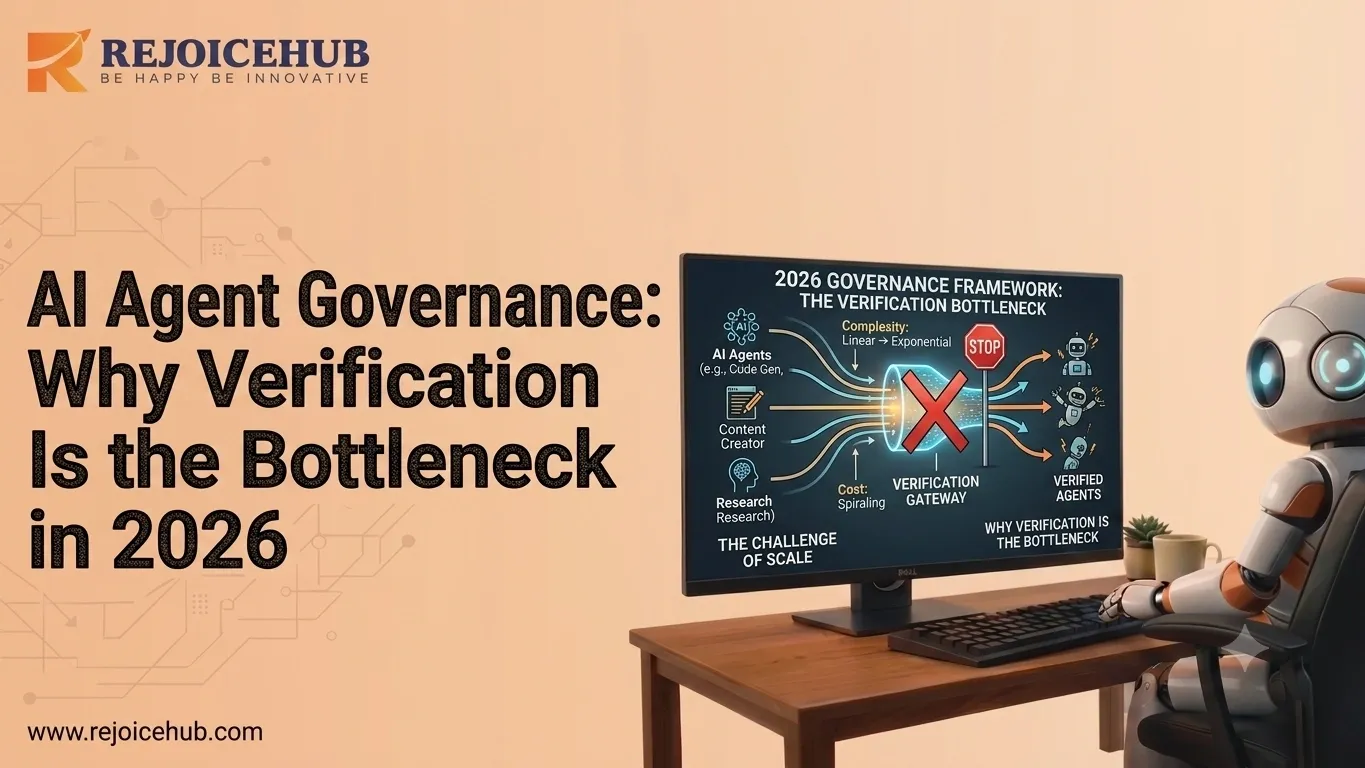
The adoption of AI across enterprises is happening at a faster rate than ever before. By 2026, more than 80% of Fortune 500 organizations will have adopted or be piloting AI agents in sales, operations, financial management, and customer service functions.
But there is one major issue that was not considered by anyone.
Given that agentic AI will play a critical role in performing complex tasks, decision-making, invoking actions, and communicating with other systems, the importance of verifying AI agents is no longer just a checkbox.
Agentic AI has advanced faster than any governance structure for overseeing such technology. An AI agent does not just perform tasks but thinks and plans to execute tasks on its own accord. Any mistake by an unverified agent can quickly turn into a costly affair.
Consequently, verification has become the biggest hurdle to enterprise adoption of agentic AI.
This guide explains what agentic AI governance entails, how the issue of verification has come to define the field, and how you can develop a verification framework to govern your AI systems.
What Is AI Agent Governance?
Definition of AI Agent Governance
AI agent governance refers to the policies, processes, tools, and oversight mechanisms an organization uses to manage how AI agents operate within its systems.
In plain terms, it's how you make sure your AI agents do what they're supposed to do and nothing else.
A solid AI governance framework includes:
- Clear rules on what agents can and cannot do
- Mechanisms for logging and auditing agent activity
- Human approval gates for high-stakes decisions
- Security controls for agent access to systems and data
- Compliance monitoring aligned with industry regulations
In business settings, however, governance is non-negotiable. The agents interact with payrolls, clients' details, accounting data, and other legally binding documentation. Without a proper system in place, that's risky business. It's a weakness, not a strength.
Why Governance Is Different for Agentic AI
The traditional programming is deterministic in nature. You program the software, perform tests, and deploy it with confidence.
Not the AI agent.
It works on its own by interpreting the situation and making decisions based on that, from the available alternatives. It makes it extremely powerful but also unpredictable. Understanding what agentic AI actually is is essential before any governance model can be designed.
AI governance for agentic AI systems must account for:
- Non-determinism: the same prompt doesn't always produce the same output
- Tool use: agents can call APIs, write to databases, send emails, and trigger workflows
- Multi-agent coordination: agents passing tasks to other agents, multiplying both capability and risk
- Evolving context: agents that learn or adapt can drift from their original intent over time
Why AI Agent Verification Is Important
You don't just give a new hire access to your full technology suite without doing your due diligence on them.
But this is basically the scenario enterprises find themselves in when they implement AI agents without verifying them properly.
Why does it matter to verify AI agents? Because trust. Enterprises and their partners must be able to trust that their AI agents are:
- Operating within certain limits
- Working based on accurate data inputs
- Not divulging any sensitive data into the wrong system
- Generating results that can be audited and explained
The problem with trust is that you assume it when it hasn't been earned.
Risks of Unverified Decisions
The risks of bypassing the verification step are clear here's how they manifest.
-
Agent hallucinations: AI agents are known for generating outputs that look correct but are false. An agent that summarizes a contract without verification may miss a crucial point, or even make one up. In industries such as law, finance, or healthcare, that's not a minor problem.
-
Regulatory non-compliance: Failure to comply with regulatory frameworks such as HIPAA, GDPR, SOC 2, and SOX doesn't matter if the agent or a human being performed some action. If an agent violates any regulation by mishandling personal information or failing to get the necessary permissions, the organization is held responsible. Enterprise AI governance frameworks in 2026 make documentation of agents' actions more important than ever.
-
Security threats: Access to most enterprise software from CRMs to ERPs to cloud storage to messaging tools is usually available to AI agents. This gives a potential intruder a new entry point into the company. Attack vectors in agent-based AI include prompt injection, data exfiltration, and privilege escalation.
-
Reputational impact: All it takes is a single incident in which your agent behaves inappropriately, and it ends up in the media, resulting in irreversible damage to the company's reputation.
Why Verification Has Become the Enterprise Bottleneck
1. Scaling Beyond Human Review
Early AI deployments were contained. One model, one use case, one team watching the outputs.
Modern enterprises run dozens, sometimes hundreds, of AI agents simultaneously. They handle ticket routing, invoice processing, lead scoring, content generation, data enrichment, and more. Reviewing every agent action manually is no longer feasible.
The volume has simply outpaced the capacity for human oversight. And that's exactly when errors start compounding.
2. Multi-Agent Workflows Increase Complexity
Single-agent deployments are manageable. Multi-agent pipelines are a different challenge entirely.
When Agent A calls Agent B, which calls Agent C, which writes to a production database, tracing a decision back to its origin becomes exponentially harder. Each handoff is a potential failure point. Each agent introduces its own probability of error.
Verifying the output of a single agent is a solvable problem. Verifying the combined behavior of a networked agent system in real time, at enterprise scale, is where most organizations hit a wall. This is a core challenge explored in agentic AI workflows that enterprises are only beginning to address.
3. Governance vs. Innovation
Here's the tension every enterprise AI leader knows:
Move fast, ship agents. Move carefully, govern them. You can't do both at the same pace.
Innovation teams want to deploy AI agents quickly to capture a competitive advantage. Risk, legal, and compliance teams want thorough testing, documentation, and approval before anything touches production.
Neither side is wrong. But without a structured governance model, this tension creates delays, inconsistent standards, and shadow AI deployments that bypass oversight entirely.
The organizations winning in 2026 are those that treat governance as an enabler of innovation, not a barrier to it. A repeatable verification framework actually speeds up deployment by removing ambiguity from the approval process.
Accelerate Your Workflows with Custom AI
Book a free consultation session with RejoiceHub. We'll map out a tailored automation roadmap for your company.
Core Components of an AI Governance Framework
A robust AI governance framework for enterprise environments typically includes five layers:
1. Policy & Compliance Controls
Every agent deployment needs a defined policy layout a set of rules governing what the agent is allowed to do.
This includes:
- Scope limitations (what systems can the agent access?)
- Output restrictions (what actions can the agent trigger?)
- Regulatory alignment (does the agent's behavior meet GDPR, HIPAA, or SOC 2 requirements?)
- Escalation protocols (when must the agent hand off to a human?)
Policy controls should be version-controlled, documented, and reviewed regularly especially when agent capabilities or underlying models are updated.
2. Human-in-the-Loop Approval
Not every agent action should be fully autonomous.
Human-in-the-loop (HITL) design means building intentional checkpoints where a human reviews and approves before the agent proceeds. This is especially critical for:
- High-value financial transactions
- Customer-facing communications
- Legal document generation
- Any action that cannot be reversed
HITL isn't a sign of distrust in the agent; it's a sign of mature AI governance for large organizations that understand where automation ends and accountability begins.
3. Monitoring and Observability
You can't govern what you can't see.
Enterprise-grade observability means tracking agent behavior in real time:
- Input/output logging for every agent interaction
- Latency and error rate monitoring
- Anomaly detection for unusual patterns
- Alerting for threshold violations or policy breaches
Monitoring turns governance from a reactive exercise (investigating after something goes wrong) into a proactive one (catching issues before they escalate).
4. Audit Trails and Accountability
When a regulator asks, "Why did your AI make this decision?" you need an answer.
Audit trails provide a complete, tamper-evident record of:
- Who triggered the agent
- What inputs it received
- What decisions were made and why
- What actions it took
- What outputs it produced
Accountability means every action can be traced to a responsible human team or system. This isn't just for compliance — it's for continuous improvement.
5. Security and Access Controls
AI agents should operate on the principle of least privilege: access only to what they need, nothing more.
Key security controls include:
- Role-based access control (RBAC) for agent permissions
- API key rotation and secrets management
- Network segmentation for agent communication
- Vulnerability scanning of agent toolchains
- Protection against prompt injection attacks
Security governance is often overlooked until there's an incident. Build it in from the start. This is especially true as enterprises build out their full AI agent infrastructure, where each layer introduces new attack surfaces.
Best Practices for AI Agent Governance
1. Establish Clear Agent Boundaries
Clearly define what the agent is and isn't permitted to do before going live. Establish the agent's responsibilities, capabilities, methods, and escalation procedures. Do this as if you were writing a job description — be clear and concise.
Vague boundaries mean that agents will exceed their mandate, causing problems when it comes time for audits.
2. Implement Continuous Verification
Governance isn't a one-time gate before deployment. It's an ongoing process.
Continuous verification means:
- Running automated test suites against agent behavior regularly
- Comparing outputs against expected benchmarks
- Flagging statistical drift in agent decisions over time
- Re-verifying agents when underlying models or integrations change
Think of it as a health check, not just a launch checklist.
3. Maintain Audit Logs
Log everything. Store logs securely. Retain them according to your compliance requirements.
Audit logs are your safety net when something goes wrong and your evidence when something goes right. Organizations subject to HIPAA, FINRA, or SOX often have mandatory retention requirements. Make sure your agent infrastructure is built to meet them.
4. Conduct Regular Risk Assessments
AI agent risk isn't static. New tools, new use cases, and model updates all change the risk profile.
Schedule formal risk assessments at least quarterly:
- Identify new threat vectors introduced by recent changes
- Review agent access permissions for scope creep
- Evaluate whether existing controls are still effective
- Update policies to reflect new regulatory guidance
Risk assessment isn't busywork it's how you stay ahead of incidents instead of reacting to them.
Top AI Agent Governance Tools in 2026
The tooling landscape for AI agent governance has matured significantly. Here are the platforms enterprises are using today:
| Tool | Primary Use Case |
|---|---|
| Microsoft Responsible AI | Policy enforcement, fairness assessment, compliance dashboards |
| OpenAI Monitoring Ecosystem | Usage monitoring, content filtering, model behavior tracking |
| Arize AI | ML observability, drift detection, production model monitoring |
| Weights & Biases | Experiment tracking, model versioning, and team collaboration |
| LangChain / LangSmith | Agent workflow tracing, debugging, and evaluation pipelines |
Microsoft Responsible AI integrates with Azure infrastructure and provides governance tooling built around Microsoft's responsible AI principles strong for enterprises already on the Azure stack.
Arize AI excels at observability for production AI systems, offering real-time monitoring and explainability features that work well in regulated industries.
Weights & Biases is widely used for model governance, particularly for teams that need detailed version control and experiment tracking across iterative agent development.
LangSmith (part of the LangChain ecosystem) has become a go-to for teams building multi-agent pipelines, offering tracing and evaluation tools purpose-built for agentic workflows.
No single tool covers every governance need. Most enterprise implementations combine two or three platforms observability + audit logging + policy enforcement layered into a unified governance stack. Choosing the right approach often comes down to whether you need custom AI software or an off-the-shelf solution for your specific agent architecture.
RejoiceHub helps enterprise teams select, integrate, and configure the right governance toolstack for their specific agent architecture. Let's talk.
Conclusion
Agentic AI has evolved beyond a prediction for the future. It is the operating model for the enterprise in 2026.
AI agents are making choices, kicking off processes, and taking actions that happen so quickly that humans could never keep up. That's the opportunity. But it's also the challenge.
Governance has emerged as the enterprise choke point because the complexities introduced by agentic models complex agent-based workflows, non-deterministic outcomes, and wide-ranging systems access exceed the capacity of existing governance processes.
An advanced AI governance architecture with policy enforcement, human-in-the-loop, monitoring, auditing, and security controls turns the governance bottleneck into a competitive advantage. It enables you to operate with confidence, not just velocity. For organizations just starting this journey, understanding your current AI adoption level is an essential first step before layering in governance frameworks.
In the coming years, the need for governance within enterprise AI environments will continue to increase. Regulatory scrutiny will ramp up. Customer demand will intensify. Boardroom interest will spike. The organizations that invest in governance platforms today will be able to scale their AI efforts.
Frequently Asked Questions
1. What is Perplexity Search as Code?
Perplexity Search as Code is a way to add AI-powered search directly into your apps or automated systems using an API. Instead of a human typing a query, your code sends the search request, gets a smart answer back, and acts on it all without any manual steps.
2. How does Perplexity Search as Code actually work?
It follows four steps: your app sends a query, Perplexity figures out the intent, pulls live web data, and then returns a clear, cited answer. The whole process takes seconds and can run automatically thousands of times, making it great for AI agents and business workflows.
3. What makes Perplexity Search as Code different from Google Search?
Google Search gives you a list of links meant for humans to read through. Perplexity Search as Code gives your app a ready-to-use, summarized answer with sources. It is built for machines and automation, not for someone sitting at a browser scrolling through results.
4. What are the key Perplexity AI developer tools available?
Perplexity offers clean REST APIs, real-time web retrieval, LLM reasoning built in, and structured response formats like JSON. It also supports multi-turn queries and connects easily with agent frameworks like LangChain, making it one of the more complete Perplexity AI developer tools out there right now.
5. Can I use Perplexity Search as Code without deep coding knowledge?
Yes, you can. Perplexity's API works with tools like n8n or Make, which are no-code or low-code platforms. If you know basic workflow automation, you can start integrating Perplexity search into your processes without writing complex code from scratch.
6. What are the real-world uses of Perplexity Search as Code?
Businesses use it for things like customer support bots, market research agents, internal knowledge tools, and competitor tracking. Any situation where your system needs current, reliable information without a human doing manual research is a good fit for Perplexity Search as Code.
7. Why do AI agents need Perplexity Search as Code?
AI agents need up-to-date information to make good decisions. Perplexity Search as Code gives them live web access the same way a human would search Google, except it is fully automated. Without this, agents would rely on outdated training data, which leads to wrong or incomplete results.