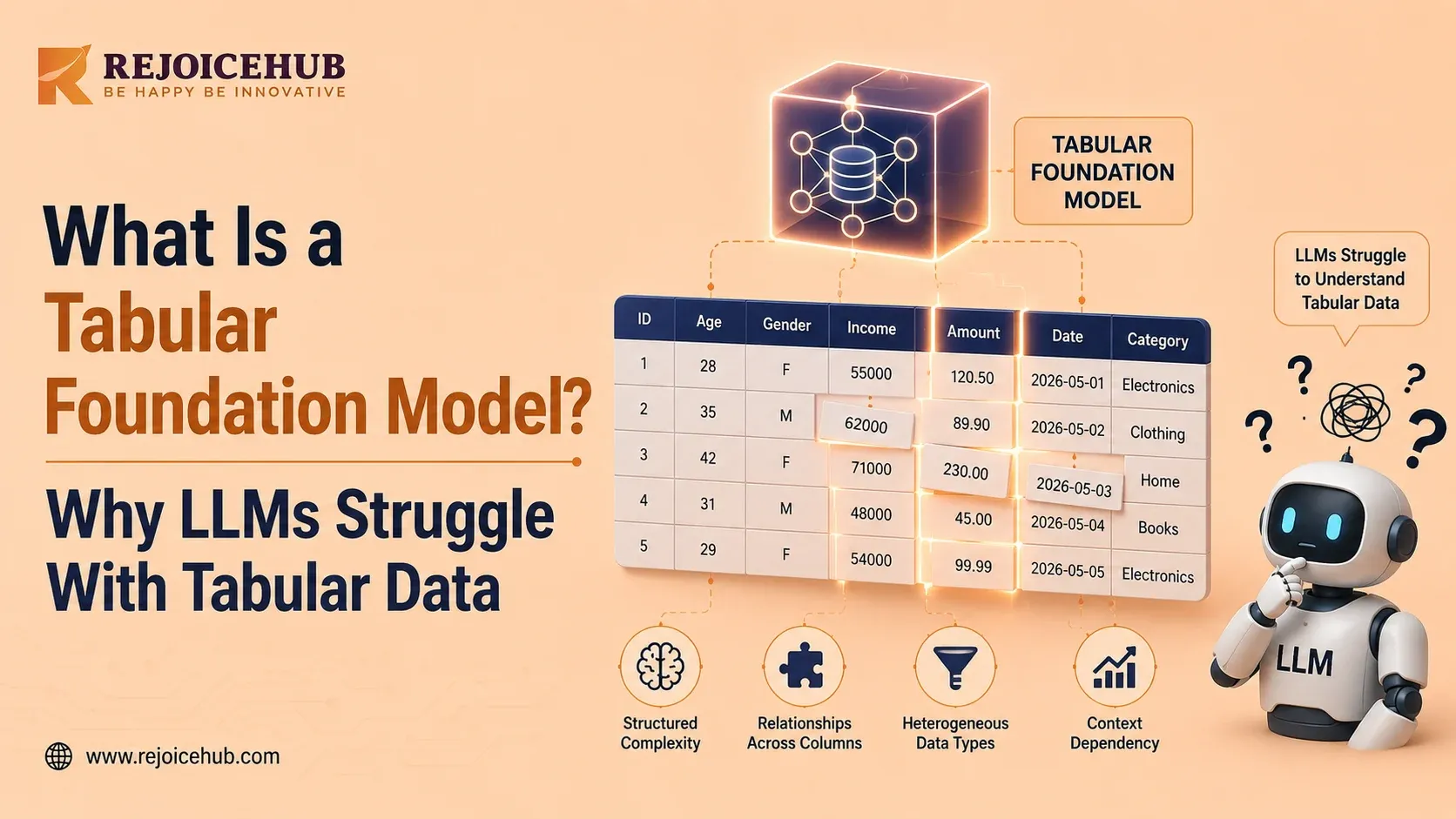
If you ever asked ChatGPT to analyze a table and got a confident but wrong answer, you know what the problem is.
A tabular foundation model is a new type of AI that understands row-and-column data structures. Unlike large language models (LLMs), which are typically trained on text, tabular foundation models can reason about data in spreadsheets, relational databases, and other structured formats.
This distinction is critically important: most business data is tabular, and LLMs are not well-suited to perform statistical or predictive reasoning over tables. In this guide, you'll learn what a tabular foundation model is, why LLMs struggle with tabular data, how zero-shot tabular prediction works, and where this technology fits into a real business AI strategy.
What Is a Tabular Foundation Model?
A tabular foundation model refers to a foundational model capable of generating predictions on tabular data that exhibit some regularity, and which only needs to be fine-tuned on a limited number of examples (or no examples at all) in order to perform that task.
These foundation models have been pretrained on a large amount of regular tables, and can therefore perform well on new tables that they encounter, in a similar vein to how large language models generalize across texts.
It accomplishes the tabular analog of performing language modeling on text by performing language modeling on the values of a column given other columns, after being pretrained on hundreds of millions of rows of various tables.
Some of the most prominent works in this vein include TabPFN, CARTE, and various other transformer-based models that have been adapted to the domain of structured data prediction.
Key Takeaways
- Tabular foundation models are pre-trained on structured data, not text.
- They can predict outcomes (classification or regression) on new datasets with little or no fine-tuning.
- They outperform traditional machine learning on small-to-medium tabular datasets in many benchmarks.
- They are distinct from LLMs, which are optimized for language, not numerical reasoning.
How Tabular Foundation Models Work
Tabular foundation models learn statistical relationships between rows and columns during pre-training on thousands of synthetic and real-world tables and apply learned knowledge to a new table during in-context learning to solve the given task without iterative training.
Here's the step-by-step process in practice:
- Pre-training on diverse tables. The model is exposed to a huge volume of synthetic and real datasets covering different column types, distributions, and relationships.
- Learning generalizable patterns. Instead of memorizing specific datasets, the model learns how tabular data behaves: missing values, correlations, outliers, and categorical encoding.
- In-context inference. When given a new table, the model treats the existing rows as "context" and predicts missing values or labels, similar to how an LLM completes a sentence.
- Zero-shot or few-shot prediction. No manual feature engineering or model retraining is required for many use cases, a major shift from traditional machine learning workflows.
This is a fundamentally different approach from training a fresh XGBoost or random forest model on every new dataset, which is still the industry norm for most companies today.
Why LLMs Struggle With Tabular Data
LLMs do not handle tabular data well, since they are typically trained to generate the next word in a sequence, not perform arithmetic reasoning across rows and columns. As a result, large language models often hallucinate statistical values, inconsistently format numbers, and have issues with wide or large tables.
This is one of the most common and costly mistakes businesses make: assuming a chatbot that writes great emails can also reliably summarize a sales dataset.
1. Row vs. Sequence Understanding
While the LLM processes data as a stream of tokens, tabular data has an internal structure where the value of a cell in column 5 may depend on the value of the cell in column 1 rather than column 4.
This is a fundamental difference that makes the LLM-based model less effective at discovering patterns that a tabular model would learn inherently.
2. Numerical Reasoning Limitations
LLMs have known issues when it comes to arithmetic, particularly with big numbers, or when multiple operations have to be performed for the calculation. Ask an LLM to calculate a weighted average across 500 rows, and the chance that it will make an error increases exponentially.
Tabular foundation models, on the other hand, are trained to model distributions of various numerical values.
3. Lack of Column-Wise Context
An LLM reading a spreadsheet as text loses the structural meaning of columns, headers, data types, and units, which can get flattened into ambiguous text. A model trained on tabular structure preserves that context natively.
4. Context Window Constraints
Large tables (thousands of rows) often exceed what an LLM can process in a single context window, forcing truncation or summarization that loses information.
Expert tip: If your team is using ChatGPT or Claude to "analyze" large CSVs today, treat the output as a starting point, not a source of truth, until it's been validated against the actual data.
Tabular Foundation Model vs LLM: Key Differences
The essential difference between a tabular foundation model and an LLM is that the latter is focused on unstructured text, while the former works with structured data.
| Feature | Tabular Foundation Model | Large Language Model (LLM) |
|---|---|---|
| Primary data type | Structured tables (rows/columns) | Unstructured text |
| Core strength | Numerical & categorical prediction | Language generation & reasoning |
| Training data | Synthetic + real tabular datasets | Web text, books, code |
| Typical use case | Forecasting, classification, scoring | Content, summarization, chat |
| Handles large numeric tables | Yes, natively | Limited, error-prone at scale |
| Retraining needed per dataset | Often none (zero-shot) | Not applicable, different task type |
| Examples | TabPFN, CARTE | GPT-4, Claude, Gemini |
What Is Zero-Shot Tabular Prediction?
Zero-shot tabular prediction is a model's ability to perform accurate predictions on an entirely new dataset that was not used during training and requires no task-specific training or fine-tuning beyond what was learned during pre-training.
In practice, this means a business could upload a new sales dataset and get accurate churn predictions or lead scores within seconds, rather than spending days building and validating a custom model.
This is a significant shift for teams without dedicated data science resources, a category that includes most early-stage SaaS companies and SMBs.
Real-world example: A mid-size subscription business wants to predict which customers are likely to churn next month. A classic approach would involve gathering relevant historical data with labels, feature engineering, and training an ML model that can take a while to build. With tabular foundation models, you can often achieve similar results in a matter of minutes by leveraging information encoded in the model during pretraining for similar churn prediction tasks across different industries.
Real-World Business Use Cases for Tabular AI
Tabular foundation models and broader tabular AI systems are already being applied across industries:
- Sales & Revenue Teams: Lead scoring and deal-close probability without building a custom ML pipeline.
- E-commerce: Demand forecasting and dynamic pricing based on historical sales tables.
- Finance & Fintech: Credit risk scoring and fraud detection on transaction tables.
- Healthcare Operations: Patient no-show prediction and resource allocation from structured records.
- HR & Recruiting: Candidate-role fit scoring from structured applicant data.
- SaaS Product Teams: Churn prediction and expansion-revenue forecasting from usage tables, a common need for growing SaaS teams.
Expert recommendation: Begin with a focused, high-value pilot use case (e.g., customer churn or lead scoring) to gain confidence in the technology before attempting to apply it enterprise-wide. Otherwise, there is little control over who will be using your tabular AI or how they will be using it.
Common Mistakes Businesses Make When Applying AI to Tabular Data
Even well-resourced teams run into avoidable pitfalls:
- Using an LLM for numeric analysis by default. It's fast and familiar, but a general-purpose AI chatbot isn't built for the job.
- Skipping data validation. Foundation models still need clean, consistent column formatting to perform well.
- Assuming zero-shot means zero-oversight. Predictions should still be spot-checked against known outcomes before being trusted for decisions.
- Ignoring data privacy in cloud-based tools. Sensitive tabular data (financial, health, customer PII) needs proper handling, not just uploading it into any AI chatbot.
- Building custom ML from scratch when a foundation model would work faster and cheaper.
How RejoiceHub Helps Businesses Implement Tabular AI Solutions
Understanding tabular foundation models is one thing, plugging them into production systems (CRM, ERP, internal platforms) to perform real work is another.
We at RejoiceHub specialize in helping startups and SaaS companies realize the potential of building custom AI agents that combine the contextual power of LLMs with the precision of tabular models, delivering true business value.
If you want to build an AI agent that understands your data, makes decisions, and plugs into your existing systems, let us help you realize that vision, without the long trial-and-error cycles most companies face when trying to implement this technology in-house.
Accelerate Your Workflows with Custom AI
Book a free consultation session with RejoiceHub. We'll map out a tailored automation roadmap for your company.
Conclusion
Tabular foundation models represent an important shift in how businesses can work with structured data. Instead of treating spreadsheets and databases as text for an LLM to interpret, these models are designed to learn patterns across rows, columns, numerical values, and categorical features.
That does not mean LLMs are becoming irrelevant. The strongest business AI systems will often combine both approaches: LLMs for language, interaction, and orchestration, and tabular models for prediction and structured-data reasoning.
FAQs
Frequently Asked Questions
What is a tabular foundation model?
A tabular foundation model is an AI system trained specifically on row-and-column data instead of text. It learns patterns across spreadsheets and databases, so it can predict outcomes on new tables with little or no extra training.
Why do LLMs struggle with tabular data?
LLMs read data as a stream of text, not as rows and columns. This means they lose column relationships, make math errors on large numbers, and often hallucinate values instead of calculating them correctly.
What is zero-shot tabular prediction?
It's when a model predicts outcomes on a brand-new dataset without any extra training or fine-tuning. The model already learned general table patterns during pretraining, so it can apply that knowledge instantly.
Is TabPFN better than XGBoost for small datasets?
For small to medium datasets, TabPFN often matches or beats XGBoost while skipping the manual feature engineering and retraining steps. XGBoost still performs well on very large, complex datasets.
Can ChatGPT or Claude accurately analyze Excel data?
Not reliably for large or numeric-heavy files. These LLMs can summarize small tables well, but they often make calculation errors, so results should always be checked against the real data.
What's the main difference between a tabular foundation model and an LLM?
An LLM is built for language, chat, and text generation. A tabular foundation model is built for numerical and categorical prediction on structured data like spreadsheets and databases.
Do tabular foundation models need training data every time?
Usually not. Most tabular foundation models are pretrained on huge amounts of table data already, so they can make predictions on your new dataset without needing you to train them from scratch.
Which industries use tabular AI models the most?
Sales, e-commerce, finance, healthcare, HR, and SaaS teams use tabular AI for lead scoring, demand forecasting, fraud detection, patient no-show prediction, and churn prediction.
Is CARTE a tabular foundation model?
Yes, CARTE is one of the well-known tabular foundation models, along with TabPFN. Both are built to handle structured data prediction tasks without needing a fresh model for every new dataset.
How should a business start using tabular foundation models?
Start small with one clear use case, like churn prediction or lead scoring. Test the model's accuracy on known outcomes before rolling it out across other teams or departments.