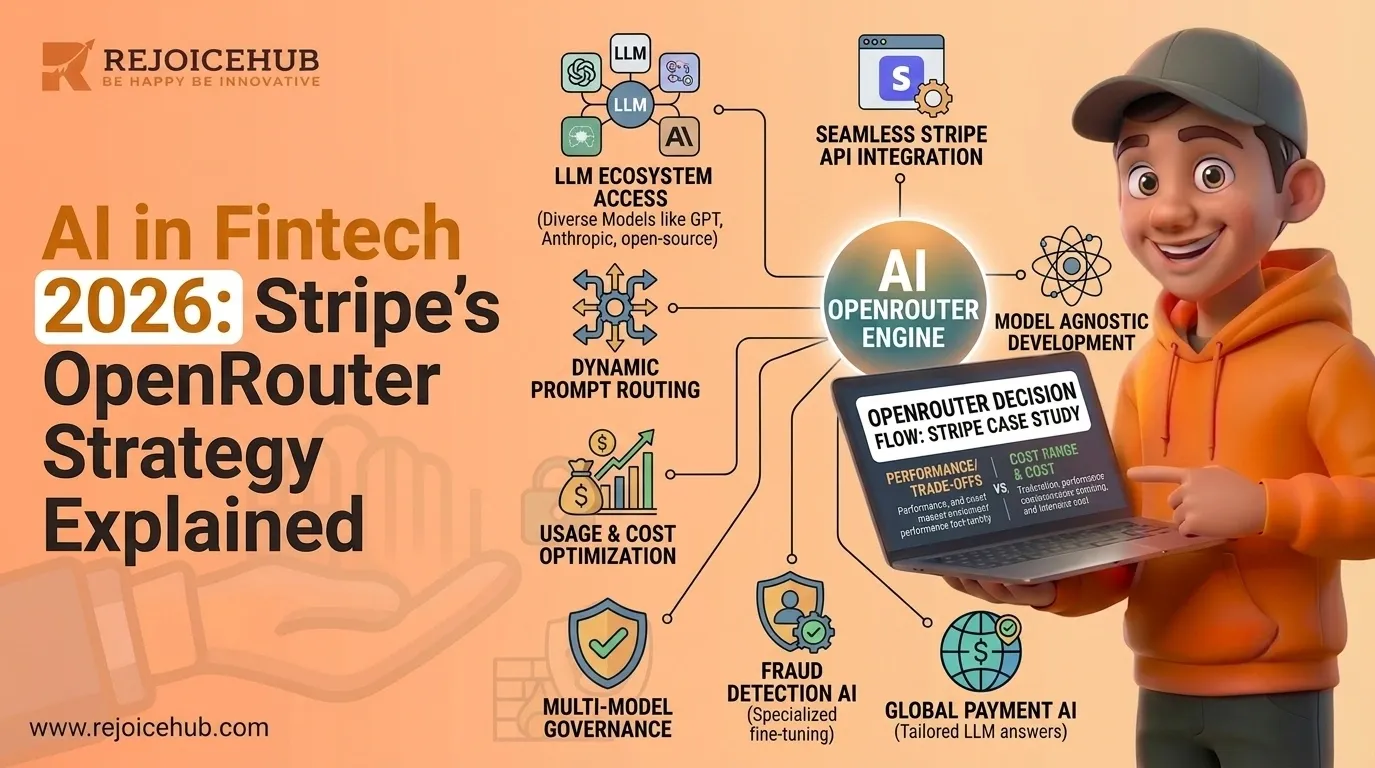
AI in fintech has officially left the building. Not just in the form of chatbots, but at the level of infrastructure, where it actively participates in shaping money flows, assessing risk, and enabling communication with customers, a shift that's part of the broader wave of artificial intelligence transforming your business operations across every industry.
The clearest sign yet came in late July 2026, when the Wall Street Journal revealed that Stripe is in advanced talks with OpenRouter about acquiring the AI model routing platform, which would value the startup at around $10 billion, a massive jump from its $1.3 billion valuation after having valued itself at about the same amount just two months earlier.
The deal is not done yet, and it may not happen at all, but if it does, it will be another sign that the leading payments platform wants to dominate not only the financial infrastructure layer but also the emerging layer of AI infrastructure.
For founders, SaaS teams, and operators, this is less of a story about M&A and more about a glimpse into the future of payments, AI, and automation. In this post, you will learn:
- What AI in fintech actually means and why it matters now
- Why Stripe is circling OpenRouter, and what "model routing" means in plain English
- What an AI-powered payment stack looks like, layer by layer
- How AI is already reshaping fraud detection, chargebacks, and compliance
- What this shift means for your business over the next 12–24 months
What Is AI in Fintech?
Artificial intelligence in fintech is the use of machine learning models, large language models (LLMs), and automated decision-making in the financial product domain, payments, lending, banking, insurance, compliance, and more. If you want a deeper primer, this overview of artificial intelligence in finance covers the fundamentals in detail.
These are powered by algorithms that can perform inductive reasoning rather than rule-based if/then statements, "flag any transaction over $10,000" is not AI, but "learn what transactions are likely to be fraudulent and flag them" is.
What is the role of AI in fintech
The role of AI in fintech breaks down into a few core jobs:
- Detecting anomalies a human analyst would miss or catch too late
- Scoring risk for credit, fraud, and chargebacks in milliseconds
- Automating decisions that used to require manual review
- Personalizing financial products based on real behavior, not static profiles
- Talking to customers through AI agents that resolve issues without a ticket queue
In short: AI in fintech is less about "adding a feature" and more about compressing decision time from days or hours down to milliseconds.
Why fintech companies are investing heavily in AI
Fintech runs on thin margins and high transaction volume, which makes it one of the best possible environments for AI ROI. A few reasons investment is accelerating:
| Driver | Why It Matters |
|---|---|
| Automation | Cuts operational costs on repetitive back-office work (KYC, reconciliation, support) |
| Fraud detection | Losses scale with volume; AI catches patterns rules-based systems miss |
| Underwriting | Faster, more accurate risk decisions mean more approvals with less default risk |
| Customer support | AI agents handle tier-1 queries instantly, 24/7, without headcount growth |
| Payments | AI payments routing improves approval rates and reduces processing costs |
All of them offer a clear path to revenue or cost savings, and that's why boards are accelerating approvals for investments in AI technologies this year, a trend reflected in how quickly companies are climbing the enterprise AI adoption roadmap.
If you're looking to build a custom AI agent for fraud triage, support, or underwriting, RejoiceHub can help you go from idea to production without the trial-and-error.
Accelerate Your Workflows with Custom AI
Book a free consultation session with RejoiceHub. We'll map out a tailored automation roadmap for your company.
Why Stripe Wants OpenRouter
Here's where it gets interesting for anyone paying attention to Stripe AI strategy.
What OpenRouter actually does
OpenRouter is an AI model-routing platform. In plain terms, it sits between a business and dozens (or hundreds) of AI models, from OpenAI, Anthropic, Google, Meta, DeepSeek, and others, and automatically routes each request to the best model for the job, based on cost, speed, or capability.
Instead of building directly on a single provider's API, a company plugs into OpenRouter once and gets access to the entire AI model market. OpenRouter's CEO has openly compared the company's role in AI to Stripe's role in payments: both sit in the middle as connective infrastructure, charging a small fee for convenience and reliability.
Why that's exactly what Stripe wants
Stripe already processes payments for OpenRouter's own customer transactions, so the two companies aren't strangers. But the strategic logic runs deeper than an existing vendor relationship. A few reasons Stripe OpenRouter talks make sense:
- Avoiding vendor lock-in: Just as Stripe abstracted away the complexity of card networks and banks, model routing abstracts away dependence on any single AI lab.
- Latency optimization: Routing a request to the fastest available model, rather than a fixed one, matters when AI is making real-time payment decisions.
- Cost optimization: Not every task needs a frontier model. Smart routing sends simple tasks to cheaper models and complex ones to premium models, the same cost-discipline logic Stripe already applies to payment routing.
- Reliability: If one model provider has an outage or degraded performance, traffic reroutes automatically. That's non-negotiable for anything touching money movement.
- Owning the "AI economic layer: Stripe has publicly described wanting to build infrastructure for a world where AI agents transact, and tokens become "fungible with money." Owning the routing layer for AI models puts Stripe closer to that ambition, not just closer to card rails, and it dovetails with Stripe's own moves like the Link wallet built for AI agents.
Whether or not the roughly $10 billion deal closes, the interest itself tells you where payments companies think the next decade of value creation lives: not just moving money, but moving intelligence.
AI Payment Infrastructure Explained
So what does an AI-native payment stack actually look like? It's easiest to think of it as layers stacked on top of the traditional rails:
Traditional Payment Stack (cards, ACH, bank rails) ↓ AI Layer (LLMs + ML models interpreting context, intent, risk) ↓ Routing (LLM routing across models; payment routing across processors) ↓ Risk Engine (fraud scoring, anomaly detection, compliance checks) ↓ Decision Engine (approve, decline, flag for review, step-up auth) ↓ Payment Processor (executes the final transaction)
This is AI payment infrastructure in practice: AI doesn't replace the payment stack, it sits on top of and inside it, making every step smarter and faster.
A few terms worth knowing:
- AI payment processing: using ML/AI models to authorize, score, and route individual transactions in real time
- Payment orchestration: coordinating multiple payment processors, gateways, and now AI models, to pick the optimal path for each transaction
- Enterprise AI payments: large-scale deployment of AI across a company's entire payment stack, not just a single feature
If your organization is exploring what it actually takes to stand this up, this breakdown of how to build an AI agent stack for business is a useful starting point.
The companies winning here, Stripe among them, aren't just adding an AI chatbot to their dashboard. They're rebuilding the decision-making core of the payment stack around AI, a pattern also visible in how Google's Universal Commerce Protocol is trying to standardize agent-driven transactions across the web.
How AI Is Transforming Payment Operations
This is where the theory becomes very concrete. Here's what AI is already doing inside payment operations today:
- Fraud detection: ML models flag suspicious transaction patterns in real time, far faster than rule-based systems, and adapt as fraud tactics evolve.
- Risk scoring: Every transaction, merchant, and customer gets a dynamic risk score instead of a static one, updated continuously as new data arrives.
- Chargeback prediction: AI models can flag transactions likely to result in a chargeback before they happen, allowing merchants to intervene early.
- Dynamic routing: Transactions get routed to the payment processor (or, increasingly, the AI model) most likely to succeed at the lowest cost, mirroring exactly what OpenRouter does for AI models.
- Compliance: AI agents can continuously monitor transactions against KYC/AML rules, flagging edge cases for human review instead of blanket manual audits, which also raises new questions around managing non-human identities in enterprise AI.
- AI agents: Autonomous software agents are starting to handle end-to-end workflows, reconciling accounts, resolving disputes, and even initiating payments with a human only in the loop for exceptions. For a primer on how these systems work, see what AI agents are and how they differ from a simple chatbot.
- Autonomous payments: As AI agents take on more purchasing and operational tasks, they need to transact on their own, this is the frontier Stripe's OpenRouter interest is aimed at, and it's closely tied to the rise of agentic commerce more broadly.
- Real-time optimization: Instead of periodic batch analysis, AI systems now adjust routing, pricing, and risk decisions transaction-by-transaction.
What binds them all is that AI agents for fintech are no longer a distant future, they are a present-day reality in the operations of the world's largest payment processors. Some of this reliability also depends on emerging standards like the Model Context Protocol (MCP), which lets AI systems safely connect to external tools and data sources.
Would you like an AI agent for your fraud, support, or reconciliation process? We at Rejoicehub offer tailor-made AI agents for fintech and SaaS processes; contact us to discuss what we can build for you.
What This Means for the Future of Fintech
Zoom out, and a few clear trends emerge for the next 12–24 months:
- AI-native payment platforms will out-compete bolt-on AI features: Companies building AI into the core decision layer, not just a chatbot on top, will win on cost and reliability.
- LLM-powered infrastructure will become standard, not experimental: Routing, fraud detection, and support will run on LLMs by default within a couple of product cycles.
- AI agents making payments will move from pilot to production: Expect agent-initiated purchasing, subscription management, and B2B procurement to become common, not novel, much like the shift already underway in agentic commerce for online shopping.
- Multi-model AI will replace single-vendor dependency: Just as Stripe abstracted payment processors, businesses will abstract AI model providers; resilience and cost control demand it.
- Payment automation will extend deeper into back-office finance: reconciliation, dispute resolution, and compliance reporting will run with far less manual touch, closing some of the enterprise infrastructure gaps that still slow AI agent adoption today.
If Stripe's interest in OpenRouter closes or even if it doesn't, the strategic signal stands: the fintech companies that treat AI as infrastructure, not a feature, are the ones setting the pace for everyone else, a mindset shift already visible in how quickly AI agents are replacing traditional SaaS tools across finance and operations.
Conclusion
AI is no longer an add-on to fintech products, it has become the foundation upon which they are built. Stripe's reported pursuit of OpenRouter is a sign of things to come: a world in which payments infrastructure is unbundled, exposing the AI router layer to those who wish to own it, and not just the payments rails below it.
The trend towards smarter, more flexible, model-agnostic payment systems will continue regardless of whether Stripe completes its rumored acquisition of OpenRouter. And the companies that seize the opportunity to reduce expenses, improve reliability, and create new AI-native financial products, whether by understanding the true cost of building an AI agent or simply learning how to deploy AI agents without a dedicated ML team, will dominate the fintech industry for years to come.
Frequently Asked Questions
1. Question: What is AI in fintech?
AI in fintech means using machine learning and smart algorithms inside financial products like payments, lending, and banking. Instead of following fixed rules, these systems learn patterns and make decisions on their own, like spotting fraud or approving a loan faster than a human ever could
2. What is the role of artificial intelligence (AI) in fintech?
The role of AI in fintech is to speed up decisions, catch fraud early, score risk instantly, and personalize financial products for each customer. It also powers AI agents that handle customer support and back-office tasks, cutting down the need for manual work.
3.Why is Stripe interested in OpenRouter?
Stripe is reportedly in talks to acquire OpenRouter, a platform that routes requests to the best AI model for each task. This move would help Stripe avoid depending on one AI provider, cut costs, and stay reliable, the same way it already handles payment routing.
4. What is AI payment infrastructure?
AI payment infrastructure is the layer of smart technology sitting on top of traditional card and bank rails. It includes fraud scoring, risk checks, and automated routing, all working together so each transaction gets approved faster and at a lower cost than old rule-based systems.
5. What does LLM routing mean in payments?
LLM routing means sending each AI task to the model best suited for it, based on cost, speed, or accuracy. Just like payment orchestration picks the best processor for a transaction, LLM routing picks the best AI model, so businesses aren't stuck with just one provider.
6. How are AI agents used in fintech today?
AI agents for fintech already handle real jobs like reconciling accounts, resolving disputes, and flagging chargebacks before they happen. Some are even starting to initiate payments on their own, with humans only stepping in for exceptions, not every single transaction.
7. What is enterprise AI payments?
Enterprise AI payments means a company uses AI across its entire payment stack, not just in one small feature. This includes fraud detection, risk scoring, compliance checks, and routing, all connected together to make the whole payment process smarter and more automatic.