In the rapid business world of today, traditional methods of operations and customer service are no longer sufficient. Data volumes are increasing, and customer expectations are continuously rising; companies are having to deal with the situation.
Enterprise AI has become the revolutionary solution that completely changes the way organizations work and compete.
This technology is not limited to automation; instead, it helps companies to be ahead of the game by predicting market trends, simplifying hard processes, and taking remarkably accurate data-based decisions.
Quick Summary
Enterprise AI is identified as the set of artificial intelligence systems that are purposefully built and utilized for resolving complex business problems at the level of an organization.
However, AI for the enterprise is primarily aimed at introducing intelligent automation, machine learning, and data analytics to the main business processes rather than having them as independent applications.
What is Enterprise AI?
Enterprise AI is the use of advanced AI technology to enhance the value of the organization.
Instead, they are developing AI systems that are flexible and compliant enough for the whole company to use, and at the same time, they are powerful enough to deal with the most sensitive data smoothly and without any interruption.
Consider the enterprise AI as the smart nervous system of your company. It not only processes and analyzes data from diverse sources in parallel but also detects the trends in your business data, and finally, provides recommendations or takes the actions that are in line with your strategic goals.
The main feature that differentiates it is its enterprise-grade capabilities: strong security measures, smooth integration with current systems, governance structures, and the possibility to perform critical operations without any failure.
Why is Enterprise AI Important?
In a single day, companies produce more data than they could analyze with traditional methods in years. Customers would not settle for less they want to be treated as individuals, to have their queries answered instantly, and to have smooth and uninterrupted communication no matter what channel they use.
Companies that make use of AI have a Huge advantage since they can not only handle great volumes of data at lightning speeds that are human-unmanageable but also distinguish patterns that are otherwise hidden, and perform complex tasks with accuracy that is always consistent. Companies that welcome AI in their enterprise are not just enhancing the processes that already exist; they are finding whole new business models, revenue sources, and ways to please the customer.
Examples of Enterprise AI
The enterprise AI has already started to revolutionize the largest industries by simplifying difficult processes and providing insights in a manner that is beyond human capability. Here are the main sectors where AI is having a measurable impact:
1. Retail
AI is redefining the retail industry by studying huge volumes of customer interaction data to make better decisions and provide better customer service. Incredibly accurate predictions are made about the demand for products.
-
Shopping experiences are tailored to the specific needs of each customer.r
-
Analyzes at the same time purchasing trends, seasonal patterns, social sentiment, and economic indicators
2. Manufacturing
AI systems that improve efficiency, precision, and production quality are being taken up by manufacturing companies. Such tools are responsible for automating inspections and eliminating issues that might otherwise result in halting operations.
-
The technology of computer vision can inspect thousands of goods per hour and detect defects that are not visible to the human eye.
-
The systems are constantly learning to detect new problems concerning quality.y
-
Predictive maintenance looks after machine sensors and averts the occurrence of breakdowns.
-
It also schedules repair work automatically before a failure takes place
3. Banking & Finance
AI technology is a major factor in the overall growth of banks and other financial service providers already. It does so by continuously monitoring and processing the security of transactions up to the point of being a secured trust, and then helping to detect the party responsible for the fraud.
-
The systems for fraud detection analyze transaction patterns in a split second
-
It marks the doubtful actions very accurately out of the bulk of safe transactions, even if they number in millions.
-
It is a dynamic process that adapts to and even surpasses the new fraud methods.
4. Healthcare
AI is making medical breakthroughs move faster and giving healthcare workers a helping hand through smart diagnostic tools. It gives patients better results by providing timely insights and quicker research.
-
AI imaging systems play a key role in precise and early diagnosis
-
Foresees the decline of the patient for proper intervention
-
Accelerates the process of drug discovery by screening a large number of compounds
Benefits of AI for an Enterprise
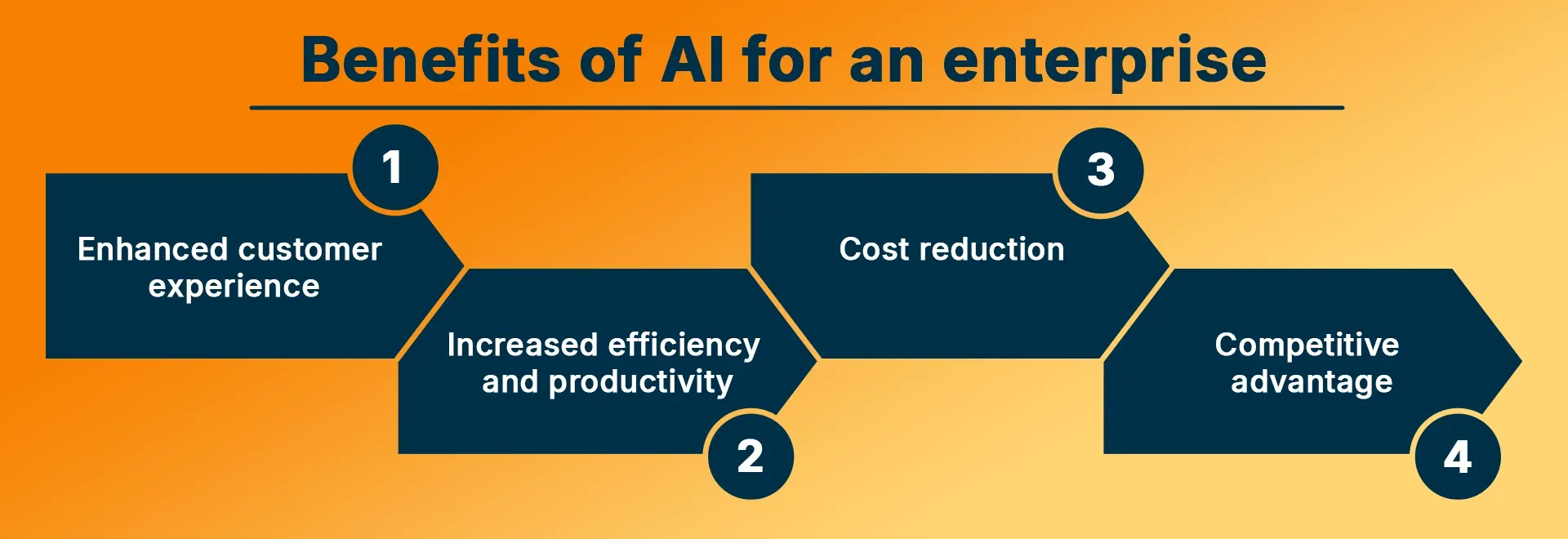
AI technology transforms businesses by automation complex processes, such as finding insights in data that were hard to discover before, thus making the whole process not only smart, faster, but also more efficient.
-
EnhancedCustomer Experience
The transformation of AI for Enterprises will change how companies treat clients and customers by giving the opportunity of personalized service, which is the main advantage of AI technology.
-
Increased Efficiency and Productivity
AI in the enterprise is a technology that can take over repetitive, time-consuming tasks that drain employee energy and organizational resources. Document processing that needed hours is now done in seconds.
-
Cost Reduction
The implementation of enterprise AI entails an initial investment, but the long-term savings are enormous. The automation of employee jobs in the case of everyday tasks cuts down the labor costs to a significant extent. Predictive maintenance tackles the problem of costly unplanned stoppages by ensuring that the machines are always working.
-
Competitive Advantage
AI adoption in organizations for business purposes gives them the power over their competitors that others still cannot reach. New business strategies are decided upon quickly because of the use of better data and insights. They also create and improve their products, having gone through the standard digital process of fast experimentation.
Also Read: What is an AI Assistant
Enterprise AI Use Cases
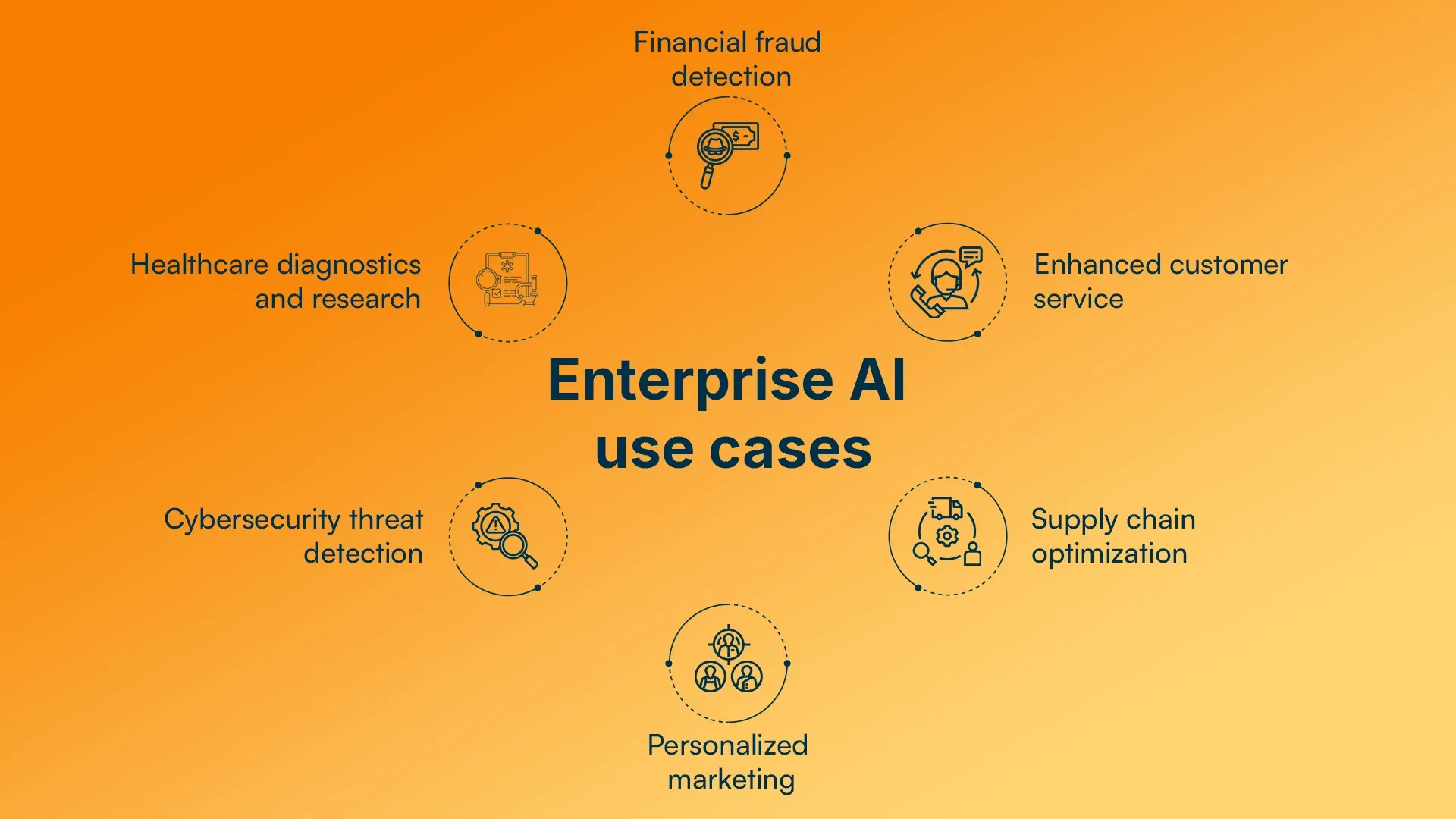
Enterprise AI is used by businesses to automate tasks, improve accuracy, and make smarter decisions using data.
-
Financial Fraud Detection
Financial institutions utilize enterprise AI systems that monitor a million transactions at the same time and very accurately identify the fraudulent patterns, which is better than traditional rule-based systems.
-
Enhanced Customer Service
The customer service platforms powered by AI are changing the support operations totally by managing the regular inquiries at once and sending the complicated issues to the right agents.
The natural language processing is allowing these systems to grasp the customer's intent no matter how the question is asked, thus providing correct information from the knowledge base, dealing with returns, making appointments, and even recognizing the customer's annoyance for properly escalating the talk.
-
Supply Chain Optimization
Enterprise AI transforms supply chain management by predicting demand fluctuations, optimizing inventory levels, identifying potential disruptions, and suggesting routing alternatives.
These systems analyze weather patterns, geopolitical events, supplier performance, seasonal trends, and countless other variables to keep products moving efficiently.
-
Personalized Marketing
AI in the enterprise enables marketers to deliver the right message to the right person at the right time through the right channel.
Machine learning algorithms analyze customer data to predict purchase propensity, identify optimal communication timing, generate personalized content variations, and allocate marketing budgets across channels for maximum return.
-
Cybersecurity Threat Detection
Security teams leverage enterprise AI to identify threats that would slip past traditional defenses. AI systems establish baselines of normal network behavior, then flag anomalies indicating potential breaches.
They analyze millions of security events daily, correlating patterns across systems to detect sophisticated attacks.
-
Healthcare Diagnostics and Research
Enterprise AI is a game-changer in supply chain management as it forecasts demand, balances stocks, spots interruptions in the supply chain ahead of time, and even advises on the best transportation routes.
All these things are done by considering a myriad of factors such as weather, politics, suppliers' ability to deliver, the season's impact on sales, and many more, to ensure smooth product flow.
Challenges of Enterprise AI
Whether the implementation of enterprise AI is successful and has significant benefits is a question that an organization must answer thoughtfully. The first reason can be data quality issues because many AI initiatives and systems need clean, well-organized, and representative data to function effectively, but most companies have poor data quality due to data silos, inconsistencies, or incompleteness.
The challenge of integrating the systems often turns out to be more complicated than one would think. The old systems were not designed with AI in mind, which resulted in the creation of technical barriers that necessitated a considerable amount of engineering work. When AI systems handle sensitive data, security and privacy issues become even more prominent, thus calling for strong governance frameworks and compliance measures.
The shortage of talent remains another hurdle along the way. For example, the organization will require data scientists, AI engineers, and business executives who have both technology and domain expertise—this is a rare combination in labor markets where the demand for such personnel exceeds the supply. Moreover, to form these teams, the organization will incur the cost of recruiting and training.
How Do I Implement Enterprise AI?
Implementing enterprise AI starts with understanding your business goals and identifying where AI can add real value. With the right strategy, organizations can smoothly integrate AI into their operations and scale it over time.

1. Identify High-Impact Use Cases
Draw a roadmap of the organization's biggest problems and bypasses where artificial intelligence could bring a measurable impact on the value. Give preference to the processes that are repetitive, data-rich, and time-consuming; these present the most obvious returns on investment in AI and create a push for larger programs.
2. Define Your Business Goals
Instead of vague aspirations, set specific, measurable objectives for your company’s AI project. Clear-cut goals make it possible to carry out the right evaluation and to demonstrate ROI to stakeholders.
3. Assess Your Data
Perform a detailed assessment of your data resources-their standard, availability, management, and being AI-application-ready. Highlight the discrepancies that necessity cleanup, the unification of systems that need integration, and the data privacy concerns that have to be dealt with before deploying AI in Enterprise setups.
4. Choose the Right AI Technology
It is advisable to assess the available AI platforms and tools according to your particular use cases, present infrastructure, and organization capabilities. Determine the need for pre-built solutions, custom development, or hybrid approaches, which are the three main categories that best suit your needs, considering their functionality, cost, integration complexity, and vendor support options.
5. Develop and Test Your AI
Step by step, develop your AI solution from the ground up, first producing a minimum viable product that caters to your main use case. Do extensive testing in controlled settings with actual data, evaluate the output against the predetermined targets, detect edge cases, and improve the algorithms before the whole organization gets the technology.
Conclusion
The enterprise AI revolution is a reality that is transforming every single industry, and it is not a far-off dream anymore.
The organizations that will take strong and swift steps for the advantage of the data, automated processes, and smart decision-making will be the ones to gain the advantage of having a competitive market position over others for a long time. RejoiceHub LLP service can help companies implement these AI strategies effectively.
Frequently Asked Questions
1. What is the difference between enterprise AI and consumer AI?
Enterprise AI focuses on solving complex business problems at an organizational scale with robust security, compliance, and integration capabilities, while consumer AI targets individual users with simpler, standalone applications like virtual assistants or photo editing tools.
2. How long does it take to implement enterprise AI?
Implementation timelines vary significantly based on use case complexity, data readiness, and organizational capabilities, ranging from 3-6 months for focused applications to 18-24 months for comprehensive enterprise-wide transformations.
3. Do I need a large team to implement AI in the enterprise?
While dedicated AI expertise helps, organizations can start with small cross-functional teams combining business domain knowledge with technical skills, often supplemented by external consultants or AI platform vendors who provide implementation support.
4. What industries benefit most from enterprise AI?
Virtually every industry gains value from AI enterprises, though financial services, healthcare, manufacturing, retail, and logistics have seen particularly dramatic transformations due to their data-intensive operations and clear automation opportunities.
5. How much does enterprise AI cost?
Costs range dramatically from tens of thousands for focused applications using pre-built platforms to millions for custom enterprise-wide implementations, with ongoing expenses for maintenance, training, and infrastructure that organizations must budget accordingly.