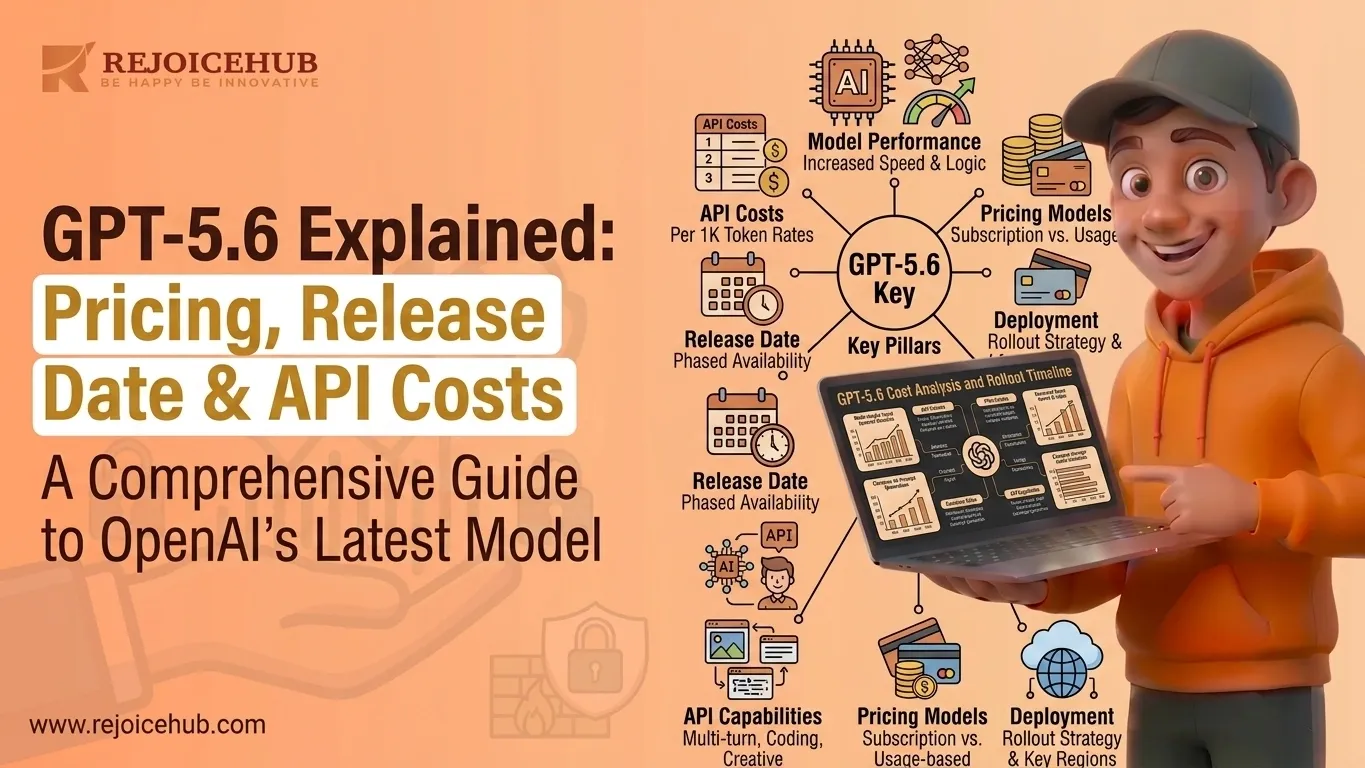
AI prices have been increasing constantly in recent months due to the growing use of large language models in customer support, sales, content creation, and other areas a trend that's pushed many teams to rethink their enterprise AI cost strategy.
GPT-5.6 is a new version of the large language model developed by OpenAI in July 2026. One of the most notable changes in the latest iteration of the model is a change in the pricing system. Instead of having a unified pricing option for the performance of various tasks, users can now choose from three options.
In this article, we will explore what exactly constitutes the GPT-5.6, the differences between Sol, Terra, and Luna, their prices, and ways to optimize the use of the service.
Understanding this information is essential if you are planning to use any AI agents or automation tools utilizing the new model.
What Is GPT-5.6?
Overview
GPT-5.6 is the latest milestone in OpenAI's language model development, and it appears to differ significantly from previous iterations including its immediate predecessor, GPT-5.5. Unlike earlier versions, GPT-5.6 is comprised of three separate capability tiers - Sol, Terra, and Luna - each optimized for specific combinations of intelligence, speed, and cost.
The naming convention for these models appears to be different as well. According to OpenAI, the number indicates the generation of the model (5.6), while the letter represents a "durable capability" that can be upgraded independently in the future. This is a significant change from previous iterations, which used a simpler naming convention (GPT-4o, GPT-4.1, GPT-5, etc.) that did not distinguish between different capabilities.
GPT-5.6 Release Date
The GPT-5.6 release date was July 9, 2026, when OpenAI moved the family to general availability across ChatGPT, Codex, and the OpenAI API following a short, coordinated preview period.
Key Improvements
So what's actually new in GPT-5.6, beyond the tiering?
-
Stronger coding performance: Sol posted new highs on independent coding-agent benchmarks, reportedly using far fewer output tokens than prior-generation models to get similar or better results a comparison worth reading alongside our breakdown of Cursor Composer vs GitHub Copilot.
-
Better long-horizon agent work: GPT-5.6 shows gains on tasks that require staying on-task across many steps useful for agentic AI workflows that need to complete multi-part processes without losing context.
-
Programmatic Tool Calling: Models can now write and execute JavaScript in an isolated runtime to orchestrate tool calls, rather than making one tool call at a time a natural extension of ideas introduced by the Model Context Protocol.
-
Multi-agent mode: The API can spin up parallel sub-agents for focused, simultaneous work a built-in version of the "swarm of agents" pattern many teams were already building manually, and a sign of how fast the AI agent infrastructure market is maturing.
-
More predictable prompt caching: GPT-5.6 introduces explicit cache breakpoints and a fixed minimum cache lifetime, which changes how you should think about caching costs (more on that below).
Why It Matters for Your Business
Here's the practical takeaway: not every task requires your most capable (i.e., expensive) model; a support chatbot that resolves FAQs does not need the same capacity to debug production code. The ability to scale from relatively simple to highly complex tasks is precisely the point of GPT-5.6's tiered approach, which should help organizations realize the broader benefits of AI for business by using the right tool for the job.
GPT-5.6 Sol vs Terra vs Luna
Each GPT-5.6 tier targets a different part of the cost-to-capability curve. Here's how they break down.
1. Sol The Flagship
Performance: Sol is OpenAI's newest and most capable model in the organization, and it has the highest coding capability of any of the models, excelling in agentic coding benchmarks and long-horizon evaluations, and is the only one able to access 'highest' reasoning effort and "ultra" multi-agent mode.
Use cases:
- Complex, multi-step coding agents working across large codebases, similar to how teams are now using Claude Code routines to automate developer workflows
- Long-running research or analysis workflows
- High-stakes reasoning tasks (financial modeling, technical due diligence)
- Enterprise copilots handling ambiguous, high-complexity requests
2. Terra The Balanced Model
Terra is at the center, promising to deliver the performance of GPT-5.5 at a much lower price compared to other models, making it our go-to option for day-to-day agent or interactive tasks, such as first-pass code reviews, implementing features within a specific scope, or a customer support agent that needs to reason through a few moderately complex queries.
3. Luna The Affordable Model
Luna is the fastest and cheapest tier in the family. It's built for high-volume, lower-complexity work: summarization, labeling, classification, drafting, and first-pass responses that can escalate to Terra or Sol when needed. For startups and SMBs running thousands of routine calls a day, Luna is often where most of your AI content creation token volume should live.
Accelerate Your Workflows with Custom AI
Book a free consultation session with RejoiceHub. We'll map out a tailored automation roadmap for your company.
GPT-5.6 API Cost Comparison
1. Token Pricing Concepts
Before comparing prices, it helps to understand how OpenAI API billing actually works:
- Input tokens are what you send to the model (your prompt, context, retrieved documents).
- Output tokens are what the model generates back and they're almost always priced higher than input tokens, a dynamic also visible in how Claude Opus 4.7 task budgets are structured.
- Cached tokens are input tokens the model has seen recently and can reuse cheaply instead of reprocessing from scratch.
With GPT-5.6, caching got more structured: you can now set explicit cache breakpoints, cached content has a guaranteed minimum cache life of 30 minutes, and cache writes are billed at a premium (1.25x the uncached input rate) while cache reads still get a steep discount. In practice, that means caching is more predictable, but it also means it's easy to overpay on cache writes if you're not deliberate about what you cache a concept we cover in more depth in our guide to prompt caching and LLM API costs.
2. GPT-5.6 Pricing Table
Here's how much GPT-5.6 costs, per 1 million tokens:
| Model | Input (per 1M tokens) | Output (per 1M tokens) | Best fit |
|---|---|---|---|
| GPT-5.6 Sol | $5.00 | $30.00 | High-complexity, low-volume tasks |
| GPT-5.6 Terra | $2.50 | $15.00 | Balanced, everyday workloads |
| GPT-5.6 Luna | $1.00 | $6.00 | High-volume, simple tasks |
Cache reads keep a roughly 90% discount off the standard input rate, regardless of tier which matters a lot for agents that repeatedly re-read the same system prompt, documentation, or codebase context. For a broader look at how this stacks up against competing models, see our comparison of GPT-5.5 vs Claude Opus 4.7 for business.
3. Choosing Models by Workload
A simple way to think about it:
- High complexity, low frequency (e.g., a one-off data migration script) → Sol
- Medium complexity, regular frequency (e.g., a support agent resolving tickets) → Terra
- Low complexity, high frequency (e.g., tagging inbound leads, summarizing emails) → Luna
This framing is also useful when estimating the overall cost to build an AI agent from scratch, since model choice is one of the biggest recurring cost drivers.
Cost Optimization & API Strategy
The biggest lever for reducing costs is not choosing the cheapest model for all tasks, but rather decomposing the problem into easier/harder ones. Most production workloads are a combination of both, and defaulting to the best/most expensive model for everything can cause budgets to quietly balloon one of the recurring enterprise AI infrastructure gaps we see teams run into.
Which GPT-5.6 Model Is Best?
There's no single "best" GPT-5.6 model it depends on what you're building and how much volume you're running. Here's a simple decision tree:
- Are you running high-volume, repetitive tasks (classification, tagging, first-pass drafts)? → Start with Luna. Escalate to Terra only when accuracy drops below your threshold.
- Are you building a customer-facing product with moderate reasoning needs (support, onboarding, internal tools)? → Terra is your default. It's the best cost-to-capability ratio for most everyday SaaS use cases.
- Are you building coding agents, research agents, or workflows that require long, multi-step reasoning? → Sol, reserved for tasks that actually need it. Use it as an escalation tier, not a default.
- Are you a developer prototyping or unsure which tier fits your use case? → Start on Terra for development, benchmark against Luna and Sol on your real data, then lock in the cheapest tier that meets your accuracy bar in production a practical first step toward deploying AI agents without an ML team.
How to Reduce GPT-5.6 Costs
Choosing the right tier is one thing, but how can companies reduce AI costs after they get going?
-
Routin: is one such mechanism, with logic that directs requests to the cheapest possible tier for a given job, and only to more expensive ones if the work cannot be done with the available confidence score, triage, or rule-based prioritization. This alone often dramatically reduces AI costs compared to throwing a mixture of similar but differing tasks at a single model the same principle that underpins how AI agents automate workflows more broadly.
-
Caching: becomes possible due to the explicit breakpoint in GPT-5.6's cache, meaning that prompts should be constructed in a way that allows as much of the system message, documentation, few-shot examples, and other static information to be cached separately from the variable user input as possible, letting the higher share of requests fall under the cheaper per-token rate. Good context engineering practices make this significantly easier to implement consistently.
-
Batching: should be used whenever possible for non-real-time requests, reports, summaries, or augmented data sets, as processing them in groups (even if waiting a day for the next set) will often be cheaper and easier to account for than scattering individual requests throughout the day.
-
Prompt optimization: then plays a role in reducing token count for both input and, especially, output: while all three tiers have output tokens priced at a sharp premium to input, the ratio is far steeper for the lower two, and reducing model verbosity (with shortening of the prompt) or explicit length limits has a massive effect on reducing AI costs.
Finally, monitoring should be done at a per-task level rather than per-token, as a cheaper model with a much higher degree of retries may in practice be much more expensive than a simple single pass on a more expensive model a maturity marker worth tracking as part of a broader AI adoption roadmap.
This is all part of the broader infrastructure design for reducing AI costs at scale. And this is where RejoiceHub's AI architectural design expertise helps, by building in the necessary mechanisms to route, cache, manage, and monitor all your requests in a way that lets you fully utilize the potential of the underlying technology without wasting money on unneeded complexity in your AI infrastructure.
Conclusion
GPT-5.6 offers increased versatility by enabling organizations to select the most suitable AI model for their specific needs and workload requirements. However, adopting a mix of Sol, Terra, and/or Luna can be highly effective in terms of both cost and performance, provided that the infrastructure is properly set up to intelligently route requests across the different models.
In case your organization contemplates building AI agents, copilots, or automated processes with OpenAI APIs, RejoiceHub can assist you in designing an efficient and cost-effective solution. Please contact us to discuss your particular case further.
Frequently Asked Questions
1. What is GPT-5.6?
GPT-5.6 is OpenAI's newest language model, launched in July 2026. Instead of one version, it comes in three tiers - Sol, Terra, and Luna. Each tier is built for a different mix of speed, cost, and intelligence, so you can pick the right one for your task.
2. When is the GPT-5.6 release date?
OpenAI released GPT-5.6 on July 9, 2026. It became available across ChatGPT, Codex, and the OpenAI API after a short preview period. This rollout marked the shift to the new three-tier system, replacing the older single-model pricing approach used in past GPT versions.
3. What is GPT-5.6 Sol?
Sol is the flagship, most powerful model in the GPT-5.6 family. It handles complex coding agents, long research tasks, and high-stakes reasoning work like financial modeling. Sol is also the only tier that can use the "highest" reasoning effort and "ultra" multi-agent mode.
4. How much does GPT-5.6 cost?
Pricing depends on the tier. Sol costs $5 per million input tokens and $30 per million output tokens. Terra costs $2.50 input and $15 output. Luna, the cheapest option, costs $1 input and $6 output per million tokens, making it ideal for high-volume tasks.
5. What is the GPT-5.6 API cost comparison?
Sol is the priciest but most capable, best for low-volume, high-complexity work. Terra sits in the middle, offering solid performance at a lower cost for everyday tasks. Luna is the cheapest, built for high-volume, simple jobs like summarizing or tagging. Cached tokens get a 90% discount.
6. Which GPT-5.6 model is best?
There's no single best model - it depends on your workload. Use Luna for high-volume, repetitive tasks, Terra for everyday customer-facing or moderate reasoning work, and Sol only for complex coding or research agents. Most teams save money by mixing tiers instead of using one.
7. What is GPT-5.6 pricing for Terra and Luna?
Terra costs $2.50 per million input tokens and $15 per million output tokens, making it a balanced choice for daily workloads. Luna is cheaper, at $1 input and $6 output per million tokens, and works best for simple, high-volume jobs like classification or drafting.