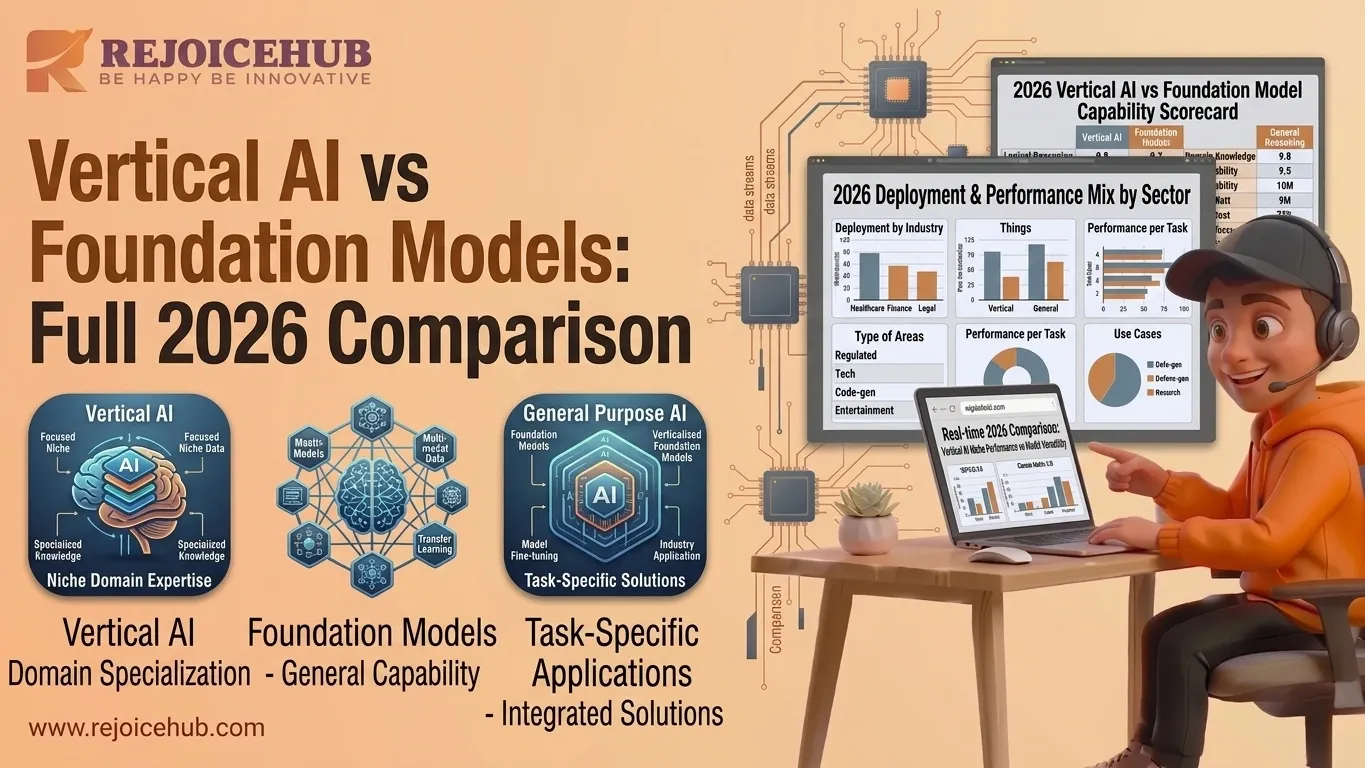
The AI race is no longer about building the biggest language model.
Foundations are shifting towards companies that are building best-in-industry AI products. This is why founders should care about the move away from big model labs and towards Vertical AI vs Foundation Models as the strategic choice for 2026, especially as AI continues transforming business strategy across every sector.
If you are a founder asking yourself whether to build an application on top of a foundational model or invest in a specialized industry AI product, then this guide will explain to you what Vertical AI is, how it compares to Foundation Models, and why many startups are now choosing the vertical route for Enterprise AI deployments in 2026.
What Is Vertical AI?
Definition
Vertical AI is Artificial Intelligence developed for a certain industry, process or business function rather than being a universal solution that serves all sectors.
Compared to more general models, Vertical AI is usually better trained, fine-tuned or wrapped for:
- Industry-specific AI logic and terminology
- Deep domain expertise (compliance rules, industry data, jargon, regulations)
- Specialized workflows that map directly to how a business actually operates, often powered by purpose-built AI agents
In simple terms: Vertical AI doesn't try to answer every question in the world. It tries to solve one business problem better than anyone else.
Vertical AI Examples
Vertical AI companies and Vertical AI startups are popping up across nearly every industry. Some of the most common Vertical AI use cases include:
- Healthcare: AI agents that handle patient intake, clinical documentation, and insurance pre-authorization, reflecting the broader shift toward AI in healthcare
- Legal: Contract review, case research, and compliance monitoring tools built for law firms
- Finance: Fraud detection, underwriting automation, and financial reporting agents, an area where artificial intelligence in finance is accelerating rapidly
- HR: Resume screening, onboarding automation, and employee support chatbots
- Sales: Lead qualification agents and AI-powered outreach tools tailored to specific sales motions
- Customer Support: Industry-trained support agents that understand product-specific issues, similar to the workflows covered in this AI customer support automation guide
- Manufacturing: Predictive maintenance and supply chain optimization agents
Each of these examples shares one thing in common: the AI isn't generic. It's built around real business workflows, not general conversation.
What Are Foundation Models?
Foundation Models are fundamental large-scale artificial general intelligence systems that underpin most of the modern AI applications. The most popular foundation models include:
- GPT (OpenAI)
- Claude (Anthropic)
- Gemini (Google)
- Llama (Meta)
- GLM (Zhipu AI)
Each of these systems is trained on very large datasets and performs a wide range of tasks related to natural language processing and understanding, spanning the full spectrum of types of artificial intelligence.
Foundation Models offer:
- Broad capabilities across countless use cases
- Strong reasoning and language understanding
- A flexible base that developers can build on top of
Foundation Models for enterprise AI are hugely powerful, but narrowly focused, and perform best when applied to specific, limited domains. They often lack industry-specific knowledge or process understanding and cannot be easily tuned to address vertical-specific regulatory, workflow, or customer requirements. To overcome these shortcomings, a new class of foundation models called Vertical AI has been introduced.
Accelerate Your Workflows with Custom AI
Book a free consultation session with RejoiceHub. We'll map out a tailored automation roadmap for your company.
Vertical AI vs Foundation Models Explained
Here's a side-by-side look at the difference between Vertical AI and Foundation Models:
| Vertical AI | Foundation Models |
|---|---|
| Industry-specific | General-purpose |
| Higher ROI for targeted use cases | Flexible across many use cases |
| Faster deployment for a specific workflow | More customization required |
| Built-in domain expertise | Broad reasoning capability |
| Designed around business workflows | Designed for general tasks |
The Core Difference
Foundation Models are the engine. Vertical AI is the car that is built to drive on a specific road. A Foundation Model can generate an email, summarize a contract, or answer medical questions in general terms much like the broader category of generative AI compared to traditional AI. Using the same model, the right Vertical AI product will be able to process a patient intake form, identify a compliance risk in a contract, or qualify a support ticket based on the specific products your company sells.
Benefits of Vertical AI
- Faster time-to-value because the AI already understands the industry
- Lower prompt-engineering and fine-tuning overhead
- Higher accuracy on domain-specific tasks
- Easier to sell to enterprise buyers who want proof of ROI, not just a chatbot, which ties directly into the broader benefits of AI for business
AI Models for Business Automation
Most modern AI models for business automation are a combination of both approaches, where a foundational model is complemented by a vertical layer that embodies workflow logic, proprietary data, and other business-specific elements, such as guardrails. This trend is closely tied to the rise of AI automation and is likely to become the norm for serious AI products.
Why Founders Are Choosing Vertical AI in 2026
Why are startups choosing Vertical AI? The answer comes down to business fundamentals, not just technology preference.
-
Lower Infrastructure Costs
Training or fine-tuning a foundation model from scratch is an extremely costly process, so vertical AI startups are built on top of existing Foundation Models through APIs, cutting down on infrastructure and computational expenses a factor worth weighing against the overall cost to build an AI agent.
-
Faster Time to Market
Because the underlying model already exists, founders can focus their engineering time on workflows, integrations, and domain data, not model training. This means shipping in weeks instead of months, especially when founders follow a proven approach to building an AI agent stack for business.
-
Better Defensibility
Are Foundation Models becoming commoditized? Increasingly, yes. Multiple labs now offer comparable general-purpose models, which makes the model itself a weak moat, a dynamic playing out across the wider AI agent infrastructure market.
Vertical AI startups build defensibility through proprietary data, workflow integrations, and industry relationships things a competitor can't copy just by calling the same API.
-
Higher SaaS Margins
Vertical AI products solve high-value, specific problems, which allows for premium pricing and stronger unit economics compared to generic AI wrappers, part of the reason per-seat SaaS pricing is being challenged by agent-first models.
-
Easier Customer Acquisition
Selling "an AI chatbot" is a hard pitch. Selling "an AI agent that cuts your insurance claims processing time by 60%" is a much easier conversation with a specific buyer the same logic driving adoption of tools like AI SDRs.
-
Stronger Product-Market Fit
Vertical AI business models are built around solving one painful, expensive problem extremely well, which naturally leads to tighter product-market fit than horizontal, general-purpose tools, a distinction explored further in AI agents vs SaaS tools.
Vertical AI Market Trends
The future of Vertical AI in 2026 points toward:
- More AI startups building on top of Foundation Models rather than training their own
- Increased enterprise demand for compliance-ready, industry-specific AI agents
- Consolidation around a few dominant Foundation Models as the shared infrastructure layer
- Vertical AI companies raising strong funding rounds due to clearer ROI stories, in line with broader enterprise AI adoption roadmaps
This is the essence of why startups are moving beyond Foundation Models as their core product: the model is infrastructure, not the product itself.
Should Businesses Build Vertical AI Applications?
Not every business needs a custom Vertical AI product. Here's how to decide.
1. When to Choose Foundation Models
- You need general-purpose capabilities (writing, summarizing, coding assistance)
- Your use case isn't tied to a specific regulated industry
- You're prototyping or testing an idea quickly, which often comes down to a custom vs off-the-shelf AI software decision
2. When to Build Vertical AI
- Your workflows are industry-specific and repetitive
- You have proprietary data that a general model can't access
- Compliance and accuracy requirements are high
- You want to automate a core business function, not a one-off task
- You need a defensible, sellable product, not just an internal tool — something increasingly achievable even if you deploy AI agents without an in-house ML team
3. Decision Checklist
Ask yourself:
- Do we have industry-specific workflows that a generic AI can't handle well?
- Do we have proprietary data we can use as a competitive advantage?
- Are compliance or regulatory requirements involved?
- Are we trying to automate a core, repeatable business process?
- Is customer support or another high-volume function eating up our team's time?
If you checked two or more boxes, Vertical AI is likely worth building, and it may help to review how to build an agentic AI system for business before you start.
Businesses looking to build secure, AI-powered products can benefit from custom AI development services that combine foundation models with industry-specific intelligence. This is exactly where RejoiceHub specializes. If you're looking to build a custom AI agent for your industry, RejoiceHub can help design, build, and deploy it around your real business workflows.
Conclusion
Foundation Models will continue to be the foundation of the AI infrastructure layer, providing the core reasoning, language understanding, and intelligence required by the industry.
In contrast, Vertical AI will be the business layer, where companies can create their competitive edge by building on specialized data sets and producing products within a specific industry. Many enterprises are still closing the infrastructure gaps standing between them and full AI agent adoption.
For businesses that want to create an AI product for their enterprise, engaging expert AI development teams is a strategic choice to build an innovative product while mitigating implementation risks.
Therefore, if your business wants to build an AI product for the enterprise and move beyond foundational models, RejoiceHub will partner with you to design, develop, and implement AI agents that extend beyond chatbots and are trained on your data and processes.
Frequently Asked Questions
1. What is Vertical AI?
Vertical AI is artificial intelligence built specifically for one industry or business function, combining domain expertise with specialized workflows rather than general-purpose capabilities.
2. What are Foundation Models?
Foundation Models are large, general-purpose AI systems (like GPT, Claude, Gemini, Llama, and GLM) trained on massive datasets to handle a broad range of tasks.
3. What is the difference between Vertical AI and Foundation Models?
Foundation Models provide general-purpose intelligence and act as the underlying infrastructure. Vertical AI applies that intelligence to a specific industry or workflow, adding domain expertise, proprietary data, and business-specific logic.
4. Why are startups choosing Vertical AI?
Startups choose Vertical AI for lower infrastructure costs, faster time to market, stronger defensibility, higher margins, and easier customer acquisition compared to building general-purpose AI products.
5. Are Foundation Models becoming commoditized?
Largely, yes. As more labs release comparable general-purpose models, the differentiation is shifting away from the model itself and toward the specialized application built on top of it.
6. Is Vertical AI the future of enterprise AI?
Vertical AI is becoming the business layer of enterprise AI, the place where startups create real, sustainable competitive advantages using Foundation Models as the underlying infrastructure.
7. Which industries benefit from Vertical AI?
Healthcare, legal, finance, HR, sales, customer support, and manufacturing are among the industries seeing the fastest Vertical AI adoption due to their complex, repeatable, and high-value workflows.