Picture hiring a bunch of specialists, like a researcher, an analyst, a writer, and a fact-checker, and then letting them go solo completely, no talking, no steering. The researcher wraps up first, but for some reason forgets to pass the notes along.
Then the analyst comes in, basically starting from zero. The writer ends up duplicating what somebody else already did, more or less. So you get this messy effort burned, things tangled, and a finished piece that nobody is really satisfied with.
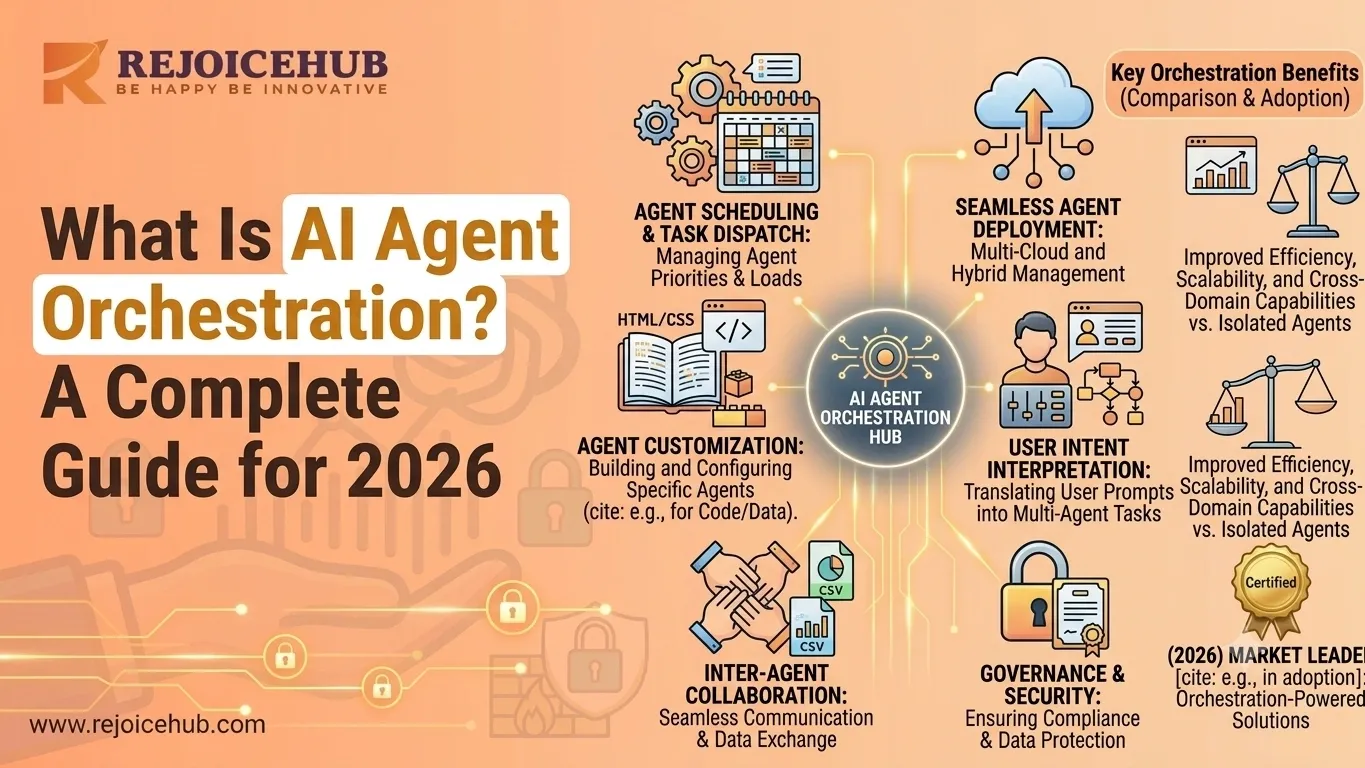
That is exactly what AI agent orchestration does for artificial intelligence systems. As organizations deploy more AI agents to handle complex tasks, orchestration has become the critical layer that transforms a group of isolated tools into a coordinated, intelligent system. In this article, we break down what AI agent orchestration is, how it works, why it matters, and what you need to know to understand this fast-growing concept.
What Is AI Agent Orchestration?
The management of AI agents entails orchestrating more than one autonomous AI agent working together towards accomplishing a common goal under a defined and regulated process.
This can be better understood by first defining what constitutes an AI agent. This is an autonomous software program capable of understanding its environment, reasoning on how to solve a given task, performing tasks with the aid of APIs or database access, and adapting based on the outcomes without much involvement from human beings.
Unlike a script-based chatbot, an AI agent makes decisions on its own and accomplishes multiple steps without human guidance.
Taking into consideration the nature of modern AI programs, there is very little need for one agent alone to accomplish a task. For instance, in a customer support application, one agent will be used to understand the user's issue, another one for account retrieval, and yet another to generate a solution.
AI Orchestration vs. AI Agent Orchestration
These two terms are related but not the same, and the distinction matters.
AI orchestration is the broader discipline of coordinating AI components, machine learning models, data pipelines, APIs, and automation tools to work together efficiently within a system. Think of it as managing the entire AI tech stack.
AI agent orchestration is a subset of this. It focuses specifically on coordinating autonomous agents that can make independent decisions, take actions, collaborate with each other, and adapt dynamically as conditions change. Where AI orchestration optimizes execution paths, AI agent orchestration manages intent-driven systems where agents are actively reasoning and negotiating task ownership, not just executing predefined steps.
The key difference: AI orchestration follows fixed rules. AI agent orchestration reads the moment, weighs context, and chooses the next action intelligently. To understand how this plays out in practice, it helps to look at how agentic AI workflows are structured and what makes them distinct from traditional automation.
How Does AI Agent Orchestration Work?
At the heart of AI Agent Orchestration lies the notion that multiple intelligent entities need to have a way to work together without conflicting with one another. This is how it happens, in brief:
Step 1: Task Decomposition
A high-level goal is broken down into smaller, manageable subtasks. For example, "generate a competitive market analysis report" might be split into: gather data, analyze trends, identify gaps, and draft the report.
Step 2: Agent Assignment
The orchestrator assigns each subtask to the most suitable specialist agent based on its capabilities. One agent might be optimized for web research, another for data analysis, another for writing.
Step 3: Execution and Coordination
Agents begin executing their assigned tasks sometimes in sequence (one after another), sometimes in parallel (simultaneously). The orchestrator manages dependencies, making sure Agent B doesn't start until Agent A has completed its handoff.
Step 4: Context Management
This is where orchestration becomes truly powerful. The orchestration layer stores what agents know, retrieves information they need, and updates shared context as new data comes in. Without this shared memory, agents would act blindly, making decisions based on incomplete or outdated information. Context is the connective tissue of any well-functioning multi-agent system. In fact, context engineering in AI has emerged as a dedicated discipline precisely because of how critical this layer is to system performance.
Step 5: Feedback and Adaptation
Once agents deliver their results, the orchestrator evaluates outcomes and reshapes the workflow if needed. If one agent fails or produces unexpected output, the system can reroute the task, retry with a different agent, or flag it for human review. Over time, the orchestration layer becomes smarter, recognizing patterns, avoiding dead ends, and optimizing routes that consistently work.
Key Components of an AI Agent Orchestration System
A well-built orchestration system is made up of several interdependent components working together:
- The Orchestrator: The "conductor" of the system. This one has the master plan, allocates tasks, handles sequencing, and enforces the governance rules. It does not do the actual work — it only tells who should.
- Specialized Agents: The workers. Each agent is designed for a specific function: data retrieval, content generation, compliance checking, user communication, and so on. Specialization is what makes multi-agent systems more powerful than a single general-purpose agent.
- Shared Memory / Context Layer: The system's short-term and long-term memory. This layer ensures that information flows between agents, so every handoff carries the full context of what has happened before.
- Communication Channels: The protocols through which agents exchange information. This includes how they signal task completion, pass data, and request resources from each other.
- Governance and Guardrails: Rules that define what agents can and cannot do. This includes security policies, cost limits, compliance constraints, and human-in-the-loop checkpoints for high-stakes decisions.
Orchestration Patterns
Not all multi-agent systems are structured the same way; three main configurations can be seen in practice:
1. Centralized Orchestration
All agents are controlled by one orchestrator. This structure provides an explicit chain of command and good auditability, but may lead to a bottleneck problem.
2. Sequential Orchestration
Agents operate in a specific sequence, passing their results to each other. This type is optimal in the case of a linear workflow with specific dependencies.
3. Federated Orchestration
Independent agents or different organizations cooperate without a full exchange of information and transfer of power. It works well in industries with strict regulations (healthcare, banking), where the sharing of personal data is restricted.
A hybrid configuration is used in many companies centralized governance of critical rules for compliance purposes, with agents performing task delegation autonomously.
Real-World Use Cases and Examples
AI agent orchestration might sound abstract, but its applications are already reshaping how businesses operate across industries.
-
Customer Service
A user contacts a company with a billing complaint. One agent identifies the intent behind the message. A second agent retrieves the customer's account history from the CRM. A third checks the applicable billing policy. A fourth drafts a personalized response. The entire interaction happens in seconds, with each agent contributing its specialty, and the customer never knows four systems were involved. This is why AI customer support automation has become one of the most compelling enterprise use cases for orchestrated agents.
-
Financial Services
An investment firm uses orchestrated agents to monitor portfolio risk. A data agent pulls market feeds continuously. An analysis agent flags anomalies. A compliance agent checks regulatory implications before any action is taken. A reporting agent generates summaries for human review. What once required a team of analysts working overnight now runs continuously and automatically.
-
Software Development
Orchestrated agents fit naturally into CI/CD pipelines, where one agent reviews code changes, another runs automated tests, a third checks for security vulnerabilities, and a fourth deploys approved changes. This kind of multi-agent coordination dramatically shortens development cycles and reduces human error.
-
Content and Marketing
A content team uses orchestrated agents to go from keyword research to a published article with minimal manual intervention. A research agent identifies trending topics. A brief agent structures the outline. A writing agent produces the draft. An optimization agent checks SEO compliance. A publishing agent uploads the final piece to the CMS. Each handoff carries full context, so nothing gets lost in translation. Teams exploring how AI agents can automate workflows often find content pipelines to be one of the fastest areas to see measurable ROI.
Top AI Agent Orchestration Frameworks
For developers and technical teams evaluating their options, several frameworks have emerged as leading tools for building orchestrated multi-agent systems:
- LangChain: One of the most widely used frameworks for building language model-driven workflows. It provides tools for chaining prompts, managing context, and integrating with external APIs. It is highly extensible and excellent for prototyping, though enterprise-grade governance typically requires additional layers on top.
- AutoGen (Microsoft): Designed specifically for enabling multiple agents to collaborate in dynamic, conversational workflows. It is particularly well-suited to research environments and experimental setups where flexibility matters more than strict governance.
- LangGraph: Built for complex, stateful workflows where agents need to loop, branch, and revisit previous steps. Good for systems where the path from input to output is not linear.
- CrewAI: Focuses on role-based agent teams, making it intuitive to define agents with specific roles, goals, and backstories that guide their behavior within the system.
- Salesforce Agentforce: An enterprise-grade platform that integrates orchestration directly with CRM data, compliance controls, and business KPIs. Designed for organizations that need governance embedded into the orchestration layer from the start, not added as an afterthought.
The right framework depends on your use case, technical resources, and governance requirements. Teams just getting started often begin with LangChain or CrewAI, while enterprises with strict compliance needs tend to lean toward purpose-built platforms. For a broader view of the landscape, exploring the top AI agent companies driving this space can help inform your evaluation.
Benefits and Real Challenges of AI Agent Orchestration
Benefits
-
Scalability It is easy to add new agents or configure existing agents since orchestration is in place. Enterprises do not have to rebuild their whole system from scratch.
-
Efficiency With orchestrated agents sharing knowledge and splitting tasks, the need for inefficient, redundant operations is removed from individual AI implementations. It leads to better use of computing resources, hence reducing costs.
-
Improved Decision Making With coordinated efforts of agents in analysis and output generation, the insight becomes richer than that generated by an individual agent. The decisions made by an organization will be based on the complete information available.
-
Governance and Compliance Since the rules are enforced in a centralized manner, every move of agents is trackable, accountable, and follows a particular standard. This is extremely important for organizations operating in regulated sectors.
-
Less AI Sprawl Without orchestration, enterprises find themselves using tens of isolated AI solutions working in silos according to different rules and generating inconsistent outputs. Understanding the use cases of AI agents in business makes clear why a unified orchestration layer is no longer optional for scaling organizations.
Challenges
No technology comes without its complexities, and AI agent orchestration does not fall outside of this rule.
-
Loss of Context If the context layer is not properly configured, important details may be lost in translation between different agent handovers. Such losses can be hard to track down.
-
Compounding Errors In a highly interdependent multi-agent system, an error by one agent can have consequences for the whole process flow until human intervention stops it. Proper error handling is key here.
-
Complexity of Governance As the number of agents increases, the complexity of establishing and maintaining consistent governance for all of them rises. It becomes especially complicated if agents use external APIs or other third parties.
-
Resource Costs Multiple agents require more computing resources. Without careful handling of resources in the orchestration layer, costs will rapidly increase. Organizations building out their infrastructure should factor this in when estimating the cost to build an AI agent system at scale.
Conclusion
The orchestration of AI agents is not only a technological term; it is the key factor that distinguishes a set of efficient but disconnected technologies from an intelligent system that is capable of solving complicated and practical issues.
In the conditions of rapid growth of AI usage in various industries, the possibility to coordinate multiple agents successfully through effective governance, context sharing, and dynamic workflow management will be one of the critical skills that will distinguish the companies using AI efficiently from those failing with their AI implementations.
For developers working on their first multi-agent prototypes, product managers evaluating AI platforms, and business leaders trying to comprehend the future of AI, understanding the orchestration of AI agents and knowing how to build an AI agent stack for your business will be of great help in navigating what comes next.
Frequently Asked Questions
1. What is Meta-Harness, and what does it actually do?
Meta-Harness is an AI agent orchestration framework that manages multiple AI agents working at the same time. It handles task coordination, shared memory, tool access, and decision routing all from one central layer, so your agents don't duplicate work or lose context mid-workflow.
2. Why do businesses need AI agent orchestration in the first place?
When you run multiple AI agents without any coordination layer, things break fast. Agents repeat each other's work, lose shared context, and there's zero visibility into what's happening. Orchestration fixes all of that by giving every agent a clear role and a shared system to work within.
3. How is Meta-Harness different from tools like LangChain or CrewAI?
LangChain and CrewAI are great for small or early-stage setups, but they weren't built for large-scale, multi-agent production environments. Meta-Harness comes with built-in shared memory, centralized tool management, and full audit trails, things that the other frameworks make you set up manually, which gets expensive fast.
4. What are the main benefits of using AI agent orchestration for my business?
The biggest wins are faster execution, better scalability, and much lower operational complexity. Instead of managing ten separate agent environments, everything runs under one system. Workflows can also be reused across departments, which saves serious time when you're growing your AI operations.
5. Is Meta-Harness suitable for regulated industries like healthcare or finance?
Yes, and that's actually one of its stronger selling points. Meta-Harness logs every agent action, tool call, and decision making it fully auditable. For industries where compliance and explainability aren't optional, having that kind of governance baked in from day one is a real advantage.
6. Can small businesses or startups use Meta-Harness, or is it only for large enterprises?
Meta-Harness was designed with enterprise scale in mind, but any team running more than a couple of AI agents can benefit from it. If you're already dealing with coordination headaches or tool redundancy, the orchestration layer starts paying off well before you reach enterprise size.
7. What does a real-world multi-agent workflow look like inside Meta-Harness?
A good example is B2B sales automation. One agent pulls lead data, another scores it, a third writes a personalized email, a fourth reviews it for tone, and a fifth sends it all coordinated automatically through Meta-Harness. Every agent shares context, and the whole flow runs without manual handoffs.