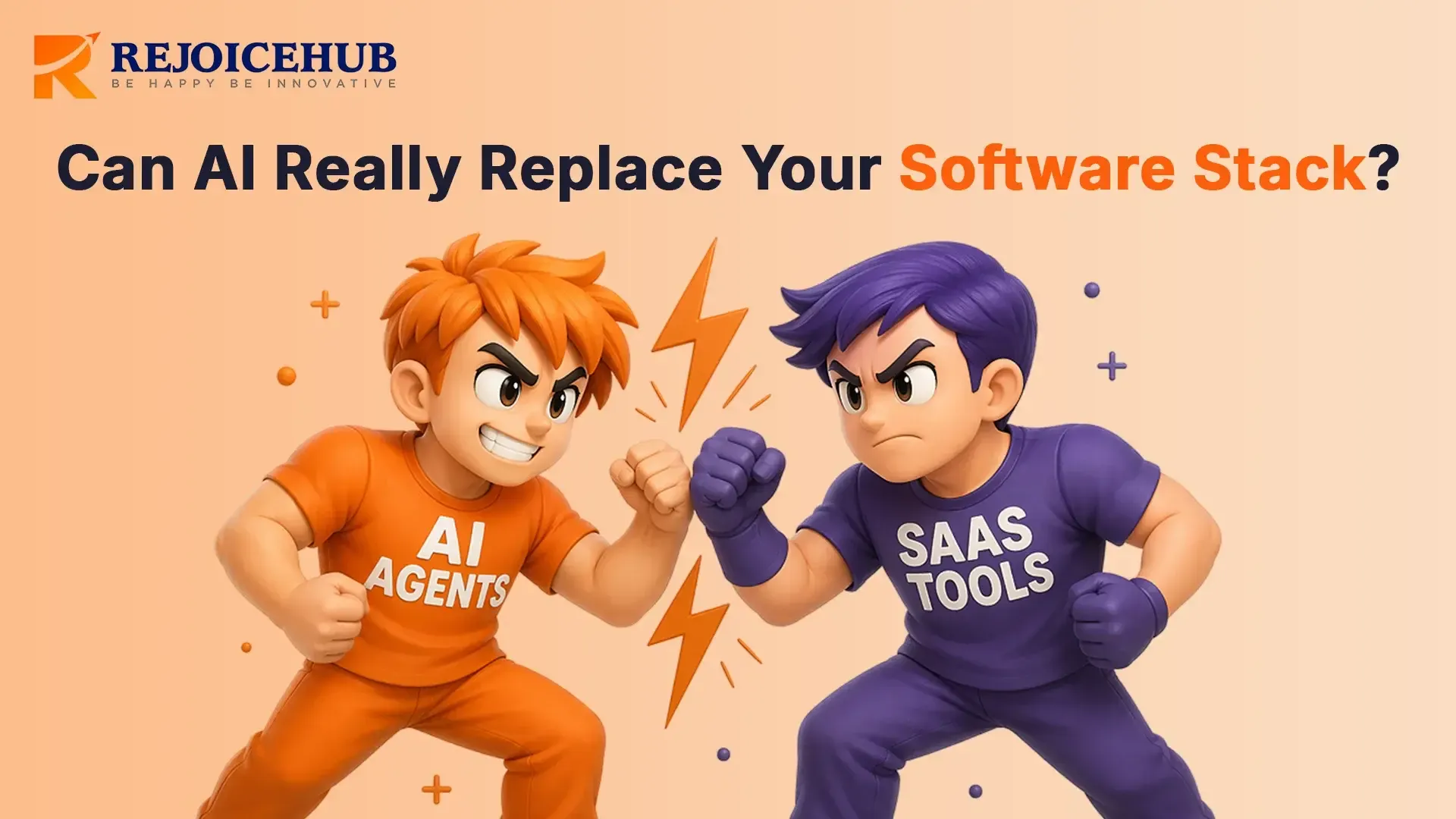
Businesses in the United States currently allocate more than $15,000 to software-as-a-service (SaaS) applications for each employee annually. The software suite includes project management tools and customer relationship management (CRM) systems and email marketing applications and analytics dashboards and numerous other applications. Most tools in this collection operate with minimal communication ability. The SaaS stock market experienced a $2 trillion decline which indicates that software stack bloat has reached its final stage.
AI agents now serve as the new technology replacement. This article will explain the differences between AI agents and SaaS systems by defining both terms and comparing their pricing and functionalities and offering guidance to businesses on selecting their optimal solution.
What Are AI Agents and Traditional SaaS Tools?
Before we start our comparison process, we need to establish our definitions. The terms used in this context appear to be common, but they require specific explanation. The following section provides their actual definitions.
AI Agents Explained
An AI agent functions as an independent software system which possesses the ability to understand objectives and make decisions while executing tasks without needing ongoing human supervision.
Unlike a chatbot that just answers questions, an AI agent can:
- Research information from multiple sources
- Draft and send emails on your behalf
- Update your CRM after a sales call
- Analyze data and surface insights automatically
- Trigger workflows across different tools
The best demonstration of this concept exists in Claude Managed Agents which serve as AI agents that use the Anthropic Claude model to perform intricate business functions. The system operates through flexible reasoning which enables it to adapt to various situations while carrying out its tasks.
RejoiceHub provides expert services for organizations that need to create personalized AI agents for business which match their specific operational needs.
Traditional SaaS Explained
The software as a service platform provides users with cloud-based access to particular software functions which they can use through a subscription. Users should consider this approach:
- CRM: Salesforce, HubSpot
- Email marketing: Mailchimp, Klaviyo
- Project management: Asana, Monday.com
- Analytics: Google Analytics, Mixpanel
- Customer support: Zendesk, Intercom
Each tool performs one specific task effectively. But as your business grows, you end up paying for 10-20 different subscriptions and spending more time managing the tools than actually using them.
AI Agents vs SaaS: Key Differences
Here's a direct comparison to make the decision easier:
| Feature | AI Agents | Traditional SaaS |
|---|---|---|
| Task Handling | Multi-step, autonomous | Single-function, manual-driven |
| Cost Structure | Usage-based or outcome-based | Fixed monthly subscription |
| Flexibility | Adapts to your workflow | You adapt to the software |
| Automation Level | High - can self-execute tasks | Low to medium - requires human triggers |
| Integration | Can bridge multiple tools | Often requires native integrations or Zapier |
| Learning Curve | Low (natural language) | Medium to high (feature-heavy UI) |
| Scalability | Scales with usage | Scales with seat count (expensive) |
| Setup Time | Days to weeks (custom) | Hours to days |
The core difference: SaaS gives you tools. AI agents automate your workflows and get things done.
AI vs SaaS Cost Comparison
This is the part that drops jaws. Let's see what a standard 10-member startup might be spending on SaaS tools every month.
| Tool | Monthly Cost |
|---|---|
| HubSpot CRM (Starter) | $50 |
| Mailchimp (Standard) | $100 |
| Zendesk (Suite Team) | $550 |
| Asana (Premium) | $130 |
| Slack (Pro) | $87 |
| Zoom (Pro) | $150 |
| Notion (Team) | $80 |
| Google Workspace | $120 |
| Total | ~$1,267/month |
So that's $15,204 a year on this lean stack. Many businesses are spending anywhere from 3 to 5 times that amount.
The AI Agent Alternative
Now consider deploying a custom AI agent that handles:
- Customer support triage (replacing part of Zendesk's function)
- Email campaign drafting and scheduling (reducing Mailchimp dependency)
- CRM data entry and follow-up reminders (automating HubSpot tasks)
- Internal Q&A and documentation (cutting Notion usage)
The development of a complete AI agent business automation solution through RejoiceHub requires a one-time project payment and additional monthly costs for API usage, which total less than three months of your existing SaaS expenses.
AI provides businesses with a genuine chance to decrease their software-as-a-service expenses, which are currently experiencing rapid growth. Your organization achieves subscription savings while it combines multiple disjointed processes into a single cohesive intelligent platform.
Key insight: The goal isn't to eliminate every SaaS tool. It's to stop paying for 6 tools when 1 AI agent can do the work of 4.
Can AI Agents Replace SaaS Tools? (Use Cases)
The short answer: yes, in many areas. But not all of them.
Where AI Is Replacing SaaS
1. Customer Support
AI agents can handle tier-1 and tier-2 support tickets without assistance by reading context information and checking order history while they write responses and escalate issues only when it is necessary. Businesses that use AI customer support automation can manage three to five times more support tickets while maintaining their existing staff levels.
The high-volume repetitive support situations between Zendesk and Intercom face direct competition from this approach.
2. Marketing Automation
AI agents can draft personalized email sequences, segment audiences based on behavior, and schedule campaigns without any manual input. Rather than toggling between your CRM and email platform, a single agent handles the full funnel. This directly challenges tools like Mailchimp and Klaviyo for AI use cases in marketing where volume and repetition are the norm.
3. Data Analysis
Instead of pulling a report from your analytics tool and manually interpreting it, an AI agent can query your data, identify trends, and deliver a plain-English summary with recommendations automatically, on a schedule.
No dashboard. No manual exports. Just answers. Explore how AI tools for data analysis are making this a reality across industries.
Where SaaS Is Still Needed
AI agents are powerful, but they're not a fit for everything:
- Compliance-heavy tools: Platforms like DocuSign, Rippling (payroll), or HIPAA-compliant EHR systems have regulatory requirements baked in. You can't just swap these for a custom AI agent without significant legal risk.
- Specialized platforms: Industry-specific tools (legal, accounting, healthcare) have deep feature sets and compliance certifications that AI agents can't replicate out of the box.
- User-facing portals: If your customers log into a platform daily (like a billing portal or customer dashboard), a SaaS product is still the right solution.
The smart play is a hybrid model: use AI agents for the work that happens between your SaaS tools, and keep the specialized platforms for what they do best.
When Should Businesses Replace SaaS with AI?
The optimal time for this transition does not exist because different businesses require different readiness stages. The following framework shows how to assess your situation for decision-making purposes.
-
Startups (Under 50 Employees)
You should start using AI agents because this moment presents the best opportunity for doing so. Your organization needs to move data from old systems because you currently lack any existing systems. Your team can create efficient operations starting from their first day of work.
Recommendation: Avoid stacking 15 SaaS tools. Instead, invest in 3-4 core platforms and use AI agents to fill the gaps. Review these AI business ideas for startups to understand how early-stage companies are building lean and smart from day one.
-
SMBs and Mid-Market (50-500 Employees)
The current business situation causes you to experience financial pressure from software-as-a-service expenses. Your organization needs AI agents because your operational processes have reached a level which requires AI solutions.
Recommendation: Start with a targeted AI agent project - one workflow, one department. Measure ROI. Then expand.
-
Enterprise (500+ Employees)
Enterprise has the biggest opportunity but also the most friction: procurement, IT security, compliance reviews. AI agents don't replace your ERP. But they can sit on top of it, pulling data and executing tasks across departments. Understanding agentic AI workflows can help enterprise teams structure their adoption roadmap intelligently.
Recommendation: Work with an AI development partner (like RejoiceHub) to deploy agents within your existing ecosystem.
-
Quick Decision Checklist
Use this to evaluate if AI agents make sense for you right now:
- Are you spending $1,000+/month on tools with overlapping features?
- Do your teams manually move data between systems?
- Are there repetitive tasks your team does daily that follow a consistent pattern?
- Are you hiring headcount just to manage software workflows?
- Do you want to scale without proportionally scaling headcount?
If you checked 3 or more boxes, AI agents should be on your roadmap.
What the $2T Sell-Off Means for the Future of SaaS
The SaaS sector experienced a market capitalization decline of approximately $2 trillion during the period from 2022 to 2023, which created shockwaves for an industry that had grown accustomed to obtaining exceptionally high valuations and experiencing continuous expansion.
What caused it?
The "growth at all costs" model got eliminated by rising interest rates. But more importantly, investor sentiment shifted away from software that requires human labor to operate and toward software that replaces human labor.
That's AI.
Analysts and venture firms now charge their financial holdings toward AI-native tools: platforms that use large language models to process data by reasoning and taking action instead of merely retaining and showing information. This shift is already reshaping the AI agent infrastructure market at a fundamental level.
What does this mean for traditional SaaS?
- Consolidation is coming. Smaller, single-function SaaS tools are already struggling. Expect acquisitions, shutdowns, and mergers.
- AI wrappers won't survive. SaaS products that simply added a "GPT-powered" button to their dashboard won't hold their position. The market wants native AI, not bolted-on features.
- Buyers are getting smarter. CFOs are scrutinizing software spend more than ever. The question in every renewal conversation is now: "Can AI do this cheaper?"
This doesn't mean SaaS is dead. Salesforce, ServiceNow, and Workday aren't going anywhere. But the mid-tier SaaS market, the $50-$500/month tools that do one thing, is under serious pressure.
The winners of the next decade will be companies that adopt AI-native workflows early. The losers will be the ones still paying for 20 SaaS subscriptions in 2027, wondering why their leaner competitors are outpacing them.
Conclusion
Business automation now reaches new possibilities, which AI agents establish as its new standard. The system provides flexible access to services while delivering results at decreasing operational costs. The system proves most effective when used to handle high-volume tasks that require multiple tools to operate continuously.
The traditional SaaS model remains relevant for businesses that operate in compliance-focused industries and need specialized software or tools for customer service. The practice of adding multiple subscription services to a business operation has reached its conclusion.
The most effective current strategy requires organizations to begin with minor tasks. Organizations should select one operational process. Organizations should develop one AI agent. Organizations should track their outcome assessment.
Frequently Asked Questions
1. What is the main difference between AI agents and traditional SaaS tools?
SaaS tools do one specific job and wait for a human to use them. AI agents actually go out and complete tasks on their own. Think of SaaS as a tool sitting on a shelf, and an AI agent as a worker who picks it up and gets the job done without being told every step.
2. Can AI agents really replace SaaS tools for small businesses?
Yes, in many cases they can. AI agents can handle customer support, email campaigns, CRM updates, and more, all in one place. For small teams spending over $1,000 a month on SaaS subscriptions, switching to AI agents for repeated tasks can cut costs significantly and free up time.
3. How does the AI vs SaaS cost comparison actually work out?
A basic SaaS stack for a 10-person team can easily run $1,200 or more per month. A custom AI agent solution often costs less over three months than the same SaaS spend. You pay for usage rather than fixed seats, which makes scaling much more affordable as your business grows.
4. Which SaaS tools are most at risk of being replaced by AI agents?
Single-function tools in the $50 to $500 per month range are under the most pressure. Customer support platforms, email marketing tools, and basic analytics dashboards are already being replaced. These tools do repetitive, rule-based work that AI agents handle faster and cheaper without needing a human in the loop.
5. Are there situations where SaaS tools are still better than AI agents?
Absolutely. Compliance-heavy platforms like payroll software, HIPAA systems, or legal tools carry regulatory requirements that AI agents cannot replicate safely. Customer-facing portals where users log in daily also still need proper SaaS products. AI agents work best behind the scenes, not as customer dashboards.
6. How do I know if my business is ready to reduce SaaS costs with AI?
A few clear signs: your team manually copies data between tools, you are paying for overlapping software features, or you are hiring people just to manage workflows. If three or more of those sound familiar, your business is ready to start replacing at least some SaaS tools with AI agents.
7. What does the $2 trillion SaaS sell-off mean for businesses buying software today?
It means the market is shifting away from software that needs humans to run it and toward software that replaces human effort. CFOs now ask, "Can AI do this cheaper?" at every renewal. Businesses that stick with bloated SaaS stacks risk falling behind leaner competitors already using AI-native workflows.