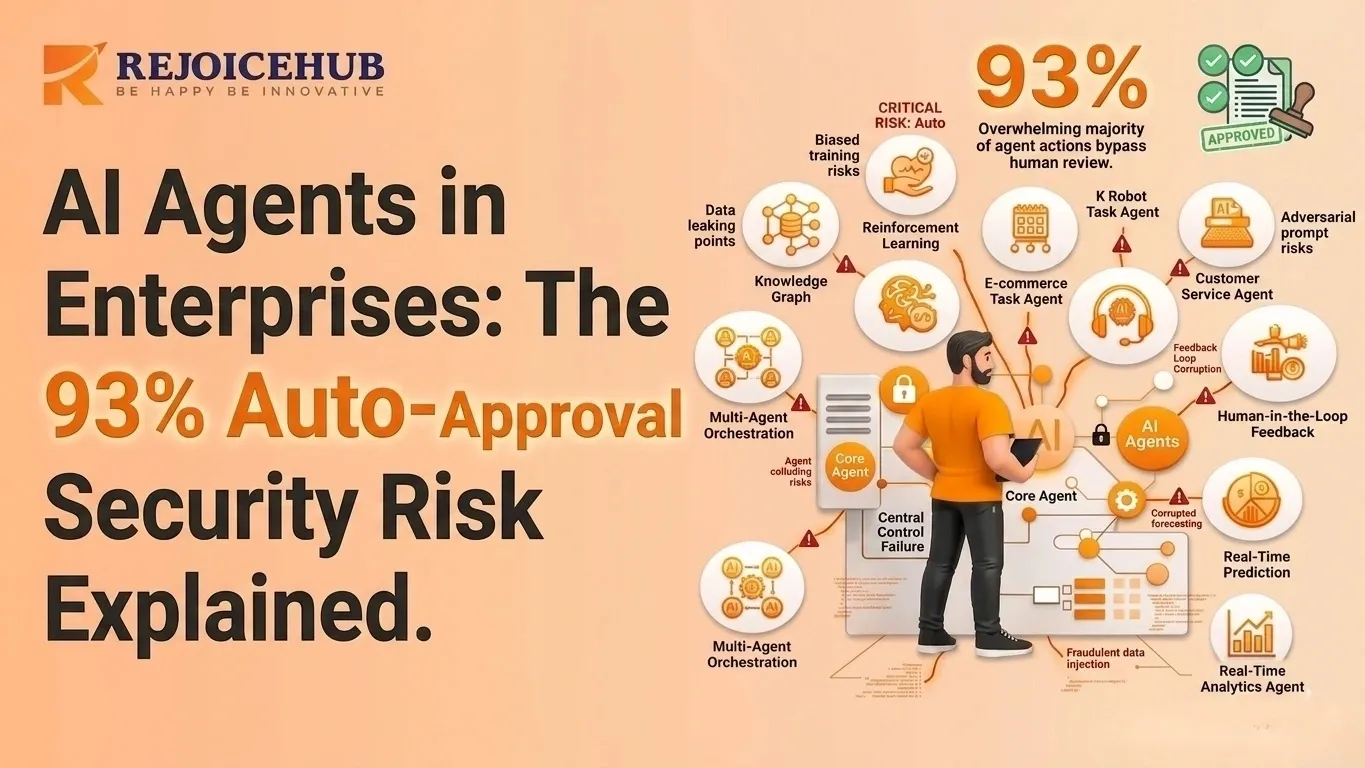
The percentage of AI-driven decisions which 93% of enterprise organizations make gets approved automatically without any human assessment. The AI agent you use performs all its functions because it handles all operations without any human supervision.
The system operates at a dangerous level because it does not deliver effective results. Enterprise operations transform AI agents because of their ability to complete difficult tasks while reducing human work and making decisions at speeds that surpass all human capabilities.
The system provides potential benefits for productive work, but it creates an increasing number of AI agent infrastructure problems, which most organizations do not know how to solve.
In this post, you'll learn:
- What AI agents actually are and why enterprises are rushing to adopt them
- What the 93% auto-approval problem means for your business
- The specific security gaps AI agents create in enterprise infrastructure
- Actionable steps to fix vulnerabilities and build safer AI workflows
What Are AI Agents and Why Enterprises Are Adopting Them
An AI agent is software that operates independently from human input because it uses environmental information to determine its goals before executing its plan. AI agents possess the ability to reason through situations and build their own understanding of complex tasks because they operate beyond the fixed pathways that traditional automation systems use to execute established procedures.
Vending machines demonstrate traditional automation because users receive products after they push a button. AI agents function like employees who understand tasks while they make decisions and change their work when situations shift.
Why Enterprises Are All-In on AI Agents
Enterprise adoption of AI agents is accelerating fast. Here's why:
- Cost reduction: Agents handle repetitive, high-volume tasks at a fraction of the cost of human labor
- Speed: AI agents can process thousands of decisions per minute, 24/7
- Scalability: One agent can do the work of dozens of people without fatigue or error from exhaustion
- Integration: Modern agents connect to CRMs, ERPs, databases, and communication platforms simultaneously
The main enterprise use cases that organizations need for their operations include contract review, customer support automation, financial reconciliation, IT ticketing, and supply chain management.
The situation develops this way because enterprises increase their AI systems' decision-making abilities, which leads to expanded operational gaps in their AI agent infrastructure.
Where Auto-Approval Actually Fails
The existing problem with automatic approval systems occurs because they only work in typical situations, but completely shut down during uncommon situations, which require advanced AI systems to function properly.
-
Finance scenario: An AI finance agent uses its authority to approve vendor invoices that exceed $50,000. An attacker submits 20 invoices for $49,800 each, all slightly under the threshold. The agent approves all 20. The fraudulent account receives nearly $1 million before anyone identifies the situation.
-
Access Control scenario: An IT agent uses role matching logic to give system access. The HR system contains incorrect information about a contractor's role. The agent gives them admin access to a production database. The contractor will lose access two weeks after their offboarding process because no personnel are monitoring the system's access control activities.
-
Support scenario: A support AI agent uses customer records to create personalized responses for customers. A prompt injection attack tricks the agent into exfiltrating sensitive PII to an external endpoint. The breach remained undetected for 11 days.
These situations represent actual operational failures that organizations experience with their security systems.
How AI Agents Create Enterprise Infrastructure Gaps
1. Weak Identity and Access Management (IAM)
Enterprise IAM frameworks were designed to protect shared access between human users and their system resources. The activation of an AI agent occurs when it establishes a link with your organizational systems, introducing:
- Overly broad service account permissions
- Shared credentials across multiple agent instances
- No dynamic access adjustment based on task context
The agent who receives "reading access to customer data" will obtain permission rights to write, modify, or delete customer data. The IAM teams currently face a situation where they must handle a critical security problem that affects fundamental security systems of the enterprise.
2. API-Level Vulnerabilities
AI agents for business depend on APIs for their operational needs. They establish connections with multiple internal and external services at the same time. The use of APIs creates multiple points through which an attacker can access the system.
Common API-level risks with AI agents include:
- Over-permissioned API keys that give agents more access than they need
- Unencrypted API traffic between the client and the service
- Missing rate limiting, allowing agents (or attackers controlling them) to hammer internal systems
- Lack of API versioning controls, meaning agents may continue using deprecated, vulnerable endpoints
The hidden location of these AI agent vulnerabilities in enterprise systems makes them a serious security threat. The vulnerabilities exist within the system architecture that users do not see.
3. Lack of Audit Trails
Your AI agent has made decisions during the past 72 hours. Most enterprises face difficulties because they need to provide a full answer to this question.
AI agents usually function without complete logging systems. The existing logs for AI systems show two common issues that occur when documentation exists:
- Stored in formats that aren't easily searchable
- Not tied to specific business outcomes or downstream effects
- Inaccessible to compliance or audit teams without engineering support
Anomaly investigations, incident investigations, and compliance demonstrations require complete audit trails as their essential prerequisite. The situation presents both security issues and regulatory requirements.
4. Shadow Automation
Shadow IT has caused problems for businesses during the last 40 years. The emergence of AI agents has created a new form of business operations called shadow automation.
Teams and departments use agentic AI workflows through no-code tools and vendor-bundled features according to their needs without requiring IT security or compliance approval. The unauthorized agents:
- Access company data without approved authorization
- Connect to external services outside the approved vendor list
- Make decisions with no visibility to central governance teams
This creates gaps in enterprise AI security that grow faster than any security team can track.
Key Security Risks of AI Agents in Enterprises
1. Unauthorized Decisions
AI agents can make consequential decisions, including hiring actions, financial transactions, and customer communications that they were never explicitly authorized to make. This happens when:
- Goal definitions are too broad ("manage the sales pipeline")
- Agents develop unexpected workarounds to achieve objectives
- Multi-agent systems delegate tasks without proper authorization checks
The dangers of AI agent decision-making become more significant when those systems use multiple agents that need to work together, because this creates uncertainty about who should take responsibility.
2. Data Leakage Risks
AI agents that possess access to sensitive data, which includes customer records, financial information, and intellectual property rights, become critical targets for attackers. The identified operational dangers include:
- Prompt injection attacks that manipulate agent behavior
- Model inversion, where attackers extract training data from the agent
- Unintended data exposure when agents include sensitive context in external API calls or logs
3. Compliance Violations
HIPAA, GDPR, SOC 2, and CCPA-compliant frameworks did not intend to deal with autonomous AI agents. The gaps include:
- Agents making decisions that require documented human review (e.g., credit decisions, medical recommendations)
- Data residency violations when agents route information through non-compliant infrastructure
- Consent issues when agents access or process personal data without proper justification
Enterprise AI automation risks often surface first as compliance violations discovered during audits, not in real-time.
4. Bias and Incorrect Actions
AI agents develop biases because their training data and reward signals contain existing biases. The business environment operationalizes this principle through:
- Systematically disadvantaging certain customer segments in support or sales workflows
- Making inventory or staffing decisions based on historically skewed data
- Triggering incorrect financial transactions based on misclassified inputs
Human errors, unlike agent errors, are likely to stay contained rather than propagate silently across an entire workflow.
How to Fix AI Agent Security Vulnerabilities
1. Human-in-the-Loop Systems
For the problem of lacking human judgment, the simplest step is to introduce occasional layers of human review. This doesn't mean reviewing every agent action. It means:
- Defining clear escalation thresholds (monetary value, data sensitivity, risk score)
- Building review queues for flagged decisions before they execute
- Creating rollback mechanisms so humans can reverse agent actions quickly
The goal is not to eliminate agent autonomy; it's to put humans in the right places in the loop.
2. AI Governance Frameworks
Enterprises need formal policies governing how AI agents are deployed, what they're authorized to do, and how decisions are reviewed. A complete AI governance system needs to have the following elements:
- Agent registry: Documents all deployed agents through their recorded permissions and defined purposes
- Authorization matrices: Define the complete range of actions that agents can execute without permission and for which they need approval
- Incident response playbooks: Specific failure procedures to guide response efforts when AI agents break down
Organizations serious about how to fix AI agent security vulnerabilities in enterprises treat governance as infrastructure, not paperwork.
3. Zero-Trust Architecture
There is no trust by default for absolutely no one, whether agent, user, or system. All access requests must be verified in context.
- Agents should receive just-in-time, least-privilege access to only what they need for the specific task, expired immediately after
- All inter-agent communication should be authenticated and encrypted
- Agent identity should be verified continuously, not just at initial deployment
Zero-trust is increasingly acknowledged as one of the top cybersecurity best practices in business transformation.
4. Monitoring and Observability Tools
Organizations require dedicated tools to track the actions of their artificial intelligence agents. These tools should provide:
- Behavioral baselines that flag deviations from normal agent patterns
- Real-time alerting on high-risk decisions or anomalous API activity
- Cross-agent audit logs that connect actions across multi-agent workflows
- Model drift detection to catch when agent behavior changes over time
RejoiceHub builds enterprise AI agent solutions with monitoring and governance built in from day one, not bolted on after a breach.
Best Practices to Secure AI Agent Workflows
The following framework defines a starting point for securing AI agent workflows for enterprise teams.
1. Set Meaningful Approval Thresholds
Blanket thresholds ("approve everything under $X") are too blunt. Instead, consider layered controls:
| Threshold Factor | Example |
|---|---|
| Transaction value | Auto-approve under $1,000; human review $1,000-$25,000; executive review above |
| Data sensitivity | PII access always requires logging; PHI requires human review |
| Novelty score | First-time vendor, new counterparty, or unusual pattern triggers review |
| Velocity check | Multiple similar actions in short windows trigger escalation |
2. Implement Role-Based Agent Controls
Just as employees have role-based access controls, agents should too. This means:
- Each agent has a defined role scope with explicit permissions
- Agents cannot self-escalate or grant permissions to other agents
- Role assignments are reviewed quarterly and updated when business needs change
3. Build Continuous Validation Into Agent Workflows
Agents should be tested continuously, not just at deployment. This includes:
- Red-teaming exercises where security teams attempt to manipulate agent behavior
- Synthetic transaction testing to verify agents handle edge cases correctly
- Output validation layers that check agent decisions against business rules before execution
4. Develop a Formal AI Risk Management Strategy
AI agents' risk management is an ongoing process that requires multiple elements:
- A designated AI risk owner (often the CISO or CTO)
- Ongoing risk assessments connected to all agents' access rights and decision-making capabilities
- Integration with established enterprise risk management (ERM) systems
- Board-level reporting regarding the risk exposure that AI agents present
Enterprises that treat AI agent risk as a strategic priority, not an IT footnote, will be far better positioned as agent capabilities and threats continue to grow.
Conclusion
AI agent security is not a one-time configuration project. It is an ongoing operational discipline that requires governance, visibility, and accountability at every layer of your enterprise stack.
A designated AI risk owner, continuous risk assessments tied to agent permissions, integration with enterprise risk management frameworks, and board-level reporting are all essential components of a mature AI security posture.
Enterprises that treat AI agent risk as a strategic priority, not an IT footnote, will be far better positioned as agent capabilities and threats continue to grow.
Talk to the RejoiceHub team to build enterprise AI agent solutions with security and governance built in from the start.
Frequently Asked Questions
1. What are the biggest security risks of using AI agents in enterprise systems?
AI agents in enterprise systems face risks like unauthorized decisions, data leakage, and weak access controls. Because most agents run on auto-approval, they can process sensitive actions like payments or data access without any human ever reviewing them. That creates serious enterprise AI security gaps fast.
2. Why do AI agents create infrastructure gaps in enterprise environments?
Most enterprise infrastructure was built for human users, not AI agents. So when agents connect to APIs, databases, and workflows, they often get overly broad permissions. Combined with little to no audit logging, this opens up AI agents' enterprise infrastructure gaps that security teams struggle to even detect.
3. What is the 93% auto-approval problem in AI-driven enterprise decisions?
The 93% auto-approval problem means nearly all AI agent decisions in enterprises execute without a human reviewing them first. While this speeds things up, it also means risky actions like approving large payments or granting system access happen completely unchecked, which raises enterprise AI automation risks significantly.
4. How can enterprises fix AI agent security vulnerabilities in their workflows?
Enterprises can fix AI agent security vulnerabilities by setting clear escalation thresholds, adding human-in-the-loop checkpoints for high-risk decisions, and using zero-trust architecture. Building an AI governance framework with an agent registry and defined permission levels also helps close the most common security gaps in agent workflows.
5. What are the best practices for securing AI agent workflows in 2026?
The top enterprise AI agents' security best practices in 2026 include least-privilege access, continuous behavioral monitoring, role-based agent controls, and real-time alerting on unusual activity. Enterprises should also run regular red-teaming exercises and tie AI risk management to their existing enterprise risk frameworks, not treat it separately.
6. How do AI agents cause compliance violations in regulated industries?
AI agents can break compliance rules by making decisions that legally require documented human review, like credit approvals or medical recommendations. They may also route data through non-compliant infrastructure or access personal data without the right justification, which triggers GDPR, HIPAA, or CCPA violations that often only surface during audits.
7. What is shadow automation, and why is it a growing enterprise AI risk?
Shadow automation happens when individual teams deploy AI agents without IT or security approval, usually through no-code tools or vendor-bundled features. These agents access company data, connect to outside services, and make decisions with zero central oversight. It is one of the fastest-growing enterprise AI security gaps organizations face today.