Your online shopping experience will undergo permanent modifications.
You begin your online shopping experience by entering a search term into Google, followed by examining the search results and selecting a product page to view. The process exists as something we have all executed countless times.
Now picture an artificial intelligence system that will perform all of those tasks for you by delivering results in a matter of seconds through its advanced thinking capabilities and complete operational independence.
e-Commerce will reach its future destination in 2026, which Google Universal Commerce Protocol UCP provides as its essential operational structure. The architectural framework that enables this transformation exists through Google Universal Commerce Protocol UCP. As AI search technology takes over from conventional keyword search methods, the product discovery and purchasing procedures that consumers use will undergo a complete transformation. Google UCP establishes a standard that dictates how artificial intelligence systems should function with merchant platforms to enable customers to complete purchases without requiring any manual intervention.
The guide presents an explanation of Google UCP through its operational details and business relevance, while providing competitive advantages to your organization through advanced preparation before your rivals enter the market.
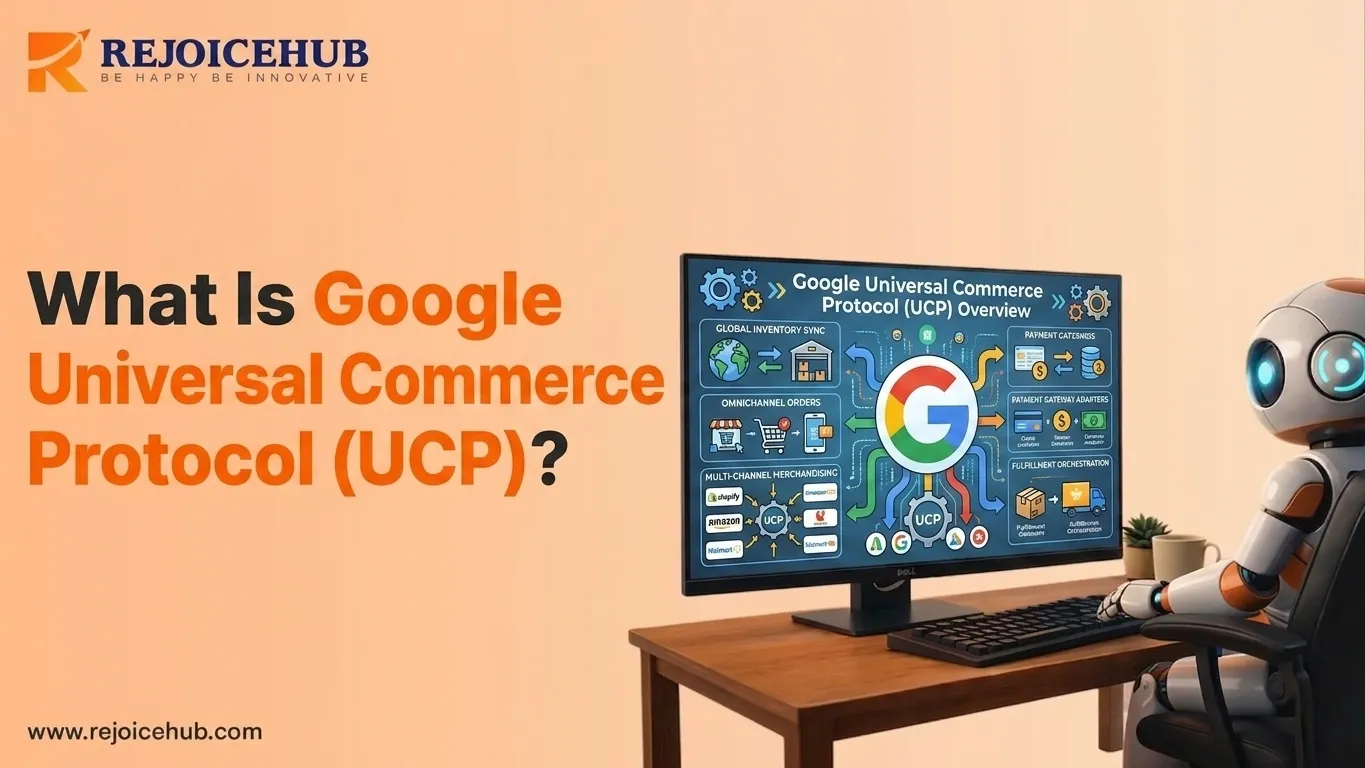
What Is Google Universal Commerce Protocol (UCP)?
Google Universal Commerce Protocol (UCP) is a standardized AI commerce protocol that defines how AI agents communicate with merchant systems to discover products, retrieve real-time pricing, check availability, and execute purchases all autonomously, without manual human interaction at each step.
In simpler terms, UCP is the common language AI agents use to shop the internet for you.
The word "protocol" here means a set of rules and standards similar to how HTTP defines how web browsers communicate with servers. UCP does the same for AI-driven commerce. It creates a universal interface layer so that any AI agent (Google Gemini, a custom shopping bot, an enterprise AI buyer) can talk directly to any merchant system without custom integrations for every single platform.
UCP sits at the heart of Google's vision for an AI commerce ecosystem where:
- Buyers don't search they describe their needs to an AI agent
- Agents fetch, compare, and purchase across multiple merchants simultaneously
- Merchants receive structured, high-intent commerce traffic
- The entire transaction loop is automated and intelligent
UCP functions as the primary foundational element that establishes the basis for the I-Commerce Protocol 2026 to create a new standard that will transform the complete process of online transactions.
How Google UCP Works in AI Shopping
The process of AI shopping through Google UCP requires tracking the user path from initial intent until the final purchase. The flow diagram shows all essential elements which make up the system.
Step-by-Step Flow: From Query to Purchase
Step 1 User States Intent: A shopper tells Google's AI (or another UCP-compatible agent): "Find me a wireless noise-cancelling headphone under $200 with same-day delivery in Austin."
Step 2 AI Agent Activates: The AI agent parses this intent and begins querying connected merchant systems through the UCP layer. It knows exactly what data to request: product specs, current pricing, real-time inventory, and delivery windows.
Step 3 UCP Fetches Structured Data: Using UCP-defined API calls, the agent simultaneously queries multiple merchant systems. It retrieves product data, compares prices across retailers, verifies stock, and checks delivery eligibility all in real time.
Step 4 Agent Evaluates and Selects: The AI agent applies the user's preferences and filters the best match. No human scrolling through page 3 of search results. The agent does the cognitive work.
Step 5 Purchase Executes: With user authorization (or pre-set buying rules), the agent completes the purchase applying coupons, selecting shipping, and confirming the order. The entire checkout flow is autonomous.
Key Technical Components of UCP
- Standardized APIs: UCP defines a common API schema that merchants implement once, making their catalog accessible to any compliant AI agent
- Structured Product Data: Products must be described in UCP-compatible formats: schema.org markup, real-time inventory feeds, and machine-readable pricing
- AI Agent Interface: The agent layer (powered by models like Gemini) interprets user intent and translates it into UCP-compliant data requests
- Merchant Systems Integration: Existing eCommerce platforms (Shopify, Magento, WooCommerce, custom stacks) connect to the UCP layer via adapters or native support
- Transaction Execution Layer: UCP includes mechanisms for secure, authorized purchase completion directly via agent commands
Why UCP Changes AI Shopping in 2026
-
From Search to Action
People conduct traditional searches in a passive manner. A user searches, reads, considers, and eventually acts usually after multiple sessions and comparison visits. The average B2C purchase journey involves 6+ touchpoints.
UCP transforms the entire consumer journey into one complete interactive moment. The AI system performs two functions: it discovers solutions and proceeds to implement them. The transition from "search-assisted commerce" to agentic commerce represents the main development.
-
Autonomous Purchasing at Scale
UCP establishes new standards for business buyers who conduct B2B procurement activities. The AI agent automatically restocks office supplies which it maintains through continuous inventory monitoring, while performing real-time vendor comparisons to choose the most cost-effective option, which it uses to complete the purchase order process without needing any purchase order email.
Consumers receive a shopping assistant that understands their buying preferences while it tracks product prices to make purchases at the most advantageous times.
-
Deep, Real-Time Personalization
UCP uses agent-level operations to access complete user history, user preferences, and current user situation data. Through UCP, AI agents can evaluate customer requirements by using budget information, brand preferences, delivery time needs, previous customer behavior, and existing stock levels.
In 2026, Google AI shopping functions as an independent shopping system instead of operating as a traditional search engine.
UCP vs. Traditional eCommerce APIs
Key Differences at a Glance
| Feature | Traditional eCommerce API | Google UCP |
|---|---|---|
| Integration style | Manual, siloed, platform-specific | Standardized, AI-native protocol |
| Agent compatibility | Not designed for AI agents | Built specifically for AI agents |
| Checkout flow | Manual user-driven checkout | Autonomous agent-executed purchase |
| Real-time data | Often static or cached | Dynamic, live product & pricing data |
| Personalization | Limited, rule-based | AI-driven, contextual & predictive |
| Developer effort | High custom per platform | Low single unified protocol |
| Commerce intent | Informational + transactional | Action-first, purchase-ready |
UCP vs. MCP and ACP
It's worth briefly addressing how UCP sits alongside other emerging AI protocols:
-
MCP (Model Context Protocol): Developed by Anthropic, MCP standardizes how AI models access external tools and data sources. It's a general-purpose context protocol. UCP is commerce-specific and transaction-focused.
-
ACP (Agent Communication Protocol): ACP governs how AI agents communicate with each other in multi-agent systems. UCP governs how agents communicate with merchant commerce infrastructure.
The two protocols work together in actual implementation. The advanced 2026 agentic commerce system will utilize three components, which include MCP for contextual information, ACP for managing multiple agent activities, and UCP for connecting to merchant systems to handle purchasing operations.
UCP = commerce execution. MCP = context. ACP = agent coordination. Together, they form the backbone of modern agentic AI systems.
Benefits of Google UCP for eCommerce Platforms
For businesses that operate online, UCP becomes essential because it serves as their fundamental system, which distinguishes between merchants who have implemented AI solutions and those who remain unprepared. The following information describes the actual functions that Google UCP provides to eCommerce platforms.
1. Faster, Simpler Integrations
Today, every AI shopping platform requires unique custom integrations for businesses to achieve integration. UCP changes that.
The implementation of UCP establishes automatic access for all compliant AI agents after its initial setup. The integration process becomes simpler because merchants with expansive product lines experience reduced operational costs.
2. Better Product Discovery
AI agents using UCP don't browse they query with precision. The product appears when the intent of a user matches the product, which occurs only when the user searches with specific keywords. The system provides improved discovery results because it produces better outcomes while generating less irrelevant content and attracting more customers who intend to make purchases.
3. AI-Driven Conversions
The process includes built-in conversion when an AI agent makes a product selection and completes an automatic purchase. The process begins when customers add items to their carts, and it continues until they leave the site without completing their purchase. Learning how to use AI in your eCommerce business is now a direct competitive advantage and UCP is the infrastructure that makes it possible at scale.
4. Reduced Friction Across the Funnel
UCP eliminates three conversion obstacles, which include slow page loading time, complicated checkout processes, and product pages that provide unclear information. The data layer operation of the agent system makes all other aspects irrelevant. The presence of clean, structured data enables agents to conduct commerce without facing any obstacles.
5. Competitive Differentiation Right Now
UCP adoption is still early. AI systems will choose merchants who adopt UCP before it becomes essential for all businesses. The first businesses to enter the market will gain access to agent-controlled traffic because their rivals are still improving their meta tags.
How Businesses Can Prepare for Google UCP
This location serves as the point where strategic planning transforms into practical implementation. The process of UCP preparation requires multiple tasks because organizations need to establish complete operational readiness through their data systems and AI integration capabilities.
Step 1: Audit and Optimize Structured Data
UCP relies on machine-readable product information. Ensure your catalog uses schema.org markup correctly including Product, Offer, AggregateRating, and Availability schemas. Every field an AI agent needs must be structured and accurate.
- Implement JSON-LD schema markup across all product pages
- Validate using Google's Rich Results Test
- Ensure real-time inventory feeds are accurate and accessible
- Maintain consistent, clean product taxonomy
Step 2: Modernize Your Product APIs
Your backend needs to support dynamic, real-time data queries. Legacy systems that return static data won't cut it in an agentic commerce world. Move toward:
- RESTful or GraphQL APIs with real-time data
- Headless commerce architecture
- API-first product catalog management
- Webhook support for inventory and pricing events
Step 3: Integrate AI Agent Infrastructure
The next challenge for developers involves creating new AI systems that can connect with existing digital infrastructures. The project requires three main components, which include deploying agents for UCP-compatible system interfaces, testing agent-driven purchase flows, and developing oversight mechanisms to control autonomous transactions.
Understanding how AI agents can automate your workflows is a critical first step before building UCP-ready infrastructure. RejoiceHub specializes in AI agent development and automation. Whether you need structured data architecture, API modernization, or end-to-end AI agent integration for UCP readiness, our team builds it. Start at rejoicehub.com.
Step 4: Train Your Team on Agentic Commerce Strategy
UCP alters the approach to marketing, merchandising, and sales operations. The system should be designed to understand agent objectives rather than human search patterns. Your content, pricing method, and product distribution approach must demonstrate artificial intelligence decision-making processes, which extend beyond human psychological understanding.
The Future of Agentic Commerce with UCP
The current period represents the initial phase of a significant transformation that will affect all aspects of society. The present business landscape of agentic commerce shows its development through the progression of UCP.
-
AI Agents Become Buyers
AI agents will handle complete online shopping processes in major product categories, which include electronics, B2B procurement, consumer staples, and travel, between 2027 and 2028. The agent is the new customer. Merchants who see AI agents as the future of business automation will achieve remarkable market growth in agentic commerce.
-
Google Ecosystem Dominance
Google UCP establishes an attractive force that draws users to its AI commerce ecosystem, which includes Search AI Mode, Gemini assistants, Google Pay, and Google Shopping.
Merchants who follow UCP standards receive better visibility on Google's shopping platforms. This system functions similarly to today's Google algorithm, which favors structured data but has greater importance because the agent purchases items instead of making recommendations.
-
Commerce Automation at Every Scale
UCP provides commerce automation solutions which Kubernetes operators can use to serve both Shopify merchants and Fortune 500 procurement teams. Small businesses can compete with enterprise players if their data and APIs are UCP-compliant. Enterprise buyers can achieve full procurement automation through their entire purchasing process.
The winners in agentic commerce will not be determined by company size but by their ability to integrate artificial intelligence technology.
The future of e-commerce will not depend on increased webpage visits. The future of e-commerce will use intelligent agents to make optimal purchasing decisions for humans who receive greater assistance from artificial intelligence technology.
Conclusion
Google Universal Commerce Protocol exists as an active technology because developers work on it currently, which provides businesses that understand its functions today a competitive advantage for future operations.
The following information constitutes our absolute knowledge base:
- AI has become the main method for discovering products that people previously found through traditional search methods.
- Agentic commerce, which involves AI-powered purchasing agents that operate autonomously for users, has entered the stage of actual development.
- UCP serves as the essential protocol that enables all operational processes to function at large-scale capacity.
- Google AI commerce ecosystem grants early UCP adopters special advantages through its exclusive access rights.
Frequently Asked Questions
1. What is Google Universal Commerce Protocol (UCP)?
Google Universal Commerce Protocol, or UCP, is a standard set of rules that lets AI agents talk directly to online stores. It helps AI find products, check prices, confirm availability, and complete purchases all on your behalf, without you manually doing anything.
2. How does Google UCP work in AI shopping?
When you tell an AI what you want to buy, UCP kicks in behind the scenes. The AI sends requests to multiple merchant systems at once, pulls live product and price data, picks the best match for your needs, and completes the purchase — all within seconds, without you clicking through pages.
3. What makes Google UCP different from regular eCommerce APIs?
Regular eCommerce APIs need a custom setup for every platform and are built for human users. Google UCP is built specifically for AI agents. It uses one unified standard that any merchant can plug into, making it far faster to set up and much better at handling real-time, automated purchases.
4. What is agentic commerce, and how does Google UCP support it?
Agentic commerce means AI agents shop and buy for you without needing your input at every step. Google UCP is the backbone of this; it gives AI agents a common language to talk to any online store, check live data, and finish transactions quickly, making truly autonomous shopping possible.
5. How does Google UCP change online shopping in 2026?
In 2026, instead of searching and clicking yourself, an AI agent handles your entire shopping process. Google UCP makes this work by connecting AI agents to merchant systems in real time. You describe what you want, and the agent finds, compares, and buys it all on its own.
6. How can eCommerce businesses prepare for Google UCP?
Start by making sure your product pages use proper schema.org markup so AI agents can read your data. Then update your backend APIs to return live, real-time product and pricing info. Businesses that get their data structured and AI-ready early will have a big advantage when UCP becomes the norm.
7. Is Google UCP the same as MCP or ACP?
No, these are three different protocols that work together. Google UCP handles buying from merchant systems. MCP, made by Anthropic, gives AI models the context they need. ACP manages how multiple AI agents talk to each other. In a full AI shopping system, all three work side by side.