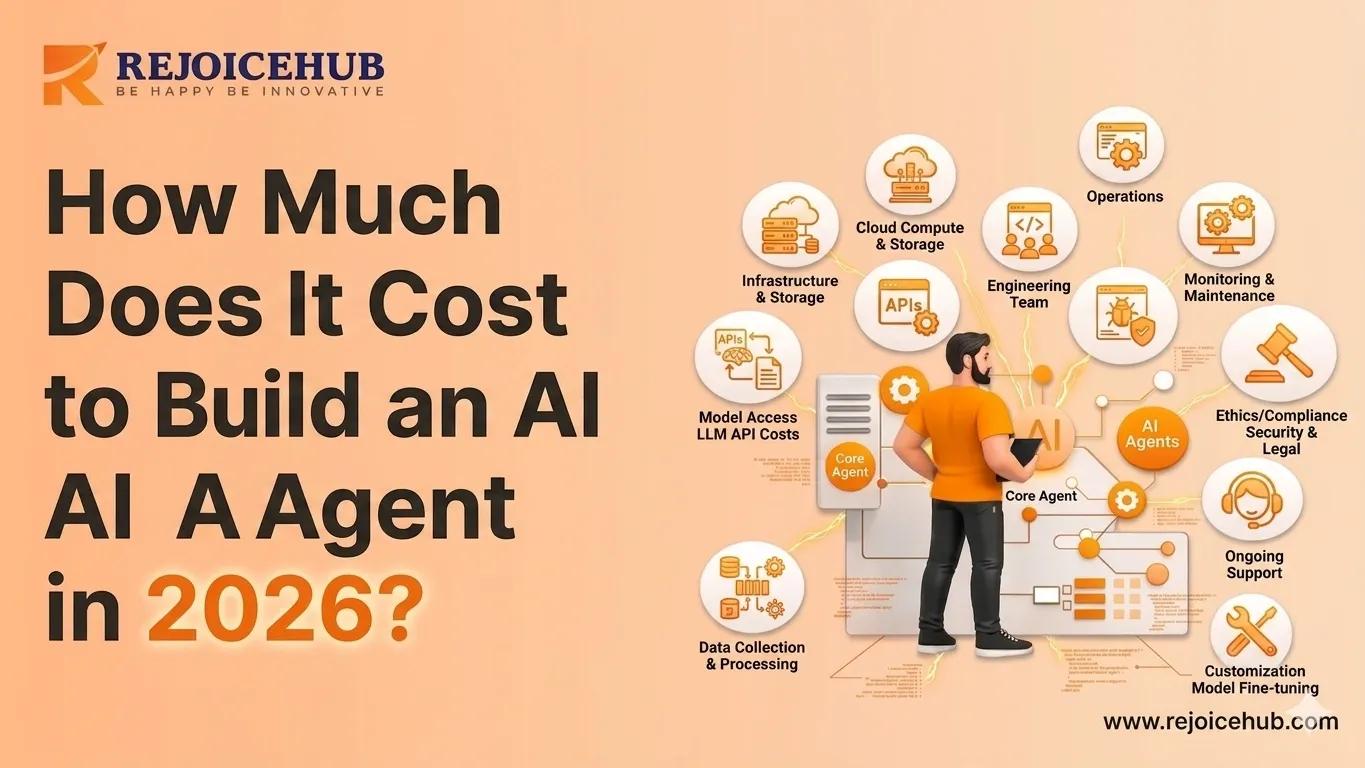
The current discussion about AI agents has become a major topic among people. The headline "Build your own AI agent for $10/month using an API," which you found on the internet, does not provide accurate information about the cost of running your business operations. If you're evaluating whether to invest in AI agents for business automation, understanding the full financial picture is the first step toward making a smart decision.
All expenses for AI agents extend beyond their API costs, which organizations must pay in 2026. The total expenses become apparent when you include engineering, hardware, and infrastructure costs, maintenance expenses, and hidden failure costs.
This guide provides you with an authentic and complete explanation of production-grade AI agent development costs, along with the factors that determine ROI, which will help you make an informed investment choice.
How Much Does It Cost to Build an AI Agent in 2026?
Quick answer: The cost to build an AI agent in 2026 ranges from $5,000 for simple automation to $300,000+ for enterprise-grade systems.
| Agent Type | Use Case Examples | Cost Range |
|---|---|---|
| Simple AI Agent | FAQ bot, lead qualifier, email responder | $5,000 – $20,000 |
| Mid-Level AI Agent | Multi-step workflows, CRM integration, data analysis | $20,000 – $80,000 |
| Enterprise AI Agent | Custom LLMs, compliance-heavy, multi-system orchestration | $80,000 – $300,000+ |
The ranges display extreme fluctuations because different factors, such as system complexity, industrial requirements, and production system readiness, need to be evaluated. The following information explains the reasons behind the value of each number.
Complete AI Agent Cost Breakdown
Building an AI agent consists of a variety of costs that are interconnected. Below are listed the costs that go into building a production model.
1. Compute & LLM/API Costs (10–20% of total)
This is the cost most people think about first, and ironically, it's usually the smallest piece.
- GPT-4o API: ~$0.005 per 1K output tokens
- Claude Sonnet: ~$0.003 per 1K output tokens
- Gemini 1.5 Pro: competitive pricing for high-volume use
For a typical mid-sized business agent running 50,000 requests/month, monthly LLM costs often land between $200–$800. The entire financial plan depends on all other expenses, which serve as the actual financial burden.
2. Engineering & Development (Largest Cost: 40–60%)
The actual distribution of your budget can be found in this location. Building a production AI agent requires more than just prompting because it needs actual software engineering work.
- Prompt engineering and testing
- Agent orchestration (LangChain, CrewAI, AutoGen, or custom)
- Tool/function calling logic
- Memory and context management
- Error handling and fallback flows
In the US, senior AI engineers bill around $150 to $300 per hour. For a lower-level developer, labor costs could range anywhere from 200 to 400 hours. Understanding what agentic AI workflows actually involve can help you scope this engineering effort more accurately before committing to a budget.
3. Infrastructure & Hosting (10–15%)
AI agents need a home, and that home costs money to run reliably.
- Cloud hosting (AWS, GCP, Azure): $300–$3,000/month depending on scale
- Vector databases (Pinecone, Weaviate, pgvector): $100–$500/month
- Queue systems, storage, logging, and monitoring tools
For enterprises needing 99.9% uptime with redundancy, infrastructure costs scale fast. This is also a key component of the broader AI agent infrastructure market that has matured significantly heading into 2026.
4. Integration Costs (10–20%)
The standalone AI agent provides restricted benefits because it cannot communicate with your current systems. The process of connecting different systems increases both technological difficulties and financial expenses.
- CRM (Salesforce, HubSpot): API configuration and data mapping
- Internal databases: Secure query layers and schema understanding
- Communication tools (Slack, email, Zendesk): Webhook and event handling
- Industry-specific platforms: EHR systems in healthcare, ERPs in manufacturing
Each integration is not just plug-and-play. There are validations, errors, and security reviews. Businesses exploring how AI agents can automate workflows often underestimate these integration costs until they're deep into the build process.
5. Maintenance & Ongoing Updates (15–25% annually)
Here's what no one tells you upfront: AI agents need constant care.
- Model updates when providers release new versions
- Prompt drift when outputs degrade over time without any changes
- New business rules, product updates, or compliance changes
- Retraining or fine-tuning if using custom models
Expect to budget 15–25% of your build cost annually for maintenance. This is often completely overlooked in initial planning.
Hidden Costs Most Businesses Ignore
This is the section that most probably your vendors would not want to expose to you. The hidden cost could range from 20–40% of your actual operating AI revenue.
1. Prompt Failures & Retry Logic
AI agents require multiple attempts to achieve their correct solution. The system generates errors that need to be solved through retry mechanisms, creating additional API requests and increasing development work.
The absence of proper guardrails leads to 5–15% failure rates during production. One practical way to reduce this cost is through prompt caching for LLMs, which can meaningfully lower the number of redundant API calls your agent makes. The system accumulates multiple retries at a rapid pace.
2. Data Cleaning & Preparation
Your AI agent achieves its best performance only when it operates with high-quality data. Your internal data requires extensive cleanup work because it contains inconsistent formats, duplicate records, and missing fields before you can use it for deployment.
For enterprise clients, data prep alone can cost $10,000–$50,000+, especially in regulated industries.
3. Monitoring & Debugging
You need to know when your agent fails and why. That means building or buying observability tooling.
- LLM observability platforms (LangSmith, Helicone, Langfuse): $100–$500/month
- Custom dashboards for business stakeholders
- Alert systems for anomalous behavior
4. Security & Compliance
This is especially critical in healthcare, fintech, legal, and HR use cases. Compliance isn't optional, and it's expensive to bolt on after the fact.
- HIPAA, SOC 2, GDPR compliance reviews
- Data encryption at rest and in transit
- Access controls and audit logging
- Penetration testing and vulnerability assessments
Organizations that choose to avoid immediate payments for these expenses will need to spend three to five times more money when they attempt to address the problems after their compliance inspection or security breach.
RejoiceHub Tip: Always ask any vendor for a full cost-of-ownership estimate not just the build cost. The total picture is what determines real ROI.
AI Agent Cost vs. ROI for Businesses
Now for the part decision-makers care about most: is this worth it?
| Metric | Human Team | AI Agent |
|---|---|---|
| Avg. cost per task (support inquiry) | $8 – $15 | $0.01 – $0.05 |
| Available hours | 40 hrs/week | 168 hrs/week (24/7) |
| Scalability | Linear (hire more) | Near-instant |
| Error rate (with training) | 5–10% | 2–5% (with guardrails) |
| Ramp-up time | 2–4 weeks | Days after build |
Real-World ROI Example
A medium-sized SaaS company handling 10,000 customer support tickets per month.
| Cost Item | Without AI Agent | With AI Agent |
|---|---|---|
| Monthly support cost | $40,000 (5 agents) | $6,000 (1 agent + AI) |
| Tickets resolved in < 2 min | 12% | 68% |
| Customer satisfaction score | 3.6 / 5 | 4.2 / 5 |
| Annual savings | — | $408,000 |
Build cost of $45,000 → ROI achieved in under 6 weeks.
For a deeper look at real-world applications, exploring use cases of AI agents in business can help you identify which scenario most closely matches your own operations.
What Affects AI Agent Development Cost?
1. Complexity & Number of Capabilities
The basic operations of a single-task agent that handles FAQ questions demonstrate greater simplicity than the functioning of a multi-agent system that needs to use multiple tools while accessing current information and forwarding cases to human operators. The engineering time required for each additional function to be built into a system will double its previous engineering time requirements.
2. Customization vs. Off-the-Shelf
You can start your project by using Intercom AI or Drift as your base and then modify it to create a unique solution. Weighing a custom vs. off-the-shelf AI software approach is one of the first strategic decisions that will significantly shape your total cost. Custom projects require higher expenses, but they provide greater control over outcomes, while platforms enable quicker deployment at the cost of flexibility and ongoing licensing fees.
3. Industry-Specific Requirements
- Healthcare: HIPAA compliance, EHR integrations, clinical validation adds $20K–$60K
- Fintech: Real-time fraud logic, regulatory reporting, PCI-DSS adds $15K–$40K
- Legal: Document understanding, citation accuracy, privilege rules add $10K–$30K
- E-commerce: Inventory APIs, personalization, returns logic, relatively lower add-ons
4. Data Availability & Quality
The process of training your agent will proceed at a quicker pace when you possess organized, clean data. The process of establishing your initial system requires extensive preliminary tasks and financial expenses when you deal with unstructured documents.
How to Reduce AI Agent Costs Without Compromising Quality
Companies can achieve positive returns on investment without spending two hundred thousand dollars. The following methods show how intelligent businesses maintain expense control.
-
Start with an MVP
Define the single highest-impact use case. Build that first. Prove ROI. Then expand. A focused $15K MVP often delivers faster value than a sprawling $100K platform.
-
Use Hybrid Models Strategically
Not every task needs GPT-4o. Route simple queries to cheaper models (GPT-4o-mini, Claude Haiku) and reserve expensive models for complex reasoning. This alone can cut LLM costs by 60–70%.
-
Invest in Prompt Engineering Early
Good prompts reduce failures, retries, and output post-processing. A senior prompt engineer spending 20 hours upfront can save hundreds of hours of debugging later.
-
Work with Specialists, Not Generalists
A generalist dev agency learning AI on your dime will cost you twice in time and in rebuild costs. Working with a specialized AI agent development team means faster builds, fewer mistakes, and better architecture decisions from day one.
RejoiceHub specializes in production AI agent development for US businesses. From scoping to deployment, we help you build right the first time without burning budget on avoidable mistakes. Visit rejoicehub.com to get a free estimate for your project.
Conclusion
Most people still think "AI is cheap" because they only look at token pricing. The real expenses required to create a successful AI agent will exceed API costs well into 2026. The biggest expense comes from engineering talent, system integration, testing, workflows, and long-term operational support.
Engineering and development work consume 40 to 60 percent of total project expenses, while maintenance activities and ongoing updates account for 15 to 25 percent of costs each year. If you're planning to build a production AI agent, RejoiceHub can help you estimate, build, and scale efficiently. Our team has helped US startups and enterprises go from concept to production without the surprise costs.
Frequently Asked Questions
1. How much does it cost to build an AI agent in 2026?
The cost to build an AI agent in 2026 ranges from $5,000 for a simple bot to $300,000+ for enterprise-level systems. The final number depends on how complex the agent is, what it connects to, and whether you need compliance features like HIPAA or SOC 2.
2. What is the biggest cost when building an AI agent?
Engineering and development take up 40–60% of the total budget. Writing prompts, setting up workflows, handling errors, and connecting tools all take serious time. API costs are actually a small part, usually just 10–20% of what you'll spend overall.
3. Are there hidden costs in AI agent development?
Yes, and they add up fast. Data cleaning, retry logic for failed outputs, security reviews, and monitoring tools can quietly add 20–40% to your operating costs. Most vendors won't bring these up unless you ask for a full cost-of-ownership breakdown upfront.
4. What does enterprise AI agent development cost?
Enterprise AI agents typically cost between $80,000 and $300,000+. These systems need custom model setups, multi-system connections, strict compliance checks, and round-the-clock reliability. Industries like healthcare and fintech can add another $15,000–$60,000 just for regulatory requirements.
5. How do businesses calculate ROI from AI agents?
Look at what you spend on human tasks today versus what the agent would cost per task. One real example: a SaaS company saved $408,000 per year on customer support after spending $45,000 to build an agent and hit full ROI in under six weeks.
6. Can I reduce AI agent development costs without losing quality?
Yes. Start with one high-impact use case instead of building everything at once. Use cheaper models for simple tasks and save powerful ones for complex work. Good prompt engineering early on also cuts down failures and saves debugging hours later in production.
7. How much does ongoing AI agent maintenance cost per year?
Plan to spend 15–25% of your original build cost every year on maintenance. This covers model updates, fixing prompt drift, adapting to new business rules, and keeping everything running smoothly. Skipping this budget is one of the most common mistakes businesses make.