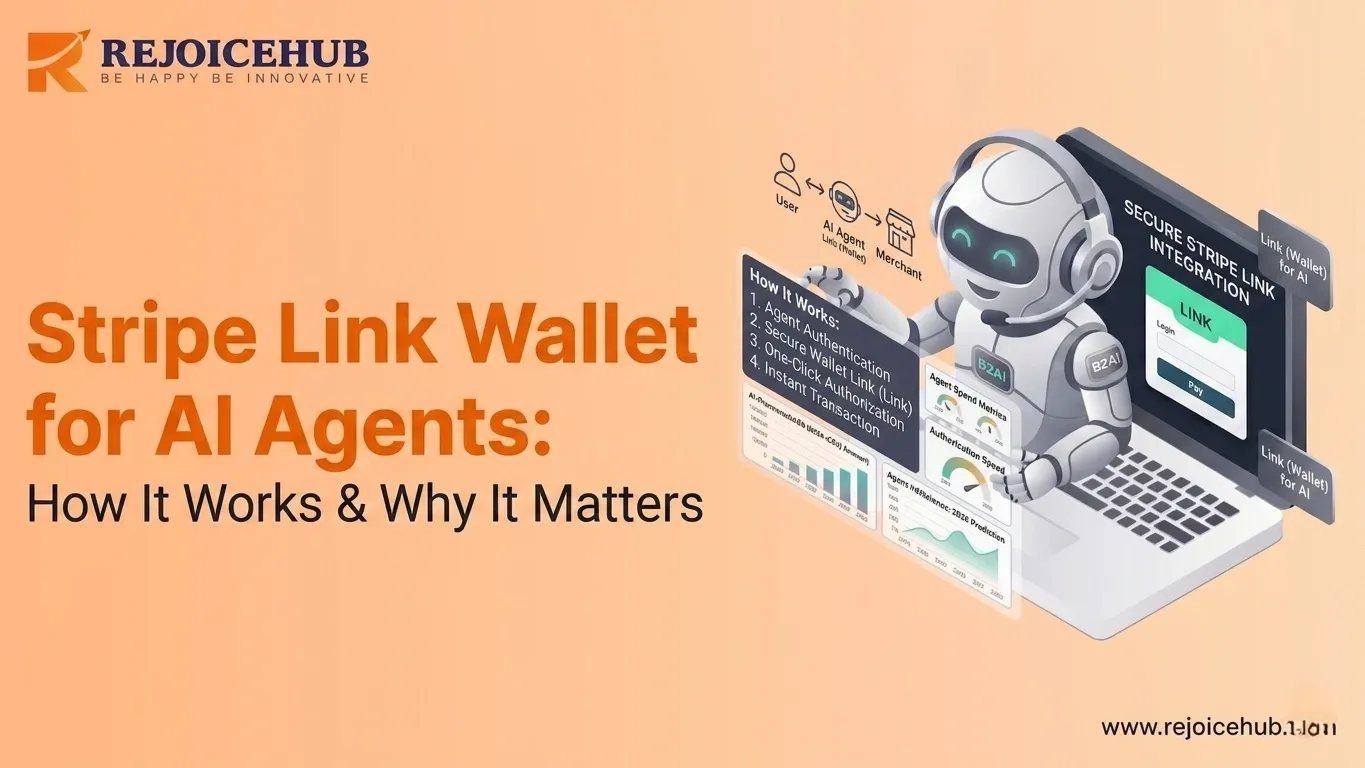
The existence of AI agents today shows that they have entered the realm of reality instead of staying within the boundaries of science fiction. AI systems handle all aspects of business operations through their ability to book meetings, process customer inquiries, manage order fulfillment, and execute business processes without requiring any human intervention. The issue persists because organizations have not established proper methods to handle payment processing operations.
The AI agent needs to control all aspects of purchase transactions because the system reaches 100 percent operational capacity only when it handles all payment needs. The introduction of Stripe Link Wallet for AI agents brings a revolutionary change that improves all aspects of payment processing.
This guide will explain how Stripe Link Wallet functions as well as its importance for AI agents and the payment system integration process, together with its commercial impact for your organization throughout 2025 and future years.
What Is Stripe Link Wallet and How It Works
Before diving into AI agent use cases, let's get clear on what Stripe Link actually is. The system provides different payment options, which allow users to make transactions through various methods.
What Is Stripe Link?
Stripe Link functions as Stripe's system for storing customer payment information. When a customer checks out using Stripe Link for the first time, their payment details card number, billing address, bank account are encrypted and stored securely in the Link network.
Link identifies customers through their email or phone contact information during their next checkout at any business that uses Stripe. Customers only need to click once to complete their purchase because they will not have to re-enter their card information.
Featured Snippet Answer: Stripe Link Wallet is a saved-payment identity system built on Stripe's infrastructure. It stores users' payment details securely across the Stripe network, enabling one-click checkout on any Stripe-powered platform without re-entering card information.
How Stripe Link Stores Payment Details
Stripe Link uses tokenization to store payment data. Here's what that means in practice:
- Card details are never stored in plain text they're converted into encrypted tokens
- Tokens are tied to the user's email or phone, not just one device or platform
- Link works across all Stripe merchants not just the one where details were first saved
- PCI-compliant storage means businesses don't handle raw card data at all
One-Click Checkout Mechanism
Here's how the one-click checkout flow works when Link is enabled:
- User enters their email at checkout
- Stripe checks if the email is linked to a saved payment identity
- If yes, Link sends a quick verification (email or SMS OTP)
- User confirms payment details auto-populate
- Purchase completes in seconds
All these stages (1–4) can be automated via Stripe's API for completely autonomous operations.
Why AI Agents Need a Payment Layer
Agentic AI technology has become one of the major transformations that currently reshape business technology. However, people who discuss agentic AI workflows fail to address an essential issue that arises when agents require payment for items.
The Rise of Autonomous AI Agents
In 2025, AI agents are called upon to carry out tasks that used to demand human cognitive skills:
- E-commerce agents that restock inventory when levels drop below a threshold
- Travel agents who book flights, hotels, and car rentals based on trip briefs
- SaaS agents that subscribe to tools or renew licenses automatically
- Sales agents who purchase leads, run ad budgets, or book meeting rooms
These agents do not just need to act they need to do transactions. For this, they will require a payment layer that is integrated within their workflows.
The Problem with Manual Checkout
The system requires human users for its traditional checkout processes. The system uses specific security measures including CAPTCHAs, OTPs, multi-step forms, and fraud detection triggers to identify users who do not resemble humans.
An AI agent encounters difficulties when it attempts to navigate standard checkout pages because the system only permits human users to make purchases. This creates a critical gap in any AI-powered workflow.
What the AI Automation Payments System Must Deliver
For AI agents to effectively operate in transactional capacities, the underlying AI automation payments system must be configured as the supporting foundation:
| Requirement | What It Means for AI Agents |
|---|---|
| Instant | No waiting for manual approval or human confirmation |
| Secure | Tokenized, PCI-compliant, and fraud-resistant |
| API-Driven | Fully programmable no UI interaction needed |
| Scalable | Handles thousands of transactions across many agents |
| Authorized | User-delegated permissions so agents can spend on behalf |
Stripe Link meets all required standards through its integration with Stripe's payment API. This solution has become the preferred option for teams that develop payment systems that use AI agents.
How Stripe Link Wallet Works for AI Agents
We will demonstrate the actual checkout process of an AI agent through a Stripe payment system. You need to learn this process first before starting your development work.
-
AI Agent Checkout Flow
Here is how an AI initiates and completes a purchase with the help of Stripe Link:
- AI agent identifies a required purchase (e.g., restocking product inventory)
- The agent calls the Stripe API to create a Payment Intent with the purchase amount and currency
- Stripe API triggers the payment process, referencing the saved Link payment method
- The user's stored Link identity is retrieved via tokenized credentials no OTP needed for pre-authorized flows
- Stripe processes the payment and returns a confirmation object to the agent
- Agent logs the transaction, updates records, and continues its workflow
The entire process transpires in a matter of seconds, with no need for an actual human click.
-
Tokenized Payment Process
The key to making this work without human intervention is tokenization. Here's the technical reality:
-
When a user authorizes an AI agent to transact on their behalf, their payment method is saved as a customer object in Stripe
-
Stripe generates a reusable Payment Method ID linked to that customer
-
The AI agent uses that Payment Method ID in every subsequent API call no card details, no PAN, no raw data
-
Stripe handles all the security, compliance, and fraud detection behind the scenes
-
User Authentication via Link
The initial setup requires user authentication but only once. Here's the setup flow:
- User visits your app or authorizes your AI agent platform
- They complete a Link-enabled checkout to save their payment details
- Their Customer ID and Payment Method ID are stored securely on your backend
- From this point, the AI agent uses these credentials for all future transactions no re-authentication needed unless permissions change
This "authorize once, transact many times" model is what makes Stripe Link ideal for AI agent payment workflows.
Stripe AI Agent Payment Integration Guide
Ready to build? Here is a practical Stripe AI agent payment integration guide to help you begin your project. The system establishes fundamental requirements that web applications, AI SaaS platforms, and agent-based systems need to operate.
Prerequisites
- A Stripe account (go to stripe.com to sign up)
- Stripe API keys (publishable + secret) — found in your Stripe Dashboard
- Stripe SDK installed (Node.js, Python, or your preferred language)
- Link enabled in your Stripe Dashboard under Settings > Payment Methods
- A backend server to handle Payment Intent creation securely
Step 1: Install the Stripe SDK
# Node.js
npm install stripe

# Python
pip install stripe
Step 2: Create a Stripe Customer (One-Time Setup per User)
const stripe = require('stripe')(process.env.STRIPE_SECRET_KEY);

const customer = await stripe.customers.create({
  email: '[email protected]',
  name: 'Jane Smith',
  metadata: { agent_id: 'agent_001' }
});

// Store customer.id in your database
console.log(customer.id); // cus_xxxxx
Step 3: Save a Payment Method via Link
// Create a SetupIntent to save the payment method
const setupIntent = await stripe.setupIntents.create({
  customer: 'cus_xxxxx',
  payment_method_types: ['link', 'card'],
  usage: 'off_session', // Critical for AI agent use
});

// Return client_secret to frontend for Link UI
return setupIntent.client_secret;
Step 4: Trigger Payment from the AI Agent (Backend)
// AI agent initiates this call automatically
const paymentIntent = await stripe.paymentIntents.create({
  amount: 4999, // Amount in cents
  currency: 'usd',
  customer: 'cus_xxxxx',
  payment_method: 'pm_xxxxx', // Saved Link payment method
  off_session: true,
  confirm: true,
});

console.log(paymentIntent.status); // 'succeeded'
Step 5: Enable Link in Your Frontend (Initial Setup Only)
// React + Stripe Elements
import { PaymentElement } from '@stripe/react-stripe-js';

<PaymentElement
  options={{
    layout: 'tabs',
    defaultValues: { billingDetails: { email: user.email } }
  }}
/>
// Link will automatically appear as a payment option
Benefits of Using Stripe Link for AI Applications
Here's why businesses building on AI are choosing Stripe payments for AI applications over traditional payment infrastructure:
1. Faster Checkout = Higher Conversion
Stripe's own data shows that Link checkout can significantly improve conversion rates compared to standard flows. Every millisecond and every friction point impacts performance for AI agents running at large-scale operations. Link eliminates both.
2. PCI Compliance Out of the Box
Your application maintains complete distance from card data by using Stripe Link. Stripe handles all compliance tasks, which enables you to concentrate on development work without needing to establish security protocols or manage PCI DSS requirements.
3. Global Scalability
Stripe Link operates in more than 46 countries while enabling transactions in more than 135 currencies. The same integration solution enables your AI agent for business automation to make purchases from both US suppliers and European SaaS vendors.
4. Better UX for AI-Driven Apps
Users authorize once, grant permissions, and the agent handles the rest. The system operates without requiring re-authentication, without requiring manual approval, and without any obstacles to user access.
5. Real-Time Webhooks for Agent Coordination
Your AI agent receives real-time payment events through Stripe's webhook system, which monitors successful payments, failed transactions, dispute resolution, and refund processes without requiring manual oversight.
| Feature | Stripe Link | Traditional Checkout |
|---|---|---|
| Checkout Speed | ~2 seconds | 60–120 seconds |
| PCI Compliance | Handled by Stripe | Your responsibility |
| AI Agent Compatible | Yes | No |
| Global Coverage | 135+ currencies | Varies |
| Recurring Payments | Native support | Custom dev needed |
Real-World Use Cases: AI Agents + Stripe Link in Action
The Stripe Link system for AI agents presents its best advantages here. Competitors require users to complete manual payment procedures, while Stripe provides production-ready support through its API-first system.
1. AI Shopping Assistants
The retail AI agent tracks prices to identify the best available deal, which it uses to make automatic purchases when prices drop under a predetermined limit. The Stripe Link payment system handles the entire transaction process while keeping you asleep and without requiring your payment approval.
Business value: Automate purchasing decisions, reduce procurement costs, and never miss a deal.
2. SaaS Automation Tools
B2B SaaS platforms deploy AI agents that replace traditional SaaS operations, handling tool subscription management, automatic service cancellation, and billing adjustments within their established pre-approved financial boundaries.
Business value: Reduce SaaS spend by up to 30% through automated subscription optimization.
3. Subscription Management Bots
When a card declines, the system automatically attempts to process payments again using a secondary payment method through Link. The system achieves payment recovery while decreasing customer loss rates without requiring any human work.
Business value: Recover 15–25% of failed subscription payments automatically.
4. Travel Booking Agents
Corporate travel AI agents operate in real time to book flights, hotels, and ground transportation, adjusting their schedule when unexpected situations occur.
Business value: Reduce travel booking time from hours to minutes while maintaining spend controls.
5. Procurement & Supply Chain Agents
AI agents automatically reorder materials from inventory stock when product levels fall below established minimum thresholds. The procurement process achieves complete automation through Stripe Link without requiring any human involvement.
Business value: Eliminate stockouts and reduce manual procurement overhead by 40–60%.
Conclusion
The evolution of AI agents has reached a point where they now serve as essential tools for businesses. Companies that successfully utilize these technologies will achieve better performance than their rivals because they will deliver products to market faster while reducing expenses and enhancing customer satisfaction.
AI agents require a payment system that matches their technology capabilities for them to achieve full self-sufficient operation. Understanding how AI agents can automate your workflows is the first step but without a robust payment layer, that automation remains incomplete.
Stripe Link Wallet functions as the essential payment system. It delivers all necessary components which AI-based systems require through its tokenization feature, API capabilities, security measures, and scalability options, while eliminating the impediments which standard checkout systems create.
Frequently Asked Questions
1. What is Stripe Link Wallet, and how does it work for AI agents?
Stripe Link Wallet is a saved-payment system built on Stripe's network. It stores card details as encrypted tokens tied to a user's email. For AI agents, this means payments can be triggered through the API automatically, no manual checkout, no OTP, and no human needed to complete the transaction.
2. Can AI agents make payments without human approval using Stripe?
Yes, once a user authorizes the AI agent and saves their payment method through Stripe Link, the agent can make purchases independently. Using the saved Payment Method ID, the agent calls Stripe's API to complete transactions on its own, making the AI automation payments system fully hands-free.
3. How do I set up Stripe AI agent payment integration?
Start by creating a Stripe Customer object for each user. Then use a SetupIntent with off_session: true to save their payment method via Link. After that, your AI agent can trigger payments anytime using the stored Payment Method ID, no frontend interaction needed for future transactions.
4. What is the AI agent checkout flow using Stripe Link?
The AI agent spots a purchase need, creates a Payment Intent via Stripe's API, references the saved Link payment method, and Stripe processes it all in seconds. There's no form to fill, no CAPTCHA to beat, and no human sitting at a screen. It's a clean, fully automated checkout flow.
5. Is Stripe Link safe for AI-driven payment automation?
Absolutely. Stripe Link uses tokenization, meaning no raw card data ever touches your system. It's PCI-compliant by default, and Stripe handles fraud detection in the background. This makes Stripe payments for AI applications both secure and easy to manage without building custom security layers.
6. What are real business use cases for AI agent payments with Stripe?
AI agents can restock inventory, manage SaaS subscriptions, book travel, recover failed payments, and run procurement all using Stripe Link. Each use case benefits from the "authorize once, pay many times" model, cutting manual effort and helping businesses save time and reduce operational costs significantly.
7. Does Stripe Link work globally for AI agent transactions?
Yes. Stripe Link supports payments in over 135 currencies across 46+ countries. So whether your AI agent is purchasing from a US supplier or renewing a European SaaS tool, the same Stripe AI agent payment integration handles it all without needing separate regional setups or payment gateways.