Think about the last time you bought something online. You opened a browser, typed a few words into a search bar, scrolled through dozens of options, read reviews, compared prices, and finally maybe clicked "Buy Now." Depending on your certainty about making a decision, the entire procedure required between ten minutes and one hour to complete.
People can now imagine a world where they need to perform no additional tasks. The development of agentic commerce will create a system that enables users to shop through online platforms which will operate automatically. Most people remain unaware that online shopping has started to transition into automatic systems which major technology companies now operate. To understand the foundation behind this shift, it helps to first explore what agentic AI really is and how it works.
People seek a different method of shopping because they no longer wish to conduct manual product searches. Shoppers need to find an intelligent solution because they face two challenges through which they must navigate endless product choices and multiple tabs until they reach decision exhaustion. Shoppers search for results which provide them with a personal experience that enables fast access to results.
The article provides complete information about agentic commerce through the description of its operational process and the identification of its developers and its business applications for your company.
What Is Agentic Commerce?
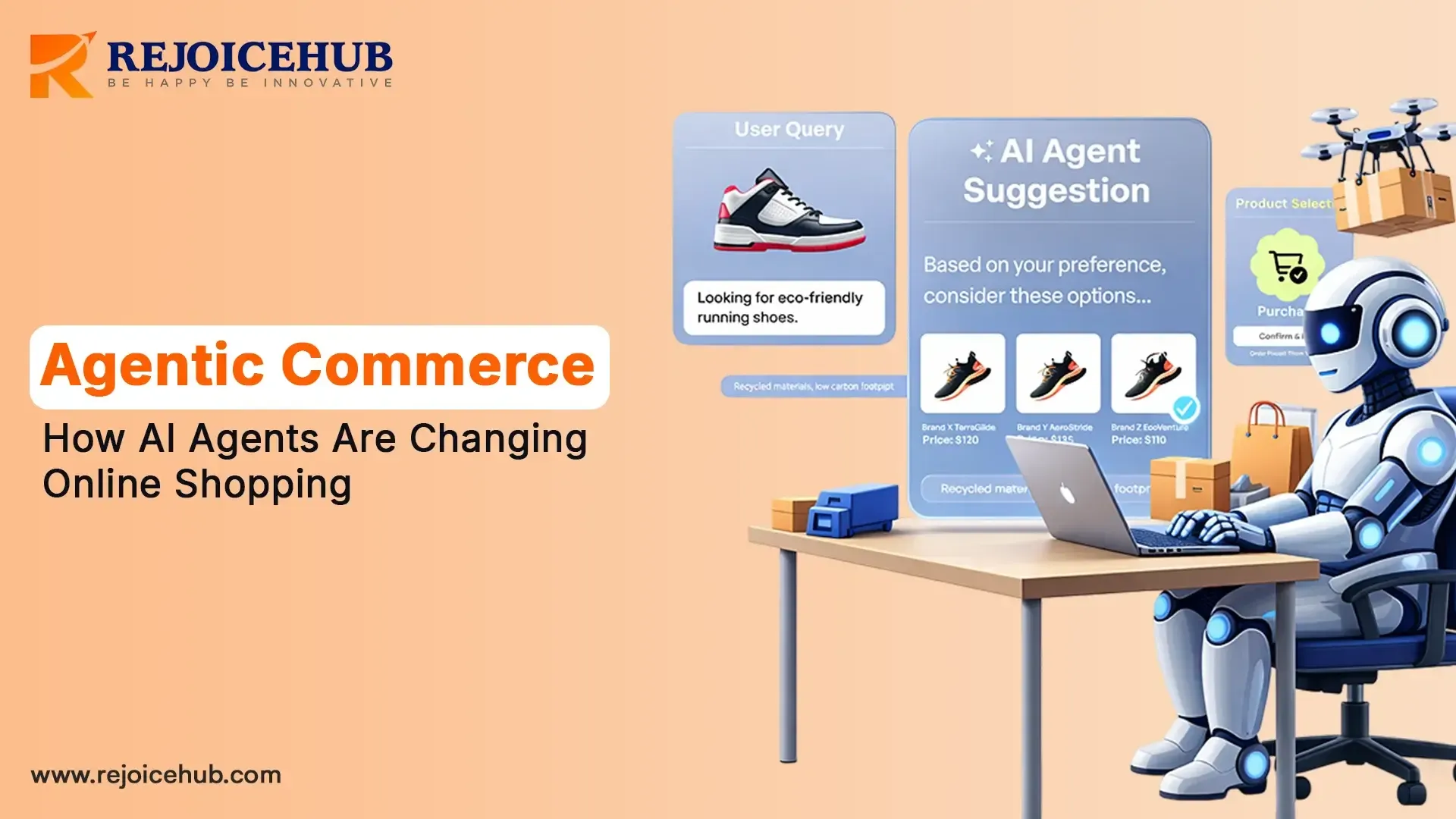
Agentic commerce operates as an AI-powered retail system that uses autonomous AI agents to browse products and evaluate them and complete purchases for users by handling all aspects of shopping which includes product discovery and price assessment and payment processing. The agents operate autonomously while they utilize current information and user-specific preferences to make intelligent purchasing choices.
The distinction between this technology and standard AI automation remains unclear to you. The question you raised serves as an excellent inquiry. People already use basic AI automation systems to shop because they exist in most online shopping platforms. The system operates like auto-fill which remembers your address or the Amazon platform which shows related products through its "You might also like" feature. Reactive AI systems operate through user input which triggers their response mechanisms.
Agentic AI operates as a distinct entity which functions through its active operational mode. The system executes all purchasing activities because it proactively monitors your buying patterns without needing your input to start a search. Intelligent shopping agents represent the fundamental technology which enables agentic commerce to function correctly.
The intelligent shopping agent will automatically purchase coffee for you when it detects your low supply based on your previous purchases because it will search multiple stores to find the lowest price and use your loyalty points to complete the transaction. The process you describe reaches beyond automation because it enables people to exercise control over their situation.
How Agentic Commerce Works in Online Shopping
To this end, let us decompose the three critical layers that bind agentic commerce's working in the real world.
-
AI Shopping Agents: The Decision-Makers
The AI shopping agent serves as the primary component of this system. The virtual assistant which operates through your devices acts as a highly intelligent personal shopper who understands your buying patterns better than you can.
The agents operate through their capacity to make independent choices. The agents execute their tasks without needing your consent for their complete process. The agent will conduct product filtering and comparison and make purchases according to your preference for sustainable products which cost less than your specified limit without needing to contact you at each stage.
The agents become distinct from each other through their capacity to create unique user experiences. The system does not send random results because the system uses specific user data which the user has previously collected. Understanding the different types of AI agents helps clarify how each one is designed to serve different purposes within these systems.
-
Data and Behavior Analysis: The Brain Behind the Decisions
The entire process depends on obtaining accurate information. Agentic AI commerce depends on user preference analysis which requires information from various sources including browsing history and purchase patterns and social signals and contextual data which includes location information and seasonal patterns.
Predictive buying serves as the solution to this requirement.
The system anticipates your needs before you become aware of them. The system understands that you place printer ink orders every three months and that you buy new shoes during autumn and that you choose free shipping instead of express delivery. The agent uses these established patterns to create its operational decision-making process.
The result? A shopping experience that feels less like browsing a store and more like having someone who genuinely knows your tastes do the shopping for you. This is made possible by agentic AI workflows that continuously learn and act on behavioral data.
-
Transaction Automation: The Final Step
The agent must complete the purchase after it reaches its final decision. The system uses automated transaction processes which represent the system's most thrilling feature.
Mastercard became the first major financial institution to enter this market space. Their AI-powered payment systems operate through agent-based commerce because they enable complete payment processing without human interaction at checkout.
The checkout process represents the main obstacle which users face during online shopping. Customers will complete their purchases because they no longer need to fill out lengthy forms. The agent operates everything from its hidden position while maintaining smooth operations throughout the process.
Key Players Reshaping Agentic Commerce
The current transformation process operates as an independent event. The largest companies in technology and finance markets are developing the infrastructure needed to create agentic commerce systems.
-
OpenAI and the Agent Communication Protocol (ACP)
The research work which OpenAI has conducted extends beyond its chatbot development efforts. The Agent Communication Protocol work which they developed serves as a core component for constructing agentic commerce systems.
The ACP system functions as a universal communication framework that enables AI agents to exchange information across multiple platforms and services. The system functions as a shared language which enables your shopping agent to communicate with a store inventory system and a logistics API and a payment processor at the same time.
The development of autonomous AI systems which can function across multiple environments depends on this particular type of system interoperability. A deeper look into LLM agents reveals how these large language models power the intelligence behind such cross-platform communication.
-
Google and the Unified Commerce Protocol (UCP)
The unified commerce ecosystem which Google builds functions through their Unified Commerce Protocol (UCP) which connects merchants with payment systems and logistics providers and consumer-facing AI agents into one unified system.
The vision here is big. UCP creates a standardized layer which allows AI agents to interact with every retailer and platform in the system because current e-commerce systems require different checkout processes for every store.
The store requires agent accessibility because businesses need this feature to reach customers who use AI for their entire shopping experience. This connects directly to how AI is being used in retail stores to create smarter, more integrated customer journeys.
-
Mastercard: Reinventing How Payments Happen
Mastercard conducts essential work within this industry through its ongoing research operations. The company develops secure payment systems which AI systems can activate through their complete identification and fraud protection and instantaneous payment processing capabilities that require no human intervention for card number entry.
The three companies OpenAI, Google, and Mastercard work together to develop a new type of business infrastructure which functions as an operational backbone. The system undergoes a fundamental transformation through this development which extends beyond a simple product modification.
Benefits of Agentic Commerce for Businesses
Let's get practical. If you run an online business, here's why agentic commerce should be on your radar right now.
-
Increased conversions: When an AI agent is doing the shopping on behalf of a user, it's not browsing for fun — it's buying. The intent is already there. If your store is agent-friendly and your product data is clean and accessible, you're far more likely to capture that sale.
-
Hyper-personalization: Traditional ecommerce personalization shows you "similar products" based on a few clicks. Agentic AI personalization goes much deeper it builds a complete picture of the buyer's preferences and only presents what is genuinely relevant. When shoppers see exactly what they want, they buy.
-
Reduced cart abandonment: Studies consistently show that roughly 70% of online shopping carts are abandoned before checkout. The reasons are usually mundane complicated forms, unexpected fees, the need to create an account. Agentic commerce sidesteps all of this. The agent completes the transaction without the friction that causes abandonment.
-
Faster decision-making: Consumers today are overwhelmed with options. Agents cut through the noise and act quickly, compressing the sales cycle significantly. A decision that might have taken three days of comparison shopping can happen in seconds. Exploring use cases of AI agents in business shows just how wide this impact already reaches across industries.
Agentic Commerce vs Traditional eCommerce
It helps to see this side by side. Here's a direct comparison of how traditional ecommerce and agentic commerce differ across the key stages of the buying journey.
| Aspect | Traditional eCommerce | Agentic Commerce |
|---|---|---|
| Discovery | Manual search by the user | AI agent proactively finds products |
| Browsing | User scrolls through results | Agent filters by learned preferences |
| Recommendations | Algorithm-based suggestions | AI-driven, context-aware choices |
| Decision-making | User compares manually | Agent evaluates and decides autonomously |
| Checkout | User fills forms, enters payment | Agent completes transaction automatically |
| Personalization | Based on cookies and clicks | Deep behavioral and preference modelling |
| Cart Abandonment | High friction at checkout | Near zero agent completes the loop |
| Speed | Minutes to hours | Seconds to minutes |
Looking at that table, it's clear this isn't an incremental upgrade. It's a fundamentally different model for how commerce works.
Challenges and Risks of Agentic AI Commerce
Mastercard conducts essential work within this industry through its ongoing research operations. The company develops secure payment systems which AI systems can activate through their complete identification and fraud protection and instantaneous payment processing capabilities that require no human intervention for card number entry.
The three companies OpenAI, Google, and Mastercard work together to develop a new type of business infrastructure which functions as an operational backbone. The system undergoes a fundamental transformation through this development which extends beyond a simple product modification. Businesses preparing for this shift should also study how AI is transforming business operations overall to understand both the risks and the strategic opportunities ahead.
The Future of Agentic Commerce
The current situation shows that we have just started to observe this transformation. The current path of development shows first signs of progress whereas its growth rate is now increasing. The most extreme shopping experience that requires no user input operates as the main showcase for this development path. In a zero-click world, you don't search, browse, or choose you simply receive. Your agent identifies your requirements which he will manage without your involvement. The system appears to be science fiction yet its fundamental components already exist.
People will eventually adopt AI agents as their main tool for completing tasks. Users currently need to install the Amazon app for Amazon shopping and the Zara app for Zara shopping. You will have one personal shopping agent who manages your connections with all stores in the agentic future. The app layer becomes invisible.
People now use both voice recognition technology and autonomous shopping systems. Your AI voice agent will conduct research and select products while handling their purchase and delivery when you say "I need a birthday gift for my mother under fifty dollars." The future exists closer to present reality than most people believe.
Conclusion
Let's bring it all together. Agentic commerce is not a trend you can afford to ignore. People now use online stores to search for products and make purchasing decisions which creates a new shopping experience. The shift is being driven by some of the most powerful companies in the world OpenAI, Google, and Mastercard and it's backed by real consumer demand for a faster, smarter, less effortful shopping experience.
For businesses, the message is simple: the stores that optimize for intelligent shopping agents now will be the ones capturing the next generation of buyers. Those who delay will discover they have become unseen to an increasing number of customers who use AI-based shopping assistance. Understanding the benefits of AI for business is the first step toward building a strategy that keeps you ahead of this curve.
The early adoption advantage in agentic commerce is real. The infrastructure is being built right now. The platforms are being standardized. The agents become more intelligent every month.
The businesses that move now will define the rules. The ones that wait will play by them.
Looking to implement AI-driven commerce? RejoiceHub provides intelligent shopping system solutions which suit your business needs through agent-ready product feeds and automated checkout experiences. Contact us today to begin developing your future requirements.
Frequently Asked Questions
1. What is agentic commerce?
Agentic commerce is a system where AI agents handle the entire online shopping process for you, from finding products and comparing prices to completing the purchase without you needing to click through pages or fill out forms manually.
2. How is agentic commerce different from regular online shopping?
In regular online shopping, you search, scroll, and decide everything yourself. With agentic AI commerce, a smart AI agent does all of that for you. It learns your preferences, finds the best options, and buys what you need automatically.
3. What are intelligent shopping agents?
Intelligent shopping agents are AI-powered tools that act like personal shoppers. They study your buying habits, understand your preferences, and make purchase decisions on your behalf without needing your approval at every single step.
4. How does agentic commerce work in online shopping?
Agentic commerce works in three main steps: an AI agent studies your preferences and past behavior, searches for the best matching products across stores, then completes the checkout automatically, no forms, no waiting, no decision fatigue.
5. Which companies are building agentic commerce right now?
OpenAI, Google, and Mastercard are the main players. OpenAI is building the Agent Communication Protocol, Google is developing a Unified Commerce Protocol, and Mastercard is creating secure payment systems that AI agents can use without human input.
6. What are the biggest benefits of agentic commerce for businesses?
Businesses get higher conversions, fewer abandoned carts, faster sales cycles, and deeper personalization. Since AI agents shop with clear intent rather than casual browsing, stores that are agent-ready are more likely to capture sales quickly.
7. Does agentic commerce reduce cart abandonment?
Yes, significantly. Around 70% of carts get abandoned mainly because of long checkout forms and friction. Since agentic AI commerce handles the entire transaction automatically, most of that friction simply disappears, and purchases get completed.
8. Is agentic commerce safe for payments?
Mastercard and other major companies are specifically building secure, fraud-protected payment systems for agentic commerce. These systems allow AI agents to process payments safely with full identification checks and real-time fraud protection built in.
9. What is the Agent Communication Protocol by OpenAI?
It is a shared communication framework that lets AI agents talk to different platforms like store inventory systems, payment processors, and logistics APIs at the same time. It is what makes cross-platform agentic commerce actually possible.
10. What is Google's Unified Commerce Protocol?
Google's Unified Commerce Protocol (UCP) is a standardized layer that connects merchants, payment systems, logistics providers, and AI shopping agents into one system. It lets agents interact with any retailer without needing a separate integration for each store.
11. Will agentic commerce replace traditional e-commerce?
Not replace, but seriously reshape. Traditional eCommerce still exists, but agentic commerce adds a faster, hands-free layer on top. Businesses that do not optimize for AI shopping agents risk becoming invisible to a growing group of AI-assisted buyers.
12. How can a business prepare for agentic commerce?
Start by cleaning up your product data, making your store agent-accessible, and reducing checkout friction. Businesses that build agent-ready product feeds and automated checkout experiences now will have a strong head start over competitors who wait.
13. What does a zero-click shopping experience mean in agentic commerce?
Zero-click shopping means you do not search, browse, or choose anything manually. Your AI agent figures out what you need, finds the right product, and completes the purchase entirely on its own. You simply receive what you need.