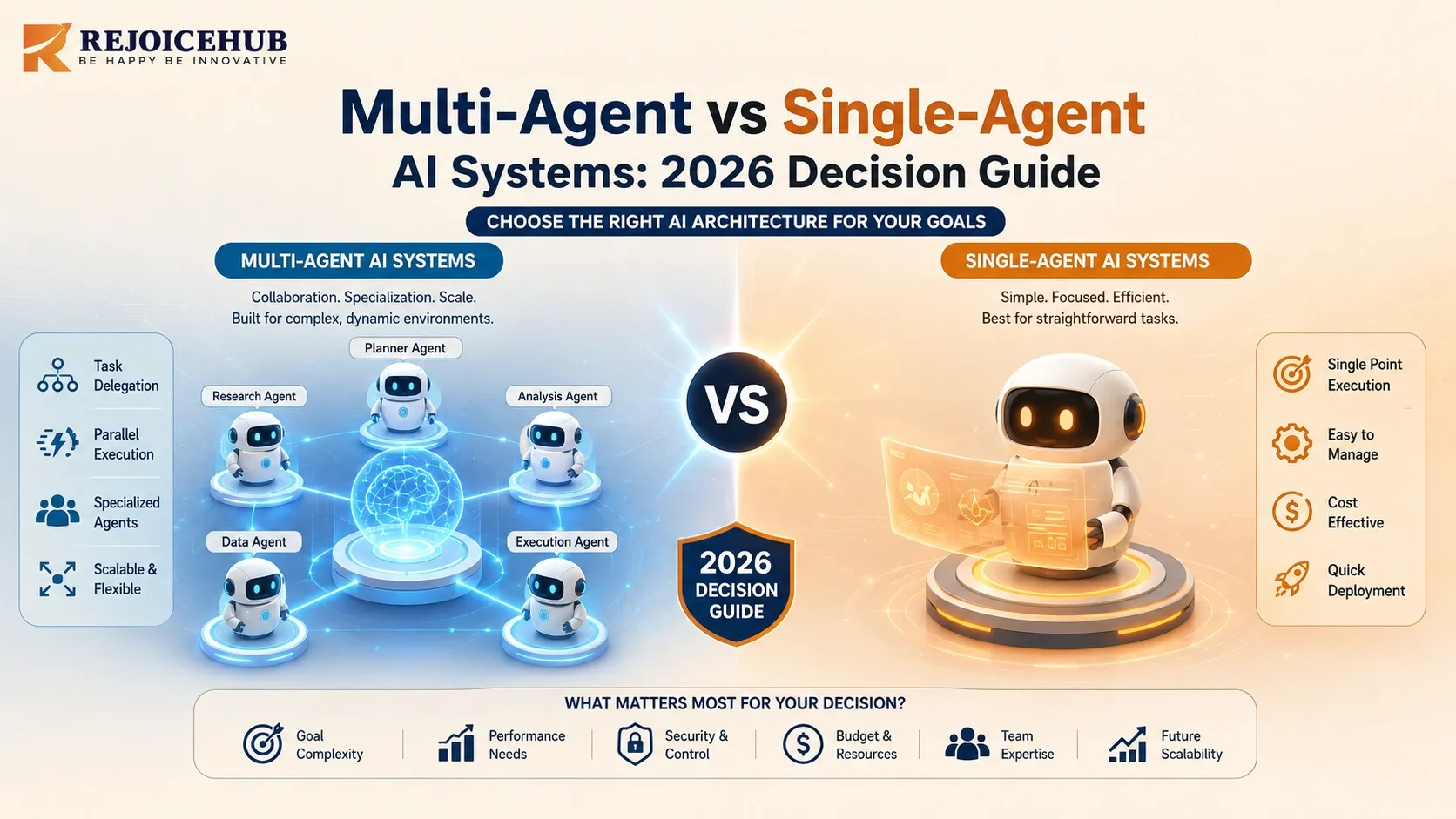
If you are building an ai powered product or automating a business process in 2026, you have almost certainly encountered the choice between a single agent and multiple agents.
the single vs multi agent dilemma dictates your technical architecture, determines your cloud costs, and drives your time-to-market. in short, adding agents provides diminishing returns in almost all use cases.
This guide explains the five factors that must be evaluated when choosing between a single and multiple-agent system.
you will learn what determines the viability of either approach in your use case, and why blindly pursuing multi-agent solutions will almost certainly lead you astray
Single Agent vs Multi-Agent AI: What's the Difference?
A single-agent AI system is designed in a way that allows it to perform tasks using only one reasoning loop. It involves planning, tool calling, and response creation in a single run.
On the other hand, a multi-agent AI system breaks down the tasks into smaller ones and employs different specialized agents that carry out the functions and exchange information through an orchestration layer.
What is a Single-Agent AI System?
A single-agent system is exactly what it sounds like: one AI agent owns the entire workflow.
-
One agent controls the workflow, no handoffs, no routing logic
-
One reasoning loop, the agent plans, acts, and evaluates within a single context
-
Tool calling happens directly from that one agent
-
Memory and context stay in one place, reducing sync overhead
-
Execution is linear and easy to trace
Example flow: User → Single AI Agent → Tools → Result
This is the architecture behind most support bots, internal Q&A assistants, and document summarizers you'll find in production today.
What is a Multi-Agent AI System?
A multi-agent system distributes work across multiple agents, each with a narrower job description.
-
Multiple specialized agents: e.g., a researcher, a planner, an executor
-
Different responsibilities per agent, often mapped to a specific skill or domain
-
Agent-to-agent communication, either direct or brokered
-
Shared or passed context between agents (a frequent source of bugs if not designed carefully)
-
An orchestration layer that sequences, routes, or parallelizes agent work
Example flow: User → Planner → Researcher → Executor → Reviewer → Result
If you want a deeper technical breakdown of how orchestration layers work, our guide on AI agent orchestration covers the routing patterns behind multi-agent systems.
Featured Snippet Answer What is the difference between single-agent and multi-agent AI?
A single-agent AI is a system that uses only one model and one reasoning process to perform a task from beginning to end, whereas a multi-agent AI divides the task into smaller parts and uses various specialized agents that work together through an orchestration layer to accomplish the task and create a combined solution.
Single Agent vs Multi-Agent Architecture Compared
Single-agent architecture is more cost-effective, faster, and simpler in its focus, whereas the multi-agent architecture offers specialization, parallelism, and the ability to perform more complex workflows that span multiple domains.
| Factor | Single-Agent | Multi-Agent |
|---|---|---|
| Architecture | One agent | Multiple agents |
| Complexity | Low | High |
| Cost | Usually lower | Usually higher |
| Latency | Usually lower | Can be higher |
| Specialization | Limited | High |
| Parallel execution | Limited | Strong |
| Debugging | Easier | More difficult |
| Scalability | Good for focused workflows | Better for complex workflows |
| Coordination | Minimal | Required |
| Best for | Simple workflows | Complex workflows |
Accelerate Your Workflows with Custom AI
Book a free consultation session with RejoiceHub. We'll map out a tailored automation roadmap for your company.
-
Cost and Token Usage
Every added agent on a workflow is another model call, another context window, and in many cases, another set of results from a tool getting stuffed back into a prompt somewhere. In a multi-agent system, context is very often doubled up across agents, resulting in an inflated token count far beyond what actually needs to be processed.
This is one of the most common budget surprises teams run into. Our breakdown of AI agent token budgets and cost optimization walks through how to model this before you commit to an architecture.
-
Latency and Performance
Sequential agent handoffs - planner to researcher to executor to reviewer - introduce latency at every step, as each agent waits for the previous to complete. Parallel execution can mitigate this by doing truly parallel work (e.g. having three research agents work independently on different sources), but that requires careful design; it won't happen by default.
-
Reliability and Debugging
More agents imply more surfaces for things to go wrong. A single-agent system has only one possible point of failure, which is relatively simple to reason about. A multi-agent system can fail during handoffs between agents, within shared context, or inside any individual agent - and finding the source of the problem requires appropriate observability machinery.
Common mistakes teams make here:
-
Skipping structured logging between agent handoffs
-
No evaluation harness to catch regressions after a prompt change
-
Treating agent-to-agent context passing as "free" when it's a real integration point
This production-centric perspective is crucial to the current (2026) discourse on agentic systems, which has shifted towards questions of coordination, latency, costs, and reliability, rather than philosophical definitions. The reliability-driven focus, in particular, makes this report worth reading for any manager who wishes to evaluate the allocation of autonomy between human workers and AI agents (or between multiple AI agents in a multi-agent system).
Key Takeaway: Multi-agent systems aren't inherently "better" they're a trade: you gain specialization and parallelism, and you pay for it in cost, latency risk, and debugging complexity.
Single Agent vs Multi-Agent Examples and Use Cases
Single-agent systems are most successful in relatively narrow domains, such as customer service and document summarization, while multi-agent systems are more appropriate in broader domains, such as software engineering and financial analysis.
1. Single-Agent AI Examples
-
Customer support assistant answers FAQs, pulls order status, escalates when needed
-
Internal knowledge assistant searches company docs and answers employee questions
-
Document summarization condenses reports, contracts, or meeting notes
-
Simple lead qualification scores and routes inbound leads based on a fixed set of criteria
-
Content generation drafts marketing copy, product descriptions, or emails
2. Multi-Agent AI Examples
-
Software development a planner breaks down a feature, a coding agent implements it, a review agent checks the diff
-
Enterprise research multiple agents pull from different sources and a synthesis agent compiles findings
-
Complex customer support a router agent hands off to billing, technical, or account specialists
-
Financial analysis workflows one agent pulls data, another models scenarios, a third flags anomalies (see our guide on AI in financial reconciliation and agentic workflows for a real-world pattern)
-
Multi-step business automation chained agents handle intake, processing, and follow-up across systems
3. Practical Example: One Problem, Two Architectures
Single Agent: Customer query → One agent → Tools → Response
Multi-Agent: Customer query → Router → Support Agent → Billing Agent → Knowledge Agent → Reviewer → Response
The single-agent version provides faster responses and is cheaper for each individual query than the multi-agent one. However, it is less effective in the cases when the user actually asks about multiple topics, including both billing and technical support issues. On the opposite, the multi-agent version effectively solves any query but requires additional efforts, time, and money for maintaining several agents in the system.
When Should You Use Single-Agent, Multi-Agent, or Hybrid AI?
Choose single-agent AI for straightforward, sequential tasks where cost and speed matter most. Choose multi-agent AI when tasks need specialized expertise, independent verification, or parallel work across domains. Choose a hybrid model when you need the reliability of deterministic workflows alongside the flexibility of specialized agents.
1. Choose Single-Agent AI When:
-
The workflow is straightforward
-
Tasks are mostly sequential
-
Few tools are required
-
Low latency matters (e.g., real-time chat)
-
Cost needs to stay controlled
-
One agent can reliably complete the task end-to-end
2. Choose Multi-Agent AI When:
-
Tasks require specialized expertise per step
-
Multiple agents can work independently
-
Parallel execution is genuinely valuable
-
The workflow spans different domains (e.g., legal + finance + ops)
-
Independent verification improves output quality
-
Complexity exceeds what one agent can reliably manage
3. Choose Hybrid AI When:
A hybrid design combines a central orchestrator, specialized agents, and deterministic workflows using AI where judgment is needed and fixed logic where consistency matters more than flexibility.
This is a meaningful distinction, because current architecture discussions increasingly treat hybrid designs as a third option, not just a compromise between single and multi-agent. If you're weighing how much of a workflow should stay deterministic, our explainer on deterministic AI is a useful companion read, alongside our guide on what a multi-agent system actually is under the hood.
Key Takeaway: Hybrid architecture isn't a compromise it's often the most production-ready option, pairing agent flexibility with the predictability of fixed workflows where it counts.
Single Agent vs Multi-Agent LLM: Which Is Better for Your AI Product?
The LLM you choose isn't the only architectural decision; model capability, tool calling, context window, memory design, and orchestration all shape whether single or multi-agent makes sense. Start single-agent, measure its limitations, then add agents only when the workflow demands it.
Before deciding how many agents to run, weigh these factors:
-
Model capability a stronger model can often handle more of a workflow single-handedly
-
Tool calling how many distinct tools does the task actually need?
-
Context window can one agent hold enough context to finish the job accurately?
-
Memory does the workflow need persistent memory across sessions? (See our AI agent memory guide for design patterns)
-
Agent orchestration do you have the infrastructure to route and monitor multiple agents reliably?
-
API costs multi-agent systems multiply model calls; model this before committing
-
Evaluation can you test and score outputs consistently as complexity grows?
-
Security more agents means more surface area; our AI agent security guide covers the risks that scale with agent count
-
Human-in-the-loop requirements does a step need human approval before it executes?
A Quick Decision Rule
Begin with a single agent, and evaluate its limitations (accuracy, tool coverage, or scope) before adding additional agents. The additional agents should be added only for processes that are too specialized or parallelizable for the primary agent.
This keeps your architecture rooted in reality (not overpromising capabilities) and keeps costs predictable during the validation period.
For a full breakdown of what agent projects actually cost to build and run, see our guide on AI agent costs, pricing models, and ROI.
Conclusion
The choice between Single-Agent and Multi-Agent architecture is dictated not by some abstract quest for innovation, but by the concrete need to design a system around one’s specific requirements.
A single agent architecture is optimal for one particular use-case that would benefit from speed, simplicity, and reduced overhead.
A Multi-Agent system, on the other hand, has more flexibility and can be utilized in more varied and complex situations, as well as support multiple simultaneous tasks, through the use of multiple agents.
Finally, in practice, the best approach is often to combine the two, using deterministic algorithms in whatever domain one’s system has to operate in, and leaving the more complex and nuanced tasks to an AI agent.
Frequently Asked Questions
1. What is the main difference between single agent and multi agent in AI?
A single agent handles an entire task within one reasoning loop, while multi-agent systems split the task across several specialized agents coordinated by an orchestration layer. Single-agent setups are simpler and cheaper; multi-agent setups handle more complex, multi-domain workflows but require more infrastructure to run reliably.
2. When should a startup choose single-agent over multi-agent AI?
Startups should default to single-agent AI when the workflow is sequential, uses few tools, and needs low latency and predictable cost. It's also the faster path to an MVP. Multi-agent architecture is worth the added complexity only once a single agent's limitations are clearly documented through real usage.
3. Are multi-agent AI systems always more accurate than single-agent systems?
No. Multi-agent systems can improve accuracy on complex, multi-domain tasks through specialization and review steps, but they also introduce more failure points at agent handoffs. Accuracy depends on workflow design and orchestration quality, not simply on adding more agents.
4. How does single agent vs multi agent architecture affect API costs?
Multi-agent systems typically increase API costs because each agent adds its own model calls, and context is often duplicated as it passes between agents. Single-agent systems usually cost less per task since everything runs through one reasoning loop and one context window.
5. 5. What are common examples of multi-agent AI systems in business?
Common multi-agent examples include software development pipelines (planner, coder, reviewer agents), enterprise research systems, complex customer support with specialized routing, and financial analysis workflows that combine data-pulling, modeling, and anomaly-detection agents.
6. Is a hybrid AI architecture better than single-agent or multi-agent alone?
Hybrid architecture isn't universally "better" — it's a fit for workflows that need both AI flexibility and the predictability of deterministic logic. It combines a central orchestrator, specialized agents, and fixed workflows, which often makes it more production-ready than a strict single-vs-multi choice
7. How do I decide between single agent, multi agent, or hybrid for my AI product?
Start with a single agent, measure where it hits real limitations in accuracy, tool coverage, or workflow scope, and only add agents or hybrid logic when those limitations require specialization, parallel execution, or deterministic reliability that one agent can't deliver on its own.