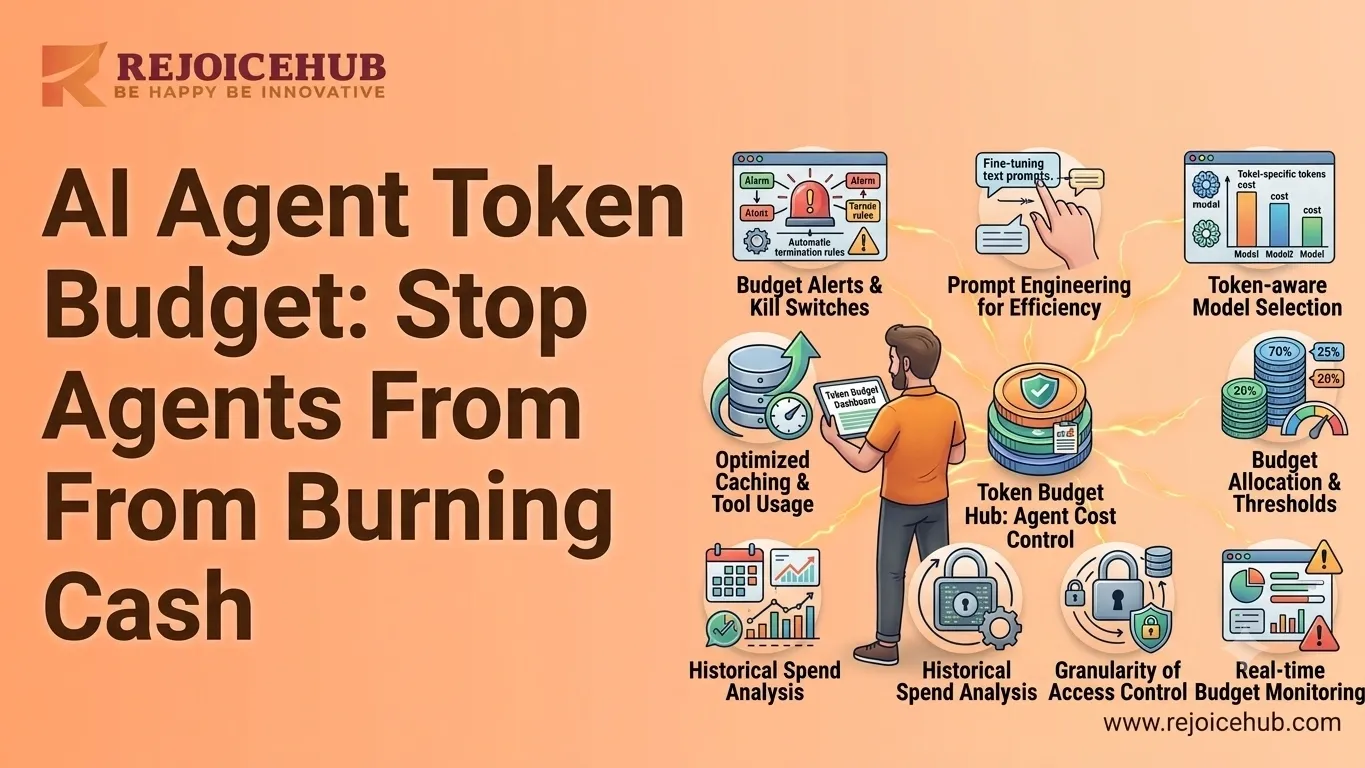
AI agents act quickly. Sometimes, faster than your budget can handle.
An AI agent can formulate a plan, call three different tools, search its memories, second-guess itself, and return a final answer in a matter of seconds. Each of these steps costs money in the form of tokens that must be spent to access an API.
Most teams do not know how much it is costing them until they receive a bill. An AI Agent Token Budget is the practical control panel that keeps token spending in check and helps you rein in large language model costs before they spiral out of control.
In this article, we will explain what a token budget is, why agents spend tokens at such a rapid rate, and how to set limits to avoid spending too much.
What Is an AI Agent Token Budget?
An AI Agent Token Budget is a defined limit or allocation for the number of tokens that an agent, user, or a workflow can spend on a model within a specified period – per query, per session, per day, or per month.
In other words, it's analogous to the amount of data on your phone plan; when your data is almost exhausted, you receive a low-data warning, and when it's depleted, your mobile data gets turned off.
Similarly, a token budget is an allocated number of tokens, and depending on the proximity to the spending limit, you can be notified or even prevented from performing additional operations until the next billing cycle starts.
This budget applies to all stages of execution – the input prompt, model response, plus any tools called and their responses in the case of agents.
How tokens work in Large Language Models
Tokens are the small chunks of text that LLMs read and generate, roughly 4 characters or ¾ of a word in English.
Every interaction with a model involves two token costs:
- Input tokens: your prompt, system instructions, retrieved context, and chat history
- Output tokens: the model's generated response
Both are billed, and providers structure this billing around per-token pricing models that vary depending on the model and provider you choose. A long conversation with a large context window can rack up thousands of tokens before the agent even finishes "thinking."
Why token budgets matter
Without a budget, there is no ceiling. An agent that gets caught in a reasoning loop or repeatedly fetches context is capable of using an unconstrained number of tokens.
A budget enforces deliberate design and causes the team to rethink if they really need all of the context window, and if the agent really needs to call all five tools, or if two of them would have been sufficient. This is the question that typically has the single largest impact on the token budget.
Difference between token limits and token budgets
These two terms get mixed up often, but they're not the same thing.
| Term | What It Controls |
|---|---|
| Token Limit | The maximum tokens a single request can contain (set by the model provider) |
| Token Budget | The maximum tokens your organization allows across users, agents, or time periods (set by you) |
A token limit is a hard technical ceiling from the LLM provider. A Token Budget for AI Agents is a business decision — your own spending guardrail, layered on top. Some providers have even begun formalizing this idea, as seen with task-level budgets built directly into newer models.
Why AI Agents Burn Cash So Quickly
AI agents are not simply tools for answering questions posed to them; they are goal-driven systems that operate by planning, acting, and adapting their plans, each of which comes with an associated cost. This is part of why understanding what LLM agents actually are matters before you try to control their spending.
These are the factors that contribute to the high cost of AI agents:
- Large context windows. Feeding an agent an entire document, database schema, or long chat history multiplies input token costs on every single call.
- Multi-agent workflows. When one agent hands a task to another, and that agent hands it to a third, you're paying for tokens at every handoff.
- Tool calls. Each time an agent queries an API, searches the web, or reads a file, that interaction adds tokens on top of the base conversation.
- Memory retrieval. Agents that pull from long-term memory or vector databases often inject large chunks of retrieved text back into the prompt.
- Recursive reasoning. Agents that "think out loud" through multiple reasoning steps generate extra output tokens for every loop.
- Long conversations. The longer a session runs, the more history gets re-sent with each new turn, since most models aren't stateful.
This is the reality of AI Inference Costs in Autonomous Agents and Multi-Agent Systems — the more autonomy and context you give an agent, the more it costs to run.
| Cause | Cost Impact |
|---|---|
| Large context window | High every call re-sends full context |
| Multi-agent workflows | High tokens billed at every handoff |
| Tool calls | Medium adds tokens per external query |
| Memory retrieval | Medium to High injects retrieved text into prompts |
| Recursive reasoning | Medium extra output tokens per reasoning loop |
| Long conversations | High full history often re-sent each turn |
Best Practices for AI Agent Cost Optimization
Once you understand where the spend comes from, AI Agent Cost Optimization becomes a lot more manageable. Here's where to start.
-
Prompt optimization
Shorter, sharper prompts save tokens on every single call. Cut boilerplate instructions, remove redundant examples, and keep system prompts lean. This ties closely into good context engineering practices, which shape how much information an agent actually needs to see.
-
Context trimming
Don't send the whole conversation history or full documents by default. Summarize older context, chunk large documents, and only retrieve what's relevant to the current step.
-
Token budgeting
Set hard and soft limits per agent, per user, and per task type. This is the core mechanism for AI Resource Allocation across your organization.
-
Caching responses
If multiple users or agents ask similar questions, cache and reuse responses instead of regenerating them from scratch. Techniques like prompt caching can cut repeat-query costs significantly.
-
Model routing
Not every task needs your most expensive model. Route simple tasks (classification, summarization, formatting) to smaller, cheaper models, and reserve premium models for complex reasoning.
-
Setting spending alerts
Real-time alerts, tied into AI Cost Analytics dashboards, catch runaway usage before it becomes a five-figure surprise on your monthly bill.
Together, these practices are how teams reduce LLM API costs without sacrificing agent performance.
How to Implement AI Agent Spending Limits
Knowing the theory is one thing. Putting AI Agent Spending Limits into practice is where the real savings happen.
- Per-user limits: Cap how many tokens an individual user can consume per day or per session, especially for internal tools open to your whole team.
- Per-agent limits: Assign each agent a token allowance based on its role. A simple FAQ agent shouldn't have the same budget as a research agent doing deep, multi-step analysis, and this becomes especially important as teams explore the different types of AI agents they deploy across the business.
- Monthly budgets: Set an organization-wide monthly ceiling tied directly to your AI spend forecast, not an afterthought.
- Department budgets: Give marketing, sales, and support their own allocations so one team's usage spike doesn't eat into another's.
- Auto-shutdown thresholds: Build in automatic pausing or throttling once usage hits a defined percentage of the budget before it fully runs out.
- Dashboard monitoring: Centralize usage tracking so leadership can see spend in real time, not two weeks later on an invoice.
These controls are the pillars of good AI Governance and AI Operations, and they lie at the heart of what's being dubbed AI FinOps the analog of cloud FinOps for managing budgets and spend on AI infrastructure. Getting this right also depends on closing common enterprise infrastructure gaps that often go unnoticed until costs spike.
If you want to build your own custom AI agent, incorporating these controls at the architectural level from the start, RejoiceHub can help you design it.
AI Agent Token Budget Best Practices for Enterprises
For larger organizations running multiple agents across departments, token budgeting needs to be an ongoing discipline, not a one-time setup. Here's what that looks like in practice:
- Monitor token usage weekly: Weekly reviews catch cost creep early, before it compounds into a major overage.
- Audit prompts regularly: Prompts drift over time as teams add "just one more instruction." Regular audits keep them lean.
- Choose the right LLM for each task: Match model capability to task complexity don't default to the most powerful (and expensive) model for every job.
- Limit unnecessary context: Only pass what the agent actually needs to complete the current step, not everything available.
- Track ROI against AI spending: Tie token spend back to business outcomes deals closed, tickets resolved, hours saved — so cost conversations are grounded in value, not just line items, a discipline that fits naturally into a broader AI adoption roadmap.
These habits reflect how experienced teams actually operate AI systems at scale grounded in real usage data, not guesswork. Many of these teams are also weighing the true cost of building an AI agent from scratch versus adopting managed platforms, and factoring in the realistic cost to build an AI agent stack for their organization.
Conclusion
AI agents are proving their worth, but their value is conditional to the extent that they can be afforded. Token budgets are the solution to this challenge.
Small optimizations in context lengths, model routing, and caching contribute to meaningful cost reductions. Meanwhile, organizations that approach the challenge as an AI FinOps problem, with the necessary governance and oversight, reap rich rewards in terms of cost control and scalability the same forces driving broader business automation with AI agents across industries today.
If you're building enterprise AI agents, RejoiceHub helps businesses design cost-efficient AI systems with token management, governance, and performance optimization. Explore our AI Agent Development Services to get started.
Frequently Asked Questions
1. What is an AI Agent Token Budget?
An AI Agent Token Budget is a set limit on how many tokens an agent or team can use in a given time, like per day or per session. It covers prompts, responses, and tool calls, helping you avoid surprise bills from runaway AI usage.
2. Why do AI agents cost more than regular chatbots?
AI agents plan, call tools, check memory, and sometimes talk to other agents before giving an answer. Every one of these steps uses tokens. This is why AI Agent Cost Management matters more for agents than for simple question-answer bots.
3. How is a token limit different from a token budget?
A token limit is set by the AI provider and controls how many tokens fit in one request. A Token Budget for AI Agents is something your team sets on top of that, controlling overall spend across users, agents, and time periods.
4. What are the best ways to reduce LLM API costs?
You can trim unused context, cache repeated answers, route simple tasks to cheaper models, and set spending alerts. These small changes, done together, support real AI Agent Cost Optimization without hurting how well your agents perform their tasks.
5. What is AI FinOps and why does it matter?
AI FinOps is the practice of managing AI spend the way cloud teams manage cloud costs. It brings structure to AI Token Usage through budgets, tracking, and alerts, so leadership always knows where the money is going.
6. How do you set AI Agent Spending Limits?
Start with per-user and per-agent caps based on their role. Add monthly budgets, department-wise splits, and auto-shutdown rules once usage hits a certain point. This layered setup gives you full control over AI agent spending.
7. Why is AI Agent Token Management important for businesses?
Without proper AI Agent Token Management, agents can loop, over-fetch context, or call too many tools, quietly driving up costs. Good management keeps spending predictable, ties usage to real business value, and prevents budget shocks at month-end.