 Every few weeks, a headline speaks about the fall in the value of AI tokens. Businesspersons logically think that if tokens are less expensive, AI agents as well must also be less expensive.
This assumption is not correct and causes companies to lose money.
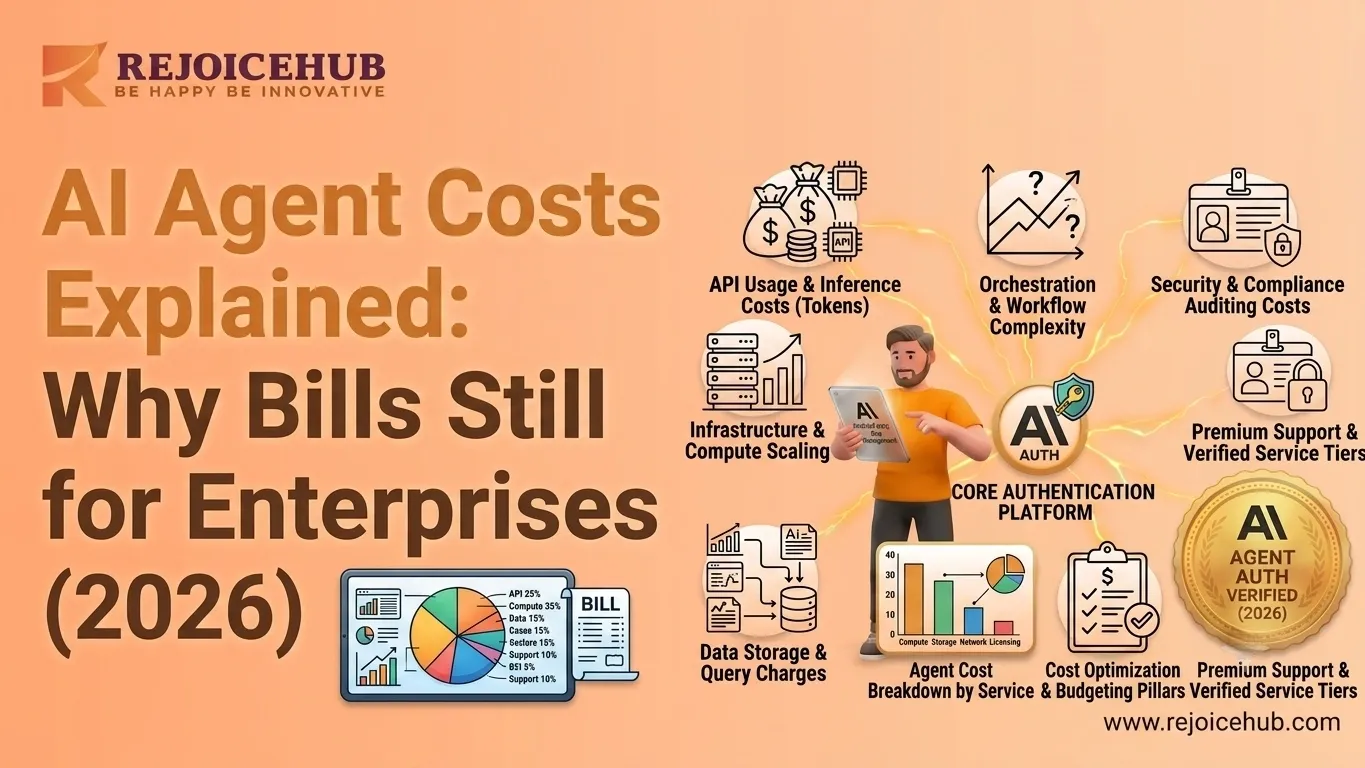
In order to understand the real cost to build an AI agent, it is important to look at much more than the price of a single API call. There is a fact that the price per token has decreased during the last two years; however, the cost of running an AI agent is generally higher than before.
The reason is that the cost of tokens represents just a small fraction of much bigger expenses. In addition to that, companies have to bear expenses related to the creation of all the necessary orchestration logic to tie the agent to its operations, infrastructure ensuring its smooth running, integration with systems already in place in the organization such as CRMs and helpdesks, as well as monitoring systems allowing them to be notified of any failures before customers do.
This article will help you understand the real price behind AI agents, as well as how to minimize it.
What Are AI Agent Costs?
AI agent costs refer to the total financial investment required to build, deploy, and maintain an autonomous or semi-autonomous AI agent, not just the fee charged per API call.
Definition of AI Agent Costs
An AI agent cost includes every expense tied to getting an agent to reliably complete a task: model usage, the infrastructure it runs on, the tools it connects to, and the people who build and monitor it.
AI Agent Pricing Model Explained
Most AI agent pricing models combine several cost drivers rather than a single flat fee:
- Token-based usage cost per input/output token from the LLM provider
- Compute and hosting servers, GPUs, or cloud functions running the agent
- Third-party tools vector databases, search APIs, or automation platforms
- Development time engineering hours to build and customize the agent
- Support and maintenance ongoing updates, bug fixes, and monitoring
These cost drivers are also shaped by the broader AI agent infrastructure market, which continues to evolve as more vendors enter the space.
Token Costs vs. Total Cost of Ownership (TCO)
Featured Snippet Answer: Token cost is the price paid to an AI provider for processing input and output text. Total cost of ownership (TCO) includes token cost plus infrastructure, integrations, development, monitoring, and maintenance, often making TCO 5–10x higher than token spend alone.
In short: token price is the tip of the iceberg. The real expense sits below the surface in:
- API costs
- Infrastructure
- Development
- Maintenance
- Operations
If you're evaluating how much an AI agent costs, understanding per-token pricing alone won't give you an accurate number.
Why Are AI Agents Expensive?
AI agents aren't just chatbots with better marketing. They plan, reason across multiple steps, call external tools, and often operate with minimal human input, and all of that adds cost.
1. Beyond Token Pricing
A single customer request handled by an agent might trigger 5–15 separate model calls: understanding intent, retrieving data, calling a tool, verifying the result, and generating a response. Each step consumes tokens, even if the per-token price is low. Techniques like prompt caching can help reduce some of this repeated overhead.
2. Infrastructure and Cloud Costs
Agents need to run somewhere. That means:
- Cloud computing for hosting the agent logic
- Storage for logs, embeddings, and memory
- Networking and uptime guarantees for production use
Many teams underestimate these needs until they run into real infrastructure gaps at scale.
3. Tool Integrations
Agents are only useful when connected to real systems, such as Slack, Salesforce, Zendesk, internal databases, and more. Each integration requires setup, authentication, error handling, and ongoing upkeep. Getting this right often means designing a proper AI agent stack from the start rather than bolting on tools one by one.
4. Context Windows
Longer context windows let agents "remember" more, but every additional token of context costs money every single time the agent runs, not just once. This is why context engineering has become such an important discipline for teams building production agents.
5. Multi-Step Reasoning
Unlike a chatbot that answers a question and stops, agents often loop: plan → act → check → revise. More reasoning steps mean more compute and more cost per task, which is part of why concepts like task budgets are becoming more common in agent design.
6. Human Oversight
Most production agents still need a human in the loop for edge cases, approvals, or quality checks especially early on. That's a real, ongoing labor cost, even for teams that plan to deploy AI agents without an ML team.
Why this matters: Traditional chatbots answer questions. AI agents complete multi-step tasks autonomously, which means they consume significantly more compute, tool calls, and oversight per interaction. This is the core reason AI agents are expensive compared to simple conversational bots.
Hidden Costs Businesses Often Overlook
Many companies budget for tokens and development, then get blindsided by recurring costs that don't show up until the agent is live.
| Hidden Cost | Why It Matters |
|---|---|
| Vector Databases | Enable long-term memory and retrieval, but scale in cost with data volume |
| Monitoring | Ensures reliability and catches failures before they affect customers |
| Security | Required for compliance, data protection, and safe tool access |
| Orchestration | Manages multi-step workflows and coordination between tools and agents |
| Testing | Validates performance and catches edge cases before deployment |
| Human Review | Maintains quality assurance and builds trust in agent outputs |
| Maintenance | Keeps the agent updated as models, APIs, and business needs change |
If you're planning an AI agent budget, treat this table as a checklist, not an optional add-on list, and map it against your own AI adoption roadmap.
If you're looking to build a custom AI agent for business without the guesswork, RejoiceHub can help you map out every cost category before you commit to a budget.
How Businesses Can Reduce AI Agent Costs
The good news: AI agent costs are highly manageable once you know where the money actually goes. Here's how smart teams keep spending under control.
-
Choose the Right Model
Not every task needs the most powerful (and expensive) model. Use smaller, faster models for simple tasks and reserve premium models for complex reasoning, since different types of AI agents call for different levels of capability.
-
Implement Model Routing
Route requests dynamically; simple queries go to cheaper models, and complex ones go to more capable ones. This alone can cut token spend significantly, and understanding the difference between an AI agent and an AI chatbot can help you decide where routing logic is actually worth the investment.
-
Optimize Prompts
Shorter, well-structured prompts reduce token usage without sacrificing output quality. Remove redundant instructions and unnecessary examples.
-
Cache Frequent Responses
If your agent answers similar questions repeatedly, cache those responses instead of regenerating them every time.
-
Limit Context Size
Only send the context the agent actually needs. Trim conversation history and irrelevant data before each call.
-
Monitor Token Usage
Track usage patterns to spot inefficiencies like agents looping unnecessarily or pulling excessive context.
-
Automate Intelligently
Automate high-volume, repetitive tasks first. Save complex, judgment-heavy tasks for human review or hybrid workflows. Many businesses start by learning how AI agents can help automate workflows before scaling up.
-
Scale Gradually
Start with a narrow use case, prove ROI, then expand. Scaling too fast before testing efficiency often multiplies avoidable costs.
Key principle: Cost optimization should never come at the expense of performance. The goal is efficiency, not corner-cutting.
Measuring AI Automation ROI
Reducing cost is only half the equation. To justify investment, businesses need to measure AI automation ROI clearly, and looking at proven use cases of AI agents in business is a good starting point.
Key Metrics to Track
- Cost savings reduced labor hours, lower support costs
- Productivity gains tasks completed per hour vs. manual process
- Faster response times reduced customer wait times
- Customer satisfaction CSAT or NPS score changes
- Revenue impact upsells, retention, or conversion improvements driven by the agent
Simple ROI Formula
ROI (%) = [(Total Value Gained − Total AI Agent Cost) / Total AI Agent Cost] × 100
Example: A support automation agent costs $4,000/month (tokens + infrastructure + maintenance) and saves the equivalent of $10,000/month in labor and reduced churn.
ROI = [($10,000 − $4,000) / $4,000] × 100 = 150%
That's a strong signal the investment is paying off, but only if the full cost, not just token spend, is included in the calculation.
Conclusion
Lower-priced tokens account for one element in the overall cost, but they do not make up the entire equation.
The cost of implementing AI systems is derived from a variety of different sources, such as the architecture, infrastructure, integration, monitoring, and conventional operations involved. Consequently, when companies concentrate on the pricing of tokens alone, they end up missing out on the true cost of AI implementation due to their inability to take into account the many extra costs that accrue later on in the project.
Rather than relying on tokens, the most productive thing to do would be to consider the cost of ownership as well as the return on investment altogether instead of looking at the tokens in isolation from everything else. Reviewing some of the best AI agents for business automation can also help you benchmark your own investment. This is how one goes about making sure that they have gotten fully equipped with the right tools and assessments that can help them make serious industry advances through the use of affordable AI systems.
Frequently Asked Questions
1. What is included in AI agent costs?
AI agent costs cover more than just token pricing. They include compute, hosting, tool integrations, development time, and ongoing maintenance. Businesses often forget these extra pieces, which is why the final bill ends up much higher than expected.
2. Why are AI agents expensive even when token prices drop?
A single task can trigger many model calls behind the scenes, like understanding intent, pulling data, and checking results. Each call uses tokens. So even with cheaper pricing per token, the total usage adds up fast across multi-step tasks.
3. How does the AI agent pricing model work?
Most pricing models combine several cost drivers together. This includes token usage, cloud hosting, third-party tools like databases, engineering hours for setup, and support for updates and fixes. It's rarely just one flat fee for the whole system.
4. How much does an AI agent cost to run monthly?
Costs vary a lot based on complexity, but a mid-size support agent can cost a few thousand dollars a month once tokens, infrastructure, and maintenance are combined. Simple agents cost less, while advanced multi-step agents cost noticeably more.
5. How can businesses reduce AI agent costs?
Businesses can cut costs by routing simple tasks to cheaper models, trimming unnecessary context, caching repeat answers, and shortening prompts. Starting small and scaling gradually also helps avoid overspending before the agent proves its actual value.
6. What hidden costs do companies often miss with AI agents?
Many teams forget about vector databases, monitoring tools, security setup, and human review during planning. These costs show up after launch and can quietly grow, especially as data volume and usage increase over time.
7. How is AI automation ROI measured?
AI automation ROI is measured by comparing total value gained, like labor savings or faster response times, against the full cost of running the agent. The formula is: ROI = [(Value Gained − Total Cost) / Total Cost] × 100.