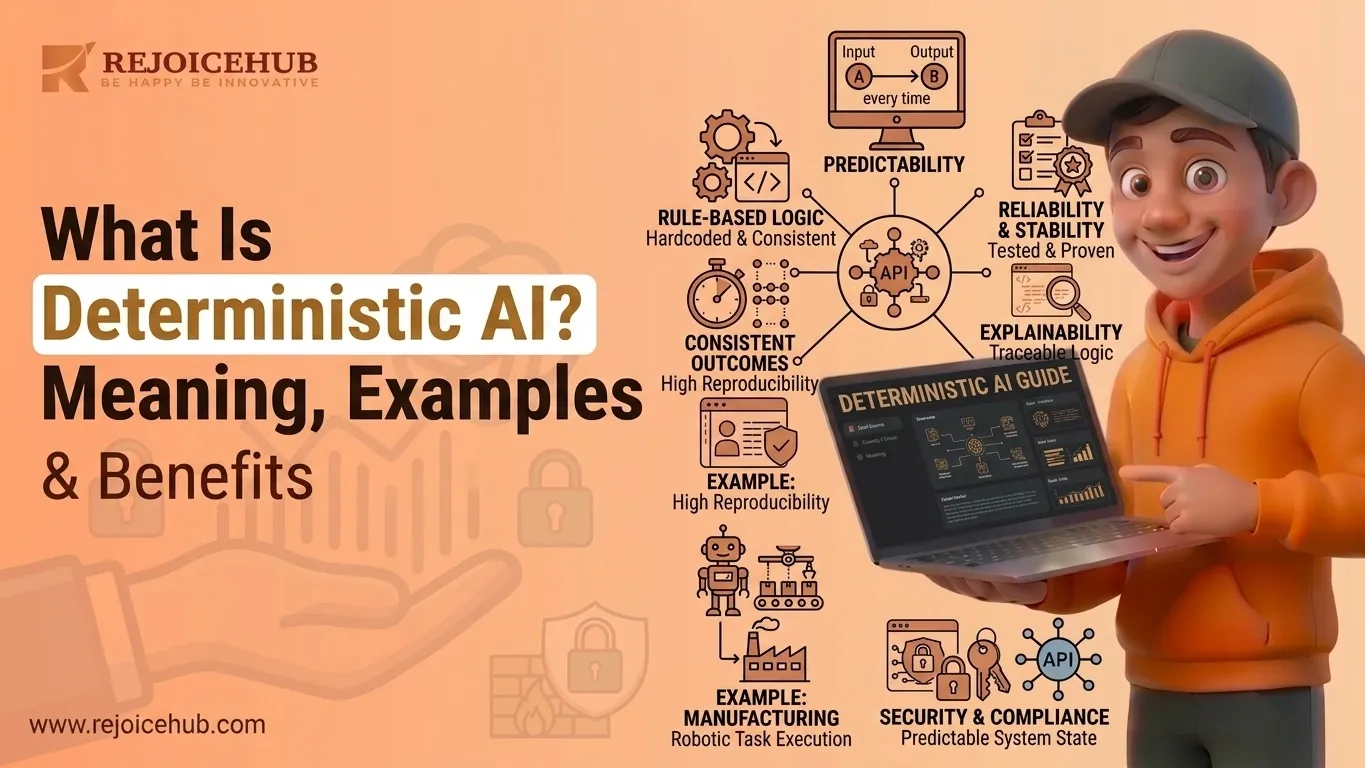
 AI is not always as fancy and complex as we sometimes see in the news. Generative AI, which can surprise us with unexpected responses, is only part of the story. The other part consists of systems based on deterministic algorithms, which always give the same answer.
This kind of artificial intelligence is often used in the day-to-day functioning of companies. Deterministic AI can be found in systems such as fraud detection tools or simple chatbots responding to questions like "What are your opening hours?"
For founders and operational leaders, understanding deterministic AI is essential it forms the basis for many safer, more reliable, and often more regulated operations in the field of artificial intelligence.
In this guide, you'll learn:
- What deterministic AI actually is (and how it's different from generative AI)
- How it works, step by step
- Real-world deterministic AI models and examples
- The benefits and limitations you need to know
- When to choose deterministic AI vs. non-deterministic AI
Let's break it down.
What Is Deterministic AI?
Deterministic AI is a kind of artificial intelligence where you get the same output every single time, as long as the input is the same. It basically stays on rails: there are predefined rules, logic, and expected steps, rather than this whole thing where it learns patterns from data over time.
Put it in plain words, sort of, if you ask it the same question twice, it returns the same answer twice. No guessing, no drift, no variation, no surprises either.
Deterministic AI vs. Learning-Based AI
This is where deterministic AI, explained side-by-side with generative or machine learning models, makes the most sense:
- Deterministic AI follows fixed, human-written rules ("if X happens, do Y").
- Learning-based AI (like large language models) learns patterns from massive datasets and generates probabilistic outputs, meaning the same input can produce different, evolving answers over time.
- Deterministic AI doesn't "learn" on its own. It executes logic that a human has already defined.
Rule-Based Decision Making
At its core, deterministic AI systems run on rule-set-based choices, which is a little clunky but kind of accurate. Developers, or business analysts in a more practical mood, set up a set of conditions, and then the system compares incoming signals against those conditions to figure out what occurs next. This is one of the more foundational types of artificial intelligence businesses still rely on today.
It's basically like a super fast decision tree that stays steady perfectly, so it's not really "thinking" or making up new moves as it goes along, not improvising either.
An Everyday Analogy
Think of the traffic light. Red means to stop, green means to go, and yellow means to proceed slowly. No exceptions, every single time, regardless of who the driver is or what the conditions may be.
Likewise, 2 + 2 = 4 on the most rudimentary calculator. That consistency is the essence of deterministic artificial intelligence.
How Does Deterministic AI Work?
Understanding how deterministic AI works comes down to four core stages that data moves through, in order, every time.
-
Input Processing
The process begins with the reception and normalization of the input, which may take many forms from filling out a form, carrying out a transaction, to submitting an inquiry by the customer or reading a sensor.
-
Rule Engine
Next, the rule engine compares the processed input against a predefined set of "if-then" conditions. This is the heart of any deterministic AI system: the logic library that determines what should happen for every possible scenario.
-
Decision Logic
According to the matching rules, the decision logic layer will decide what action or output should be performed. In case there are several matching rules, the system adheres to the predefined order of priorities, without involving any random elements.
-
Output Generation
Finally, the system generates a predictable output: an approval, a rejection, a routing decision, an alert, or a response that will be identical every time the same input is processed.
Deterministic AI Workflow: Input ↓ Rule Engine ↓ Decision Logic ↓ Predictable Output
This straightforward, traceable flow is exactly why deterministic systems are so easy to audit and explain: every output can be traced back to the exact rule that triggered it.
Accelerate Your Workflows with Custom AI
Book a free consultation session with RejoiceHub. We'll map out a tailored automation roadmap for your company.
Deterministic AI Models & Real-World Examples
So what do deterministic AI models actually look like in the real world? Here are the most common examples businesses rely on today.
1. Expert Systems
Early AI systems, made for things like tax calculation or insurance underwriting, relied on pretty huge piles of "if-then" rules that domain experts would craft by hand. A lot of industries still use newer versions of that same kind of approach, even now, just more updated and refined, you know.
2. Rule-Based Chatbots
Unlike generative chatbots, rule-based bots kind of cling to scripted decision trees. If you ask "Where's my order?" and it matches that exact phrase to one rule, then it pulls a predefined response pretty consistent and predictable, and honestly easier to test than most types of chatbots built on generative logic.
3. Fraud Detection Rules
Banks and payment processors often lean on deterministic rule sets like "flag transactions over $10,000 from a new device" plus machine learning to spot clearly suspicious behavior right away and in a pretty consistent way. This kind of logic underpins a lot of AI in finance today. Sometimes it's instant, sometimes it's slightly more nuanced, but the overall goal is the same: make sure odd patterns are caught fast.
4. Medical Diagnosis Systems
Clinical decision support tools usually lean on a kind of deterministic logic trees, like mapping symptom clusters straight into protocols so the advice stays consistent, explainable, and more or less aligned with medical guidelines a pattern that's increasingly common across AI in healthcare applications.
5. Manufacturing Automation
On a factory floor, deterministic AI kind of runs robotic arms and does quality checks, like, no room for vague behavior. If a part misses a measurement threshold, it gets rejected every single time. That's part of a broader shift in how AI is transforming the manufacturing industry, where you can not have any ambiguity on a production line because the process has to stay crystal clear.
6. Business Workflow Automation
From approving expense reports under a certain amount to routing support tickets by category, deterministic AI keeps everyday business processes fast, consistent, and rule-compliant a core piece of most AI automation strategies.
Where Deterministic AI Still Wins Over Generative AI
Generative AI is powerful, but it's not always the right tool. Deterministic AI is still preferred when:
- Regulatory compliance requires explainable, auditable decisions
- Errors carry financial, legal, or safety consequences
- The task has a clearly defined, finite set of outcomes
- Consistency matters more than creativity
Need help figuring out which approach fits your workflow? Choosing between a custom vs. off-the-shelf AI software solution matters here too. If you're looking to build a custom AI agent whether it's rule-based, generative, or a hybrid of both RejoiceHub can help you design and deploy the right solution for your business.
Benefits and Limitations of Deterministic AI
Benefits of Deterministic AI
- Predictable results: Same input, same output, every time.
- Explainable decisions: Every outcome can be traced to a specific rule.
- Easier compliance: Ideal for regulated industries like finance and healthcare.
- Faster processing: No model inference overhead; rules execute quickly.
- Lower operational risk: Reduces the chance of unexpected or biased outputs, which is one of the clearest benefits of AI for business.
Limitations of Deterministic AI
- Doesn't learn automatically: Rules must be manually created and maintained.
- Difficult to scale with complex scenarios: Too many edge cases can make rule sets unmanageable.
- Requires manual rule updates: Any change in business logic means updating the system by hand.
- Less adaptable to new data: Can't adjust to patterns it wasn't explicitly programmed to handle, unlike the flexibility highlighted in the advantages and disadvantages of machine learning.
This is exactly why many growing businesses combine deterministic logic with machine learning using rules for the parts of the process that must be airtight, and models for the parts that benefit from adaptability.
Deterministic vs Non-Deterministic AI Systems
Here's a side-by-side comparison of deterministic vs non-deterministic AI systems:
| Feature | Deterministic AI | Non-Deterministic AI |
|---|---|---|
| Output | Always predictable | Can vary |
| Learning | No | Yes |
| Flexibility | Low | High |
| Explainability | High | Moderate |
| Best Use Cases | Compliance, automation | Creativity, prediction |
When Should Businesses Choose Each Approach?
Choose deterministic AI when your process needs to stay consistent, sort of auditable, and compliant; think approvals, eligibility checks, or safety-critical automation.
Choose non-deterministic (generative) AI when your process gets better with flexibility and creativity; think content generation, personalized recommendations, or open-ended customer conversations the kind of adaptive behavior you'll also see in AI agents.
Also, many of the best-performing AI systems right now are hybrids: deterministic rules do the guardrails while generative models take care of the nuance.
Conclusion
Deterministic AI still feels pretty essential for companies that require predictable, clear, and regulation-compliant systems, you know. It's not really "outdated"; it's more like a different instrument for a different task.
Instead of replacing generative AI, deterministic AI kind of supports it; you can think of it as doing the sturdy roles where consistency and plain explainability are the big deal. Like when you need outcomes that don't drift, and you can actually justify them.
What you pick depends on what you're trying to accomplish. If you're aiming for airtight compliance and repeatable results, then deterministic AI is usually the obvious route. If you want flexibility and some creative capability, generative AI is the one that often takes the lead. In practice, many scalable AI strategies use both at once, not just one and if you're mapping this out for your own organization, it helps to understand how to build an AI agent stack for business before you commit to either approach.
If you're planning to build AI-powered automation, rule-based systems, or enterprise AI solutions, RejoiceHub can help you design scalable and reliable AI applications tailored to your business.
Frequently Asked Questions
1. What is deterministic AI?
Deterministic AI is a type of artificial intelligence that gives the same output every time you give it the same input. It follows fixed rules instead of learning from data. There's no guessing or randomness involved, just clear, predefined logic that stays consistent every single time.
2. How does deterministic AI work?
Deterministic AI works in four simple steps. First, it takes in the input and cleans it up. Then a rule engine checks it against fixed if-then conditions. Next, decision logic picks the right action. Finally, it gives a predictable output that stays the same every time.
3. What are some examples of deterministic AI models?
Common deterministic AI models include expert systems, rule-based chatbots, fraud detection rules, medical diagnosis tools, and manufacturing automation. These systems use fixed logic instead of learning from data, so they give the same predictable answer or action every single time the same input appears.
4. What is the difference between deterministic AI and non-deterministic AI systems?
Deterministic AI systems follow fixed rules and always give the same output for the same input. Non-deterministic AI, like generative models, learns patterns from data and can give different answers over time. Deterministic AI is more predictable, while non-deterministic AI is more flexible and creative.
5. What are the benefits of deterministic AI?
Deterministic AI gives predictable results, so the same input always leads to the same output. It's easy to explain since every decision traces back to a clear rule. It also processes faster, lowers risk, and helps businesses stay compliant in regulated industries like finance and healthcare.
6. What are the limitations of deterministic AI?
Deterministic AI can't learn on its own, so someone has to build and update all the rules by hand. It struggles with complex scenarios that have too many edge cases, and it can't adjust to new data patterns it wasn't specifically programmed to recognize and handle.
7. When should businesses use deterministic AI instead of generative AI?
Businesses should choose deterministic AI when a process needs to stay consistent, auditable, and compliant, like approvals, eligibility checks, or safety-critical tasks. Generative AI works better for creative or open-ended work, such as content writing or personalized recommendations, where flexibility matters more than fixed rules.