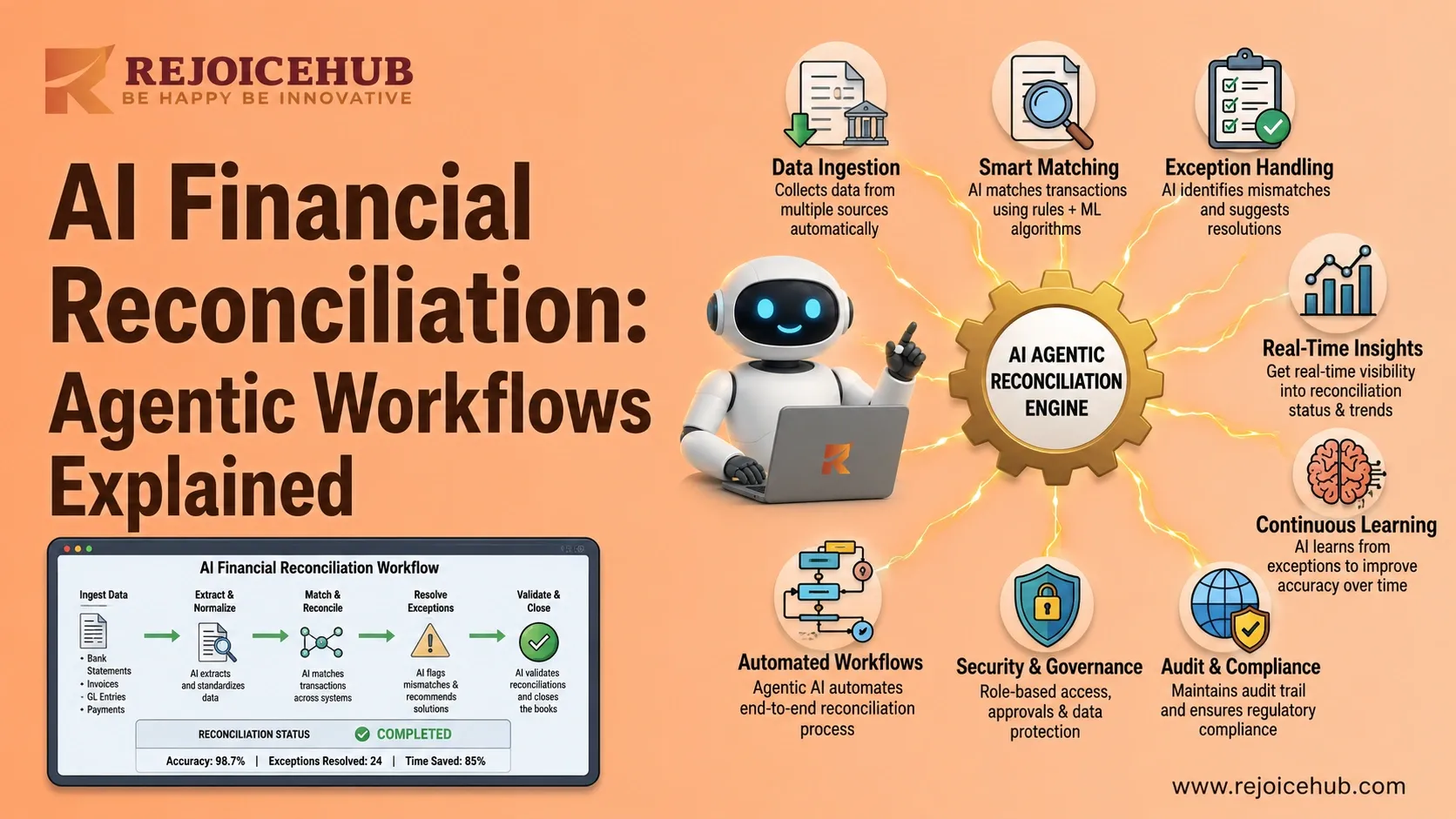
Every finance team knows the feeling: it's day three of month-end close, and someone is still hunting through spreadsheets trying to figure out why the bank statement doesn't match the general ledger. Manual reconciliation eats hours, invites errors, and delays reporting that leadership needs to make decisions.
AI financial reconciliation solves this by using intelligent agents that match transactions, investigate discrepancies, and route approvals continuously, not just at month-end. Instead of static rules that break the moment a new transaction pattern appears, AI systems learn, adapt, and explain their reasoning.
In this guide, you'll learn what AI financial reconciliation actually is, how agentic AI workflows are reshaping the financial close process, real business use cases, and how to implement this technology without disrupting your existing ERP and banking stack.
What Is AI Financial Reconciliation?
AI financial reconciliation is the use of machine learning and intelligent automation to match transactions across bank feeds, ERP, and ledger systems, flag discrepancies, and recommend corrective journal entries with far less manual intervention than traditional or rule-based reconciliation.
Definition
Traditional reconciliation relies on accountants manually comparing transaction records, or on rule-based software that matches records using fixed logic (exact amount, exact date, exact reference number). The moment a transaction doesn't fit the rule a partial payment, a currency conversion, a delayed batch a human has to step in.
AI-powered reconciliation uses pattern recognition and contextual understanding instead of rigid rules. It can recognize that a $4,987.32 payment is likely the same as a $5,000 invoice minus a processing fee, even if no rule was written for that scenario.
How It Works?
A typical AI financial reconciliation flow includes:
-
Bank data ingestion transactions pulled from bank feeds or statements
-
ERP data ingestion corresponding entries pulled from your accounting/ERP system
-
Transaction matching AI compares records using amount, date, vendor, and contextual signals
-
Exception detection unmatched or unusual transactions are flagged automatically
-
Journal recommendations the system suggests correcting entries for review
-
Human approval accountants confirm or adjust before entries post to the ledger
Callout: AI financial reconciliation combines machine learning, automation, and intelligent workflows to continuously reconcile financial data with minimal manual effort turning reconciliation from a monthly scramble into an ongoing background process.
Why Traditional Financial Reconciliation Falls Short?
Direct Answer: Traditional reconciliation whether fully manual or rule-based automation struggles with scale, context, and change. It depends on rigid logic that requires constant maintenance and still leaves teams doing manual review for anything outside expected patterns.
Common Challenges
-
Manual matching across hundreds or thousands of line items
-
Spreadsheet dependency, which introduces version-control and formula risk
-
Duplicate transactions that slip through without automated cross-checks
-
Human errors from fatigue during high-volume close periods
-
Delayed reporting, pushing decision-making timelines back
-
Month-end pressure that compounds across every close cycle
Limitations of Rule-Based Automation
Rule-based tools were a step forward, but they come with real constraints:
-
Rules break easily when transaction formats change
-
The system doesn't adapt to new vendors, currencies, or payment types
-
It cannot understand context only exact-match logic
-
It requires constant manual maintenance from finance or IT teams
Comparison: Manual vs. Rule-Based vs. AI Reconciliation
| Factor | Manual | Rule-Based Automation | AI Financial Reconciliation |
|---|---|---|---|
| Speed | Slow | Medium | Fast |
| Error Rate | High | Moderate | Low |
| Manual Reviews | Extensive | Some | Minimal |
| Adaptability | None | Static Rules / Fixed Logic | Learns Continuously |
| Approach | Reactive | Reactive | Predictive |
This is the core shift: AI-powered account reconciliation doesn't just process transactions faster it anticipates exceptions before they derail your close.
How Agentic AI Workflows Are Transforming the Financial Close Process?
Direct Answer: Agentic AI in finance uses multiple specialized AI agents that work together not a single automation script to handle matching, exception resolution, compliance checks, and journal entries as one coordinated workflow, dramatically shortening the financial close process.
What Is Agentic AI?
Agentic AI refers to AI systems that can plan, take multi-step actions, and adapt their approach based on outcomes rather than simply executing a single predefined task. In finance, this means an AI agent doesn't just flag a mismatch; it investigates why the mismatch happened and proposes a resolution.
If you're new to the concept, our breakdown of what is agentic AI covers the fundamentals in more depth.
How AI Finance Agents Work?
A typical agentic financial close workflow looks like this:
ERP
↓
Bank Feed
↓
AI Finance Agent
↓
Transaction Matching
↓
Exception Investigation
↓
Policy Validation
↓
Suggested Journal Entries
↓
Human Approval
↓
General Ledger
↓
Financial Close
Each stage runs with minimal human intervention until final approval, meaning finance teams review outcomes rather than perform the matching themselves.
Multiple AI Agents Working Together
Instead of one tool doing everything, agentic financial reconciliation typically involves specialized agents:
-
Reconciliation Agent: performs core transaction matching
-
Exception Resolution Agent: investigates unmatched items and suggests root causes
-
Journal Entry Agent: drafts correcting entries based on findings
-
Compliance Agent: checks entries against internal policy and regulatory rules
-
Audit Agent: maintains a full, explainable trail for auditors
Instead of automating individual tasks, agentic workflows automate the entire finance process from raw transaction data to a close-ready ledger. This is the same architectural pattern used in broader agentic AI workflows across other business functions like sales and support.
If your team is exploring how AI agents fit into daily operations, our guide on how AI agents can help automate your workflows is a useful next read.
Accelerate Your Workflows with Custom AI
Book a free consultation session with RejoiceHub. We'll map out a tailored automation roadmap for your company.
Key Benefits of AI Financial Reconciliation
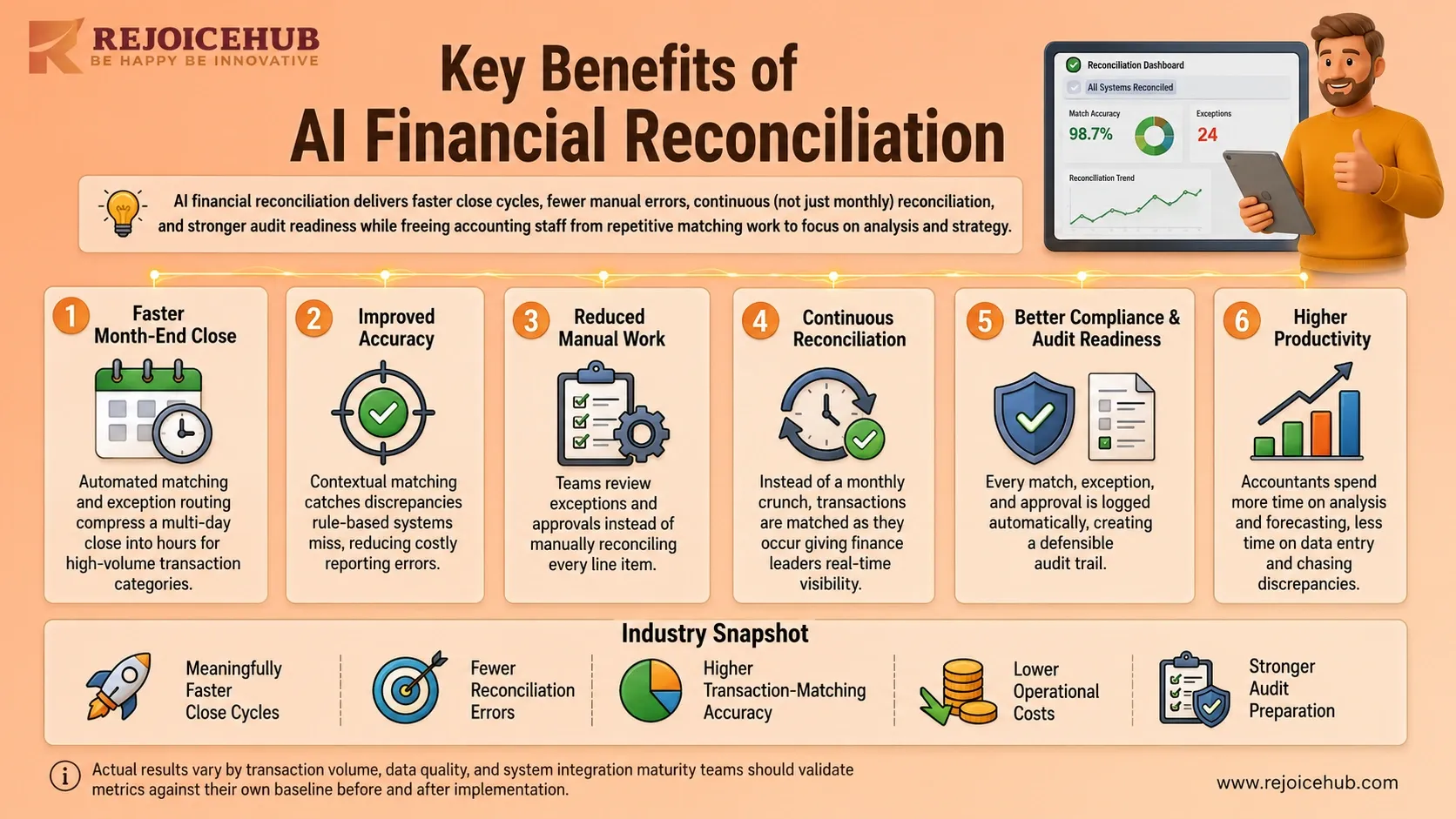
AI financial reconciliation delivers faster close cycles, fewer manual errors, continuous (not just monthly) reconciliation, and stronger audit readiness while freeing accounting staff from repetitive matching work to focus on analysis and strategy.
1. Faster Month-End Close
Automated matching and exception routing compress a multi-day close into hours for high-volume transaction categories.
2. Improved Accuracy
Contextual matching catches discrepancies rule-based systems miss, reducing costly reporting errors.
3. Reduced Manual Work
Teams review exceptions and approvals instead of manually reconciling every line item.
4. Continuous Reconciliation
Instead of a monthly crunch, transactions are matched as they occur giving finance leaders real-time visibility.
5. Better Compliance & Audit Readiness
Every match, exception, and approval is logged automatically, creating a defensible audit trail.
6. Higher Productivity
Accountants spend more time on analysis and forecasting, less time on data entry and chasing discrepancies.
Industry Snapshot: Finance teams adopting AI-driven reconciliation and close automation commonly report meaningfully faster close cycles, fewer reconciliation errors, higher transaction-matching accuracy, lower operational costs, and stronger audit preparation compared to manual or rule-based processes. Actual results vary by transaction volume, data quality, and system integration maturity teams should validate metrics against their own baseline before and after implementation.
For a broader look at ROI across finance and operations, see our article on benefits of AI for business.
Real-World Use Cases Across Industries
AI financial reconciliation applies wherever high transaction volumes meet multiple data sources banking, fintech, healthcare, retail, and SaaS all use it to match payments, catch discrepancies, and close books faster.
-
Banking: Payment reconciliation and loan reconciliation across large transaction volumes
-
FinTech: Payment gateway reconciliation and digital wallet transaction matching
-
Healthcare: Insurance claims reconciliation and billing reconciliation across payer systems
-
Retail & E-commerce: Marketplace reconciliation and refund reconciliation across multiple sales channels
-
SaaS Companies: Subscription revenue reconciliation, Stripe reconciliation, and multi-billing-system reconciliation
For SaaS businesses specifically, reconciling recurring revenue against payment processors like Stripe is one of the highest-value use cases, since discrepancies compound with every billing cycle. If you're scoping a similar project, our overview of AI agents for business outlines how custom agents are typically built and deployed.
Best Practices for Implementing AI Financial Reconciliation
Direct Answer: Successful implementation starts with your highest-volume, most repetitive reconciliation process, integrates directly with your existing ERP and banking systems, keeps humans in the approval loop, and tracks clear KPIs to prove ongoing value.
1. Start With High-Volume Processes
Pilot AI reconciliation on your largest, most repetitive transaction category first this is where automation delivers the fastest, most measurable ROI.
2. Integrate ERP and Banking Systems
AI reconciliation tools should connect directly with the systems you already use, including:
-
SAP
-
Oracle
-
Microsoft Dynamics
-
NetSuite
3. Keep Humans in the Approval Loop
AI should recommend, not autonomously post, journal entries in most organizations at least until trust and accuracy are well established. This keeps accountability with your finance team.
4. Monitor AI Performance
Track these KPIs to measure success:
| KPI | What It Measures |
|---|---|
| Match Rate | % of transactions auto-matched without human input |
| Exception Rate | % of transactions flagged for review |
| Days to Close | Total time from period end to finalized books |
| Journal Automation Rate | % of journal entries AI-suggested vs. manually created |
| Manual Touch Rate | % of transactions still requiring hands-on review |
5. Maintain Strong Governance
Any AI system touching financial data needs:
-
Detailed audit logs
-
Role-based access controls
-
Explainable AI outputs (why a match or exception was flagged)
-
Alignment with regulatory compliance requirements (SOX, GAAP, industry-specific rules)
Common mistake to avoid: Rolling AI reconciliation out across every process at once. Start narrow, prove accuracy on one workflow, then expand this is where a custom AI Agent Development partner can help design a phased rollout instead of a risky all-at-once deployment.
The Future of Agentic AI in Finance
Agentic AI is evolving from assisting finance teams to orchestrating end-to-end financial operations. Where today's AI reconciliation tools flag exceptions for human review, tomorrow's systems are moving toward:
-
Autonomous finance operations agents handling routine close tasks with minimal oversight
-
Continuous accounting books that stay reconciled in near real time, not just at period-end
-
Predictive reconciliation flagging likely discrepancies before they even occur
-
Self-healing finance workflows agents that correct known error patterns automatically
-
AI copilots for CFOs conversational tools surfacing insights directly from ledger data
-
Intelligent financial close a fully coordinated, agent-driven close process from raw data to final report
Companies exploring this shift should also understand the broader category of types of AI agents to see where reconciliation agents fit within a wider automation strategy.
Key Takeaways
-
Manual reconciliation and rigid rule-based tools can't keep pace with modern transaction volume and complexity.
-
AI financial reconciliation uses machine learning to match transactions, detect exceptions, and recommend journal entries with minimal manual work.
-
Agentic AI workflows coordinate multiple specialized agents reconciliation, exception resolution, compliance, and audit into one seamless close process.
-
Benefits include faster close cycles, improved accuracy, continuous reconciliation, and stronger audit readiness.
-
Successful implementation starts small, integrates with existing ERP/banking systems, and keeps humans in the approval loop.
Conclusion
Manual reconciliation is no longer scalable for growing finance teams. AI financial reconciliation improves speed, accuracy, and compliance in ways that manual processes and rigid rule-based tools simply cannot match.
Agentic AI workflows take this further, extending automation beyond simple transaction matching by coordinating intelligent finance agents across the entire close process from raw bank data to a fully closed general ledger.
Organizations that adopt AI-powered reconciliation today are better positioned for continuous accounting and autonomous finance operations tomorrow.
Looking to automate financial reconciliation with intelligent AI agents? RejoiceHub helps enterprises build secure, scalable AI-powered finance solutions that streamline accounting workflows and accelerate digital transformation. Talk to our AI Agent Development team about building a reconciliation workflow tailored to your ERP and banking stack.
Frequently Asked Questions
1. What is AI financial reconciliation?
AI financial reconciliation is the use of machine learning and intelligent automation to match transactions across bank feeds, ERPs, and ledgers, detect discrepancies, and recommend corrective journal entries. Unlike rule-based tools, it adapts to new transaction patterns and understands context, reducing the manual review finance teams need to perform each close cycle.
2. How is AI financial reconciliation different from traditional automation?
Traditional automation relies on fixed rules that break when transaction formats change and require constant maintenance. AI financial reconciliation uses machine learning to recognize patterns and context, so it can match transactions that don't fit an exact rule, like partial payments or currency-adjusted amounts, with far less human intervention.
3. What is agentic AI in finance?
Agentic AI in finance refers to AI systems that plan and execute multi-step tasks autonomously, using specialized agents for matching, exception resolution, compliance checks, and journal entries. Instead of automating one task, agentic workflows coordinate the entire financial close process from raw data to a closed ledger.
4. Can AI financial reconciliation integrate with existing ERP systems?
Yes. Most AI reconciliation platforms are designed to integrate directly with common ERP and accounting systems like SAP, Oracle, Microsoft Dynamics, and NetSuite, pulling data automatically rather than requiring manual exports or spreadsheet uploads.
5. Is AI financial reconciliation safe for compliance-heavy industries?
When implemented with proper governance — audit logs, role-based access controls, and explainable AI outputs — AI reconciliation can support compliance requirements like SOX and GAAP. Human approval should remain part of the workflow, especially for high-risk or unusual transactions.
6. How long does it take to implement AI financial reconciliation?
Implementation timelines vary based on transaction volume, system complexity, and integration scope, but most organizations start with a pilot on a single high-volume process before expanding. Starting narrow allows teams to validate accuracy and build trust before scaling to full financial close automation.
7. Does AI replace accountants in the reconciliation process?
No. AI financial reconciliation is designed to handle repetitive matching and flag exceptions, while accountants review, approve, and handle judgment-based decisions. This shifts finance teams away from manual data entry and toward higher-value analysis and oversight.