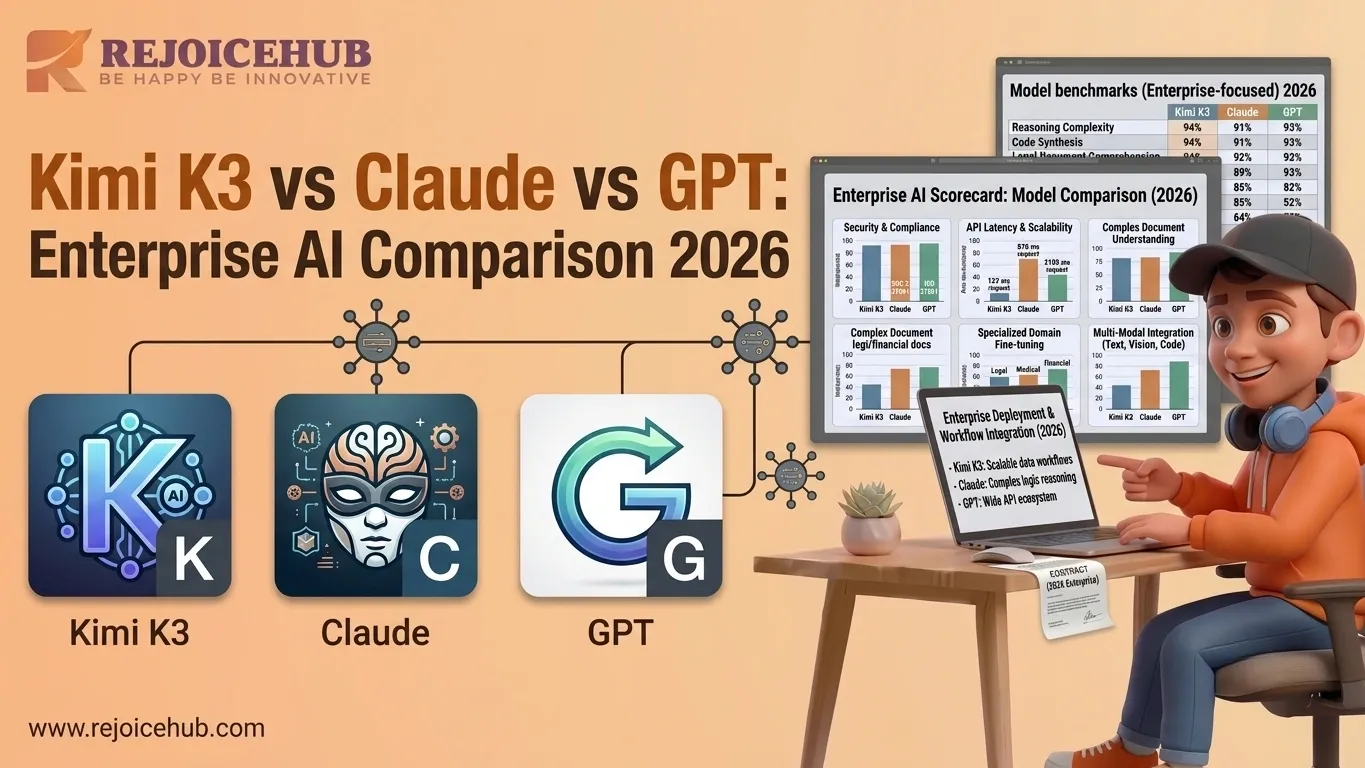
Kimi K3 vs Claude vs GPT: Which is best for enterprises? Every buyer has asked themselves this question. Moonshot announced Kimi K3, a 2.8 trillion parameter open-weight model, in July 2026. Moonshot claimed that Kimi K3 has surpassed the level of frontier models of Anthropic and OpenAI.
This news came at a critical moment for the American enterprise market, which was looking to reduce its reliance on large model suppliers. Chinese counterparts such as Moonshot, DeepSeek and Qwen have been closing the performance gap with US rivals in the past two years. At the same time, enterprises are concerned about the rising API costs, supplier lock-in risks and data sovereignty issues.
Therefore, the key question now is: Should enterprises adopt Chinese open-weight LLMs for mission-critical applications and data? And how does Kimi K3 compare to Claude and GPT in practical terms?
In this article, you'll learn:
- Why enterprises are evaluating alternatives to GPT in 2026
- How Kimi K3, Claude, and GPT compare on architecture, pricing, and enterprise readiness
- Whether Chinese open-weight models are safe to trust for business use
- Open-weight vs. closed models which fits your infrastructure
- A decision framework for choosing the right model for your enterprise
Why Enterprises Are Looking Beyond GPT in 2026
For years, GPT has been the dominant choice among enterprise AI models. That is, until recently, when the dynamics have shifted, and GPT's appeal has dwindled.
-
Rising AI costs: The cost of frontier models has risen as hallucination-free models require more tokens to produce results. Enterprises whose workloads encompass large-scale automation of customer support, document parsing, or code-writing agents find their API budgets bloated with little ROI. Many teams are now turning to smarter request routing to keep spend under control.
-
Vendor diversification: No CTO is willing to tie their organization's future to a single supplier's innovation, pricing, or availability. As such, multiple-model strategies have become de rigueur, often coordinated through a centralized layer that routes traffic across providers.
-
The open-weight trend: The rise of open-weight models disrupts the status quo, offering enterprises a chance to fine-tune and operate their own models rather than relying on a third party an approach that increasingly overlaps with running large models on owned infrastructure.
-
AI sovereignty: is the new priority. Regulated industries or organizations with a significant government presence are prioritizing on-premise and private-cloud solutions where the model weights are not hosted on a foreign supplier's servers, a concern closely tied to broader data privacy obligations enterprise leaders now have to manage.
Self-hosted deployment provides the security and compliance needed in highly regulated industries such as finance and law.
None of these trends suggest the end of the reign of GPT. The emergence of these trends speaks more to the maturation of the enterprise AI market than anything else.
If you are an enterprise evaluating options for AI models and need a third party to weigh in on your selections, we at RejoiceHub can evaluate your requirements against available models in the ecosystem.
Kimi K3 vs Claude vs GPT: Feature Comparison
Here's how the three stack up on the factors that actually matter to enterprise buyers, not just benchmark leaderboards.
Accelerate Your Workflows with Custom AI
Book a free consultation session with RejoiceHub. We'll map out a tailored automation roadmap for your company.
| Feature | Kimi K3 (Moonshot AI) | Claude (Anthropic) | GPT (OpenAI) |
|---|---|---|---|
| Developer | Moonshot AI (China) | Anthropic (USA) | OpenAI (USA) |
| Architecture | 2.8T-parameter mixture-of-experts, open weight | Proprietary transformer-based, undisclosed size | Proprietary transformer-based, undisclosed size |
| Context Window | Up to ~1M tokens | Up to ~1M tokens (model-dependent) | Up to ~1M tokens (model-dependent) |
| Reasoning | Strong on agentic and long-horizon tasks | Strong, especially on multi-step and safety-sensitive reasoning | Strong, tiered by model (fast vs. deep reasoning modes) |
| Coding | Competitive on repo navigation, debugging, tool use | Widely used for professional coding workflows | Strong, especially with Codex-style tooling |
| Pricing | Lower cost per million tokens, competitive with mid-tier US models | Mid-to-premium pricing, tiered by model | Mid-to-premium pricing, tiered by model |
| API | Available via Moonshot platform and third-party routers | Available via Anthropic API and major cloud platforms | Available via OpenAI API and major cloud platforms |
| Deployment | Self-hosted or API full flexibility | API-first, limited self-hosting | API-first, limited self-hosting |
| Open Weight | Yes | No | No |
| Enterprise Readiness | Growing, but limited compliance track record in the US | Mature, strong enterprise trust and governance tooling | Mature, broadest enterprise adoption and tooling ecosystem |
The headline finding is that Kimi K3 is competitive in terms of raw capability and price, and it is significantly more open-weight for self-hosting.
At the same time, Claude and GPT are ahead in enterprise-readiness, offering the governance, compliance, and vendor lock tools that US-based legal and procurement teams are already familiar with.
If you are unsure which enterprise LLM to select, the RejoiceHub team can help you find the right AI partner and may perform a pilot test for you to see how the models perform on your data before choosing one for production.
Should Enterprises Trust Chinese Open-Weight AI Models?
This is the question every risk team is asking, and it deserves an honest, non-biased answer not hype in either direction.
-
Security
The only way that open-weight models like Kimi K3, DeepSeek, or Qwen can offer security benefits is if you can audit and self-host it, removing the "black box API" threat entirely. The trade-off here is that the responsibility of patching and security falls onto you as their host.
-
Compliance
While there are some nuances, in general, US-based companies in healthcare, finance, and government-related industries will have compliance issues with any foreign-developed model, regardless of the country. The reason is that they have to consider not only the country-specific requirements but also SOC 2, HIPAA, and other regulations relevant to their operations.
-
Data Residency
This is where self-hosted open-weight models truly shine. By running Kimi K3, DeepSeek, or Qwen on your own infrastructure, you ensure that your data never leaves your ecosystem, which is hard to say about any other alternative, local or not.
-
AI Governance
Enterprise AI requires transparency: who trains the model, what data did they use, who examines the model, who gets to look at who has used the model, etc. Moonshot AI, like most companies, is somewhat opaque about these details, but most private US labs are just as secretive about the data they used to train their models.
-
Vendor Transparency
Anthropic and OpenAI provide comprehensive model cards, safety evaluations, and usage policies a gap that continues to define much of the broader Anthropic vs OpenAI enterprise comparison. Moonshot AI's disclosures are improving, but lag behind those of U.S. counterparts in several areas, which could be a concern for regulators conducting third-party security reviews.
-
Risk Management
The honest answer is that Chinese open-weight models are probably not completely trustworthy. Compared to their US counterparts, these models have lower control assurance, less mature documentation for compliance, and more uncertain future export control and support for enterprise use. Enterprises evaluating this trade-off often lean on a structured governance and verification framework to keep the decision auditable.
Self-hosting will help you significantly with data residency risks, but you still have to worry about other aspects of control and compliance. In any case, it is essential to evaluate each model using risk-based language based on your use case.
The regulation requirements for a small self-hosted tool for internal use may be significantly different from the requirements for a software product that processes healthcare data.
Open-Weight vs Closed AI Models: Which Is Better for Enterprises?
There's no universal winner here it depends entirely on your infrastructure maturity and compliance needs.
1. Advantages of open-weight models
- Full self-hosting control and data residency
- No per-token API lock-in predictable infrastructure costs at scale
- Deep customization and fine-tuning on proprietary data
- Freedom to switch or fork models without vendor dependency
2. Disadvantages of open-weight models
- Requires in-house ML infrastructure and expertise to run well
- You own security patching, uptime, and scaling
- Less polished enterprise tooling (SSO, audit logs, admin controls)
- Support is community or vendor-tier, not white-glove enterprise support
3. Advantages of closed models (Claude, GPT)
- Mature enterprise tooling SSO, compliance certifications, admin dashboards
- No infrastructure to manage pay-as-you-go simplicity
- Faster time-to-production for most business use cases
4. Disadvantages of closed models
- Vendor lock-in and pricing changes outside your control
- Less transparency into training data and model internals
- Data typically processed through the vendor's infrastructure
For many enterprises, the answer will likely lie in a hybrid AI gateway, which directs different classes of queries to different models, based on cost-performance criteria and data sensitivity, rather than committing to one proprietary model.
This is the type of AI infrastructure that RejoiceHub can assist you in designing including the underlying build-or-buy decision that shapes your AI platform strategy so that you're not re-engineering your systems every time a new model appears on the scene.
Which AI Model Fits Your Enterprise?
-
Choose GPT if You need the broadest tooling ecosystem, deep integrations (Codex, connectors, enterprise admin controls), and your team is already invested in OpenAI's GPT platform.
-
Choose Claude if You prioritize careful, safety-conscious reasoning, strong coding performance, and enterprise-grade governance features especially for regulated or customer-facing financial services use cases.
-
Choose Kimi K3 if You need self-hosted deployment, want to avoid per-token vendor lock-in at scale, and have the in-house infrastructure to manage an open-weight model responsibly the same considerations that come up when comparing Kimi K3 against other open-weight models like DeepSeek and Qwen.
Quick decision matrix:
| Priority | Best Fit |
|---|---|
| Lowest infrastructure cost at scale | Kimi K3 (self-hosted) |
| Fastest enterprise deployment | GPT or Claude |
| Strongest compliance tooling | Claude or GPT |
| Full data residency control | Kimi K3 (self-hosted) |
| Best coding + agentic workflows | Claude or Kimi K3 |
| Broadest ecosystem integrations | GPT |
Conclusion
No single AI model is the best choice in any scenario in 2026 - not Kimi K3, not Claude, not GPT. Your selection criteria should be dictated by your compliance requirements, existing infrastructure, security posture, budget constraints, and internal AI governance capabilities. Chinese open-weight models have carved out a clear niche in the market space, but enterprise readiness ultimately depends on your risk tolerance as an organization.
When considering enterprise AI solutions, turn to RejoiceHub to deploy, fine-tune, and integrate the most suitable models for your compliance needs and business objectives.
Whether you need a Claude-based agent, GPT-powered application, or self-hosted open-weight solution, our experts will help you select and implement the most operationally appropriate LLM infrastructure.
Frequently Asked Questions
1. Should enterprises trust Chinese open-weight AI models like Kimi K3?
Chinese open-weight AI models like Kimi K3 offer real benefits, especially self-hosting and data control. But trust depends on your industry. Regulated sectors like healthcare and finance should weigh compliance gaps carefully. For general business use, Kimi K3 can be a solid, cost-effective option if you manage security yourself.
2. What is the main difference between Kimi K3 and Claude?
The biggest difference is openness. Kimi K3 is an open-weight model you can self-host and customize freely. Claude is a closed, API-first model built by Anthropic with strong safety features and enterprise governance tools. Claude suits regulated industries, while Kimi K3 fits teams wanting full infrastructure control.
3. Is Kimi K3 cheaper than GPT and Claude?
Yes, Kimi K3 usually costs less per million tokens than GPT and Claude. Since it's open-weight, you can also self-host it and avoid ongoing API fees entirely. However, running your own infrastructure means added costs for hardware, maintenance, and security, which can offset savings over time.
4. Which AI model is best for enterprise coding tasks?
Claude and Kimi K3 both perform well for coding and agentic workflows, while GPT remains strong with tools like Codex. Claude is often preferred for careful, multi-step reasoning in professional coding. Your choice should depend on your existing tools, budget, and how much customization your team needs.
5. Are open-weight AI models safe for data residency?
Yes, open-weight models like Kimi K3 are strong for data residency because you can host them entirely on your own servers. Your data never leaves your infrastructure. This makes open-weight models appealing for organizations with strict data sovereignty rules, though you still handle security and patching yourself.
6. Does Kimi K3 meet US compliance standards like HIPAA or SOC 2?
Not fully yet. Kimi K3 and other Chinese open-weight models still lag behind Claude and GPT in compliance documentation and vendor transparency. Regulated US industries like healthcare and finance should carefully review their specific compliance needs before adopting Kimi K3 for sensitive or mission-critical workloads.
7. Should my enterprise choose one AI model or use multiple models?
Many enterprises now use a hybrid approach, routing different tasks to different models based on cost, sensitivity, and performance needs. Instead of relying on just Claude, GPT, or Kimi K3 alone, a multi-model AI gateway often gives better flexibility, cost control, and risk management for growing businesses.