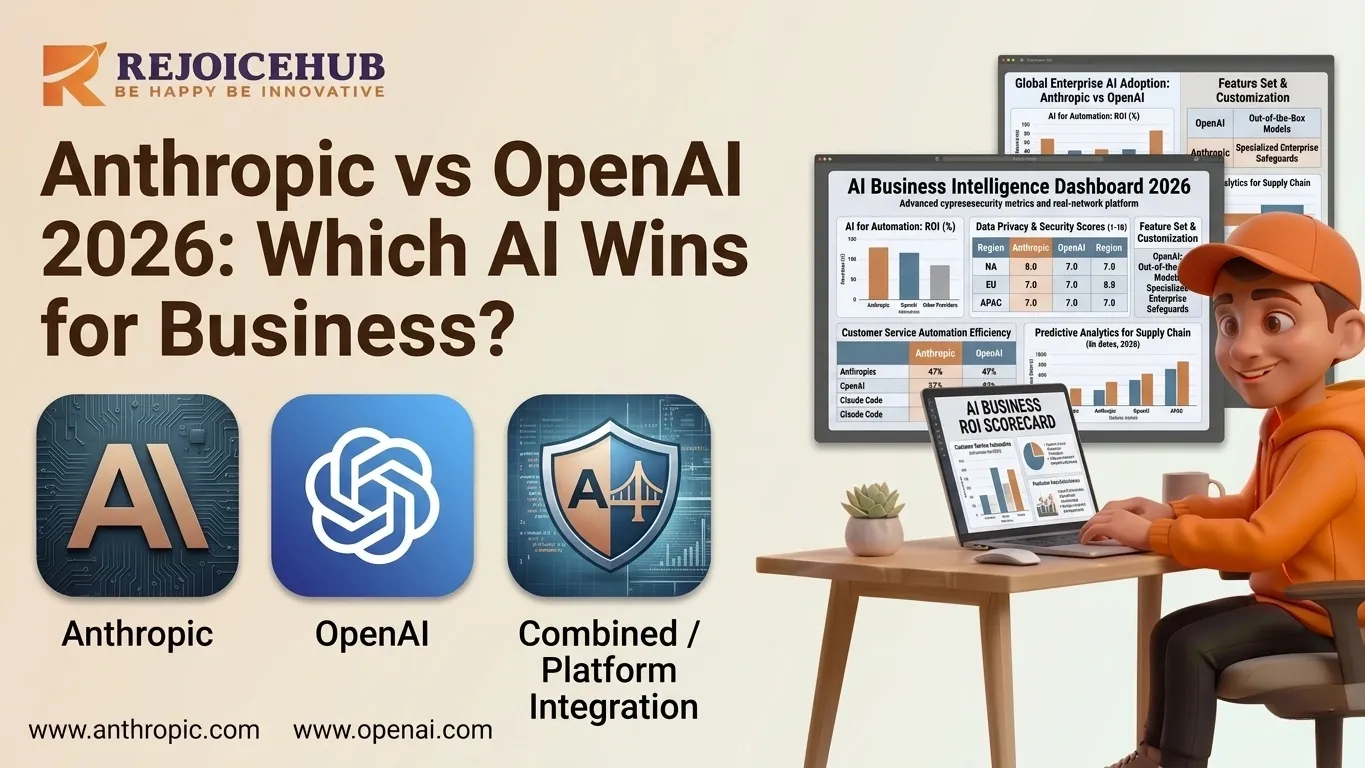
The enterprise AI race has shifted, kinda dramatically. In 2026, the question isn't whether to use AI, it's which AI platform actually works inside a real business, like day to day. For two years, OpenAI's ChatGPT basically dominated the conversation. But there's this quiet shift happening in US boardrooms, engineering teams, and operations departments, and honestly, Claude by Anthropic is starting to win more enterprise trust. It doesn't feel like pure hype. More like a pattern that keeps showing up in procurement decisions, developer forums, and IT compliance reviews across the country, over and over. So if you're a startup founder, SaaS company, or operations leader evaluating AI tools in 2026, this guide lays out the Anthropic vs OpenAI debate with no real extra noise. Just the parts that matter for your business, period. If you're also weighing custom vs off-the-shelf AI software for your team, that context will make this comparison even more useful.
Anthropic vs OpenAI in 2026: What Changed?
Two years back, the enterprise AI landscape felt simple, like OpenAI led and everyone else kinda followed. Today, it's more nuanced, not really as straightforward as it used to be.
OpenAI still kind of dominates consumer mindshare. ChatGPT is still the most recognized AI brand in America. But for enterprise teams, they're finding that consumer popularity doesn't really mean, and sure isn't the same as, enterprise reliability.
What changed:
- AI moved from experimentation to operations. Companies aren't just testing AI anymore they're embedding it into workflows, products, and customer touchpoints. That shift raises the stakes for accuracy, safety, and consistency.
- Compliance became a dealbreaker. As AI regulations tighten, especially for healthcare, finance, and legal tech, governance features have moved from "nice to have" to "must have."
- Claude scaled fast. Anthropic's Claude 3.5 and Claude 4 releases brought massive context windows, stronger coding performance, and significantly lower hallucination rates exactly what enterprise teams need.
Quick Comparison: Anthropic Claude vs OpenAI GPT (2026)
| Feature | Claude (Anthropic) | GPT-4o (OpenAI) |
|---|---|---|
| Context Window | Up to 200K tokens | Up to 128K tokens |
| Enterprise Safety | Constitutional AI, built-in guardrails | Moderation layer (separate) |
| Hallucination Rate | Lower (especially long docs) | Higher on complex tasks |
| Coding Performance | Strong (Claude Code, API-native) | Strong (GPT-4o, Codex) |
| Compliance Readiness | SOC 2, HIPAA-ready | SOC 2, HIPAA-ready |
| Enterprise Tier | Anthropic Claude for Enterprise | OpenAI Enterprise |
| API Reliability | High, consistent outputs | Variable on complex prompts |
| Custom Fine-tuning | Limited (improving) | Available |
Both platforms are enterprise capable. But for certain scenarios especially long document handling, internal workflows, and safety-sensitive operations Claude kinda has a measurable advantage in 2026.
Why Companies Prefer Anthropic Claude
1. Better Enterprise Safety and Compliance
This is kinda the single biggest factor driving enterprise teams toward Anthropic. Claude is built on Constitutional AI, which is a framework that trains the model to stick to a set of principles, not only simple prompts or instructions. What you get is outputs that feel safer, more steady, and way less likely to go "off-script" in business-critical contexts.
For regulated industries healthcare, legal, finance, HR this matters enormously.
Key safety advantages:
- Reduced harmful outputs without heavy prompt engineering
- More predictable responses across large batches of queries
- Governance-friendly architecture that satisfies enterprise legal and compliance reviews
- Lower risk of data leakage in API deployments (Anthropic's privacy commitments are strong)
Yeah, OpenAI has improved here too, but with Claude the safety properties feel baked into the model architecture, not kinda stacked on top like an add-on. For teams in regulated industries, understanding how generative AI can be used in cybersecurity adds another layer of context to why architecture-level safety actually matters.
2. Reliability for Internal Workflows
Enterprise AI isn't really about getting some clever answer one time and done. It's more about repeatability — consistent and reliable answers thousands of times across different users, different prompts, and those annoying edge cases that show up when you least expect it.
And yeah, this is where Claude kinda shines in a real way:
- Lower hallucination rates on long tasks. Claude's 200K token context window isn't just a marketing spec — it becomes noticeable as accuracy improvements when you're summarizing huge reports, breaking down contracts, or processing customer data at scale.
- More stable output formatting. If you're building workflows that pipe AI output into databases, dashboards, or other downstream tooling, then consistency is the whole deal. Claude's structured outputs tend to stay predictable, especially compared to GPT-4o during extended runs.
- Stronger long-document handling. Give Claude a 150-page legal contract or a full technical specification and it holds onto the context way better than most competing models. For internal knowledge management, it's kind of a real accelerant.
Real-world business applications where Claude's reliability wins:
- Summarizing weekly sales reports from raw CRM data
- Analyzing lengthy vendor contracts for risk flags
- Running internal knowledge bases and employee assistants
- Automating compliance documentation workflows
If you want a deeper look at how agentic AI workflows tie into this kind of operational setup, that's worth a read alongside this.
3. Stronger Coding and Knowledge Workflows
The developer community has been kinda vocal — Claude is real exceptional at code, and honestly, it's pretty obvious. Whether it's Python scripts, API integrations, or even full-stack feature work, Claude (especially when used through Claude Code) tends to deliver cleaner, more commented, more functional code than most other alternatives. It feels smoother, and yeah, the parts read better, even when things get a bit complex.
For business teams, this translates to:
- Faster internal tool development — build custom dashboards, automation scripts, and integrations faster
- Better documentation generation — Claude can read a codebase and write developer docs that actually make sense
- AI-powered internal assistants — train Claude on your company's knowledge base and deploy a custom assistant your team actually uses
For SaaS companies specifically, Claude's coding strength means your engineering team can ship faster, with less of those AI-generated bugs in the mix. If you're comparing coding tools more specifically, the Claude Code vs GitHub Copilot breakdown is a solid next read.
OpenAI vs Anthropic Enterprise AI Comparison
1. Claude vs GPT for Business Teams
Different teams have different needs, so it kinda makes sense. Here's how the two platforms break down by department:
Marketing Teams
- GPT-4o: Excellent for creative copy, ad variations, social content — still strong here
- Claude: Better for long-form content strategy, brand voice consistency, research-heavy content
Coding & Engineering
- GPT-4o: Strong with OpenAI's ecosystem, Codex integrations, GitHub Copilot alignment
- Claude: Claude Code offers superior multi-file reasoning, fewer hallucinated APIs, better documentation
Customer Support
- GPT-4o: Good for standard FAQ handling, quick responses
- Claude: Better for nuanced conversations, complaint handling, longer ticket threads
For a broader look at how AI customer support automation actually works in practice, that guide covers the full picture well.
2. API Ecosystem and Integrations
Both platforms offer pretty robust APIs, but they do sort of target different enterprise deployment patterns, and it shows.
OpenAI's API Ecosystem: OpenAI kinda benefits from being first to market — so there are more third-party integrations, plugins, and SaaS tools built around GPT than around Claude. If your team already uses tools that have GPT baked in, your switching costs are not just theoretical.
Anthropic's API Ecosystem: Claude's API is catching up fast though. For custom enterprise deployments — where you're building from scratch, not just plugging into existing tools — Claude's API is increasingly the go-to choice for serious engineering teams, and yeah, it's getting attention.
Key considerations for enterprise deployment:
- Custom AI agents: Claude's instruction-following is more precise, making it easier to build reliable agents for specific business tasks
- SaaS integrations: OpenAI still leads in plug-and-play integrations; Claude is the better choice for custom-built solutions
- Multi-model strategies: Many enterprise teams are now running both — GPT for consumer-facing features, Claude for internal operations
3. Pricing and Scalability
Both platforms have enterprise pricing. Here's the real thing that matters when you scale, not just in the small test runs:
- Context window economics: Claude's 200K token window means you can chew through larger documents in fewer API calls. For businesses doing lots of document analysis, the cost savings can be pretty material — especially versus having to split large docs across multiple GPT calls.
- Enterprise contracts: Both have volume-based pricing. OpenAI's enterprise tier is more mature, but Anthropic's side is scaling quickly and can be more competitive for API-heavy workloads.
- Long context economics: If your use case regularly lands at 50K+ token prompts — legal analysis, financial modeling, research synthesis Claude's token pricing at high context is often more favorable.
For a detailed breakdown of how Anthropic's per-token pricing works at scale, that guide breaks it down clearly for enterprise buyers.
Quick rule of thumb:
- Light, high-volume queries → OpenAI API often more cost-effective
- Heavy, long-context enterprise workflows → Claude often wins on total cost
The Enterprise AI Shift in 2026
Something fundamental has changed in how US companies are thinking about AI, like not just in a casual way. In 2023–2024, the big question was Can we use AI? But by 2026, the real question sounds more like How do we make AI a reliable part of our day-to-day operations? And that small wording shift it changes everything about how AI platforms get judged.
Instead of chasing shiny novelty or brand recognition, people are putting heavy weight on reliability itself, on governance, and on consistent performance across time.
Three forces are driving this shift:
1. AI Governance Is Now a Business Risk Boards and legal teams are asking hard questions. Which AI outputs can be trusted? Which platforms have defensible safety frameworks? Anthropic's Constitutional AI gives enterprise buyers clearer answers. Understanding the AI adoption levels and enterprise roadmap is a useful frame for where your company sits in this shift.
2. The Rise of AI-Native Workflows Progressive companies aren't just adding AI to existing workflows — they're redesigning workflows around AI capabilities. This requires models that behave predictably at scale, not just impressively in demos.
3. Implementation Partners Matter The AI platform you choose is only half the equation. How you implement, customize, and maintain AI systems determines your actual ROI. Companies that work with experienced AI implementation partners see results 3–5x faster than those going it alone.
Which AI Platform Is Better for Business?
Okay, let's say it plainly there's no one universal winner, really. The "right" platform is mostly about what you actually need, in your own situation, not some generic list.
- OpenAI (ChatGPT / GPT-4o) tends to fit startups and small squads → you get more consumer-style integrations, it's quicker to get going, and there are more tutorials plus community resources that feel easy to tap into
- Anthropic Claude usually lands better for enterprise operations → you're looking at stronger safety guarantees, really solid long-context handling, and outputs that are more steady for important business workflows
- For coding teams, Claude (and especially Claude Code) often feels cleaner → better code generation, stronger multi-file reasoning, and documentation that's less messy
- If you're building consumer-facing products → OpenAI is often the obvious pick → stronger brand recognition, lots of existing integrations, and a plugin ecosystem that's already mature
- For regulated industries, Claude again → Constitutional AI gives you a more readable governance narrative, which helps during compliance reviews
Honestly, the most capable enterprise teams in 2026 aren't just picking either/or. They're stitching together multi-model setups, where each platform does what it does best kind of like a relay. For a practical look at how to build an AI agent stack for business, that guide walks through exactly how teams are structuring this.
Conclusion
The Anthropic vs OpenAI debate in 2026 isn't really about which AI is "smarter" it's more like, which one matches how your business actually runs day to day. Both of them are unbelievably capable.
It's mostly about the operational reality compliance requirements, the messiness of your workflow, how deep your team is technically, and where you're trying to go as you scale.
Claude has picked up real enterprise trust for reliability, safety architecture, and that long-context performance that just keeps things steady. OpenAI still has massive mindshare and a very mature integration ecosystem. Honestly, both are going to show up in the enterprise AI landscape for a long time probably as core building blocks.
So what separates companies that win with AI from those that struggle? Implementation. Picking Claude or GPT is kind of step one the real leverage comes from building the right agents, the pipelines, the daily workflows around them. That's where a lot of businesses end up needing expert support, not just "choosing a model" and calling it done. If you're ready to move beyond evaluation into execution, deploying AI agents without an ML team is a practical place to start.
Frequently Asked Questions
1. Is Anthropic better than OpenAI for business use in 2026?
For most enterprise teams, yes, especially if you work in healthcare, legal, or finance. Claude handles long documents better, hallucinates less, and has safety built into the model itself. OpenAI still leads in plug-and-play integrations, so the right pick depends on what your team actually needs.
2. What makes Claude different from ChatGPT for companies?
Claude is built on something called Constitutional AI, which means safety rules are baked into how the model thinks, not added on top later. That makes outputs more predictable and trustworthy for internal business tools, compliance workflows, and high-stakes tasks where consistency really matters.
3. Which AI has a bigger context window, Claude or GPT-4o?
Claude wins here. It supports up to 200,000 tokens, while GPT-4o caps at around 128,000. For businesses processing long contracts, reports, or research documents, that difference is fewer API calls, better accuracy, and lower cost per large document.
4. Why are enterprise teams in the US moving toward Anthropic Claude?
It mostly comes down to reliability and governance. As AI gets embedded into real workflows, teams need outputs that stay consistent, not just impressive in demos. Claude's safety architecture, lower hallucination rate, and strong long-document handling make it easier to trust at scale.
5. Is OpenAI or Anthropic better for coding and developer teams?
Claude, especially through Claude Code, tends to produce cleaner, better-commented code with fewer made-up API references. It handles multi-file reasoning well and writes documentation that's actually useful. OpenAI still fits if your team already uses GitHub Copilot or tools built around GPT.
6. Can small businesses and startups use Anthropic Claude, too?
Absolutely. Claude is available through the API and claude.ai for teams of any size. That said, OpenAI's ecosystem has more ready-made integrations and tutorials, so startups wanting a quick setup often start there. Claude tends to shine more when you're building something custom from scratch.
7. Should businesses use Claude or GPT-4, or both?
Honestly, the smartest enterprise teams in 2026 are using both. GPT handles consumer-facing features and quick integrations well. Claude runs internal operations, document workflows, and compliance tasks better. Running them together as a multi-model setup often gives you the best of what each one does.