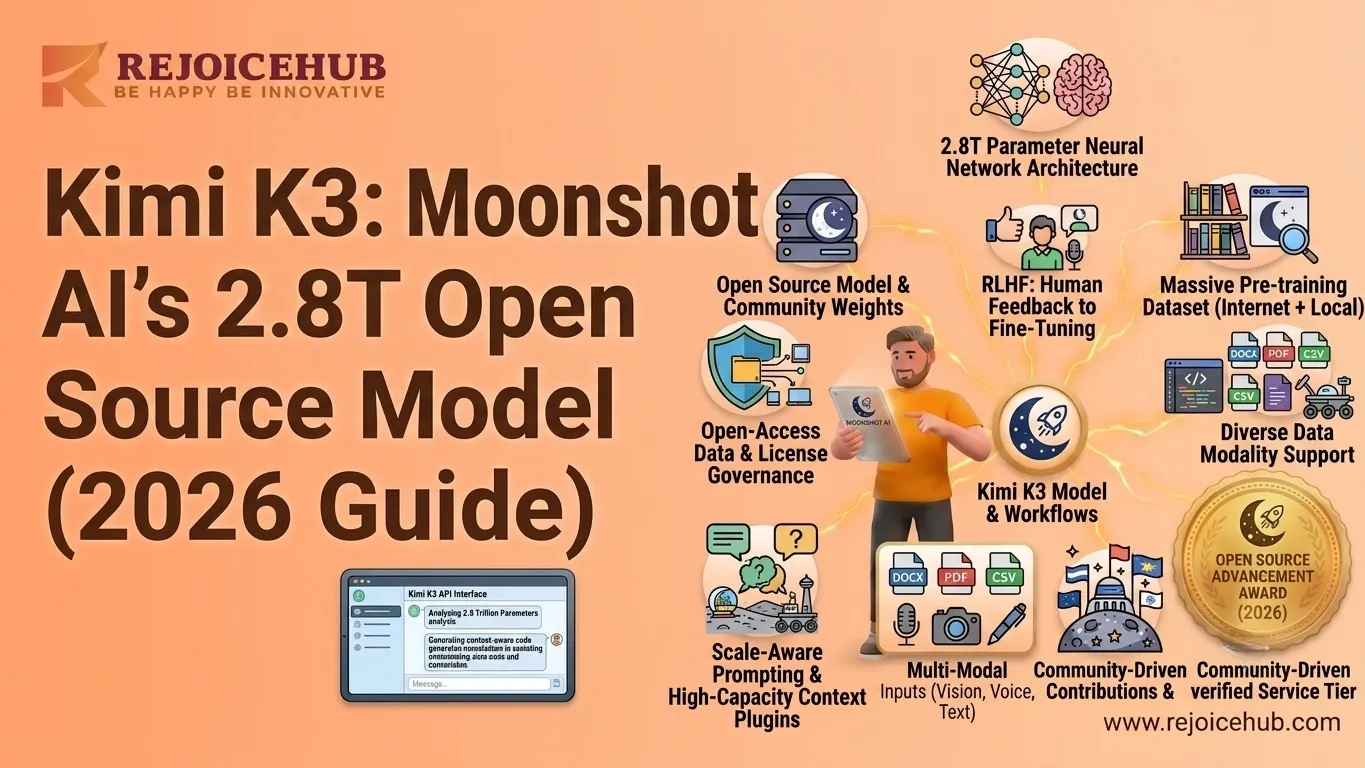
Kimi K3 is now the talk of the town in open-source AI circles. This 2.8-trillion-parameter open-weight model made its debut this month, July 2026, as Moonshot AI - the Chinese company behind the Kimi chatbot - announced Kimi K3 as the world's first "open 3T class" model, with independent evaluations deeming it competitive with the best proprietary large language models on the market.
The long-standing open-core AI race between Meta (Llama series), DeepSeek (R1/R2 research models and V series), and Moonshot (K2 series) has finally converged on a model that brings the capability of proprietary research to meet the performance of the open-source models. But what implications does this have for you - a startup founder or product manager trying to ship an AI product built on generative AI versus training your own large language models?
In this post, you'll learn:
• What Kimi K3 is, and how it came to be a "frontier" model in open-source AI
• How Kimi K3 differs from both Meta and DeepSeek open-source LLMs
• How Kimi K3 compares to GPT-5 and the Claude series in terms of capabilities
• How to access Kimi K3 and leverage it in practice
• How Kimi K3 fits into the overall stack of an open-source AI product in 2026
What Is Kimi K3?
Kimi K3 is the large language model of Moonshot AI's flagship release, a 2.8-trillion-parameter mixture-of-experts (MoE) model that will be open-weight on July 16, 2026. It offers a 1-million-token context window, vision capabilities, and a thinking mode for extended coding and agentic work.
A few quick facts to anchor the rest of this article:
Built by: Moonshot AI, a Beijing-based startup backed by Alibaba, Tencent, and Meituan Release date: July 16, 2026 (full open weights expected by July 27, 2026) Model type: Sparse Mixture-of-Experts (MoE), successor to the Kimi K2 family Positioning: Open-weight, released under Moonshot's Modified MIT License (following the pattern of K2.5, K2.6, and K2.7 Code)
Moonshot has been working towards this since Kimi K2 first came out in 2025. Kimi K3 is bigger than ever before, but what makes this release special is that Moonshot is actually open-sourcing the weights of a frontier-scale model for the first time, and no other company has achieved this at this level of parameters.
Key Features of Kimi K3
-
2.8 trillion parameter MoE architecture
On paper, Kimi K3 is gigantic; in reality, it's surprisingly efficient. It accomplishes this by utilizing a sparse Mixture of Experts (MoE) architecture, which Moonshot refers to as Stable LatentMoE - only 16 out of its 896 expert models are used for each token, or just 1.8% of the overall parameter count.
The benefit of this approach is clear: the performance of a 2.8 trillion parameter model, while only using roughly 1.8% of the parameters for each request.
Two architectural innovations drive this efficiency:
Kimi Delta Attention (KDA): A hybrid linear attention mechanism that Moonshot says enables significantly faster decoding in million-token contexts Attention Residuals (AttnRes): A technique that selectively retrieves information across model depth instead of accumulating it uniformly, improving training efficiency at minimal added cost
-
Long-context reasoning
The Kimi K3 large model is available with 1 million tokens in the context window, which is a big improvement compared to the previous K2 series 256K. This means that the model can process an entire code repository, a long legal document, or a stack of support tickets at once in one prompt.
Together with the new "always-on" thinking mode, K3 can perform multi-step reasoning by default and no longer needs a special mode for complex tasks, making it easier for various types of AI agents that need to plan before acting.
-
Coding capabilities
The area in which Kimi K3 has raised the most interest is coding, where it has topped independent evaluations on Arena's Frontend Code benchmark and has been found by Moonshot to be capable of performing long-horizon coding tasks with only minimal human intervention.
These are tasks that typically require working across dozens of files and multiple editing sessions, and such capabilities place K3 in direct competition with coding assistants like Claude Code and GitHub Copilot that developers currently rely on.
As a result, enterprise teams are considering Kimi K3 as a potential backend for internal copilots designed to assist with coding tasks.
-
Tool calling and agent support
Kimi K3 is optimized for agentic workflows, supporting structured tool calling, and is compatible with both OpenAI- and Anthropic-style APIs, as well as the Kimi Code CLI within the Moonshot Agent framework.
For enterprises looking to develop agentic applications, the capability to execute reliable tool calling is far more important than conversational fluency. The design of Kimi K3 reflects this reality, as it was engineered to address the unique demands of agent workloads, including effective context management and robust error recovery.
If you're evaluating models like Kimi K3 for a custom AI agent, RejoiceHub's AI agent development team can help you test, benchmark, and deploy the right model for your workflow.
Accelerate Your Workflows with Custom AI
Book a free consultation session with RejoiceHub. We'll map out a tailored automation roadmap for your company.
Kimi K3 Benchmarks and Performance
Moonshot places Kimi K3 just below the very best proprietary models, while significantly outperforming all others it was compared against, including other leading-edge models from OpenAI and Anthropic's previous iteration.
According to both Moonshot's own assessments and independent evaluations, here is Kimi K3's performance relative to other models:
| Model | Type | Parameters | Context Window | Where It Stands vs. K3 |
|---|---|---|---|---|
| Kimi K3 | Open-weight MoE | 2.8T total (~1.8% active) | 1M tokens | — |
| GPT-5 series (current: GPT-5.6 Sol) | Proprietary | Undisclosed | Large | Ahead on overall performance |
| Claude (current frontier models) | Proprietary | Undisclosed | Large | Top proprietary models edge out K3 overall; K3 outperforms mid-tier Claude models on coding/agentic tasks |
| DeepSeek (V4 Pro, successor to R1) | Open-weight | ~1.6T | Large | K3 is roughly 75% larger and scores higher on coding benchmarks |
| Llama (Meta's open-weight line) | Open-weight | Smaller-scale (dense/MoE variants) | Moderate | K3 significantly outsizes and outperforms on reasoning and coding |
A few things worth calling out:
Reasoning: K3's always-on thinking mode gives it a real edge over instruction-tuned models that need a separate reasoning mode toggled on through careful context engineering. Coding: K3 ranked first on independent frontend code benchmarks and reportedly outperformed prior-generation Claude and GPT-5 models on agentic coding tasks, though it still trails the newest top-tier proprietary releases. Math and reasoning benchmarks: Third-party evaluators place K3 among the top handful of models globally on composite reasoning leaderboards, a sharp jump from the K2 family.
The conclusion is that Kimi K3 is not the best model in the open-weight category, but it has achieved the best open-weight model so far, and on some tasks such as coding, it can even surpass some previous closed-weight large language models that require paid API calls.
How to Use Kimi K3
There are several ways to get access to Kimi K3, depending on whether you want a hosted service or full control over deployment.
Hugging Face: Full open weights are expected on Moonshot's Hugging Face organization by July 27, 2026, following the Modified MIT License used for the K2 family. GitHub: Moonshot typically publishes inference code, deployment guides, and tool-calling documentation alongside its Hugging Face releases. API: Kimi K3 is already live via Moonshot's API (model ID kimi-k3), with OpenAI- and Anthropic-compatible endpoints, priced at roughly $3 per million input tokens and $15 per million output tokens. Local deployment: Once weights are public, expect support through common inference engines such as vLLM and SGLang, following the same pattern as K2.5, K2.6, and K2.7 Code. Cloud deployment: For most businesses, running a 2.8-trillion-parameter model in-house isn't realistic. Cloud GPU providers and managed inference platforms are the practical path.
On hardware: Moonshot recommends serving K3 across dozens of accelerators at minimum. This is not a model you run on a laptop or a single GPU server - it's either enterprise-grade inference infrastructure or API-hosted.
Not sure whether local deployment, cloud hosting, or API access is the right call for your use case? RejoiceHub's Generative AI consulting services help teams choose and implement the right model infrastructure without overspending.
Kimi K3 Use Cases
Kimi K3's combination of scale, long context, and agentic design opens up several practical applications for businesses:
AI coding assistants Long-horizon coding support across entire codebases, thanks to the 1M-token context window Enterprise copilots Internal knowledge assistants that can hold large document sets (contracts, policies, support histories) in context AI agents Multi-step, tool-using agents for research, operations, and customer workflows, leveraging native tool calling, similar to what top AI agent companies are already building Research Academic and industry teams using an open-weight frontier model for reproducible experiments without API lock-in Customer support Agentic support bots that can reason through multi-turn tickets and pull from long historical context
If you're testing an agent for one of these use cases your actual model choice is only one part of what determines success in production. The agent framework, available tools, and appropriate guardrails also have a major impact on success.
Should You Use Kimi K3?
Pros
Open source: Full weights (expected under a Modified MIT License) mean no vendor lock-in and the freedom to fine-tune or self-host Strong coding performance: Ranks at or near the top of independent coding benchmarks among all models tested, proprietary or open Enterprise-friendly: Compatible with OpenAI/Anthropic-style APIs, making it easier to slot into existing agent frameworks and enterprise infrastructure
Cons
Hardware requirements: Running K3 locally requires substantial GPU infrastructure — this isn't a model most SMBs will self-host Early ecosystem: As a brand-new release, tooling, community fine-tunes, and third-party integrations are still catching up Production maturity considerations: The model launched days ago; full weights, official benchmarks, and long-term stability data are still coming in
Practical recommendations
If you are a developer or technical team, you should consider trying Kimi K3 API for coding and agentic tasks, at least for now, while it still offers a significant cost per task advantage over the best alternatives.
If you are a business or SaaS shop that does not have the resources to host models, you should wait for the open weights to stabilize and focus on building the right agent around it rather than trying to run it yourselves.
The biggest opportunities for most companies are likely to be found in creating the right agent architecture around the model.
Conclusion
The significance of Kimi K3 lies in its demonstration that open-weight models can rival the best proprietary models in practical applications such as coding and reasoning with extensive context, not just theoretical benchmarks. Kimi K3 represents the largest open-weight model ever published and is right up there with the state-of-the-art models from OpenAI and Anthropic.
The position of Kimi K3 in the open-source model hierarchy is at the top, along with the recent models from DeepSeek and Meta's Llama series, but at a significantly higher level in terms of parameter count and capabilities, setting new standards for what open-source models can achieve in 2026.
The decision to adopt Kimi K3 as a business-critical model depends on the specific requirements of the application, the available infrastructure, and the maturity of the surrounding technology stack. The primary recommendation is to conduct a thorough analysis of the use case and its alignment with the available resources.
Frequently Asked Questions
1. What is Kimi K3?
Kimi K3 is Moonshot AI's newest open-source AI model, built with 2.8 trillion parameters. It uses a mixture-of-experts design, so it only activates a small part of its parameters for each task. This makes it powerful but still efficient enough to run without needing endless computing power.
2. Who made Kimi K3 AI?
Kimi K3 was built by Moonshot AI, a startup based in Beijing. The company is backed by big names like Alibaba, Tencent, and Meituan. Moonshot is already known for its earlier Kimi K2 model series, and K3 is their biggest and most advanced release so far.
3. Is Kimi K3 free to use?
Yes, Kimi K3 is open source and released under Moonshot's Modified MIT License, so anyone can download and use the weights once fully available. If you don't want to host it yourself, you can also use Moonshot's API, which charges based on how many tokens you use.
4. How does Kimi K3 compare to GPT-5?
GPT-5 still performs better overall, especially on general tasks. But Kimi K3 holds its own in coding and agent-based work, and it beats older Claude and GPT models in some benchmarks. Since K3 is open source, it also gives more flexibility than closed models like GPT-5 don't offer.
5. How does Kimi K3 compare to Claude?
Top Claude models still perform better overall than Kimi K3. But K3 manages to beat mid-tier Claude models when it comes to coding and agentic tasks. So while Claude's best models stay ahead, Kimi K3 proves that open-source models are catching up fast in specific areas.
6. What makes Kimi K3 different from DeepSeek and Llama?
Kimi K3 is bigger than DeepSeek V4 Pro, roughly 75% larger, and it scores higher on coding tests. Compared to Meta's Llama models, K3 clearly performs better in reasoning and coding tasks too. Its large size combined with strong benchmark results puts it ahead of both.
7. How can developers start using Kimi K3?
Developers can access Kimi K3 through Moonshot's API right away, since it works with both OpenAI and Anthropic-style formats. Full open weights will be available on Hugging Face soon. For local use, you'll need strong GPU setups, since this model isn't built to run on regular laptops.