In the span of eighteen months, open-weight AI models have transitioned from an interesting experiment to a central decision point for businesses. Today, when a company wants to develop an application leveraging large language models (LLMs) in 2026, the question is no longer whether they should build upon an open model, but rather which one to choose.
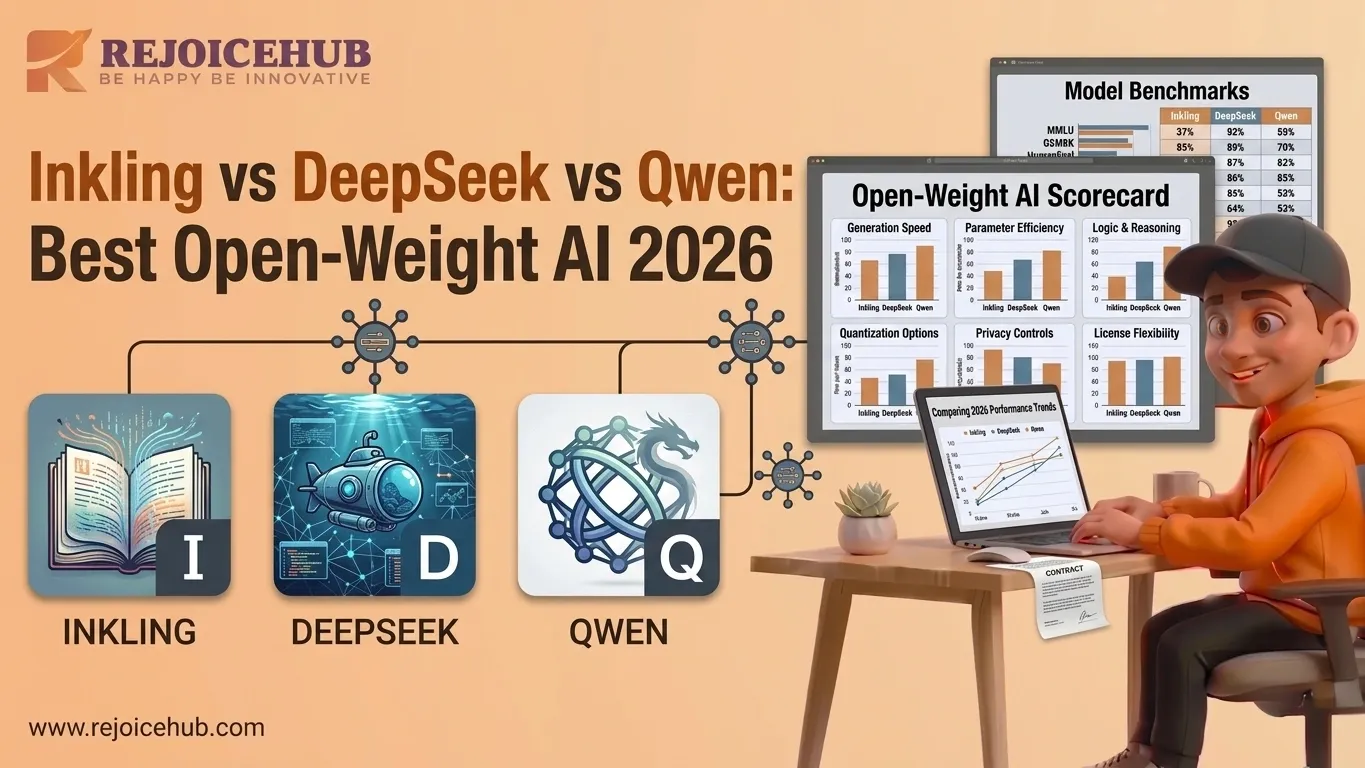
At the forefront of this discussion are the open models of Inkling, DeepSeek, and Qwen, all of which released impressive open-weight language models in 2026. However, each company has taken a different approach to offering its solution, balancing performance, license friendliness, and enterprise readiness.
This guide is intended for founders, CTOs, and product leaders considering adopting one of these open-weight language models, comparing and contrasting the capabilities of each in coding, reasoning, agents, and enterprise readiness, and evaluating which use cases are better served by a proprietary model over an open alternative. This is also the same evaluation process our team at RejoiceHub runs before recommending a model for a client's AI agent or automation project. If you'd rather skip the research and get a model matched to your workload, our AI Development Services team can help.
What Are Inkling, DeepSeek, and Qwen?
Before comparing the two models, it is important to understand the differences between them, what they are used for, and who created them. All three language models are part of the wider open-source LLM ecosystem, which is competing with proprietary models such as GPT and Claude.
1. Inkling AI Overview
Inkling is the first open-weight foundation model from Thinking Machines Lab, the AI startup founded by former OpenAI CTO Mira Murati. It launched in mid-2026 under an Apache 2.0 license one of the most business-friendly licenses in open-weight AI.
Core capabilities:
- Mixture-of-Experts architecture with a large total parameter count but a much smaller active parameter footprint, keeping inference costs manageable.
- Native multimodal support across text, images, and audio.
- Controllable "thinking effort," letting developers dial reasoning depth up or down depending on the task.
- Strong emphasis on calibration: the model is trained to express appropriate confidence rather than answering everything with false certainty, which reduces hallucination in production use.
- Competitive coding performance on SWE-bench Verified, positioning it as a serious option for engineering-heavy workloads.
Target users: Enterprises seeking to specialize a base model on their data, developers of latency-critical agents (e.g., coding assistants, LLM graders, synthetic data generators), and users who want a western Apache-licensed alternative to chinese open-weight models.
2. DeepSeek AI Overview
DeepSeek requires less introduction than ever before, as the Chinese AI lab's home-grown models continue to deliver near-frontier performance at a tiny fraction of the cost of its closed counterparts.
Strengths:
- Two-tier release strategy: a large "Pro" model for maximum capability and a smaller "Flash" model for latency-sensitive, high-volume workloads.
- Extremely aggressive pricing often a tenth or less of what comparable closed models charge per output token.
- A hybrid attention architecture that makes long-context processing (up to 1 million tokens) far cheaper to run than earlier generations.
- Strong agentic coding results, with independent trackers placing DeepSeek's flagship among the highest-scoring open-weight models on SWE-bench Verified.
- Open-weight ecosystem: DeepSeek releases full weights under the MIT license, one of the most permissive licenses available, and the model has broad day-one support across vLLM, SGLang, and major inference platforms.
3. Qwen AI Overview
Qwen is Alibaba's model family, and it has split into two tracks in 2026: an open-weight model fully licensed under Apache 2.0, and a closed flagship series of models available only via API for customers who want the most powerful agentic model from Alibaba.
Alibaba's most capable agentic model.
Alibaba's AI ecosystem: Qwen is a complete model that includes Qwen Code (the terminal coding agent), Qwen Agent (the tool-use model), Qwen Studio, and is deeply integrated into Alibaba Cloud Model Studio. The open-weight version also connects to third-party coding tools such as Claude Code, Cline, and OpenCode.
Enterprise focus: The large language model Qwen was designed for long-horizon autonomous agent workflows, which often entail tens of thousands of reasoning steps over dozens of hours, and for multilingual support for more than 200 languages, which are both critical for enterprise-level business scenarios.
Across all three, you're looking at genuine contenders in the open-source LLMs category, each with a different bet on what enterprises actually need.
Inkling vs DeepSeek vs Qwen Comparison
Here's how the three stack up across the criteria that matter most for real deployments.
| Feature | Inkling | DeepSeek | Qwen |
|---|---|---|---|
| Coding | Strong; competitive SWE-bench Verified scores, efficient token usage on coding tasks | Very strong; among the top open-weight scorers on SWE-bench Verified | Strong across both open (Qwen Coder) and closed (Qwen Max) tiers; excellent terminal/agentic coding |
| Reasoning | Solid general reasoning with controllable "thinking effort" for cost control | Near-frontier reasoning on math and knowledge benchmarks, though independent evals show a gap vs. closed frontier models | Flagship model posts high scores on reasoning benchmarks like GPQA; open-weight tier is more modest |
| Context Window | Up to 1 million tokens | Up to 1 million tokens by default | Up to 1 million tokens (flagship); smaller for some open-weight variants |
| Token Efficiency | Designed for cost/latency-sensitive workloads with a small active-parameter footprint | Hybrid attention architecture sharply cuts inference cost at long context lengths | Efficient MoE variants (small active-parameter models) available for self-hosting |
| AI Agents | Good agentic tool use; still an early ecosystem compared to the other two | Strong agentic coding; growing agent tooling support | Purpose-built for long-horizon agents — demonstrated 30+ hour autonomous runs with 1,000+ tool calls |
| Fine-Tuning | Purpose-built for fine-tuning via its own platform; designed to "rapidly learn" from customization | Fully open weights under MIT make fine-tuning straightforward, no restrictions | Open-weight tier is fully fine-tunable under Apache 2.0; flagship (closed) is not |
| Enterprise Deployment | Apache 2.0, Western jurisdiction, VPC/on-prem friendly | MIT license, extremely cost-efficient, but data residency is a consideration for some industries | Mature ecosystem, extensive multilingual support, but flagship model is API-only |
-
AI Benchmarks
No single model was overall superior based on the provided benchmarks, and vendor-reported performance significantly exceeded results on independent evaluations. When comparing models based on their reported scores, look at software-engineering benchmarks (SWE-bench verified, Terminal-Bench) which test code-writing ability, and knowledge/reasoning benchmarks (GPQA, MMLU-Pro) which evaluate verbal reasoning.
While all models are relatively similar on most metrics, results on independent tests are generally lower than scores reported by the vendors developing the models, so it's worth looking out for this discrepancy when considering which model to use.
-
Context Window
A wide context window is often more valuable than most benchmarks suggest. All three models can now hold up to 1 million tokens in context, enough to fit an entire codebase, a year's worth of support tickets, or a regulatory filing.
The critical difference is that retrieval quality drops off dramatically before hitting these theoretical limits, and you should always test with your specific data to see how it performs in practice.
-
Token Efficiency
Token efficiency, or the ratio of computational resources spent per token to quality, is where the savings are found.
All the mentioned solutions make use of a Mixture-of-Experts-type inference architecture that only activates a fraction of parameters for any given request. This lets models with hundreds of billions of parameters stay within budget. Both DeepSeek and Qwen offer significantly reduced parameter counterparts for latency-sensitive applications, and Inkling's active parameter footprint is similarly designed to maximize performance within a specific price range.
Which AI Model Performs Best for Different Use Cases?
1. Best for Coding
For raw coding throughput, the battle between DeepSeek vs Qwen for coding is probably between the best optimized coding assistants available at the moment, as both companies have independently released their own coding-optimized models, which have been tested and verified against high SWE-bench scores.
While DeepSeek's flagship appears to have an edge in terms of raw performance, Qwen's open-weight coding models have demonstrated exceptional performance on lower-end GPUs, giving better throughput per watt. Inkling is a strong contender, but it is still early days for this particular model, and there are fewer independent third-party performance evaluations at this time.
2. Best for AI Agents
This is my favorite category, and the one which shows off Qwen's main strength. Their flagship model was explicitly made with long-horizon, tool-heavy agent workflows in mind, and they show off the fruits of that development with various multi-hour-long autonomous chains of hundreds of tool calls each.
DeepSeek is right up there with good agentic coding performance, while Inkling's controllable reasoning depth makes them a good choice for more cost-sensitive agents requiring only limited autonomy per task.
3. Best for Enterprise AI
When considering enterprise-class artificial intelligence, the choice between the presented solutions is typically made based on licensing terms and data residency, rather than raw performance specifications. For instance, Inkling's Apache 2.0 license and availability in the Western jurisdiction make it an attractive choice for enterprises that are hesitant to rely on Chinese-based infrastructure. On the other hand, the MIT license of DeepSeek and its affordable pricing make it a compelling choice for cost-sensitive organizations that prefer to host the model on their own infrastructure.
Qwen offers the broadest range of languages and the most comprehensive set of tools, thus supporting the diverse needs of enterprises better than its competitors. However, its largest language model is only available via an API, which creates limitations for organizations that wish to host it on their own servers.
4. Best Self-Hosted LLM
If self-hosting is a priority, the optimal self-hosted LLM in 2026 conversation narrows to three: Flash (DeepSeek), open-weight Qwen, and Inkling. All three offer the crucial ability to run on substantial but non-exotic infrastructure (multi-GPU servers), and to fine-tune without license constraints.
Which of these models should developers prioritize? For coding accuracy and a willingness to invest in infrastructure, DeepSeek Pro offers the best value. For agents that must persist across many interactions and use a variety of tools, Qwen's open-weight models are better optimized. For licensing flexibility and more surgical hallucination control, Inkling appears most promising.
Strengths, Weaknesses, and Cost Considerations
Benchmarks only tell part of the story. Here's what actually shapes a deployment decision.
1. Licensing
- Inkling: Apache 2.0 permissive, commercial-friendly, no attribution headaches.
- DeepSeek: MIT arguably the most permissive license in this comparison, with almost no restrictions on commercial use or redistribution.
- Qwen: Apache 2.0 for open-weight models, but the flagship tier is fully proprietary and API-only.
2. Infrastructure requirements
All three flagship models are large enough that consumer GPUs won't cut it for the top tier. Expect to need multi-GPU cloud infrastructure (or a serious on-prem cluster) for the largest variants, while the "Flash," "Coder," and smaller MoE variants can run on a single high-end GPU or even a well-specced Mac for lighter workloads.
3. AI Cost Optimization
This is where open-weight models earn their reputation. Running inference on your own infrastructure trades a per-token API bill for a fixed compute cost which usually wins decisively at scale. Teams processing large volumes of documents, support tickets, or code reviews routinely report cutting inference spend by 70–90% compared to closed frontier APIs. The tradeoff is that you now own the DevOps: scaling, monitoring, and keeping the model updated becomes your team's job.
4.Hardware needs
- Small, distilled variants (13B–35B active parameters): single high-end GPU or a handful of consumer GPUs.
- Flagship variants (40B+ active parameters, 1T+ total): multi-GPU nodes with high memory bandwidth, typically in the cloud rather than on-prem for most teams.
5. Ecosystem maturity
DeepSeek and Qwen both have longer track records, broader third-party tool support, and more community-maintained fine-tuning recipes. Inkling is newer, but backed by a well-funded lab and already integrated with major inference providers expect its ecosystem to mature quickly given the pace of releases in this space.
Which Open-Weight AI Model Should You Choose?
There's no universal winner the right choice depends on your team, your workload, and your compliance requirements.
-
Developers building coding assistants or fine-tuning experiments: Start with DeepSeek or Qwen's open-weight coder models both have mature tooling, strong community support, and proven benchmark performance.
-
Startups that need to move fast and control costs: DeepSeek's aggressive pricing and MIT license make it easy to prototype without licensing friction, while Qwen's smaller MoE variants are a strong fallback if you need to self-host cheaply.
-
Enterprises with data residency or compliance requirements: Inkling's Apache 2.0 license and Western origin are worth serious consideration, especially for regulated industries. Qwen's flagship is a strong alternative if you're comfortable with an API-only relationship.
-
AI researchers exploring fine-tuning, calibration, or agentic behavior: Inkling's focus on calibration and controllable reasoning effort makes it an interesting research platform, while Qwen's long-horizon agent demonstrations are worth studying for anyone building autonomous systems.
If you're not sure which category you fall into or you want a model matched precisely to your workload instead of guessing from a comparison table that's exactly the kind of evaluation our team handles for clients before any code gets written.
Conclusion
A discussion on who is better among Inkling, DeepSeek, and Qwen does not have a definite answer. Each has its advantages and disadvantages. In my opinion, it can be summarized in three aspects.
Inkling has the most controllable hallucinations while providing Western platform licensing. DeepSeek has the most aggressive pricing strategy and outstanding coding benchmarks. Qwen has the most practical agentic ecosystem and the most comprehensive enterprise-level multilingual solutions.
The choice between these three depends on specific scenarios, technical implementations, and team structures.
No matter which you choose, you will see that the best open-weight LLMs have finally been able to reach near frontier-level closed models and become a viable alternative.
Frequently Asked Questions
1. What is the difference between Inkling, DeepSeek, and Qwen?
Inkling comes from Thinking Machines Lab and uses a Western Apache 2.0 license. DeepSeek is a Chinese lab's model released under the MIT license, known for its cheap pricing. Qwen, from Alibaba, offers both open-weight and closed tiers, with strong agentic and multilingual support built in.
2. Which is better for coding, DeepSeek or Qwen?
DeepSeek's flagship model usually scores a bit higher on coding benchmarks like SWE-bench Verified, while Qwen's open-weight coder models run efficiently even on lower-end GPUs. Both are solid choices, so the right pick really comes down to your budget, hardware, and project needs.
3. Is Inkling AI good for enterprise use?
Yes, Inkling AI is a good fit for enterprises that want a Western, Apache 2.0-licensed model with simpler compliance. It supports VPC and on-prem deployment, along with calibrated confidence scoring and controllable reasoning depth, which makes it appealing for regulated industries and data-sensitive teams.
4. What is the best self-hosted LLM in 2026?
There's no single winner here. DeepSeek Flash works well for teams wanting low-cost coding performance, Qwen's open-weight models handle long agent workflows nicely, and Inkling offers licensing flexibility with stronger hallucination control. The best pick really depends on your workload and infrastructure setup.
5. Which open-weight AI model is best for AI agents?
Qwen stands out here, since it was built for long-horizon, tool-heavy tasks and has shown autonomous runs lasting over 30 hours with more than 1,000 tool calls. DeepSeek also performs well in agentic coding, while Inkling works best for smaller, cost-sensitive agent tasks.
6. Are Inkling, DeepSeek, and Qwen free to use?
All three release their weights under fairly open licenses, Apache 2.0 for Inkling and Qwen's open tier, and MIT for DeepSeek, so there are no licensing fees to download and run them. You'll still need to pay for the compute required to host and run the model.
7. Which AI model should developers choose in 2026?
It really depends on what you're building. Developers focused on coding should try DeepSeek or Qwen's coder models; teams needing compliance and calibration should look closely at Inkling; and anyone building autonomous agents will likely get more value from Qwen's long-horizon capabilities.