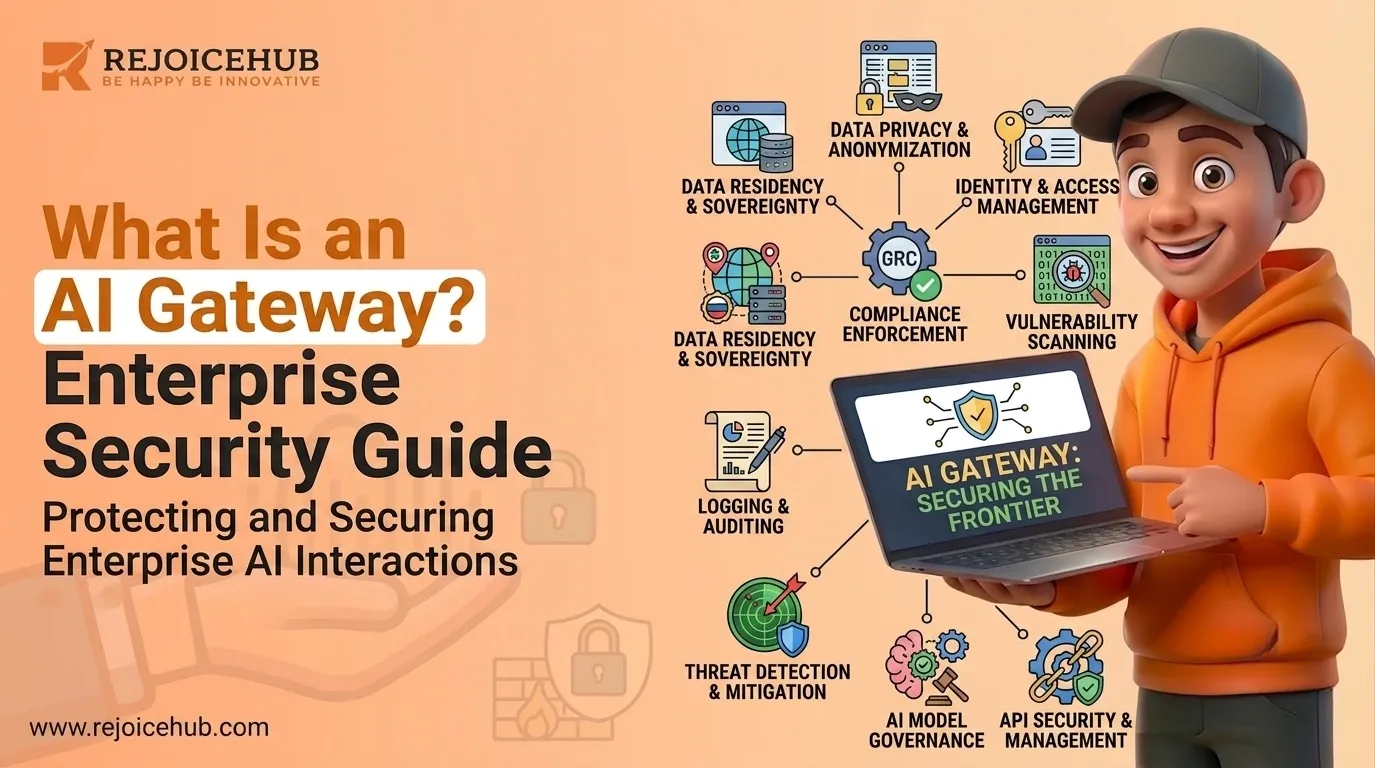
AI adoption within the enterprise is no longer a peripheral concern but rather the core enabler for how teams build code, engage with customers, and make decisions. As organizations move deeper into deploying AI agents for business automation, the need for centralized control becomes impossible to ignore.
However, few companies plan for issues that arise when five departments have deployed five different large language models (LLMs), each querying separate foundational models (FMs) with different API keys and proprietary data flowing out to unknowing IT or security teams.
In this post, we will walk through what an AI Gateway is, discuss why it is an essential enabler for responsible enterprise-wide AI innovation, review architectural patterns for implementing these critical security layers, and examine how vendors such as Prisma AIRS and NVIDIA OpenShell are approaching the task.
We will also discuss open-source AI Gateway options and share an evaluation framework to help you choose the right solution.
In short, you will want to read this post if you plan on building or operating AI agents in any capacity within your enterprise.
What Is an AI Gateway?
Definition
An AI Gateway is a control plane that sits between your application and the target AI models (LLMs) it uses. This means that instead of calling the models directly (OpenAI, Claude, Gemini, Llama, Mistral), all requests go through the gateway.
An API gateway is a well-known concept in the backend domain, and an AI gateway follows similar principles, but it is specialized to address the unique challenges arising when dealing with generative models, such as prompt injection, token costs, model diversity, and data safety.
Purpose
An AI Gateway exists to answer questions traditional infrastructure was never designed to handle:
- Which team, app, or agent is calling which model, and why?
- Is this prompt safe, or is it trying to manipulate the model?
- How much is this costing us, per request, per team, per month?
- Are we leaking customer PII into a third-party LLM?
- Can we swap providers without rewriting every application?
These questions become even more pressing as businesses grapple with non-human identities in enterprise AI, where agents and services not just people need their own verifiable credentials and access boundaries.
How It Sits Between Applications and AI Models
In a simple setup, there is no gateway between your application and the model providers. This means no shared policy, no shared logging, and no centralized place to enforce rules.
With an AI Gateway, it works like this:
Application → AI Gateway → Model Provider (OpenAI, Claude, Gemini, Llama, Mistral)
The gateway examines, authenticates, logs, and routes each request, regardless of which provider is the target. This makes it a control layer, not just an API facade.
Why Enterprises Need an AI Gateway
Typically, enterprises do not rely on one model - a midsize company may use Claude for customer service, GPT-4 class for internal tools, some open-source Llama for lower-end applications, and Gemini for a particular product feature. And without a model gateway, each of these is an attack surface.
Here's what an AI Gateway centralizes:
- Centralized AI governance: one place to set and enforce rules across every model and team, instead of policies scattered across a dozen codebases.
- Authentication: verifying which users, services, or agents are allowed to call which models, with proper credential management instead of hardcoded API keys.
- Usage monitoring: real-time visibility into who is calling what, how often, and with what results.
- Cost management: token-level tracking and budgets so one runaway agent or one chatty prompt doesn't blow up your monthly bill.
- Compliance: consistent enforcement of data-handling rules across regulated industries like finance, healthcare, and insurance.
- Model routing: sending requests to the right model based on cost, latency, capability, or failover needs, without changing application code.
- Prompt protection: screening inputs and outputs for injection attempts, jailbreaks, and sensitive data before they reach or leave the model.
If you need to create a custom AI agent for your business, RejoiceHub can help you design the very foundation of its governance from the ground up, rather than trying to retrofit it later.
Accelerate Your Workflows with Custom AI
Book a free consultation session with RejoiceHub. We'll map out a tailored automation roadmap for your company.
AI Gateway Architecture Explained
Components
A well-designed AI Gateway architecture typically flows through six stages:
Application ↓ Gateway ↓ Policy Engine ↓ Security Layer ↓ Routing Layer ↓ LLM Providers ↓ Monitoring
Here's what happens at each stage:
- Prompt inspection: incoming prompts are scanned for injection attempts, malicious instructions, and policy violations before they ever reach a model.
- Token management: the gateway tracks and can cap token usage per user, team, or application, giving finance and engineering shared visibility into cost.
- Model routing: requests are directed to the appropriate provider or model version based on rules you define (cost, task type, region, or fallback logic).
- Logging: every request and response is logged for audit, debugging, and compliance purposes.
- Rate limiting: protects both your budget and the model provider's API limits from being overwhelmed by a single misbehaving agent or user.
- Guardrails: automated checks that block unsafe outputs, hallucinated instructions, or responses that violate brand and compliance standards.
This kind of layered design is closely tied to good context engineering in AI, since how information flows through each stage directly shapes how reliably the model behaves downstream. This architecture is what separates a production-grade AI deployment from a fragile prototype that happens to work in a demo.
AI Gateway Security and LLM Protection
Security is the single biggest reason enterprises adopt an AI Gateway. Generative AI introduces attack surfaces that firewalls and traditional API gateways were never built to catch.
-
Enterprise AI Security
At the enterprise level, AI security means protecting four things simultaneously: the application, the model, the data, and increasingly the autonomous agents acting on a company's behalf.
-
Prompt Injection
Prompt injection occurs when an attacker inserts instructions in the prompt, document, or webpage that subvert the model's intended behavior. A gateway that performs prompt inspection can identify such patterns, an issue closely related to broader questions around how generative AI is used in cybersecurity.
-
Jailbreak Protection
Jailbreaks attempt to undermine the safety of a model by encouraging it to act contrary to its safety policies. AI Gateways detect and block these attempts in real-time across all requests, regardless of which team they are sent to.
-
Sensitive Data Masking
Before a prompt is sent to an external model, sensitive fields such as customer names, account numbers, or health information can be automatically masked or redacted, then re-introduced in the response if necessary.
-
Role-Based Access
Before a prompt is sent to an external model, sensitive fields such as customer names, account numbers, or health information can be automatically masked or redacted, then re-introduced in the response if necessary.
-
PII Detection
Automated detection flags personally identifiable information in both prompts and completions, which is critical for industries under GDPR, HIPAA, or CCPA obligations.
-
Audit Logging
Every interaction prompt, response, user, timestamp, model version gets logged in a way that supports compliance audits and incident investigations.
-
Model Governance
Governance covers which models are approved for use, how they're versioned, and how changes are reviewed before rolling out to production. This is one reason many teams look closely at platforms like Claude's managed agents for businesses, which bake governance controls directly into the deployment model.
-
OWASP LLM Risks
The OWASP Top 10 for LLM Applications outlines the most common risks in generative AI systems, including prompt injection, insecure output handling, training data poisoning, and excessive agency. A strong AI Gateway addresses most of these categories directly at the infrastructure layer, rather than leaving each application team to solve them independently a comparison worth exploring alongside how Claude Security stacks up against Copilot for enterprise security.
Popular AI Gateway Products
-
Overview: Prisma AIRS by Palo Alto Networks is not a point solution; it is a security platform protecting the extended AI lifecycle from applications, models and data to autonomous agents.
-
Strengths: It combines runtime protection against prompt injection, sensitive data loss, and malicious code with posture management and red-teaming capabilities that test AI systems the way a real attacker would.
-
Enterprise Security: For enterprises already standardized on Palo Alto Networks' security stack, Prisma AIRS offers the ability to extend familiar policy and visibility tools into the AI layer, reducing the burden of managing an additional solution.
NVIDIA OpenShell
-
Overview: NVIDIA OpenShell is an open-source runtime for executing autonomous AI agents in isolated environments where they can access files, make API calls, and use credentials without direct access to the underlying infrastructure.
-
Open Architecture: OpenShell enforces declarative, policy-based controls at the kernel level, governing exactly what an agent can access, execute, or reach over the network and it logs every allow and deny decision for a full audit trail.
-
Agent Integration: Because it's designed agent-first, OpenShell works with coding and automation agents directly, making it a strong fit for engineering teams running multiple autonomous agents across shared infrastructure, including GPU-backed environments. Teams evaluating this kind of interoperability often also look at what the Model Context Protocol (MCP) is and how it standardizes agent-to-tool communication.
Open Source AI Gateways
Beyond the two above, several open-source projects have become popular building blocks for teams that want more control over their AI infrastructure:
- Solo.ioa: extends API gateway expertise into AI traffic management and governance.
- Kong AI Gateway: built on Kong's established API gateway platform, adding LLM-specific routing and security plugins.
- LiteLLM Proxy: a lightweight, developer-friendly proxy for routing requests across dozens of LLM providers with a unified API format.
- APIPark: an open-source AI gateway focused on unifying API management for both traditional and AI-driven services.
As the broader AI agent infrastructure market continues to mature, expect this list of open-source options to grow quickly.
Comparison Table
| Solution | Type | Best For | Key Strength |
|---|---|---|---|
| Prisma AIRS | Managed/Enterprise | Large enterprises, regulated industries | Full AI lifecycle security + red-teaming |
| NVIDIA OpenShell | Open-source | Engineering teams running autonomous agents | Kernel-level sandboxing for agents |
| Solo.io | Open-source/Managed | Teams already using service mesh/API infra | AI traffic governance at scale |
| Kong AI Gateway | Open-source/Managed | Teams standardized on Kong | Mature plugin ecosystem |
| LiteLLM Proxy | Open-source | Startups, fast-moving dev teams | Simple multi-provider routing |
| APIPark | Open-source | Teams unifying API + AI management | Unified API and AI gateway |
Choosing the Right AI Gateway
Use this checklist to narrow down your options:
- Enterprise size: a 20-person startup and a 5,000-person enterprise have very different governance needs.
- Compliance: do you operate under HIPAA, GDPR, SOC 2, or industry-specific regulations?
- Open-source vs. managed: do you have the engineering bandwidth to run and patch your own gateway, or do you need a vendor-managed platform?
- Security depth: does it cover prompt injection, jailbreaks, PII masking, and agent-level risk, or just basic routing?
- Supported LLMs: can it route across OpenAI, Claude, Gemini, Llama, and Mistral without vendor lock-in?
- Observability: can you see cost, latency, and usage per team in real time?
- Scalability: will it hold up as you go from one AI feature to dozens of AI agents running in production?
There's no universal answer here the right gateway depends on your risk tolerance, your existing stack, and how fast your AI usage is growing. If you're still mapping out the numbers, it helps to first understand the cost to build an AI agent before committing to a gateway architecture around it.
Conclusion
AI gateways, whether they be managed platforms like Prisma AIRS, open-source runtimes like NVIDIA OpenShell, or even a light-weight proxy like LiteLLM, are table stakes for any enterprise that wants to manage more than one AI model or agent in production.
They offer critical governance and security capabilities not available through ad-hoc API calls.
And make sure you pick something you can build governance and security into from the ground up, and not something that only provides those capabilities after the fact (and, inevitably, too late). For a broader look at putting these pieces together, see our guide on how to build an AI agent stack for your business.
Looking to build secure AI applications or enterprise AI agents? Explore RejoiceHub's AI development services to design scalable, secure, and production-ready AI solutions tailored to your business.
Frequently Asked Questions
1. What is an AI Gateway?
An AI Gateway is a control layer that sits between your app and AI models like Claude, GPT, or Gemini. Instead of connecting to each model directly, every request passes through the gateway first, so you get one place to manage security, cost, and access.
2. Why do enterprises need an AI Gateway?
Most companies use more than one AI model across different teams. Without a gateway, there's no shared way to track usage, stop data leaks, or set rules. An AI Gateway brings all of this together, so nothing slips through the cracks as your AI use grows.
3. How does Prisma AIRS help with enterprise AI security?
Prisma AIRS protects your whole AI setup, not just one part. It watches for prompt injection, blocks sensitive data from leaking out, and even tests your AI systems like a real attacker would. It's built for large companies that already trust Palo Alto Networks for security.
4. What makes NVIDIA OpenShell different from other AI gateways?
NVIDIA OpenShell is open-source and built for running AI agents safely. It controls exactly what an agent can touch, run, or connect to, and logs every decision. This makes it a solid pick for engineering teams managing multiple agents on shared systems.
5. What is prompt injection, and why does it matter?
Prompt injection happens when someone sneaks harmful instructions into a prompt, file, or webpage to trick an AI model into doing something it shouldn't. It's one of the biggest risks in AI today, and a good gateway catches these attempts before they reach the model.
6. Can an AI Gateway help with compliance like GDPR or HIPAA?
Yes. AI Gateways can spot and mask sensitive data like names, health records, or account numbers before it ever reaches an outside model. They also log every request and response, which makes audits and compliance checks much easier for regulated industries.
7. Which AI Gateway should I choose for my business?
It depends on your size, budget, and compliance needs. Large enterprises often lean toward Prisma AIRS, while teams running AI agents may prefer NVIDIA OpenShell. Startups on a budget sometimes start with open-source options like LiteLLM Proxy or Kong AI Gateway instead.