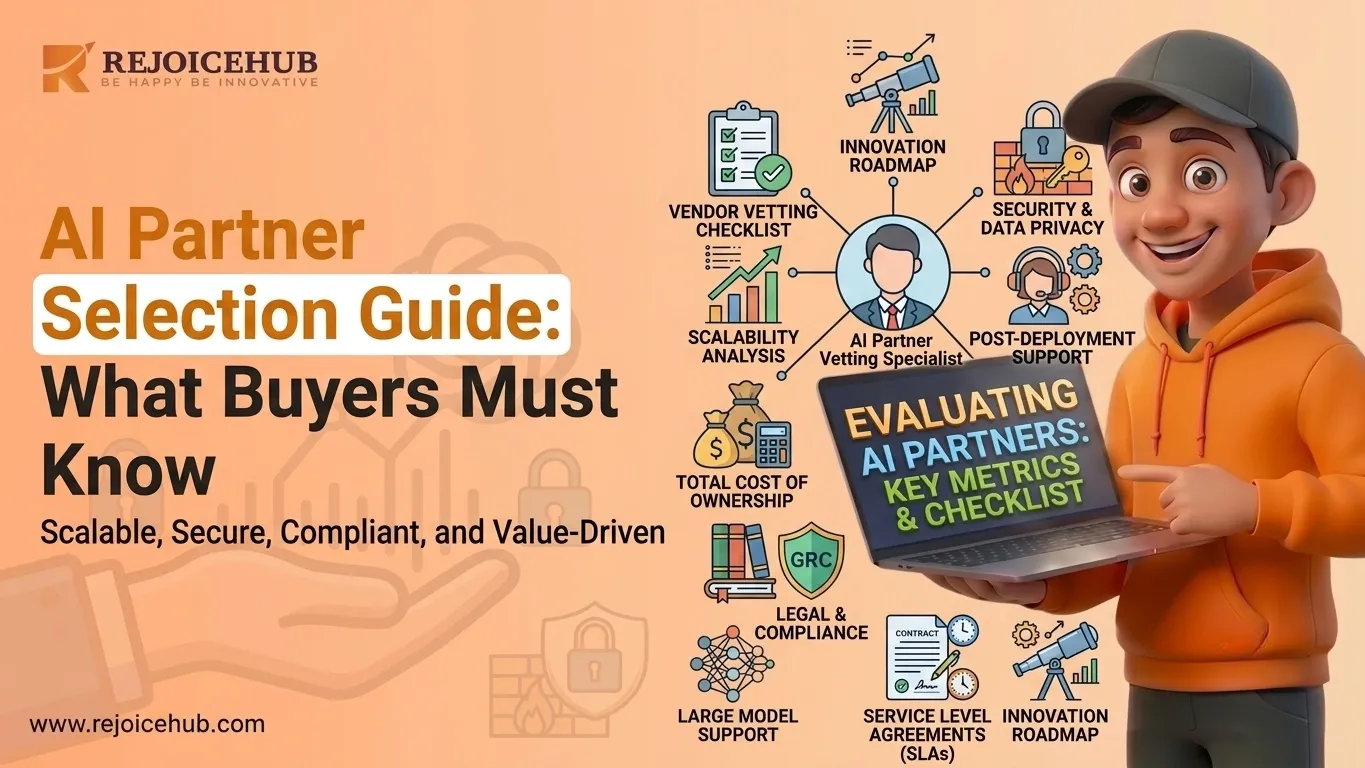
Just two years back, most companies were still asking, "Should we use AI?"
Right now, the question kind of drifted to "which AI partner should we trust?"
That's a pretty big jump, and honestly, it comes with real stakes.
The AI solutions market has really taken off. Hundreds of vendors now say they can handle intelligent automation, custom AI agents, and full-blown end-to-end workflows. But not all of them will actually land the plane. And the wrong selection can cost your business more than a simple budget; it can slow everything down. If you're still figuring out the basics, it helps to first understand what AI automation actually means and how it works before evaluating any vendor.
Here's what every buyer should know before signing anything on the dotted line.
Why the AI Market Just Got a Lot More Complicated
In 2024 alone, global investment in AI passed $200 billion, pretty much instantly in a way that makes everyone pause. Now the market feels like it is kind of flooded with vendors, from well-funded startups to enterprise giants; they all claim they can overhaul your business using AI automation solutions, or at least that's the story you keep hearing.
Still, the statistic most sales teams never really mention is this one: 60% of AI pilots fail within year one.
So the real shakeup isn't only about fresh names showing up. It's more about the widening gap between AI vendors who overpromise and the ones that actually bring AI into your day-to-day workflows in a meaningful way, not just in slide decks or demos.
| Metric | Figure |
|---|---|
| Global AI investment (2024) | $200B+ |
| US companies piloting AI | 72% |
| ROI reported by AI automation, early adopters | 3x average |
| AI pilots that fail in year one | ~60% |
The real risk isn't missing out on AI it's choosing to invest in the wrong AI partner, you know. When an implementation kind of fails, it can cost 4–6x more than the original contract, especially once you add in lost productivity, retraining of teams, and those delayed timelines that show up later, kinda.
5 Critical Questions to Ask Before Choosing an AI Partner
1. Do they build custom AI agents or just resell tools?
There's a big difference between a vendor that connects your existing tools with pre-made templates and someone who actually builds custom AI agents, tuned to how you work.
Off-the-shelf AI might help with the easy stuff, but if your processes are a little unusual, a generic tool will only take you about 20% of the way, not the whole journey.
What you really want are partners who can architect AI agents that grasp your specific business logic, the data inputs you already have, and the outcomes you want. That's where the real automation wins show up, quietly but consistently.
2. What's their integration track record?
AI doesn't live in a vacuum. Your picked partner has to connect smoothly with your CRM, ERP, marketing stack, and the data pipelines, or it just won't really matter. Try to ask for case studies from companies in your industry or vertical. "Generic" demos don't count, because they feel, kinda, like a pitch, not proof.
Understanding how AI agents help automate your workflows end-to-end is a good baseline before you evaluate any integration claims a vendor makes.
Red flag: Vendors who can't show you a working integration with at least two of your existing tools.
3. How do they handle AI governance and data security?
US-based businesses, especially in fintech, healthtech, and legal, need to be extremely careful about data handling. Ask your vendor:
- Where is your data stored and processed?
- Who can access your inputs and outputs?
- What compliance certifications do they hold (SOC 2, HIPAA, GDPR)?
- Do their AI models train on your proprietary data?
For businesses operating in sensitive sectors, it's also worth understanding how generative AI can be used in cybersecurity to better evaluate a vendor's security posture.
4. Can they scale with your growth?
A solution that works for 10 users today kinda has to still make sense for 200 users next year, right? You should ask about pricing at scale, like how they handle it when you grow, also API rate limits, and what uptime SLAs they actually promise. Don't forget dedicated support too, because when things get weird, you need real humans, not just generic replies. Vendors that can't give clear answers about any of that are often running on fragile infrastructure, even if they sound confident in the moment.
5. What does post-launch support look like?
AI implementations are not set-and-forget. Models drift, business processes change, and new workflows emerge. You need a partner who provides ongoing optimization, not just a handoff document. This is especially true when you're running agentic AI workflows that evolve with your business over time.
If you're looking to build a custom AI agent tailored to your workflows, RejoiceHub can help. We specialize in AI agent development and automation for US startups and SaaS businesses not reselling tools, but building intelligent systems around your operations. Learn more at rejoicehub.com.
Accelerate Your Workflows with Custom AI
Book a free consultation session with RejoiceHub. We'll map out a tailored automation roadmap for your company.
Types of AI Partners in the Market Today
Not all AI vendors are created equal. Here's a breakdown of the four main categories and what each is best and worst suited for:
| Vendor Type | Best For | Watch Out For | |
|---|---|---|---|
| AI Platform Giants (OpenAI, Google, Azure AI) | Large-scale infrastructure, API access | High cost, no hands-on support, steep learning curve | ✗ DIY only |
| No-Code AI Tools (Zapier AI, Make, etc.) | Quick workflows, non-technical teams | Limited customization, brittle integrations | ✗ Template-based |
| Vertical AI SaaS (HubSpot AI, Salesforce Einstein) | Within specific CRM/marketing stacks | Locked into vendor ecosystem, feature gaps | ✗ Locked in |
| AI Dev Partners (RejoiceHub, boutique firms) | Custom agents, full-stack automation, unique workflows | Varies by firm vet the team carefully | ✓ Fully custom |
For most growing US businesses, the sweet spot is some kind of dedicated AI development partner who can craft custom AI agents for business automation and make them mesh with your current stack not a bland, generic SaaS tool with AI just kinda bolted on.
What AI Automation Can Actually Save Your Business
Let's talk numbers. The ROI case for AI automation is kind of real, though it really depends heavily on the implementation quality, like how it's actually set up and run, not just the idea.
-
Operations Teams
AI agents can handle ticket routing, SLA monitoring, vendor communication, and internal reporting. Companies using custom AI automation report saving 15–25 hours per employee per week on manual tasks.
-
Sales Teams
From lead scoring to outbound sequencing and CRM data enrichment, AI agents can increase qualified pipeline by 30–40% when properly trained on your ICP data.
-
Marketing Teams
Content workflows, campaign analysis, and customer segmentation are all ripe for AI automation. Understanding how AI is transforming marketing operations can help set realistic expectations for what your implementation should deliver. The best implementations don't replace marketers they free them for high-leverage creative work.
Realistic ROI benchmark: Well-implemented AI automation typically breaks even within 4–6 months and delivers 3–5x ROI by month 12 for SMBs with 20–200 employees.
Red Flags When Evaluating AI Vendors
Before signing any contract with an AI vendor, take a closer look at how they explain their product, pricing, security, and support. A strong AI partner should be transparent about what their solution can do, where human oversight is needed, and how your data will be protected.
Be careful if a vendor promises "fully autonomous AI" with zero human involvement, avoids sharing clear data privacy or security documentation, or only shows demos built on prepared sample data instead of your actual business use case.
You should also question vendors that offer no post-launch support, no SLA commitment, or pricing models that increase heavily with usage without any clear cap.
Other warning signs include vague claims like "our AI learns your business" without explaining how, or having no references from companies similar to yours in industry, size, or complexity. It's also worth reviewing the differences between custom and off-the-shelf AI software to better spot when a vendor is overfitting a generic product to your use case.
One red flag does not always mean the vendor is wrong for you, but it should slow down the decision. If you notice multiple red flags, it is better to walk away before the investment becomes expensive.
What a Strong AI Partner Looks Like in 2026
A strong AI development partner does not start the conversation with tools, models, or technical buzzwords. They start with your business problem. The right partner takes time to understand your workflows, existing systems, customer journey, and operational gaps before recommending any AI solution.
The best AI partners build for integration from day one, stay transparent about model limitations, define success metrics before launch, and continue improving the system after go-live. They do not just deliver impressive demos. They build AI systems that work in real business environments and produce measurable outcomes.
At RejoiceHub, we work with US startups and SaaS teams to design AI agents that connect with existing workflows, learn from business data, and support practical use cases like sales automation, operations workflows, and customer support. Whether you need an autonomous sales assistant, an internal workflow agent, or a customer support AI agent, the goal is simple: build systems that scale with your business.
Conclusion
The AI market shakeup is real, and it is creating both major opportunities and serious risks for businesses. Over the next few years, the companies that win will not simply be the ones that adopt AI the fastest. They will be the ones who choose the right AI partners, ask the right questions, and invest in solutions built around real business outcomes.
Before choosing any AI vendor, ask hard questions. Look for proven case studies, clear implementation plans, transparent pricing, and partners who understand your existing workflows. Avoid generic platforms that force your team to change the way they work just to fit the software.
If your business is ready to move from AI exploration to real execution, RejoiceHub can help you scope, build, and deploy AI automation systems designed for measurable ROI, operational efficiency, and long-term scalability.
Frequently Asked Questions
1. What should I look for when choosing an AI partner for my business?
Look for a partner who starts with your business problem, not just tools. They should understand your workflows, offer custom AI agents, show real case studies, and support you even after launch, not just hand over a document and disappear.
2. Why do most AI pilots fail in the first year?
Most AI pilots fail because businesses pick vendors who overpromise but underdeliver. Generic tools, poor integrations, and zero post-launch support are the biggest reasons. About 60% of AI pilots don't make it past year one, so picking the right partner from the start really matters.
3. What is the difference between a custom AI agent and an off-the-shelf AI tool?
Off-the-shelf tools use fixed templates that work for basic tasks. Custom AI agents are built around your exact workflows, data, and goals. If your processes are a bit unique, a generic tool will only get you about 20% of the way there.
4. How do I know if an AI vendor is handling my data safely?
Ask where your data is stored, who can access it, and what compliance certifications they hold, like SOC 2, HIPAA, or GDPR. Also ask whether your data is used to train their AI models. Any vendor that avoids these questions is a red flag.
5. What kind of ROI can I expect from AI automation?
If done right, AI automation usually breaks even within 4 to 6 months. By month 12, most small to mid-sized businesses see 3 to 5 times their original investment back. Results really depend on how well the system is built and how closely it fits your actual workflows.
6. What are the biggest red flags when evaluating AI vendors?
Watch out for vendors who promise "fully autonomous AI," show only pre-built demos, skip data security details, or offer no post-launch support. Vague claims like "our AI learns your business" without any real explanation are also warning signs worth taking seriously.
7. Can AI automation really save time for operations and sales teams?
Yes, when properly set up. Operations teams report saving 15 to 25 hours per employee each week. Sales teams using AI for lead scoring and CRM enrichment have seen qualified pipeline grow by 30 to 40%. The key is having a system built around your actual data, not generic settings.