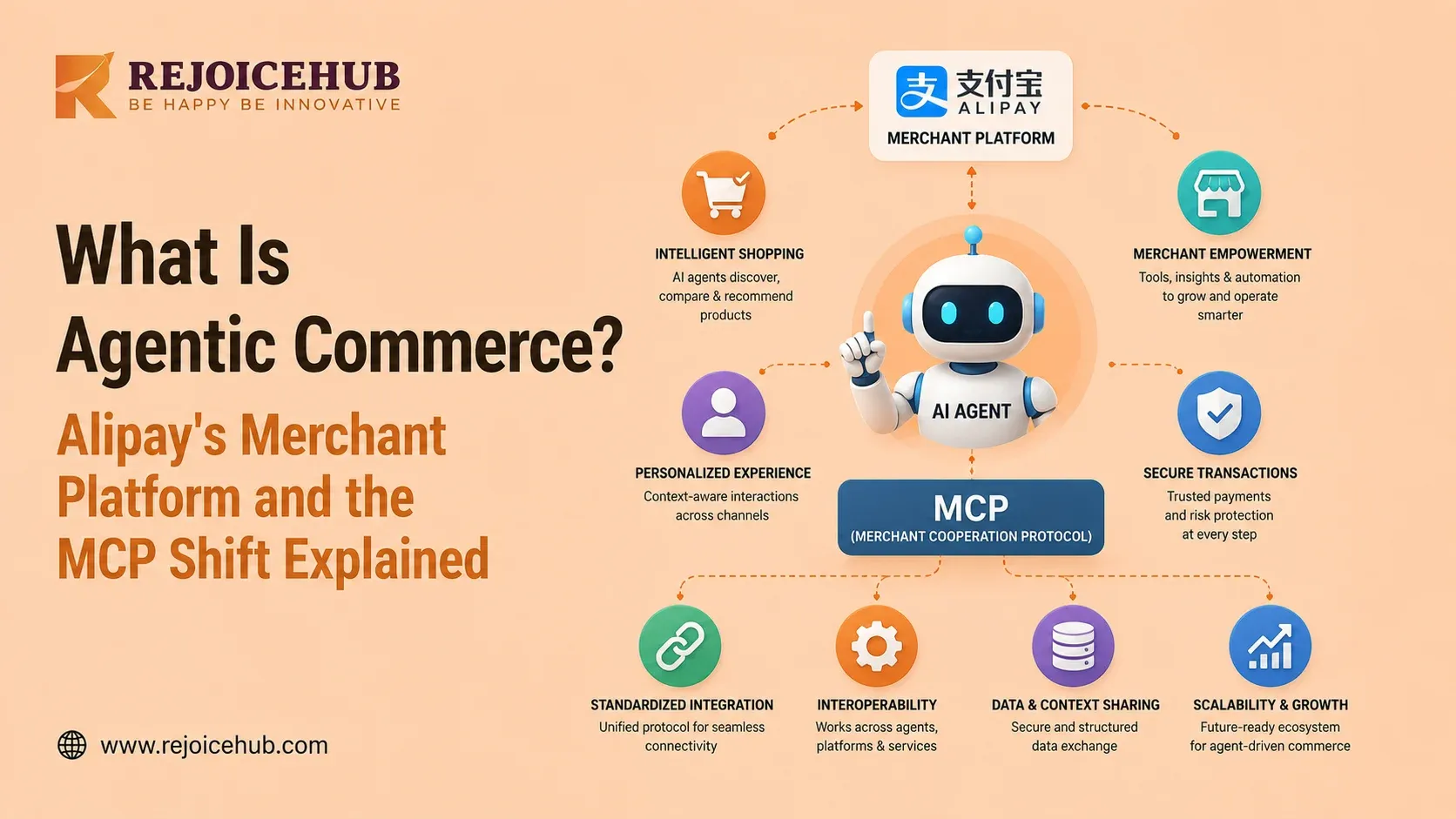
On August 17, 2026, Alipay launched something no payments company had shipped at this scale before: a full-stack platform that lets merchants turn their products, policies, payments, and support into something an AI agent can directly use, not just browse.
For nearly three decades, ecommerce has been built for one kind of visitor: a human with a browser, comparing tabs and typing in a card number.
Agentic commerce assumes a different visitor. It is a software agent acting on a person's behalf, reading a catalogue the way it would read an API, and deciding whether a merchant is even worth showing to the human at all.
Alipay's launch is the clearest signal yet of where this is heading. The technical foundation underneath it, the Model Context Protocol (MCP), is the same standard quietly becoming standard infrastructure across ecommerce, from Shopify to Salesforce to independent D2C platforms.
This guide explains what agentic commerce actually is, what Alipay built, why MCP has become the layer everyone is converging on, and how to check whether your own catalogue is agent-ready today.
What Is Agentic Commerce?
Agentic commerce is online shopping in which an AI agent carries out the task of purchasing on the shopper's behalf: discovering, comparing, choosing, and paying as opposed to clicking.
The distinction that matters is autonomy, not simple assistance. A recommendation widget that says "you might also like this" is not agentic commerce. An agent that is told to find running shoes under a set budget, confirm stock, and place the order once conditions are met is agentic commerce. The person sets the goal and the constraints. The agent handles the execution.
This shifts the requirements for what a merchant needs to expose. A human visitor may be willing to wait for a slower page or make sense of a poorly designed filter. An agent will not. It will either find a structured, machine-readable answer in seconds or move on to the next catalogue that gives it one. Being beautiful for humans and understandable for AI are two very different tasks, and most e-commerce catalogues are currently optimized for the former.
Alipay's Merchant Platform: China's First Full-Stack Agentic Commerce System
Alipay's announcement, made by Ant Group at its inaugural AI Ecosystem Partner Conference in Hangzhou, is the most complete version of an agentic commerce stack any single company has shipped to date.
The core idea: merchants get a menu of tools rather than an all-in-one solution, regardless of where they are in their AI maturity journey. From a commerce perspective, this is critical; merchants with no previous experience with AI can take their existing pages, products, and processes and turn them into agent skills and MCP tools, while those already leveraging AI capabilities can layer on top agent creation, orchestration, and operations.
The platform was connected to Ah Bao, Alipay's new consumer-facing "super service" AI agent launched in June 2026. It can carry out over 10,000 different types of services by using natural language communication, from paying utility bills to pet care and even finding charging stations for electric vehicles. KFC, Mixue Bingcheng, and Luckin Coffee have opened up their service on Ah Bao, allowing customers to pay for what they want by merely chatting.
The distribution scope is what differentiates it from a pilot project. At the time of August 2026, Ah Bao has already been integrated with five smartphone manufacturers representing over 70% of China's smartphone market, plus 16 automakers. In other words, it appears on phones, in connected cars, and with AI glasses. So when a merchant joins via Alipay's AHA (Agent Hub Access) protocol, it can not only be found in the Alipay app but also on all smartphones and connected cars where Ah Bao has been embedded.
The CEO of Ant Group, Cyril Han, spoke out about the future of agentic commerce development. According to him, it will develop rapidly in the next 6-12 months. Moreover, it will affect hundreds of millions of users and ten million+ merchants, with AI agents acting as a new touchpoint.
The MCP Shift: Why API-First Alone Isn't Enough Anymore
The reason why merchants can connect to something as complex as the Alipay system at all lies in the Model Context Protocol (MCP) that was invented by Anthropic. Subsequently, it has been adopted as the standard in the industry, enabling models to consume live structured data and perform actions in a safe and efficient manner.
A traditional REST API works well when a developer knows precisely what they need and has custom code to fetch it. MCP takes another approach, one that is much more aligned with an AI agent discovering a business domain and acting upon it. For example, an e-commerce site would expose its catalog, inventory, return policy, or checkout flow as tools discoverable by an AI agent that perform some business logic and can be embedded into applications. There is no need to custom code a new integration for a different AI platform that emerges.
The practical implication of this approach is demonstrated by Alipay's own developer tools, as the company announced today a Payment MCP Server, which allows an AI agent developer to implement payment logic by calling out to natural-language tools rather than having to build a custom REST API integration, handle webhooks, and reconcile payments.
In effect, Alipay has been testing this approach in collaboration with Rokid's Lingzhu platform in December 2025, exposing payment capabilities through MCP rather than traditional integration methods.
This trend goes far beyond payments. Within the catalog space, enterprise AI tools across the industry are already using MCP to access product information, inventory, and customer data in real-time. Shopify's Agentic Storefronts, available by default to all Shopify stores starting March 2026, use MCP to syndicate merchant catalogues to AI channels including ChatGPT, Google AI Mode, Perplexity, and Microsoft Copilot, directly from the merchant's admin panel.
It helps to see how MCP sits alongside the other protocols shaping this space, since most retailers will end up touching more than one of them:
| Protocol | What it does | Backed by |
|---|---|---|
| MCP (Model Context Protocol) | Gives an AI model real-time, structured access to catalogue, inventory, and account data, and lets it call actions as tools | Anthropic; adopted industry-wide |
| UCP (Universal Commerce Protocol) | Covers the full shopping journey, from discovery through purchase, as an open standard | Google, Shopify |
| ACP (Agentic Commerce Protocol) | Focused on product discovery and checkout handoff between an agent and a merchant | OpenAI, Stripe |
| AP2 (Agent Payments Protocol) | Provides a secure, tokenized execution layer for agent-initiated payments | Google and partners |
| AHA (Agent Hub Access) | Cross-agent, cross-device interoperability layer connecting merchants to Alipay's Ah Bao ecosystem | Alipay / Ant Group |
These protocols mostly reside at different levels of the same stack, and they do not directly compete with each other. Both MCP and AP2 are designed to be used alongside UCP. The merchant can be both MCP-compliant for data and UCP or ACP-compliant for the transaction, thus covering all the existing channels of agentic shopping, except for the ones that are already closed.
How Agentic Commerce Actually Works, Step by Step
Strip away the protocol names and the flow is straightforward:
Intent. A person tells their agent what they want, along with constraints such as budget, timeline, and must-have features.
Discovery. The agent queries agent-readable sources, including MCP endpoints and structured product feeds, instead of crawling and rendering webpages the way a search engine bot does.
Evaluation. The agent compares options against the stated constraints: price, availability, delivery window, return policy, and verified reviews.
Transaction. The agent completes the purchase through a payment protocol such as AP2 or a merchant's payment MCP server, or hands the shopper back to the merchant's own checkout, as OpenAI's ACP currently does.
To be clear about a common misunderstanding: agentic commerce is currently not about having AI agents behind the scenes complete purchases within the chat itself, unbeknownst to the human. OpenAI deprecated in-chat Instant Checkout in March 2026.
The current approach is about agent-assisted discovery and recommendation followed by a purchase on the retailer's site, where the brand retains the relationship, login credentials, and touchpoint loyalty. What changed is that now a human being, not an agent, arrives first.
Is Your Catalogue Agent-Ready? A Practical Checklist
Most merchants don't need to build something like Alipay. They should worry about not being invisible to the agents who already operate on the platforms where they currently sell their goods. A few suggestions for consideration include:
Structured product data. At minimum, use JSON-LD markup with name, brand, description, image, price (including priceValidUntil), and availability. Add GTIN or MPN, review data, return policy, and shipping details for fuller coverage. An agent that cannot parse price and stock status will skip the product, regardless of quality. This is the same groundwork covered in our guide to building agent-friendly websites.
An MCP endpoint, or a platform that provides one. Shopify stores may already have this live by default. Custom stacks will need to treat this as core infrastructure work, often routed through an MCP gateway.
Machine-readable policies. Returns, shipping timelines, and warranty terms need to exist somewhere an agent can retrieve directly, not just as prose buried on a policy page.
First-party product feeds. Agents favor accurate, first-party data over stale or scraped listings, which tend to get compared unfavorably or skipped entirely. This is also why brands are increasingly focused on getting cited correctly in AI search.
A payment path an agent can actually use, whether that means a payment MCP server, an ACP-style checkout handoff, or AP2-compatible tokenized payment support.
None of this replaces a good website. It runs alongside it, as a separate interface built for a different kind of visitor.
Make Your Catalogue Agent-Ready with Custom AI
Book a free consultation session with RejoiceHub. We'll audit your catalogue and map out an MCP-ready agentic commerce roadmap for your company.
What This Means If You're Not Selling in China
Alipay's rollout is the most significant single-vendor initiative to date, but it represents a trend that has since gathered pace in other arenas and is not an outlier.
Shopify, Salesforce's Agentforce Commerce, and third-party infrastructure providers all propose some version of making catalogues and checkout data accessible to agents in a standardised, queryable format, or risk being increasingly difficult to discover via AI-driven discovery platforms.
For now, most companies embarking on this journey should conduct a business AI readiness assessment before undertaking any substantial investments in new infrastructure: what elements of their product catalogues, policies, and checkout procedures are currently only interpretable by humans, and what might an AI agent already query in their existing systems given the right access?
The former always greatly outnumbers the latter and is much less expensive and quicker to unlock than one might think.
Where RejoiceHub Fits In
This is the kind of problem our team works on directly. Through our AI Agent Development services, we build the multi-agent workflows and MCP integrations that make a business's real product data, policies, and processes usable by external agents, not just easier for human visitors to browse.
If your team already has AI in place and wants to extend it, our Generative AI Solutions and AI Integration work connect new agentic capability directly into the systems you already run, without a rebuild.
For a deeper look at how MCP fits alongside retrieval and context engineering, our earlier guide on what an AI context layer is covers the mechanics in more depth. For payments infrastructure specifically, our guide to x402, the AI payment protocol, explains how agent-initiated payments work outside the Alipay ecosystem.
Conclusion
Agentic commerce is no longer a distant future to prepare for. Alipay's merchant platform indicates that the full stack from catalog to payments to identity can already be managed by agents at scale, and the company that makes it all happen is set to reap the rewards.
MCP is the connective tissue that makes that possible, and it is already set to spread far beyond China and Shopify, with major partners including OpenAI and Salesforce. The companies that thrive in this new world of agentic commerce will not have to scrap and restart their storefronts from the ground up.
They need to perform an audit of what their systems can already expose to an agent versus what requires a human, and have a plan in place to close that gap before their competitors do.
Frequently Asked Questions
What is agentic commerce in simple words?
Agentic commerce means an AI agent shops for you. It picks products, checks prices and stock, and either buys the item or hands you off to checkout, based on the goals and budget you gave it.
What did Alipay actually launch in August 2026?
Alipay launched a full merchant platform that turns a store's products, policies, and payments into tools an AI agent can use directly. It connects to Ah Bao, Alipay's shopping assistant used across phones and cars.
What is MCP and why does it matter for shopping?
MCP, or Model Context Protocol, lets an AI agent read a store's catalog, stock, and policies the same way it reads any other tool. It skips custom coding and works across different AI platforms.
Is agentic commerce the same as a chatbot buying things for you?
No. A chatbot suggesting products is not agentic commerce. Agentic commerce means the agent actually checks stock, compares prices against your rules, and completes or hands off the purchase on its own.
Does an AI agent complete the payment without me knowing?
No. OpenAI shut down in-chat Instant Checkout in March 2026. Right now, agents help you find and compare products, then send you to the retailer's own site to finish paying.
How is MCP different from a normal API?
A normal API needs custom code for every new integration. MCP exposes a store's catalog and policies as ready-made tools an AI agent can use right away, without a developer building a new connection each time.
What other protocols work alongside MCP in agentic commerce?
UCP covers the full shopping journey, ACP handles checkout handoff, and AP2 manages agent payments. They are not rivals to MCP. Most stores will end up using more than one together.
How do I know if my online store is ready for AI agents?
Check if your product pages have clear JSON-LD data for price, stock, and brand. If an agent cannot read your prices or return policy in seconds, it will skip your store for a competitor's.
Will agentic commerce replace normal online shopping?
Not anytime soon. Right now, a human still visits the retailer's site to pay. Agents just make the discovery and comparison part faster, so your website still needs to work well for people too.
Where is agentic commerce headed in the next year?
Ant Group's CEO expects fast growth over the next 6 to 12 months, touching hundreds of millions of shoppers and over ten million merchants. AI agents are becoming a real sales channel, not just a trend.