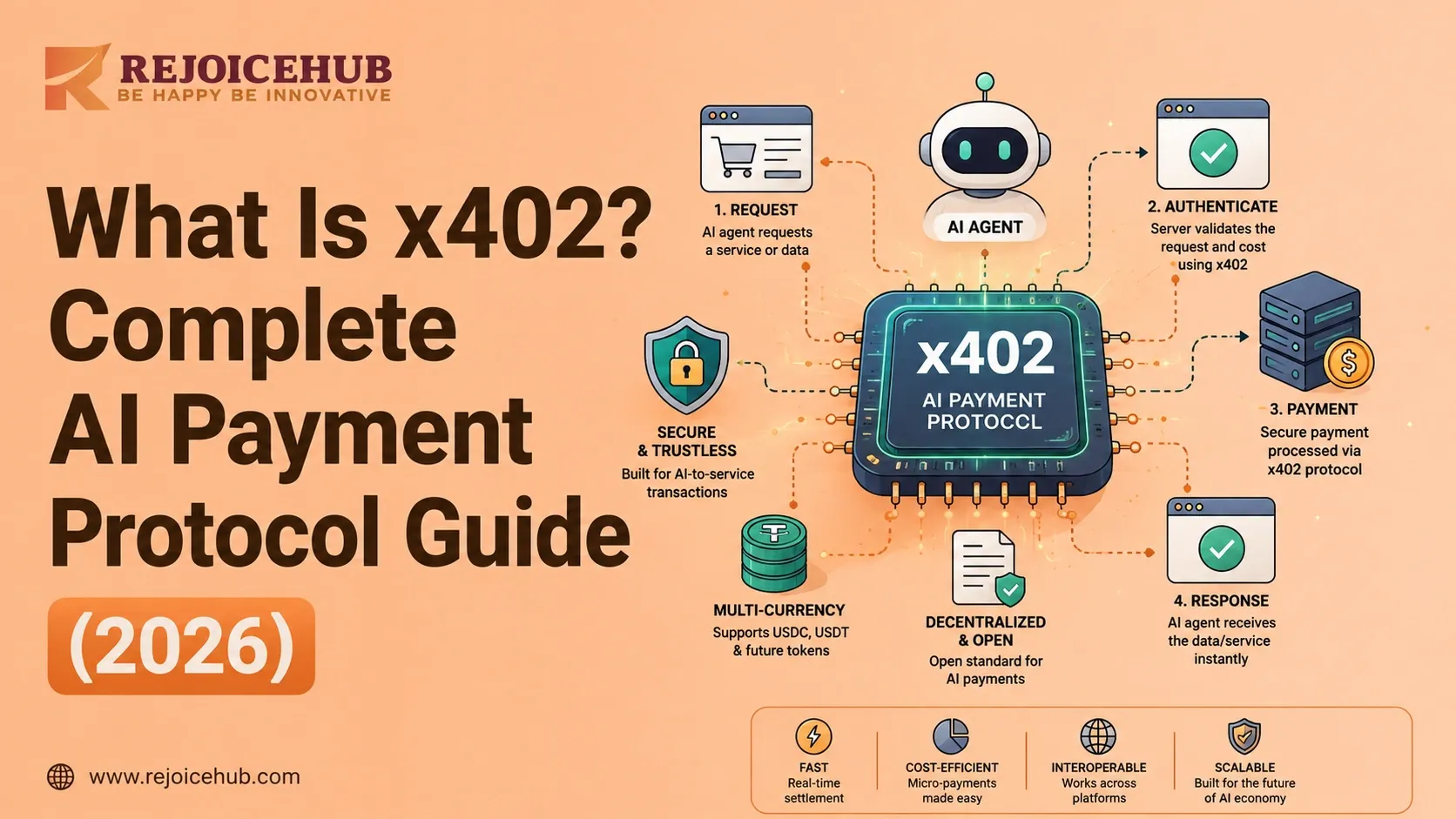
If you've been wondering "what is x402", here's the TLDR: x402 is an open payment protocol that enables AI agents and applications to pay for API access instantly and automatically using stablecoins, without requiring human approvals, credit cards, or a signup flow.
x402 extends the long-dormant HTTP 402 "Payment Required" status code and is set to become a foundational layer of the AI economy's infrastructure in 2026.
As a founder or engineering lead building agentic products, you should care about x402 deeply. The reason is simple: AI agents are already consuming the web by browsing, researching, and making purchases.
They cannot reliably use a human to click-through a Stripe payments modal or wait 3 days for a support team to send them an API key. With x402, you can program your AI assistants to pay for the things they need to get their work done.
In this guide, you'll learn what x402 is, why it exists, exactly how the payment workflow operates, real business use cases, and how it stacks up against OAuth, API keys, and traditional payment gateways.
What Is x402?
Direct Answer: x402 is an open-source, HTTP-native payment protocol, originally released by Coinbase in 2025, that enables instant stablecoin payments between software clients (including AI agents) and servers. It activates the HTTP 402 "Payment Required" status code reserved in the HTTP spec since the 1990s but never standardized to let a server request payment and a client pay in the same request cycle.
Simple Definition
The x402 protocol basically says, "Hey, here's some resources that cost 0.01 USD!" and allows either a human or an agent to send said amount in stablecoins and get it back, all in a matter of HTTP requests. No sign-ups, no stored cards, no dashboard nonsense. It's one of several emerging machine payments protocols built to let software transact without a human in the loop.
Why Was x402 Created?
Every existing way to pay for API access was built for humans, not software:
- API keys require a person to sign up, generate a key, and store it in a secrets manager.
- OAuth requires a human to click "authorize" in a browser flow.
- Credit cards require billing details a machine cannot generate or verify on its own.
None of this works when the "customer" is an autonomous AI agent that needs to discover and pay for a tool it didn't know it would need three steps ago. x402 was built specifically to close that gap for the emerging AI payment and agent economy, and it ties closely into how enterprises are rethinking AI agent authentication for non-human actors.
The Connection to HTTP 402 Payment Required
HTTP 402: Finally an HTTP Status Code that Makes Sense. The HTTP status code 402 has been part of the official specification for many years but has not been used until now. The new x402 payment protocol defines how to handle such cases. If a client tries to access a paid resource, the server will respond with 402 Payment Required and machine-readable payment instructions (amount, currency, network, address). The client pays and signs the transaction, then the server provides the requested resource.
Key Takeaway: x402 isn't a new invention from scratch; it's a practical implementation on top of an HTTP status code the web already supported, which is a big reason adoption has moved quickly.
How Does x402 Work?
Direct Answer: The x402 protocol architecture works in five steps: a client requests a resource, the server issues a 402 payment challenge, the client authorizes a signed stablecoin payment, a facilitator verifies and settles it on-chain, and the server grants access to the resource. The entire cycle typically completes in seconds.
Here's how the x402 HTTP payment protocol flow works, step by step, using a simple example: an AI research agent that needs to pull data from a paid weather API.
Step 1: Request The agent sends a normal HTTP GET request to the weather API endpoint, exactly as it would for any free API call.
Step 2: Payment Challenge Because the endpoint requires payment, the server doesn't return data. Instead, it returns an HTTP 402 status code along with a JSON payload describing what's required: the price (e.g., $0.001 USDC), the accepted stablecoin, the blockchain network, and the payment address.
Step 3: Authorization The agent's wallet software reads the payment requirements and signs a payment authorization a cryptographically signed message committing to the payment, without needing a human to approve it in real time.
Step 4: Verification The agent retries the original request, this time attaching the signed proof of payment in the payment header. A facilitator a service that abstracts away blockchain complexity verifies the signature and settles the transaction on-chain.
Step 5: Resource Access Once verified, the server releases the requested resource: the weather data, the API response, the file, or whatever was originally requested. The agent never touched a login screen or a billing portal.
| Step | What Happens | Who's Involved |
|---|---|---|
| 1. Request | Client asks for a resource | Client (AI agent) |
| 2. Payment Challenge | Server responds with 402 + price | Resource server |
| 3. Authorization | Client signs a stablecoin payment | Client wallet |
| 4. Verification | Payment is validated and settled | Facilitator |
| 5. Resource Access | Server delivers the resource | Resource server |
This is the core of how x402 works, and it's a useful mental model to keep in mind: it's one extra round trip added onto a request your API already handles.
Key Takeaway: The x402 protocol architecture adds exactly one additional round trip to a standard HTTP call: a 402 response and a retry, making it lightweight enough to bolt onto existing APIs with minimal engineering effort.
Common mistake: Teams sometimes assume x402 requires rebuilding their entire billing stack. In practice, it's usually implemented as middleware sitting in front of existing endpoints, which is one reason experienced AI agent development teams can integrate it quickly without disrupting existing infrastructure.
Key Features and Benefits of x402
Direct Answer: x402 core benefits are native machine-to-machine payments, built-in AI agent compatibility, simple API monetization, open-standard governance, near-instant settlement, cryptographic security, and a low-friction developer experience that typically takes just a few lines of middleware code.
- Machine-to-machine payments: Software can pay software directly, without a human authorizing each transaction.
- AI agent compatibility: Purpose-built for agents that need to discover and pay for tools autonomously, a natural companion to protocols like Anthropic's Model Context Protocol (MCP), which handles tool discovery while x402 handles payment.
- API monetization: Any SaaS or data API can charge per request instead of requiring a subscription tier.
- Open standard: x402 is openly published, not locked to a single vendor's proprietary billing system.
- Fast payments: Settlement typically happens in seconds using stablecoins on low-fee blockchain networks.
- Secure authentication: Payments are cryptographically signed and verified on-chain, creating an auditable trail.
- Developer-friendly implementation: SDKs exist for JavaScript/TypeScript, with community libraries for Python, Go, and Rust, so most teams can add it to an existing Express, Next.js, or Python server with minimal code changes.
Expert Insight: For SaaS founders, the real unlock isn't just "crypto payments" it's being able to monetize granular, per-call usage (think fractions of a cent) that traditional payment processors can't handle economically because of fixed transaction fees.
Real-World x402 Use Cases
Direct Answer: x402 use cases are around agent-controlled, on-demand payments: AI agents buying data or API access on demand, paid APIs that charge per use (for either end), autonomous workflows, SaaS APIs being monetized at a nano level, and developer platforms looking to expose paid endpoints but without the billing overhead.
Here's where x402 AI payments are showing up in practice:
- AI agents purchasing APIs. A research or shopping agent autonomously pays for premium data sources market data, weather, translation, image generation as needed, without a developer pre-provisioning every API key it might ever use. This is part of the broader shift toward agentic commerce, where machines complete transactions end-to-end.
- Paid AI tools. Tool providers expose functions (e.g., a PDF parser, a code sandbox, a search index) behind an x402 paywall, charging per invocation instead of a flat subscription.
- Autonomous workflows. Multi-agent systems chain several paid services together: search, summarize, generate, verify, with each hop settling its own micropayment automatically.
- SaaS API monetization. Platforms that previously required a sales call and a contract for API access can instead let any client, human or machine, pay per call and start immediately.
- Developer platforms. Infrastructure providers (including edge and serverless platforms) are adding native x402 support so any hosted API can be monetized without extra billing infrastructure. Many are also rethinking how to build agent-friendly websites so that both humans and bots can transact seamlessly.
Business Example: A SaaS company running a proprietary financial-data API could gate premium endpoints behind x402, letting AI trading agents and research bots pay per query instead of committing to a monthly plan, capturing revenue from usage that would otherwise never convert into a paid account.
Key Takeaway: The common thread across every use case is usage-based, no-account monetization, which is especially valuable for reaching the growing share of API traffic that comes from autonomous agents rather than logged-in humans.
If your team is considering where x402 for AI agents may fit within your product roadmap, this is a decision to make with an experienced AI development partner before you invest significant engineering resources.
x402 vs Traditional Payment Systems
Direct Answer: Compared to traditional payment systems, x402 does away with the account creation and human approvals steps, settles in seconds rather than days, and better yet, is purpose-built for AI agents instead of being retrofitted for them if sacrificing dispute resolution and chargeback infrastructure is acceptable.
-
Comparison Table
| Feature | x402 | Traditional APIs (Keys/OAuth/Cards) |
|---|---|---|
| Automation | Fully automated | Limited usually needs setup by a human |
| AI Agent Support | Purpose-built | Requires workarounds |
| Machine Payments | Native | Partial API keys don't move money |
| Settlement Speed | Seconds | Minutes to days |
| Developer Experience | High a few lines of middleware | Medium billing, auth, and key management |
| Dispute/Chargeback Tooling | Emerging | Mature |
-
x402 vs OAuth
OAuth tackles the authorization problem, proving that someone is who they claim to be. It doesn't handle payment itself and still requires the user to click "confirm" on the chosen provider. x402 makes the actual payment itself in its own right, hence why the two protocols are sometimes described as being used together. This distinction matters more as enterprises grapple with non-human identities that need both authorization and settlement layers.
-
x402 vs API Keys
API keys are issued only once to a human user and reused throughout the life-cycle of their use - which breaks the moment an agent needs to onboard a totally separate new paid service they've never used before. x402 enables the same agent to find an available endpoint and pay for it instantly, regardless of any prior relationship with a buyer or not.
-
x402 vs Conventional Payment Gateways
Payment gateways like card processors have historically been built around fees as a percentage of the transaction value, which makes far less sense when the transaction value is closer to a $50 purchase but doesn't work economically for a $0.001, as is the case with x402's stablecoin micropayments. Newer entrants like Stripe's wallet infrastructure for AI agents show that even traditional processors are adapting to this shift. For the first time, sub-cent monetization at scale is possible.
Common Mistake: Assuming x402 needs to replace your existing Stripe or card integration. Most production systems run x402 alongside traditional rails, using x402 specifically for machine and micropayment traffic while keeping card payments for human checkout.
Conclusion
Consider the following questions. What is x402? It is an open standard payment protocol, built on the foundations of HTTP, enabling AI agents to settle API access directly in stablecoins via the HTTP/402 status code that was previously reserved for future use by the web platform.
Why does it matter? Because the world of agentic AI requires new settlement mechanics enabling autonomous machines to make economic decisions and exchange value without human oversight, which x402 happens to represent the most prominent open standard for today, alongside efforts like Google's Universal Commerce Protocol.
As the domain of agentic AI evolves from question-answering to acting and performing, protocols such as x402 and MCP (for discoverable tooling) will reside in the infrastructure layer underneath an increasing amount of economic activity and innovation. While adoption is nascent, it is hard to deny that settlement mechanisms based on usage and natively consumed by agents are quickly becoming foundational to how the economy works in AI land, and not an esoteric crypto-adjacent experiment a trend explored further in our look at agentic commerce in 2026.
As such, if you are a founder or an engineering lead and you are considering how to make your own APIs or agents payment-ready, you should think about it now, not later.
Ready to build AI applications that are payment-ready from day one? Explore RejoiceHub's AI development services to design, build, and scale secure AI agents and monetized APIs powered by modern protocols like x402.
Frequently Asked Questions
1. What is x402 in simple terms?
x402 is an open payment protocol that lets software — especially AI agents pay for API access automatically using stablecoins. It uses the HTTP 402 "Payment Required" status code to request payment and complete the transaction within the same request-response cycle, with no account or credit card needed.
2. How does the x402 protocol work?
A client requests a resource, the server responds with an HTTP 402 status and payment instructions, the client signs a stablecoin payment, a facilitator verifies and settles it on-chain, and the server then returns the requested resource. The full cycle usually takes just seconds.
3. Is x402 only for cryptocurrency payments?
x402 is built around stablecoins (like USDC) rather than traditional currency, since stablecoins settle quickly on-chain without the volatility of other crypto assets. This makes it practical for micropayments that traditional card rails can't handle economically.
4. How is x402 different from an API key?
An API key is provisioned once by a human and reused long-term, which doesn't work well for agents needing new paid services on demand. x402 lets a client pay for and access a new endpoint instantly, without any pre-existing account relationship.
5. Can x402 work with the Model Context Protocol (MCP)?
Yes. MCP handles how an AI agent discovers and calls tools, while x402 handles how that agent pays for them. The two are commonly described as complementary layers in the same agentic infrastructure stack.
6. Who created x402, and is it an open standard?
x402 was released by Coinbase in 2025 as an open, publicly available protocol rather than a proprietary billing system, which is part of why it has been adopted across multiple blockchain networks and developer platforms.
7. Should my SaaS company implement x402?
If your API serves or expects to serve AI agents, automated workflows, or usage patterns too granular for subscription pricing, x402 is worth evaluating. An experienced AI development partner can help you assess fit and integrate it without disrupting your existing billing.