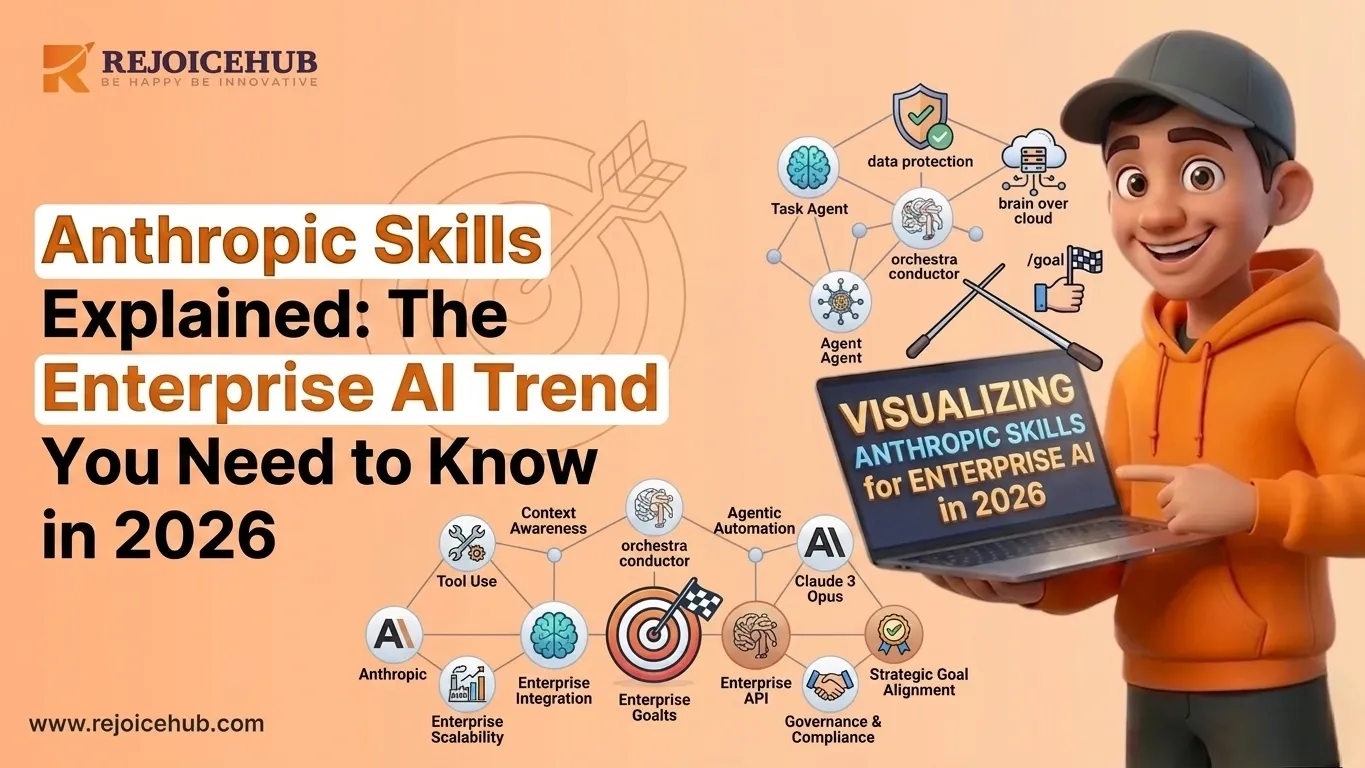
Most enterprises today kind of run on a patchwork of disconnected SaaS tools, CRMs, helpdesks, project managers, data warehouses, and communication platforms. Each one has its own API, its own login, and its own integration headaches, and yeah, keeping that all together has turned into a full-time job, basically.
Anthropic Skills are quietly changing that equation, though. As AI-native workflows move from experimental to essential, businesses are starting to rethink how the software should actually behave, not just as isolated apps glued together by fragile automations, but more like intelligent systems guided by AI agents such as Claude.
This shift is one of the most meaningful trends in enterprise automation headed into 2026, and it's moving faster than most folks realize.
What Are Anthropic Skills?
Anthropic Skills Explained
At their core, Anthropic AI Skills are reusable, context-aware abilities that AI agents can tap into to finish specific tasks, without having to lean on rigid pre-coded instructions for every little scenario.
Like a plain software function, it does one thing, every time, in a pretty fixed way. But an AI Skill is kind of different. It groks the context. It can interpret what a user or system is really asking for, then choose which action to take and actually carry it out in an AI native flow.
Key concepts behind Anthropic Skills:
- Reusable capabilities: Skills can be composed and reused across different workflows, much like building blocks.
- Contextual execution: Instead of matching fixed inputs to fixed outputs, Skills adapt based on the situation.
- AI-native workflows: These aren't bolted onto existing systems; they're designed from the ground up for AI agents to orchestrate.
This is what sets Anthropic Skills apart from some run-of-the-mill API call or even a Zapier trigger, because it's not just pipes between apps, like, you know, feed and forget. They are more like intelligent actions that an agent, say Claude, can think through, stitch together in sequence, and then run with judgment.
Why Anthropic Introduced Skills
Traditional APIs work great until they don't. They feel kind of static, brittle, and honestly developers have to plan for every last edge case ahead of time. Automation tools like Zapier or Make helped fill a few spaces, but they mostly run on simple "if this then that" style rules. At some point, that logic just stops because it can't really deal with ambiguity, and it cannot meaningfully learn from context. Then when a data format changes even slightly, everything tends to break, like right away.
Enterprises hit a wall:
- Hundreds of integrations to maintain
- No single system with end-to-end visibility
- Automation that handles routine tasks but fails on anything nuanced
Anthropic Skills were rolled in to cover that missing piece, to give AI agents a kind of more organized, dependable way to perform actions across different systems without those fragile, hardcoded kinds of rules. The target is smarter orchestration: basically letting Claude decide how to get to a goal, not only what exact button to click.
How Anthropic Skills Work
Skills vs. Traditional APIs
So this is where things get interesting for technical decision makers, at least. Here is how the two approaches stack up against each other:
| Dimension | Traditional APIs | Anthropic Skills |
|---|---|---|
| Execution style | Static, rule-based | Dynamic, context-aware |
| Flexibility | Rigid input/output contracts | Adaptive to the situation |
| Maintenance | High (every edge case coded manually) | Lower (agent handles ambiguity) |
| Workflow type | Manual or trigger-based | Autonomous and agentic |
| Intelligence | None executes exactly what you tell it | Reasons for what to do |
So, traditional APIs are kind of like tools or instruments, while skills are the capabilities that an AI knows how to actually use. In other words it's not just the function itself, it's what the system can do with it kind of like a practiced knack, not only a generic device.
The Role of Claude and AI Agents
Claude, Anthropic's AI, is the orchestration layer that makes Skills feel useful and more or less alive. When a workflow runs, Claude does not simply follow a rigid script. It sort of does the whole orchestration thing. It:
- Uses memory to retain context across a conversation or task
- Makes decisions about which Skill to invoke and when
- Chains actions: completing one task and passing results to the next
- Handles exceptions: if something doesn't work as expected, it reasons through alternatives
Real-world example: Customer Support Workflow Using AI Skills
Imagine a customer emails about some billing dispute. A classic setup sends it into a queue, and then just waits around for a human to pick it up. But an AI agent powered by Claude Skills would sort of do it more nimbly it looks at the context, figures out what's going on, and then helps with next steps instead of sitting there doing nothing, like it already knows where the ticket should go.
- Read and understand the email
- Query the billing system (using a Skill)
- Check the customer's account history (another Skill)
- Draft a resolution response with relevant data populated
- Flag edge cases to a human if needed or resolve autonomously if within policy
The whole workflow plays out in seconds, with no human touching it, and also no developer pre-loading every imaginable billing scenario ahead of time. In real life, this is how Anthropic Skills operate kinda simply, like it's expected to just do the right thing.
If you're trying to build workflows like this for your business, RejoiceHub specializes in custom AI agent development, and yep, it brings exactly this sort of automation to enterprise teams, in a more seamless way than you might expect.
Why Enterprises Are Interested in Anthropic Skills
Reducing SaaS Complexity
Most enterprises end up leaning on more than 130 SaaS applications. Each of those got picked to fix a particular problem, or so it seemed. But when they all sit side by side, they accidentally breed a fresh headache: integration overload, sort of.
In practice, every tool has to "chat" with every other tool. So, each integration also needs eyes on it, ongoing tuning, and troubleshooting when things get weird. And the real, hidden cost isn't only the subscription or the licensing. It's the engineering time spent wiring, the downtime that shows up when integrations break, and those quiet data inconsistencies that slowly creep between systems.
AI agents vs. SaaS tools offer a different model: instead of connecting app A to app B to app C with fragile middleware, an AI agent operates across all of them with a unified understanding of the goal. Fewer pipelines. Less maintenance. Smarter execution.
The operational math is compelling:
- Reduced engineering overhead on integration maintenance
- Fewer failure points in automated workflows
- Faster time-to-resolution on cross-system tasks
AI-Native Automation
That old model of automation was basically just removing repetitive clicks, you know. Now the new model is more like eliminating repetitive thinking not in a really direct way, but somehow the whole point is to cut out that mental drudgery.
AI-native automation powered by Claude Skills for enterprises means workflows that:
- Understand intent, not just instructions
- Adapt when conditions change
- Operate autonomously without constant human triggers
- Scale without proportionally scaling headcount
Anthropic Skills vs. Traditional SaaS Integrations
| Feature | Traditional SaaS Integrations | Anthropic Skills |
|---|---|---|
| Logic type | Rule-based | Context-aware |
| API style | Static APIs | Dynamic execution |
| Workflow mode | Manual triggers | Autonomous workflows |
| Connection model | App-to-app | Agent-to-system |
| Error handling | Fails or alerts | Reasons through alternatives |
| Scalability | Requires more integrations | Agent scales across systems |
| Maintenance burden | High | Significantly lower |
Could AI Skills Replace Zapier-Style Automation?
Short answer: not immediately but the trajectory is clear.
Zapier, Make, and similar tools have been enormously useful, ya know. They kind of opened up automation for non-technical teams, so people can do more without writing code. Millions of workflows run through them today, and they are not going away overnight, for real.
Still, they have real boundaries. You have to anticipate every scenario up front, like fully. They tend to stumble with anything vague or ambiguous, and they don't really "think through" it. In the end, they're only as capable as the person who set them up, not some higher intelligence.
The likely future is hybrid. Simple, predictable automations will continue to run on rule-based tools. But complex, judgment-heavy workflows the ones that currently require human intervention will increasingly be handled by AI agents using Skills.
The difference between AI Skills and APIs comes down to this: an API does what you tell it; a Skill does what the situation requires. For enterprises dealing with real-world complexity, that distinction is everything.
RejoiceHub helps businesses navigate exactly this transition building AI agent systems that work alongside, or gradually replace, legacy automation stacks where it makes sense.
The Future of Enterprise AI Skills in 2026
Rise of the Agentic Enterprise
We're stepping into the era of the agentic enterprise where AI isn't just helping humans, it's acting like a capable coworker and taking on real responsibilities, kind of like a partner in day-to-day work.
This means:
- AI coworkers that handle end-to-end workflows, not just individual tasks
- Orchestration layers that coordinate multiple agents and systems simultaneously
- Contextual computing, where AI understands the why behind a request, not just the what
The companies building this infrastructure now investing in agent development, designing AI-ready workflows, auditing which SaaS tools actually need to stay will have a meaningful head start.
What Businesses Should Do Now
The companies putting this infrastructure to work now, investing in agent development, designing AI-ready workflows, and auditing which SaaS tools actually need to stay will, in a sense, have a pretty meaningful head start.
1. Audit your SaaS dependencies: Lay out what tools your team really uses, what feels redundant, and where the biggest integration headaches show up. Those are your top picks for an AI-native replacement.
2. Experiment with AI agents on contained workflows: Choose one workflow like customer onboarding, internal ticket routing, or lead qualification and see what an AI agent could manage by itself. Start narrow; don't let it run everything at once. Measure the outcomes first, then once it actually works, expand its role bit by bit.
3. Build AI-ready data and process infrastructure: AI agents really are only as good as what data they can reach, sorta depend on it. So you should make sure your systems have clean APIs or maybe an accessible data layer so the agent can work with it, without much friction or weird hidden gaps.
4. Partner with AI-native developers: Building agentic systems requires different expertise than traditional software development. Working with teams that specialize in AI agent architecture can compress your timeline significantly.
The window for early-mover advantage is open, but it won't stay open forever.
Conclusion
The shift toward AI-native enterprise systems isn't some far-off idea; it's going on right now. Anthropic Skills, kind of, are one of the clearer signals for where this all is headed away from brittle, app-to-app linkages and toward smarter, contextual automation that can reason, adjust, and actually do.
For enterprise leaders the chance is both real and usable. You can cut SaaS mess down, turn on semi-autonomous workflows, and set your company up for AI-powered productivity jumps with the right plan in place.
The orgs that treat this as a real priority in 2026, not a "we'll handle it later" checkbox, will probably look very different from competitors in just three years.
Frequently Asked Questions
1. What are Anthropic Skills, and how are they different from regular APIs?
Anthropic Skills are reusable, context-aware abilities that AI agents like Claude use to get tasks done. Unlike regular APIs that follow fixed rules, Skills adapt based on the situation. They don't just execute a command they actually think through what the task needs and act accordingly.
2. How do Anthropic AI Skills actually work in a real business workflow?
Claude uses Anthropic AI Skills by reading the context of a task, picking the right action, and chaining steps together. For example, in a customer support case, it can read an email, pull account data, and draft a reply all without a human touching it or a developer pre-coding every scenario.
3. Why are enterprises moving toward enterprise AI Skills instead of SaaS integrations?
Most enterprises juggle 100+ SaaS tools, and keeping them connected is a constant engineering headache. Enterprise AI Skills cut that down by letting one AI agent work across all systems with a shared understanding of the goal fewer broken pipelines, less maintenance, and faster results.
4. Can Anthropic Skills replace tools like Zapier or Make for automation?
Not completely, at least not right away. Simple, predictable tasks will still run fine on rule-based tools like Zapier. But for complex workflows that need real judgment, Anthropic Skills handle what those tools can't handle, ambiguous situations, shifting data, and multi-step decisions that usually need a human.
5. What makes Claude Skills for enterprises better than traditional automation?
Traditional automation only removes repetitive clicks. Claude Skills for enterprises go further by removing repetitive thinking. Claude understands the intent behind a request, adjusts when things change, and runs full workflows on its own without needing someone to trigger every single step or anticipate every edge case.
6. How do Anthropic integrations fit into an existing enterprise tech stack?
Anthropic integrations work alongside your current tools rather than ripping everything out. Claude acts as an orchestration layer that connects to your existing systems through APIs or data layers. You don't have to rebuild from scratch; you just give the AI agent a way to access your data, and it handles the rest.
7. What should a business do first to start using Anthropic Skills?
Start small. Pick one workflow, like ticket routing or lead qualification, and test what an AI agent can handle on its own. Make sure your data is accessible and clean, then measure results before expanding. Partnering with teams that specialize in AI agent development can also speed things up a lot.