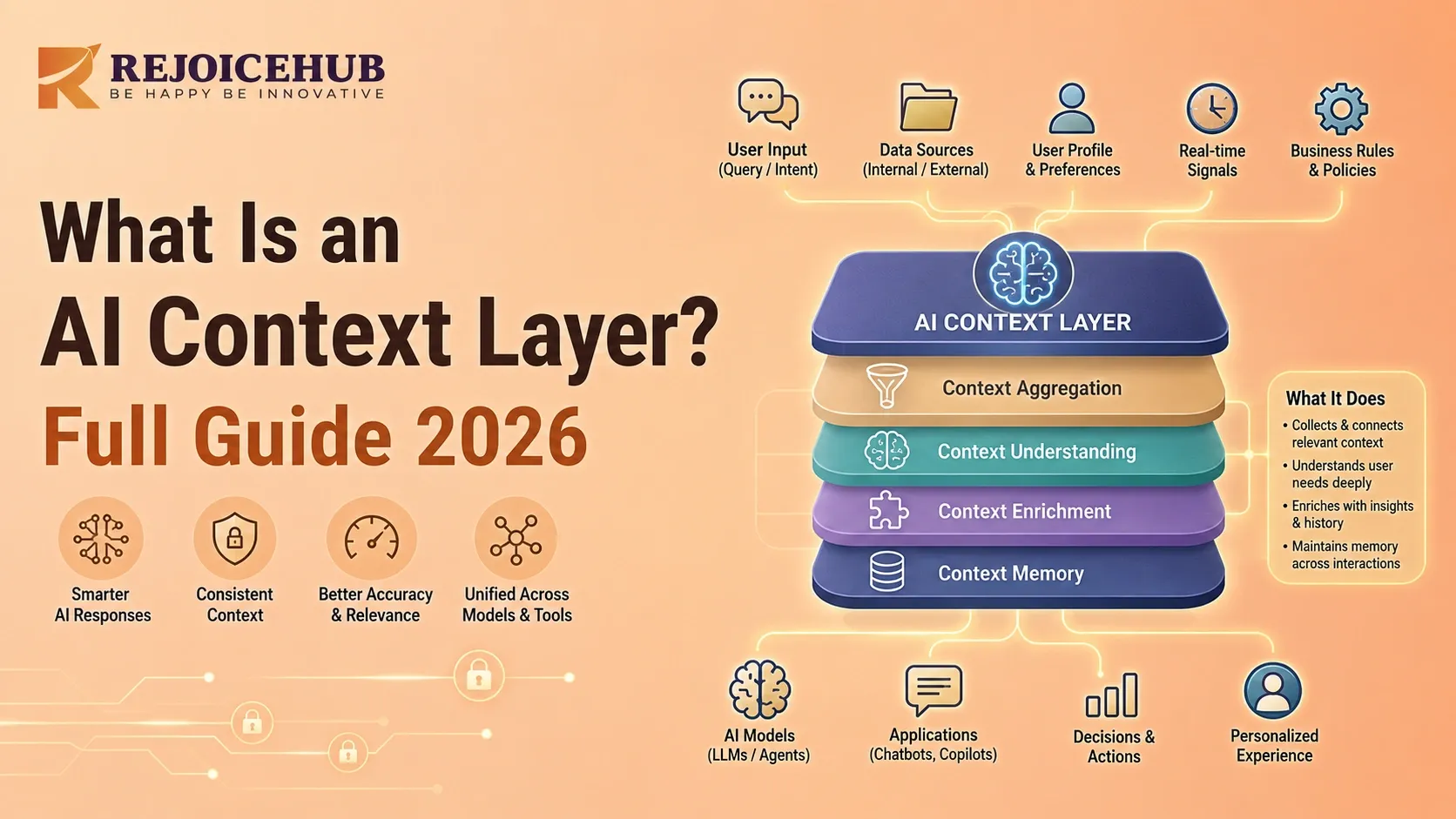
Most founders expect that once they’ve integrated an AI agent, it will “understand” their business, their customers, their pricing strategy, their support policies, their internal jargon. It can’t know that. A foundation model cannot magically extrapolate knowledge about your particular business beyond what was published on the internet before its training date.
That gap between what a model knows and what your business knows is exactly what an AI context layer is built to close.
This guide explains what an AI context layer is, why AI agents don't know your business by default, how the context layer actually works, and how it compares to related concepts like RAG and MCP, so you can build AI systems that are accurate, secure, and genuinely business-aware.
If you're evaluating how to make AI agents production-ready for your company, RejoiceHub's AI Agent Development team builds exactly this kind of context-aware infrastructure for startups and enterprises.
What Is an AI Context Layer?
Featured Snippet Answer: An AI context layer is the infrastructure that connects a foundation model to an organization's live business data CRM records, documents, APIs, and databases so the model can generate answers grounded in real, current, company-specific information instead of only general public knowledge.
Think of it as a translation and delivery system. The foundation model is the brain; the context layer is what feeds that brain the right facts at the right moment.
Key components:
-
Definition A structured pipeline that retrieves, formats, and injects relevant business data into an AI model's prompt before it generates a response.
-
Purpose To make AI outputs accurate, current, and specific to your company rather than generic.
-
Business context Customer history, product catalogs, internal policies, financial data, support tickets, and more.
-
AI knowledge layer The organized, searchable version of that business data, usually indexed for fast retrieval.
-
Difference from model training Training bakes knowledge into the model's weights permanently and expensively. A context layer supplies knowledge dynamically, at query time, without retraining so it stays current as your business changes.
Key Takeaways
-
An AI context layer sits between your data and your AI model.
-
It doesn't change the model; it changes what the model sees.
-
It's updated continuously, unlike model training, which is a slow, periodic process.
Why AI Agents Don't Know Your Business
Direct Answer: AI agents don't know your business because foundation models are trained on public internet data with a fixed knowledge cutoff. They have no access to your private systems unless you explicitly connect and feed them that information through a context layer.
-
AI Models Only Know Public Data
Foundation models are trained on books, websites, code repositories, and other public sources. They've never seen your internal Slack threads, your Salesforce pipeline, or your employee handbook, because that data was never public and was never part of training.
-
Every Company Has Unique Knowledge
No two businesses run the same way. Your pricing tiers, escalation rules, product SKUs, and customer segments are unique to you. A generic model has no way to infer these details it can only guess, and guessing in a business context is risky.
-
Missing Context Causes Poor Responses
Without context, AI agents produce answers that sound confident but are wrong, generic, or outdated. This is one of the biggest drivers of hallucination in enterprise AI deployments.
Real examples:
| Department | Without Context | With Context Layer |
|---|---|---|
| HR | Agent gives generic PTO policy answers that don't match the company's actual policy | Agent pulls the real HR handbook and gives the correct accrual rate |
| Finance | Agent can't answer "what's our Q3 burn rate" it has no financial data | Agent queries the ERP/finance system and returns the actual figure |
| Customer Support | Agent tells a customer a return is possible when the company's policy excludes that product category | Agent checks the live order and policy database before answering |
-
Why Prompting Alone Isn't Enough
Some teams try to fix this by pasting company facts into a prompt. That works for a single conversation but breaks down fast, prompts have size limits, data goes stale immediately, and there's no way to enforce who can see what. A proper context layer solves all three problems: scale, freshness, and access control. This is a core part of good context engineering practice.
How an AI Context Layer Works
An AI context layer works in four stages, connecting to business data sources, retrieving the most relevant information for a given query, injecting that information into the model's prompt, and then generating a response grounded in real data.
1. Data Sources
A context layer typically pulls from:
-
CRM customer records, deal stages, communication history
-
ERP financial data, inventory, supply chain records
-
Documents policy PDFs, contracts, knowledge base articles
-
APIs live data from internal or third-party services
-
Databases structured operational data (SQL, NoSQL)
2. Retrieval Process
When a user or agent asks a question, the system searches across these connected sources for the most relevant facts, often using semantic search rather than simple keyword matching, so it can find conceptually related information even if the exact words don't match.
3. Context Injection
The retrieved facts are formatted and inserted into the model's prompt, alongside the user's question. This is the moment where "generic model" becomes "business-aware model" for that single request.
4. Response Generation
The model generates its answer using both its general reasoning ability and the injected business facts, producing a response that's accurate, specific, and traceable back to real data.
Step-by-step workflow:
-
User asks a question or an agent triggers a task
-
Context layer identifies what data is relevant
-
Relevant data is retrieved from CRM, ERP, docs, APIs, or databases
-
Data is formatted and injected into the model's context window
-
Model generates a grounded, business-specific response
-
Response is returned (and optionally logged for auditing)
This is closely related to how AI agent memory systems retain and reuse information across sessions memory and context layers often work together in production agents.
Common mistake: Companies often connect data sources but skip the retrieval-ranking step, dumping too much irrelevant data into the prompt. This actually hurts accuracy and wastes tokens. Good context engineering is about relevance, not volume.
Accelerate Your Workflows with Custom AI
Book a free consultation session with RejoiceHub. We'll map out a tailored automation roadmap for your company.
AI Context Layer vs RAG vs MCP
An AI context layer is the broader system that manages business context; RAG (Retrieval-Augmented Generation) is one technique for retrieving and injecting that context; and MCP (Model Context Protocol) is a standardized protocol for connecting models to tools and data sources. They aren't competitors, they typically work together inside a full context layer.
| Factor | AI Context Layer | RAG | MCP |
|---|---|---|---|
| Purpose | Overall system for supplying business context to AI | Technique for retrieving relevant documents/data before generation | Standard protocol for connecting models to external tools and data |
| Data Source | CRM, ERP, docs, APIs, databases (any source) | Usually vector databases of embedded documents | Any tool or server exposed via the MCP standard |
| Memory | Can include short- and long-term memory layers | Typically stateless per query | Depends on the connected server's design |
| Enterprise Usage | Full production AI systems, agents, copilots | Knowledge base Q&A, document search | Standardizing tool/data access across multiple agents |
| Strengths | End-to-end, customizable, covers structured + unstructured data | Strong for unstructured text and semantic search | Interoperability, reusable connectors, easier maintenance |
| Limitations | Requires more engineering effort to design well | Weak on real-time structured data, needs good chunking | Still maturing; depends on ecosystem support |
In practice, a strong AI context layer often uses RAG for document retrieval and uses MCP for standardized connections to live systems. Read more on how these fit together in our guide to Model Context Protocol (MCP) and contextualized chunk embeddings.
Benefits of an AI Context Layer for Enterprises
Direct Answer: An AI context layer improves enterprise AI by increasing accuracy, reducing hallucinations, personalizing responses, speeding up decisions, and enforcing security turning a generic chatbot into a reliable business system.
-
Better AI accuracy: Responses are grounded in real company data, not guesses.
-
Personalized responses: A support agent's answer to a VIP customer reflects their actual order history and tier.
-
Reduced hallucinations: The model has real facts to draw from instead of inventing plausible-sounding answers.
-
Business-aware automation: Agents can trigger actions (refunds, approvals, escalations) based on real policy and data.
-
Faster decision-making: Executives get instant, accurate answers to operational questions instead of waiting on reports.
-
Improved customer experience: Support and sales conversations feel informed, not generic.
-
Enterprise security: A well-designed context layer enforces access controls so sensitive data only reaches authorized users and agents.
Real-world scenario: A SaaS company deploying a support agent without a context layer sees the agent give inconsistent answers about billing cycles. After adding a context layer connected to their billing system, ticket deflection improves and escalations drop because the agent now answers with real account data instead of general assumptions. This is the same principle behind well-designed AI customer support agents.
Best Practices for Building an AI Context Layer
Direct Answer: Building a reliable AI context layer requires clean structured data, strict access controls, semantic search capability, regular data refresh cycles, deliberate context engineering, ongoing monitoring, and human oversight on high-stakes decisions.
-
Clean data Garbage in, garbage out. Deduplicate and standardize source data before connecting it.
-
Access control Enforce role-based permissions so the context layer never leaks data an agent (or user) shouldn't see.
-
Semantic search Use embeddings and vector search so retrieval understands meaning, not just keywords.
-
Regular updates Business data changes constantly; stale context is almost as bad as no context.
-
Context engineering Deliberately design what data gets retrieved and how it's formatted, rather than dumping everything into the prompt.
-
Monitoring Track what context is being retrieved and used, so you can catch retrieval failures or drift.
-
Human oversight Keep a human in the loop for irreversible or high-risk actions, even when the agent has full context.
For a deeper technical breakdown, see our guides on context engineering in AI, AI agent security best practices, and closing enterprise AI infrastructure gaps.
Conclusion
An AI context layer bridges the gap between powerful language models and your organization's unique knowledge. Without it, AI agents remain generic and often produce inaccurate or irrelevant responses, no matter how advanced the underlying model is. By combining context engineering, RAG, and protocols like MCP, businesses can build AI systems that are accurate, secure, and truly business-aware.
If you're planning enterprise AI solutions, explore RejoiceHub's AI Agent Development and AI Integration services to build context-aware AI agents tailored to your business. You can also book a call directly to discuss your specific use case.
Frequently Asked Questions
1. What is an AI context layer in simple terms?
An AI context layer is the system that feeds an AI model your company's real, current data like CRM records or policies so it can give accurate, business-specific answers instead of generic ones based only on public training data.
2. What is context in an AI model?
Context in an AI model refers to the information available to it at the moment it generates a response, including the conversation so far and any data injected from external sources like a context layer.What is context in an AI model?
3. What is a contextual AI example?
A support agent that checks a customer's actual order status before answering "where's my package" is a contextual AI example it uses real, retrieved data instead of a generic guess.
4. How is an AI context layer different from RAG?
RAG is one retrieval technique often used inside a context layer. The context layer is the broader system managing all business data sources, access controls, and delivery to the model, while RAG specifically handles document retrieval.
5. How is an AI context layer different from MCP?
MCP is a standardized protocol for connecting AI models to tools and data sources. A context layer can use MCP as its connection method, but the context layer also handles retrieval logic, security, and formatting beyond just the connection.
6. Why do AI agents give wrong answers about my business?
AI agents give wrong answers because foundation models only know public data from training. Without a context layer connecting them to your actual business systems, they fill gaps with plausible-sounding guesses, which often turn out to be incorrect.
7. How do I start building an AI context layer for my company?
Start by auditing your key data sources (CRM, ERP, documents, APIs), cleaning and organizing that data, then connecting it through retrieval and access-controlled pipelines. Many companies partner with an AI development team to design this safely and efficiently.