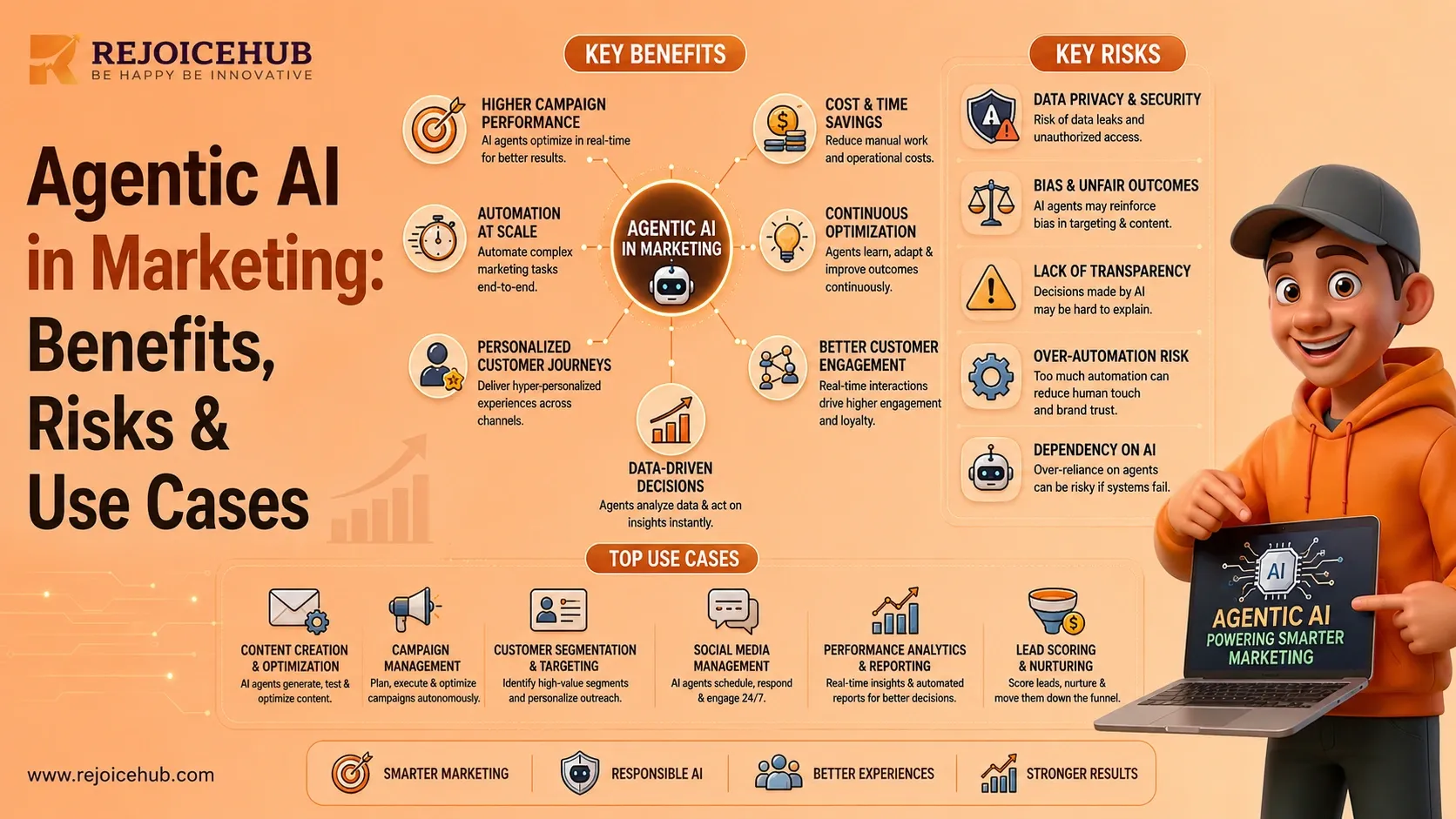
Marketing automation has evolved, from the most basic rule-driven processes to a more agile, efficient, and personalized set of actions and decisions. If this sounds like "if this, then that" marketing, you are not far off - but such rigid, pre-set automation requires constant human input to adjust and tweak.
Businesses are now looking to get ahead by doing more with less and achieving greater personalization at scale, with faster decision-making - from the C-suite down to day-to-day marketing and sales-ready processes.
That's when the need for Agentic AI in Marketing emerges - the revolutionary approach to automation that leverages generative AI, but goes far beyond it. In contrast to rule-driven or even more advanced but still deterministic prompt-driven automation, agentic AI can operate independently, making decisions, judgments, planning, and executing marketing actions with much less human input.
In this guide, you will learn:
- what Agentic AI in marketing really means,
- how AI agents in marketing operate,
- use cases of agentic marketing at different stages of the funnel,
- how to determine whether your business can benefit from agentic marketing,
- and what to watch out for when implementing it.
What Is Agentic AI in Marketing?
Agentic AI in marketing represents AI agents that perform multifunctional marketing operations requiring human supervision for independent planning and execution of marketing campaigns.
In other words, agentic AI can be compared to an enhanced form of automation that goes beyond simple programmed tasks and instructions. Think about the robotic financial analyst tool versus an actual human financial analyst. While the robotic tool is great at performing calculations, it cannot formulate recommendations, take into account situational variables, and adapt to a constantly changing business environment like a human would.
What is Agentic marketing, really?
Agentic marketing is basically the practice of leaning on autonomous agents to handle pieces of your marketing process, like campaign planning, audience segmentation, content generation, bid management, and reporting, while the agent is also making judgment calls in the middle of it all, not just running rigid, pre-set rules.
How is this different from traditional AI?
| Traditional AI/Automation | Agentic AI |
|---|---|
| Follows fixed rules ("if X, do Y") | Sets goals and figures out the steps |
| Needs a trigger for every action | Can initiate actions on its own |
| No memory between tasks | Retains context and learns over time |
| One task at a time | Coordinates multiple tasks toward one objective |
This distinction becomes even clearer when you compare it directly with generative AI versus traditional AI approaches, since agentic systems combine the creative output of generative models with independent, goal-driven execution.
How Autonomous AI Agents Work (In Plain Terms)
An AI agent typically operates in a loop:
- Understand the goal: e.g., "increase email open rates by 15%."
- Break it into steps: segment audience, test subject lines, adjust send times.
- Take action: use tools like your CRM or email platform.
- Observe results: check performance data.
- Adjust and repeat: refine the approach without waiting for a human to intervene.
That loop - plan, act, observe, learn - is what separates true agentic AI marketing from a chatbot that just answers questions.
If you're looking to build a custom AI agent for your marketing stack, RejoiceHub can help you design one that fits your existing tools instead of forcing a rebuild.
How Agentic AI Works in Marketing Automation
To understand agentic AI in marketing automation, one needs to decompose the system into its essential elements and study their contribution to the overall functionality of the agentive system.
1. Planning
Before doing anything, the agent will make a plan. If you want to reduce the number of people abandoning their carts, he will think about where they may do it and come up with a way to persuade them to finish checking out anyway. Then, instead of sending out one message, he will make several variations on the message and see which one works best. This planning ability is one of the defining traits across the different types of AI agents used in marketing today.
2. Decision Making
This is where your agentic AI gets its name. The agent doesn't follow a strict set of instructions but instead makes decisions for itself. It could decide to send out a reminder email for an abandoned cart or even offer a discount based on customer data and previous interactions rather than a predetermined script. It's worth understanding how this decision-making capability sets an AI agent apart from a simple AI chatbot, which typically just responds to queries rather than acting on its own.
3. Tool Calling
AI agents for marketing automation are not closed systems. They rely on external entities, such as customer relationship management (CRM) systems, advertising platforms, or analytical modules, to access data or perform specific actions. These interactions are typically established through API or, more recently, through the standardized Model Context Protocol (MCP) that enables agents to interact with multiple business systems securely and efficiently.
4. Memory
Unlike a one-time conversation with a chatbot, agents carry forward the context of the conversation. They learn from what worked and didn't work in the last campaign and apply those lessons to the next one, instead of starting from scratch every time - a capability closely tied to how LLM agents are architected under the hood.
5. Campaign Optimization
With planning, decisions, tools, and memory combined, the agent continuously optimizes live campaigns reallocating ad spend, adjusting send times, or refining audience segments in real time.
6. The Tech Stack Behind It
Here's what typically powers agentic AI in marketing:
- CRM integration: Salesforce, HubSpot, or similar systems feed customer data to the agent.
- Marketing platforms: email, ads, and SMS tools the agent can act through.
- AI agents: the decision-making layer (often built on LLMs like Claude or GPT).
- MCP and APIs: the connective tissue that lets agents talk to your existing software stack securely.
This is the sort of work that in-house teams tend to trip over when it comes to integration – getting AI agents for business up and running within a live business environment safely. This often requires the support of a development partner like RejoiceHub.
Agentic AI in Marketing Use Cases
Let's move from theory to practice. Here are some of the most common use cases of AI agents in business that marketing teams are deploying today.
1. Personalized Customer Journeys
Agents can design and modify individual customer journeys to reflect a customer's actions and personalize the next-best-action for the customer, rather than relying on segments that are static at the time of assignment. This is especially powerful when you look at how AI is used in eCommerce businesses to drive real-time, behavior-based personalization.
2. Lead Qualification
Instead of a human sifting through hundreds of leads, an agent scores and qualifies them automatically, flagging sales-ready prospects and even initiating first-touch outreach - a role increasingly handled by dedicated AI SDR tools.
3. Email Marketing
Agents test subject lines, adjust send times per recipient, and rewrite content variants all without a marketer manually setting up each A/B test, often working alongside AI tools for Google Ads to keep messaging consistent across channels.
4. Content Marketing
From drafting blog outlines to repurposing a webinar into five social posts, agents can handle first-draft content production using dedicated AI tools for content creation, freeing up human writers for strategy and editing.
5. Advertising Optimization
Allocation of the ad spend budget is one of the strongest use cases for agentic AI in marketing. It is much faster in reallocating the budget between channels and creatives than a human could ever be, particularly when paired with AI tools for social media marketing.
6. Customer Support
Support-focused agents don't just answer FAQs they can pull order history, resolve issues, and escalate only when truly necessary, reducing ticket volume for human teams, as outlined in this guide to AI customer support automation.
7. Predictive Analytics
Agents forecast churn risk, lifetime value, and campaign performance, then proactively suggest (or take) action before a human even notices the trend, often powered by the same AI tools for data analysis used across other business functions.
Want to see how these use cases would work for your specific business? RejoiceHub's AI Agent Development Services can help you scope a pilot project before committing to a full rollout.
Accelerate Your Workflows with Custom AI
Book a free consultation session with RejoiceHub. We'll map out a tailored automation roadmap for your company.
Agentic AI vs Generative AI vs Marketing Automation
These three terms get used interchangeably, but they're not the same thing. Here's a clear breakdown.
| Factor | Marketing Automation | Generative AI | Agentic AI |
|---|---|---|---|
| Decision making | None follows fixed rules | Limited responds to a single prompt | High plans and decides across multiple steps |
| Workflow execution | Manual setup, rule-based | Task-based, one output at a time | Multi-step, autonomous execution |
| Human input | Required for every rule change | Required for every prompt | Required mainly for goals/oversight |
| Learning capability | None | Minimal (no persistent memory) | Learns and adapts over time |
| Best use cases | Simple, repetitive triggers (welcome emails) | Content drafts, copy variations | End-to-end campaign management, optimization |
Agentic AI vs generative AI: generative AI produces content on request. Agentic AI recognizes what content is needed, generates it, deploys it, and evaluates the results - without being prompted for any of these steps.
Agentic AI vs marketing automation: automation performs the tasks you set up, while agentic AI determines what tasks to set up - and then modifies them - in response to changing conditions.
Benefits and Risks of Agentic AI in Marketing
No technology is a free lunch. Here's a balanced look at what you gain and what you need to watch for.
Benefits
- Hyper-personalization: Every customer can get a genuinely tailored journey, not just a "first name" merge tag.
- Reduced manual work: Teams spend less time on repetitive campaign setup and more on strategy.
- Better ROI: Real-time optimization means budget goes toward what's actually working.
- Faster campaigns: Launch cycles shrink from weeks to days, sometimes hours.
- Smarter decisions: Agents can process far more data points than a human team reviewing a weekly dashboard, one of the broader benefits of AI for business beyond marketing alone.
Risks
- Hallucinations: Agents can generate inaccurate content or make flawed decisions if not properly grounded in real data.
- Data privacy: Agents accessing CRM and customer data raise compliance questions that need clear governance.
- Compliance: Regulated industries (finance, healthcare) must ensure agent actions meet legal and industry standards.
- Bias: Agents trained or fine-tuned on skewed data can make unfair or ineffective targeting decisions.
- Human oversight: Full autonomy without checkpoints is risky; most successful deployments keep a human in the loop for key decisions.
The takeaway: agentic AI isn't "set it and forget it." The businesses seeing the best results treat it as a powerful teammate, not a replacement for judgment.
Should Your Business Use Agentic AI?
Not every business needs a fully autonomous marketing agent on day one. Here's a simple framework to decide.
Agentic AI tends to be a strong fit for:
- SaaS: High volume of user behavior data and a need for personalized onboarding/retention flows, especially for teams exploring new AI business ideas for startups.
- Healthcare: Patient engagement and follow-up sequences that benefit from personalization within compliance guardrails, an area where AI in healthcare is already making a measurable impact.
- Finance: Fraud-aware, personalized communication at scale, with strict oversight built in, mirroring broader trends in artificial intelligence in finance.
- E-commerce: Real-time personalization, cart recovery, and dynamic pricing/promotions.
- Enterprise marketing: Complex, multi-channel campaigns that are too large to manage manually, which is why many enterprises are building out formal AI adoption roadmaps before scaling agentic systems.
When Traditional Automation Is Still Enough
Agentic AI vs generative AI: generative AI produces content on request. Agentic AI recognizes what content is needed, generates it, deploys it, and evaluates the results, without being prompted for any of these steps.
Agentic AI vs marketing automation: automation performs the tasks you set up, while agentic AI determines what tasks to set up - and then modifies them - in response to changing conditions.
Conclusion
Agentic AI in marketing refers to systems that perform tasks independently and make decisions beyond the scope of traditional automation or generative AI. This technology provides benefits such as improved personalization, better optimization, and faster decision-making throughout the marketing funnel.
The companies that are realizing the biggest benefits are not completely hands-off, trusting automation to make decisions on their behalf, but rather use agents to perform specific tasks while reserving strategic and judgment-based work for humans, a pattern reflected across the leading AI agent companies shaping this space.
Ready to implement AI-powered marketing automation? Explore RejoiceHub's AI Agent Development Services to build secure, enterprise-grade marketing AI solutions tailored to your business.
Frequently Asked Questions
1. What is agentic AI in marketing?
Agentic AI in marketing means using AI agents that can plan, decide, and act on their own to run marketing tasks. Instead of just following rules, these agents set goals, test ideas, and adjust campaigns in real time, cutting down the need for constant human input.
2. What is agentic marketing?
Agentic marketing is when you let autonomous agents handle parts of your marketing work, like planning campaigns, segmenting audiences, writing content, and reporting results. The agent doesn't just follow a script - it makes judgment calls along the way, based on real data and past results.
3. How is agentic AI different from generative AI?
Generative AI creates content only when you ask it to, like writing a blog post from a prompt. Agentic AI goes further - it figures out what content is needed, creates it, publishes it, and checks how it performed, all without someone prompting it at every step.
4. How is agentic AI different from marketing automation?
Traditional marketing automation only runs the rules you set up ahead of time, like sending a welcome email after signup. Agentic AI decides what tasks are actually needed, sets them up itself, and keeps changing them as customer behavior or campaign results shift over time.
5. What are some agentic AI in marketing examples?
Common examples include personalized customer journeys, automatic lead scoring and qualification, email subject line testing, ad budget reallocation, and churn prediction. Agents also help with first-draft content creation and customer support, pulling order history and resolving simple issues before a human needs to step in.
6. How do AI agents work in marketing automation?
AI agents follow a loop - they understand a goal, break it into steps, take action using tools like your CRM or email platform, check the results, and adjust their approach. This plan-act-observe-learn cycle lets agents improve campaigns without waiting for someone to step in.
7. Is agentic AI a good fit for enterprise marketing?
Yes, enterprise AI marketing works well for businesses running complex, multi-channel campaigns that are hard to manage by hand. It also suits SaaS, e-commerce, healthcare, and finance, where there's plenty of customer data and a real need for personalization within proper compliance guardrails.