
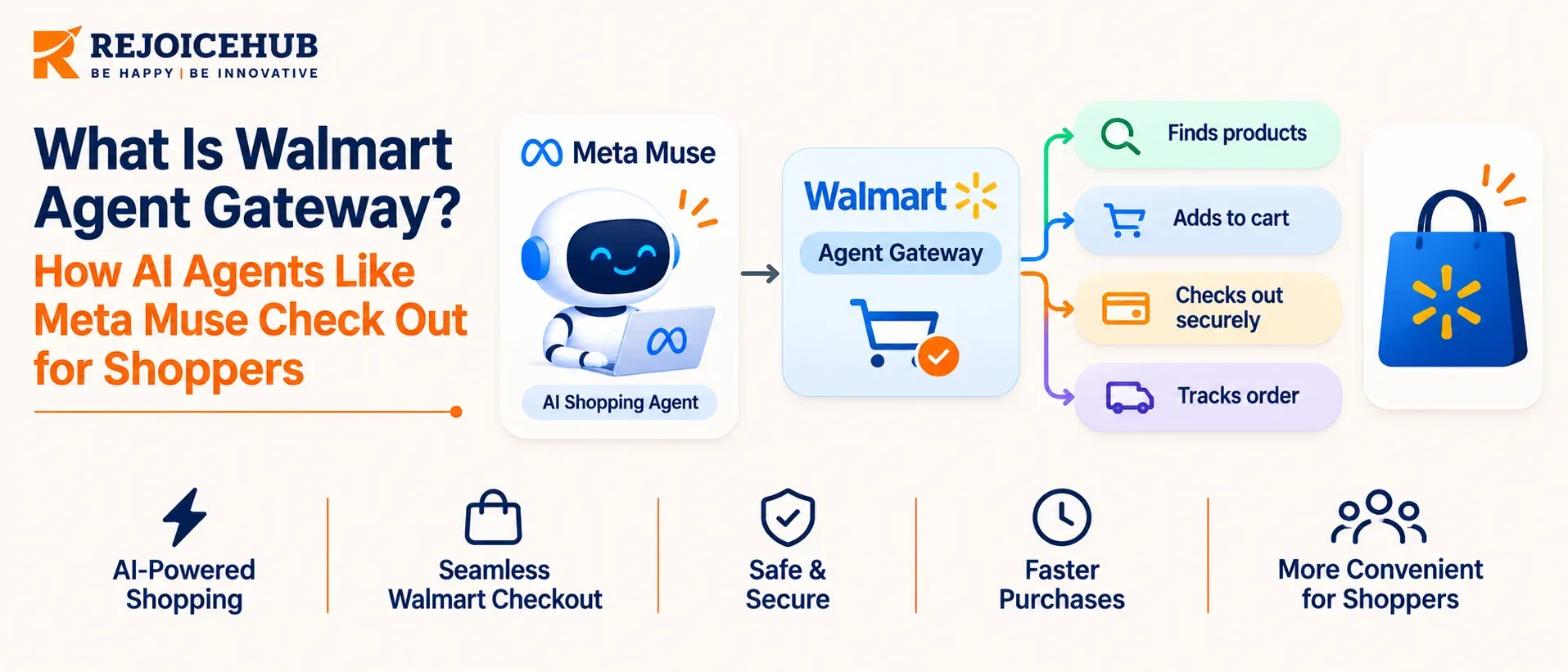
Walmart Agent Gateway is a connection point that lets approved AI agents search Walmart's catalog, add items to a cart, buy, and track orders for shoppers. Walmart announced it on October 21, 2026. Shoppers set approval rules and spending limits, and each agent gets its own profile. Access is an invitation-only beta.
Walmart has opened a front door for AI shopping agents, while Amazon blocked Meta's Muse agent from shopping on its site. This guide explains how the gateway works, how Muse pays, and what US retailers and brands should prepare now. Teams planning AI agent development for commerce can use Walmart's rules as a working template.
What Is Walmart Agent Gateway?
Walmart describes the gateway as a way of "connecting AI agents with Walmart for faster shopping, real-time answers and more control from start to checkout" (Source: Walmart Agent Gateway page, 2026). It connects agents through Sparky, Walmart's own shopping assistant.
CEO John Furner announced it on October 21, 2026, at the Masters of Scale Summit in San Francisco. It covers shopping on both Walmart and Sam's Club (Source: TechCrunch, October 21, 2026).
In plain words, it gives agents an official entry point. Agents no longer need to scrape web pages and guess which button to press.
How Do Agents Connect?
TechCrunch reports the gateway is an MCP server for approved agents. MCP, short for Model Context Protocol, is the open standard Anthropic created for connecting AI agents to tools and data.
Walmart's own page does not mention MCP by name. It says only that agents get product and fulfillment data "straight from the source" with "no more website scraping." Treat the MCP detail as reported, not confirmed by Walmart's page.
What Can an Agent Do?
Walmart's Daniel Danker said the gateway supports discovery, add to cart, purchasing, and order tracking (Source: Stellagent, October 26, 2026). Agents see the same prices as human shoppers, and applicable offers and fees appear before purchase.
How Does the Gateway Work Step by Step?
A shopper asks an agent to buy something. The agent calls the gateway, finds items, and checks out within the limits the shopper set.
- Discovery. The agent searches Walmart's live online inventory.
- Cart. The agent adds items for the shopper.
- Approval. The shopper approves the order, or the order passes automatically under a spending limit.
- Purchase. The agent places the order without seeing payment card details.
- Tracking. The agent and the shopper follow the order status.
Walmart also says customers can have agents buy their usual brands without sharing personal information or purchase history with the agent (Source: TechCrunch, October 21, 2026).
| Feature | What Walmart or reporters say |
|---|---|
| Announced | October 21, 2026 |
| Stores covered | Walmart and Sam's Club |
| Access | Invitation-only beta, limited, may be suspended at any time |
| Agents supported | Meta's Muse, plus ChatGPT, Gemini, and others |
| Payment card data | Agents do not receive card information |
| Agent sign-in today | Customer's own Walmart account |
| Membership needed | No Walmart+ required for Agent Profiles |
Data sourced from Walmart Agent Gateway page, TechCrunch (October 21, 2026), and Stellagent (October 26, 2026). Last updated: November 2026.
What Are Agent Profiles and Spending Limits?
An Agent Profile is a separate profile inside the shopper's Walmart account that holds one agent's purchases. Walmart compares it to adding an authorized user to a credit card (Source: TechCrunch, October 21, 2026).
How Profiles Get Created
- Walmart creates a profile the first time a shopper uses an agent through the gateway.
- The shopper signs in, authorizes the profile, and picks controls.
- The shopper can delete the profile at any time.
- Walmart said profiles would roll out the month after the announcement.
Two Approval Modes
Shoppers choose one of two modes. They can require approval for each transaction, or authorize transactions within a spending limit they set.
Example limits in Walmart's announcement are $50, $100, and $200, as reported by Stellagent. Walmart may still ask for extra approval inside a limit, and it has not said when.
Why Profiles Matter
Today agents sign in with the customer's own account. A profile separates agent orders from human orders, so shoppers can review and track what the agent bought. Walmart's page says users can "review and track what your agent buys."
What Is Meta Muse and How Does It Check Out?
Meta Muse is a personal AI agent that can complete tasks and make payments. Meta launched it in the US in early September 2026 on iOS, Android, and muse.ai, with access inside WhatsApp (Source: The Paypers, September 9, 2026).
The Checkout Flow
Muse pays through Link, Stripe's checkout product. Meta says Link creates a one-time-use card for each transaction, so the shopper's real card details stay hidden. Meta also says Muse is the first AI agent covered by Link's purchase protections, which include coverage for damaged or lost items and fee-free returns (Source: The Paypers, September 9, 2026).
Fortune reports that Muse shows the total for the user to approve before paying through Link (Source: Fortune, September 11, 2026).
Safeguards Meta Describes
- Muse does not have direct access to passwords or payment credentials, which sit in separate secure storage.
- A separate process called Sentinel oversees outbound activity, and users are asked for consent where required.
- Users choose which apps and data sources Muse can reach, and can revoke access.
- Meta says data inside a user's virtual machine is not shared with its advertising systems.
Notice the overlap with Walmart's model. Both keep card data away from the agent, and both put a human approval step on purchases.
Why Did Amazon Block Muse While Walmart Welcomed It?
Amazon and Walmart made opposite bets on who controls the shopping agent. Amazon blocked Muse less than two weeks after launch. Walmart built an official door and wrote the rules for it.
| Date | Event |
|---|---|
| September 9, 2026 | Meta launches Muse in the US with Stripe Link checkout |
| September 21, 2026 | Amazon blocks Muse from browsing and buying on its site |
| October 21, 2026 | Walmart announces Agent Gateway, Agent Profiles, and terms for AI agents |
| Late November 2026 | Agent Profiles expected to roll out, per TechCrunch |
Data sourced from The Paypers, Axios, and TechCrunch. Last updated: November 2026.
Amazon's Position
Amazon said it did not expect Muse to access its store and had not authorized it to reach customer accounts, scrape data, or process transactions. Its stated principle: "third-party applications that offer to make purchases on behalf of customers from other businesses should operate openly" (Source: Axios, September 21, 2026).
Walmart's Position
Walmart's approach is controlled access. It invites agents in, verifies them, limits what they can do, and blocks those that break the terms. TechCrunch frames the contrast as open versus closed (Source: TechCrunch, October 21, 2026).
What Rules Does Walmart Set for AI Agents?
Walmart's terms for agents limit what an agent can see and do. TechCrunch and Stellagent list these rules:
- Agents cannot act beyond what the shopper intends.
- Agents cannot access customers' payment information, and cannot add or change payment methods.
- Agents can access only the information needed for the task and that the customer allows.
- Information an agent receives falls under the agent provider's privacy policy.
- Agents that break the terms are blocked from the site.
- Walmart's returns process applies, even when an agent does not act as intended.
Walmart's page also lists safeguards: category restrictions, rate limits, and compliance guardrails. It adds that the system is "built with verified identities, controlled permissions and observable actions."
Do Shoppers Actually Want AI to Buy for Them?
Not yet, at least not without control. Surveys show people welcome help finding products but hesitate to hand over the purchase.
| Finding | Number | Source |
|---|---|---|
| Shoppers who would outsource shopping to an AI agent | 31% | Vogue Business survey, via Fortune, September 2026 |
| Respondents who would not share card details | 72% | Vogue Business survey, via Fortune |
| Shoppers comfortable letting an AI assistant buy for them | 16% | Coveo 2026 Commerce Relevance Report, via Axios |
| Rise in AI-assistant traffic to US retail sites, 2025 holiday season | 693.4% | Adobe, via Reuters and Fortune |
| Shoppers expected to use a personal AI agent by 2030 | 1 in 10 | Mastercard, via Fortune |
| US retail revenue from AI-mediated search and purchase by 2030 | Up to $1 trillion | McKinsey, via Axios |
Data sourced from Fortune, Axios, Reuters, and the named research firms. Last updated: November 2026.
The two sets of numbers point the same way. Traffic from agents is growing fast, but most shoppers want a say before money moves. That is why approval modes and spending limits are the core of Walmart's design.
What Should US Retailers and Brands Do Now?
Decide whether to block agents or offer an official connection, then prepare your operations either way. Order handling is where agent shopping creates the most work.
Decide Your Entry Point
Choose a policy before agents choose for you. Check that your bot defenses are not turning away partner agents by mistake. Stellagent notes this happened to Muse on Walmart's own site.
Prepare Your Back Office
Pipe17, a vendor that sells order tools, lays out the load agent orders put on sellers (Source: Pipe17, October 30, 2026):
- Inventory: Each unit an agent buys must come off every other channel at once.
- Fulfillment: Tracking numbers must reach Walmart so the order shows as shipped.
- Cancellations: Cancel requests must reach the warehouse before the order ships.
- Returns: A wrong size or a duplicate order comes back to the seller as a return.
Walmart has not said whether seller orders will show which ones an agent placed. Pipe17 expects no separate connector for agent orders, since Marketplace connectors pull them like any other order. Check with your platform before you rely on that.
Fix Your Data
Product titles, prices, stock counts, and delivery promises decide whether an agent picks your product. Clean, structured data and fast, reliable APIs matter more than page design. A team that already runs API development can expose catalog and order status in a form agents can read.
What Are the Risks and Open Questions?
The gateway is new, and several details are not public yet.
- Access: It is an invitation-only beta that "may be suspended at any time."
- Fees and partners: Walmart has not disclosed start dates, participants, or any agent operator fees (Source: Stellagent).
- Protocol: Reports say MCP, while Walmart's page does not name it.
- Agent-order visibility: Sellers may not see which orders came from agents.
- Liability: Walmart's return terms cover agent mistakes, but how costs are shared with sellers is unclear.
- Security: Agents read content from the open web, so prompt injection stays a risk for any agent you allow.
Is Your Business Agent-Ready? A 6-Step Checklist
Most retailers can prepare in weeks without rebuilding their store. Work through these steps in order:
- Audit bot rules. Confirm your defenses do not block approved agents by mistake.
- Tag agent orders. Record agent-placed orders separately so you can measure them.
- Update return terms. Cover agent-placed orders, including mistaken purchases.
- Fix inventory sync. Keep stock accurate across every channel, with buffers against overselling.
- Clean product data. Use clear titles, structured attributes, and current prices.
- Set approval rules. Require a human click for large or unusual purchases.
Conclusion
Walmart Agent Gateway shows what a controlled agent checkout looks like: verified agents, separate profiles, approval modes, and no card data for the agent. Amazon chose to block, and Walmart chose to set rules. Either way, agent orders are coming, so prepare your policy, data, and returns now.
If you want help planning agent-ready tools for your store, talk to our team about connecting AI agents to your store systems.
Frequently Asked Questions
1. What is Walmart Agent Gateway?
It is a connection point that lets approved AI agents search Walmart's catalog, add items to a cart, buy, and track orders for shoppers. Walmart announced it on October 21, 2026. It is an invitation-only beta.
2. Which AI agents work with Walmart Agent Gateway?
TechCrunch reports support for Meta's Muse, plus connections to ChatGPT, Gemini, and others. It does not name Anthropic as a supported agent. Access is limited, so check Walmart's beta page for current partners.
3. Does Walmart Agent Gateway use MCP?
TechCrunch and Stellagent report it is an MCP server. Walmart's own page does not mention MCP. Treat it as reported and confirm in Walmart's developer materials.
4. Can an AI agent see my card number at Walmart?
No. Under Walmart's terms, agents do not receive payment card information and cannot add or change payment methods. Agents can access only the information needed for the task.
5. What is a Walmart Agent Profile?
It is a separate profile in your Walmart account that holds one agent's purchases. Walmart compares it to an authorized user on a credit card. You can delete it at any time.
6. Can I set a spending limit for my AI agent?
Yes. You can require approval for every transaction, or let the agent buy within a limit you set. Reported example limits are $50, $100, and $200.
7. How does Meta Muse pay for purchases?
Muse pays through Stripe's Link, which creates a one-time-use card for each transaction. Meta says Muse does not have direct access to passwords or payment credentials.
8. Why did Amazon block Meta Muse?
Amazon said it did not authorize Muse to access customer accounts, scrape data, or process transactions. It said apps that buy for customers from other businesses should operate openly (Source: Axios, September 21, 2026).
9. What happens if an agent buys the wrong item at Walmart?
Walmart says its regular returns process applies even when an agent does not act as intended. Sellers should expect these returns and set up their return handling to cover them.
10. What should my online store do first?
Decide whether to block agents or offer an official connection. Then audit your bot rules, record agent orders separately, update return terms, and keep inventory accurate across all channels.
