
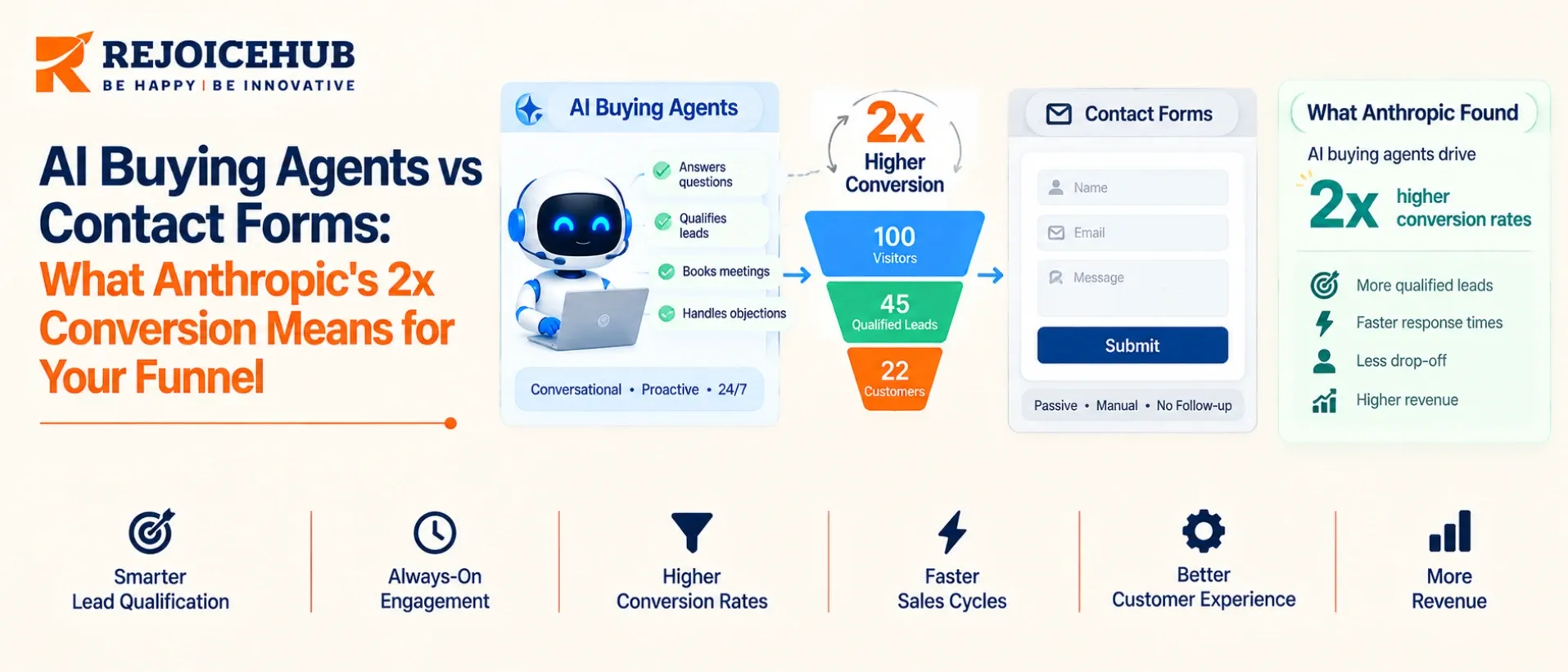
Anthropic automated away much of their Contact Sales form with a purchasing agent made of AI. The leads that the agent sent to sales teams converted into opportunities over twice as often, and deals closed about five days faster than before.
The 2x figure refers to lead-to-opportunity conversion on escalated leads and is derived from self-reported data, so take it with a grain of salt.
This post will discuss buying agents, cover how they differ from contact forms and what a production-ready implementation would look like, and how to measure success.
I'll also show you how to build one yourself using Python and open-source tools.
Key Highlights
- More than 2x lead-to-opportunity conversion for agent-escalated leads versus Anthropic's old contact form (self-reported).
- About 5 days faster deal closes.
- Thousands of conversations a day, with an opt-in design so buyers choose an agent or a human rep.
- One engineer, a few weeks: the first version was built on Claude Managed Agents (beta).
- Forms leak conversion as fields grow: roughly 23% at three fields to under 7% at ten or more (Perspective AI).
- Best practice: keep the form, let the agent absorb questions with stable answers, and measure opportunity and closed-won rates, not chat volume.
Why the Contact Form Is Breaking Your Funnel
A contact form is a channel for collecting information. Someone's name, email, plus potentially a free-text field, are dropped into a queue.
All the juicy stuff that is needed to qualify a lead, answer their questions, and scope the deal happens later. And that's where the bottleneck is.
Anthropic's own account is a good example of what can go wrong. Its sales team was getting tens of thousands of inbound requests a month, and its business development reps were unable to handle the volume.
Their reps were spending their days answering the same questions answered in the documentation, but there were still a bunch of people in the queue who never got a response.
Every extra field costs leads
The form itself can leak conversion even before the lead arrives there. In fact, in one analysis from Perspective AI in 2026, static form conversion fell from roughly 23% at three fields to under 7% at ten or more fields. Every field you add on to qualify a lead you lose.
Buyers now arrive informed
Meanwhile, buyers are changing their research habits. Adobe Analytics reported (via Reuters) that retail visits driven by AI had a 60% higher conversion rate than other forms of traffic. Shoppers come in knowing something and wanting to get into conversation, not reciting their ticket numbers.
What Anthropic Actually Reported: The Numbers
The headline is "2x conversion." The precise claim is narrower, and getting it right matters if you plan to forecast against it.
What Anthropic reported
| Metric | What Anthropic reported | What it does NOT claim |
|---|---|---|
| Lead-to-opportunity conversion | Leads escalated by the agent became sales opportunities more than 2x as often as old contact-form leads | Not a 2x lift in total site conversion |
| Sales cycle | Deals close about 5 days faster | Not a universal benchmark for other products |
| Volume | Thousands of agent conversations per day | n/a |
| Opt-in design | Buyers choose at the start between the agent and a human rep | The agent is not forced on anyone |
| Rep efficiency | One inside rep went from about 10 emails per deal to about 6, and reported 2.5x output on closed-won deals | Single rep anecdote, not a team average |
| Escalation load | Share of conversations needing a human to close fell by about half as the agent improved | n/a |
| Build effort | One engineer built the first version in a few weeks on Claude Managed Agents (beta) | Not the cost of a full enterprise integration |
How to read the 2x claim
Two caveats a good CTO should hold onto. First, this is a self-reported result from the vendor that sells the underlying model, measured on its own funnel. Second, the 2x applies to leads the agent passed along, and those buyers arrived educated and self-selected. Your lift will depend on your traffic, your product complexity, and how well the agent is built. Instrument your own numbers before you promise anyone 2x.
AI Buying Agents vs Contact Forms: Side-by-Side
Side-by-side comparison
| Factor | Contact form | AI buying agent |
|---|---|---|
| Time to first useful answer | Hours to days | Seconds, any hour, many languages |
| Who does the qualifying | A BDR, after the fact | The agent, during the conversation |
| What reaches sales | Name, email, free text | Full conversation, needs, plan and seat estimate, reason for escalation |
| Handles simple questions | No | Yes, from approved docs and pricing |
| Can complete the purchase | No | Yes, via checkout hand-off |
| Best for | Low-volume, high-touch, regulated sales | High inbound volume with repeat, answerable questions |
| Main risk | Slow response, abandonment | Wrong or off-policy answers if poorly governed |
Keep the form, add the agent
This is not a reason for deleting your form. A complex, high-value enterprise deal may well still need a human early on, which is why Anthropic kept agent opt-in. The practical is a form and an agent side by side, with the agent taking in the questions with stable answers.
7 Signs Your Contact Form Is Costing You Pipeline
- Your median first-response time is measured in days. Buying momentum decays fast. If a prospect waits 48 hours, a competitor with a live answer wins the shortlist.
- Most inbound questions repeat. Pull 200 recent form submissions. If more than half ask about pricing, seat minimums, security, or integrations, you have an automation candidate.
- BDRs spend their time on documentation lookups. That is the exact failure Anthropic described.
- Form completion is falling as you add fields. If qualification fields hurt completion, move qualification into conversation.
- Leads reach AEs with no context. If reps open every call with discovery questions the buyer already answered somewhere, you are wasting both sides' time.
- You get meaningful off-hours or international traffic. A form cannot answer at 2 a.m. in another language.
- You cannot measure why leads drop. Conversations produce structured reasons for escalation and drop-off. A form produces a name.
How AI Buying Agents Work: The Four Pillars
An AI buying agent is more than a chatbot with a nicer greeting. In production, it rests on four components.
1. Goal-driven reasoning
Anthropic's team has discovered that prompting the model to perform a specific task (understand requirements, qualify the prospect, recommend the right plan) had a better effect than providing it with extensive instructions in the form of a rule list or flowchart. The shorter the prompt, the better, provided that it contains the relevant contextual information.
2. Grounded knowledge
The agent answers from approved sources: pricing, plan limits, security and compliance documents, contract terms. This is what separates a buying agent from a generic LLM that improvises.
3. Tools
The agent needs actions: find the plan details, check the seat price, check out the session, write to the CRM, and route to an agent. It is all about having tools.
4. Hand-off logic
Every conversation ends with either a completed purchase or return of the rep with full transcript and context for follow-up, or an immediate answer to the question asked. Anthropic also captures why conversations escalated and uses that as product feedback.
Design principle: the right answer, not the biggest deal
The design pattern that we should steal: instead of pushing for the biggest deal possible, focus on delivering the right answer, and Anthropic's agent will help smaller teams to choose the cheaper option, which plays perfectly into their budget and builds trust.
What a Production Buying Agent Includes
A proof of concept is a prompt and a chat widget. A production AI sales agent typically includes:
- A governed knowledge base with owners and update cadence
- Tool integrations for CRM, pricing, billing, and checkout
- Opt-in entry points on pricing, contact, in-product, and email surfaces
- Escalation rules, including a clean human hand-off with transcript
- Guardrails for pricing commitments, legal and compliance claims, and refusal behavior
- Versioned prompts with a staging environment, so non-engineers can test changes safely
- Analytics: conversation outcomes, escalation reasons, conversion by source, and revenue attribution
- Audit logs and PII handling aligned with your security and compliance requirements
Engagement Models and Indicative Pricing
Indicative engagement models
The ranges below are illustrative planning figures, not quotes. Actual cost depends on integration depth, compliance scope, and knowledge-base quality.
| Model | Scope | Indicative range | Typical timeline |
|---|---|---|---|
| Discovery and funnel audit | Inbound analysis, use-case selection, success metrics | 5K–15K | 1–2 weeks |
| Pilot agent | One narrow buying job (e.g., pricing and plan Q&A), basic CRM hand-off | 25K–60K | 4–8 weeks |
| Production agent | Multi-surface deployment, checkout or CRM actions, guardrails, analytics | 60K–150K+ | 2–4 months |
| Managed iteration | Prompt and knowledge updates, evals, reporting | Monthly retainer | Ongoing |
Build on a Platform, Buy a Chatbot, or Go Custom?
Three approaches compared
| Approach | Strength | Trade-off |
|---|---|---|
| Off-the-shelf conversational form tools (e.g., NoForm, Tars, Perspective AI) | Fast to launch, low engineering load | Limited tool use, less control over logic and data |
| Platform-based agent (e.g., Claude Managed Agents, as Anthropic used) | Hosting, sessions, and tool orchestration handled for you; fast to production | Platform dependency; you still own prompt, tools, and knowledge |
| Fully custom agent stack | Maximum control, multi-model, deep system integration | Higher build and maintenance cost |
Reading vendor conversion stats
Vendors in the first category produce impressive figures: several cite chatbot conversion of 10-15% vs. 1-3% for forms, and one reports 50-70% completion for conversational intake vs. 30-40% for static forms.
Take them as vendor-reported and context-dependent. Many measure visitor-to-lead capture, which is a different event than lead-to-opportunity or purchase.
Where RejoiceHub fits
RejoiceHub incorporates all three approaches, and the choice of which is appropriate depends on one’s particular circumstances: the current stack, and one’s tolerances for risk and complexity. If one is looking at a first pilot in a limited domain, a platform-based approach is likely to be the quickest way to value. Meanwhile, more regulated or multi-system environments may demand a custom orchestration, despite the additional cost and complexity.
Technical Deep Dive: Architecture, Guardrails, and Measurement
Reference architecture
A buying agent typically sits behind your website chat surface and calls the limited set of tools, including a retrieval layer over approved content, plus a pricing or plan lookup, CRM write, checkout or quote, and an escalation tool. Keep it simple; have a few well-described tools. Anthropic's team described their agent as a prompt, a few tools, and the model.
Guardrails
Define what the agent may never do: quote custom discounts, make legal or compliance commitments, or state unreleased features. Route those to humans. In the case of commerce for retailers, Anthropic's blueprint is generally the same, but the checkout process remains in the retailer's existing checkout or an agentic payments provider.
Evals before launch
Build a test set from real historical form submissions. Score answer accuracy, policy adherence, and escalation correctness. Re-run it on every prompt or knowledge change.
Measure what happens after the agent
Do not stop at chat volume. Track:
- Agent-assisted lead-to-opportunity rate vs. your form baseline
- Opportunity-to-closed-won rate (to check that quality holds)
- Days to close
- Escalation reasons, ranked
- Share of conversations resolved without a human
Start narrow
Review your form submissions, find the questions with stable approved answers, and automate that job first. Expand once the metrics hold.
For retailers: shopping agent blueprints
For retailers, Anthropic released open blueprints for shopping and merchant agents in September 2026, covering retail, travel, telecom, and ticketing reference implementations. If you are weighing AI agents for ecommerce, they are a credible starting point, but verify the reported conversion gains against your own instrumented numbers.
Conclusion
AI buying agents can help businesses handle high-volume inbound traffic, answer repeated questions, reduce manual lookups, and move qualified buyers through the funnel faster. But they are not the right fit for every sales process.
If your deals are complex, rare, and relationship-driven, a human-led approach may work better, with AI supporting reps behind the scenes. RejoiceHub helps businesses identify the right use case, design AI buying agents, and take them from funnel audits to pilot and production.
Start with a focused buying workflow, define baseline metrics, and test the agent's impact before scaling it across your sales process.
Frequently Asked Questions
What is an AI buying agent?
An AI buying agent is a chat assistant that talks to buyers, answers product and pricing questions from approved sources, qualifies them, and either helps them check out or passes them to a sales rep with the full conversation attached.
How is an AI buying agent different from a contact form?
A contact form only collects a name and email for later follow-up. An AI buying agent talks with the buyer right away, answers questions, qualifies the lead, and sends sales the full context instead of a bare name and email.
Does an AI buying agent really double conversion?
Not always. Anthropic reported that agent-escalated leads became sales opportunities more than twice as often as form leads, but this is self-reported and applies only to escalated leads. Your own results will depend on your traffic, product complexity, and setup.
Should I replace my contact form with an AI buying agent?
No, keep the form and add the agent beside it. Let the agent handle questions with stable answers, and keep humans for complex, high-value deals. Anthropic also made its agent opt-in, so buyers can choose an agent or a rep.
How much faster do deals close with an AI buying agent?
Anthropic reported deals closed about five days faster. That is self-reported from its own funnel, so treat it as a rough guide. Results differ by product, buyer type, and deal size, so you should track your own days to close.
What are the signs my contact form is costing me leads?
Slow replies, repeated questions, falling form completion, and leads reaching sales with no context are the main signs. If your first response takes days, or your BDRs mostly look up documentation answers, an AI buying agent may be worth testing.
What should an AI buying agent never do?
It should never quote custom discounts, make legal or compliance promises, or announce unreleased features. Route those to a human rep. Keep the agent limited to approved pricing, plan details, and documentation so its answers stay accurate and on policy.
How do you measure if an AI buying agent is working?
Track agent-assisted lead-to-opportunity rate against your form baseline, plus opportunity-to-closed-won rate and days to close. Do not rely on chat volume alone, since busy chats can hide weak sales. Also review ranked escalation reasons and conversations resolved without a human.
How long does it take to build an AI buying agent?
A first version can take a few weeks. Anthropic's first agent was built by one engineer on Claude Managed Agents (beta). A pilot usually takes 4 to 8 weeks, and a full production agent can take 2 to 4 months.
Do AI buying agents work for complex enterprise deals?
Not on their own. Complex, rare, relationship-driven deals usually need a human early, so AI works better supporting reps behind the scenes. Agents fit best where inbound volume is high and many questions repeat with the same stable, approved answers.
