
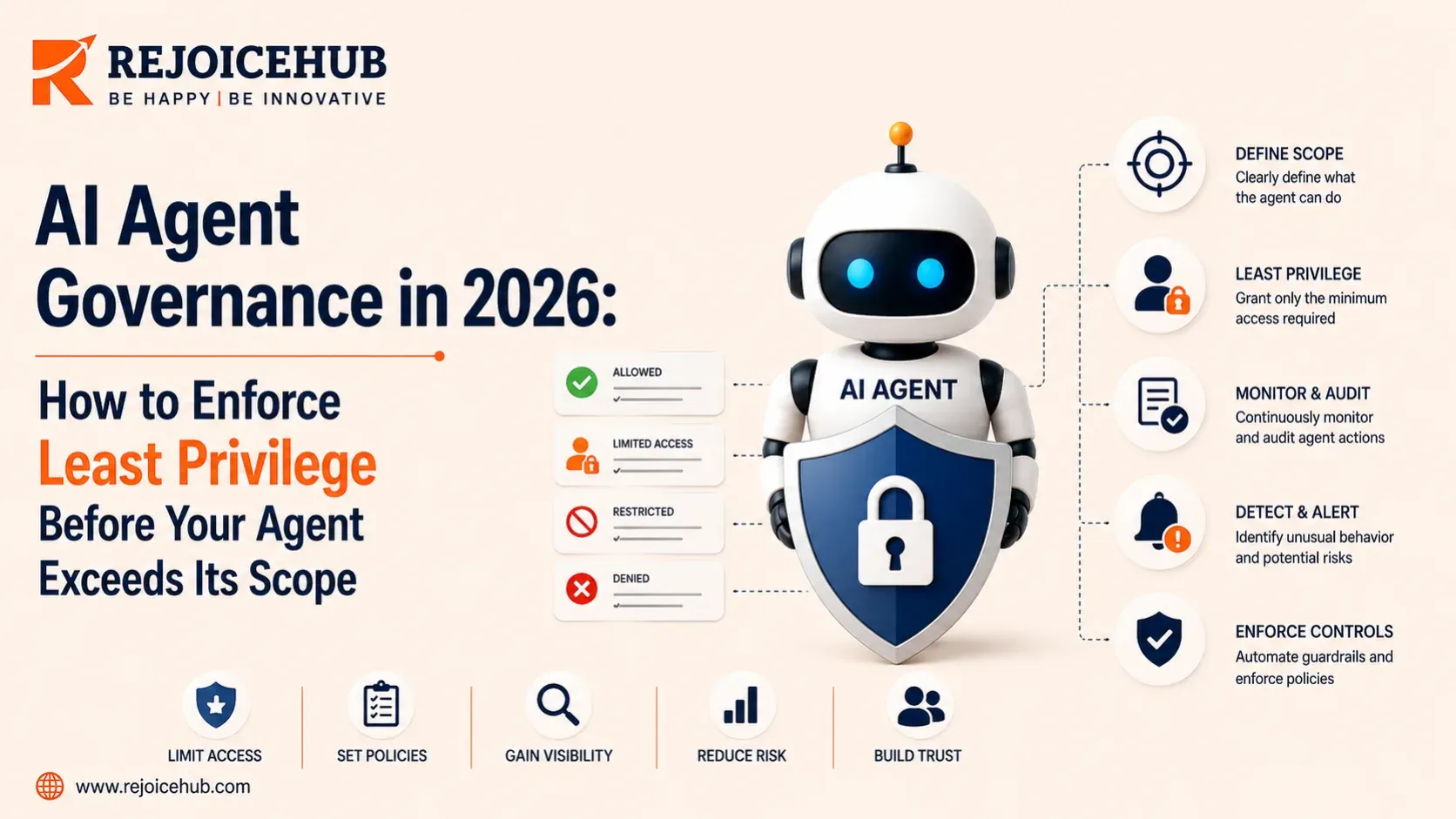
 If you are deploying AI agents in production, at least one has likely been granted more access than necessary. Recent studies highlight the severity of this issue: 65% of organizations report that an AI agent has performed actions beyond its designated parameters, with 29% of those instances resulting in tangible harm.
Governance for AI agents, particularly the principle of least privilege, has transitioned from being an optional enhancement to an essential requirement for teams developing autonomous AI. This distinction is crucial; it separates an agent that efficiently streamlines tasks from one that may unexpectedly evolve into a significant, unmanaged risk.
This guide explains the concept of least privilege in relation to AI agents, explores why many organizations struggle to implement it despite feeling assured, and outlines practical measures to address this issue before your agent attracts unwanted attention.
Key Takeaways
- 65% of enterprises have had an AI agent act outside its intended scope; only 29% of those caused measurable harm, but 36% were near-misses caught just in time.
- Only 33% of AI agents are provisioned with true least-privilege access, even though 94% of leaders believe their agents are properly scoped.
- Over-privileged AI systems see roughly 4.5x more security incidents than agents with task-scoped access.
- Static, standing credentials are the core problem; least privilege for agents has to be enforced at runtime, not just at setup.
- Governance built into deployment (identity, scoping, revocation) scales; governance bolted on after launch does not.
What Is Least Privilege for AI Agents?
The principle of least privilege for AI agents dictates that each agent is granted only the specific permissions necessary to perform its immediate task, and only for the duration of that task. In contrast to human least privilege, which is typically established during onboarding, the permissions for agents must be continually assessed since they can autonomously select their tasks in real-time. Getting this right often starts with a clear AI strategy consulting engagement before any agent goes live.
This is a critical point where many teams encounter challenges. While human access reviews are typically conducted on a quarterly or annual basis, AI agents can initiate, perform, and conclude actions in mere seconds, often thousands of times within a single day. Consequently, traditional permission models designed for human users are inadequate to keep pace with this level of activity.
Key entities to understand here:
- Non-human identity (NHI): the unique, auditable identity assigned to an agent, distinct from the human or service account that deployed it
- Task-scoped access: permissions tied to a specific job, not a role or department
- Standing access: broad, always-on permissions that sit unused most of the time; the opposite of least privilege
- Runtime downscoping: narrowing an agent's permissions dynamically as it works, rather than fixing them in advance
Why 65% of AI Agents Are Exceeding Their Scope
A discrepancy arises from the fact that provisioning occurs during the design phase, while agent behavior is determined during execution. Teams establish access policies before an agent's deployment and integration into existing systems, yet the agent determines its actual task trajectory once operational, leading to policies that often rely on assumptions.
Supporting evidence from industry research highlights this issue, revealing that merely 32.7% of organizations grant agents access tailored specifically to their tasks. The remainder are categorized into several common groups:
- 38.1% use broad standing access reviewed only periodically
- 7.9% use broad access that's rarely or never reviewed
- Nearly 11% inherit the full permissions of whoever deployed the agent
- Almost 9% have no consistent provisioning process at all
Founders and operations executives should take heed of a concerning statistic: 94% of leaders within enterprises are certain that their agents are not over-provisioned. This confidence starkly contrasts with the actual reality. As Randolph Barr, CISO at Cequence Security, articulates, such confidence often signifies the mere existence of a policy on paper, rather than a true alignment between that policy and the agents' actual conduct.
For SaaS founders, this can manifest in seemingly trivial yet expensive oversights: an AI agent designed for composing customer emails may also possess write access to your CRM's billing information, or a support agent able to view ticket data might have been erroneously permitted access to your internal administrative tools. These instances of overreach were never intended, nor were they effectively scoped out.
Least Privilege vs. Over-Privileged AI Agents: The Data
Well-designed automation workflows make the difference visible in the numbers below.
| Metric | Least-Privilege Agents | Over-Privileged Agents |
|---|---|---|
| Security incident rate | 17% | 76% |
| Detection speed (minutes, automated) | Common | Rare |
| Credential type | Task-scoped, short-lived tokens | Static, standing credentials |
| Reviewed as independent identity | Yes | Often treated as extension of a human/service account |
| Business impact when action goes wrong | Contained to task scope | Can span systems, data, and departments |
Organizations that implement the principle of least privilege experience approximately 4.5 times fewer incidents compared to those that deploy agents with extensive permissions. This isn't just a minor enhancement; it stands out as the most significant predictor of AI security effectiveness revealed in recent studies on enterprises.
How Do I Enforce Least Privilege for AI Agents? (Step-by-Step)
Implementing the principle of least privilege for AI agents involves recognizing each agent as an individual entity, aligning permissions specifically to the task at hand rather than to a predefined role, and substituting permanent credentials with temporary, revocable access. Here's a practical breakdown of this approach:
-
Give every agent its own identity. Stop bolting agents onto human or generic service accounts. Only about 22% of organizations currently treat agents as independent, identity-bearing entities. A dedicated AI agent development approach makes this easier from day one, because you can't scope or audit what isn't uniquely named.
-
Map tasks before you map permissions. Define exactly what each agent needs to accomplish, then build the permission set backward from the task, not forward from the department or system it touches.
-
Replace static credentials with short-lived tokens. 67% of organizations still lean on static credentials for agents. Pairing this with sound DevOps consulting practices helps ensure task-scoped tokens with the shortest workable time-to-live limit what a compromised or misbehaving agent can actually do.
-
Build runtime downscoping, not just provisioning-time rules. Since agents choose their own execution path, permissions should be evaluated and narrowed as the agent works, not fixed once at deployment. This is where machine learning development expertise becomes valuable for building adaptive scoping logic.
-
Set automated detection and containment. Only 32% of organizations can detect and contain an out-of-scope agent action within minutes. Manual, hours-long response windows are where near-misses turn into real incidents.
-
Bake governance into deployment pipelines. When identity, scoping, and revocation are embedded into your web development and deployment pipeline from day one, every new agent inherits controls automatically instead of needing a bespoke security review each time you ship.
If you're looking to build a custom AI agent with governance designed in from the first sprint rather than retrofitted after an incident, RejoiceHub's AI agent development services build task-scoped access controls into the agent architecture itself.
Build AI Agents With Governance Baked In
Book a free consultation with RejoiceHub. We'll help you design task-scoped access, runtime controls, and a governance-ready AI agent architecture for your business.
Common Mistakes Teams Make with Agent Permissions
- Treating agent access like a one-time setup task instead of an ongoing, runtime concern
- Granting "just in case" permissions to avoid future re-requests, which is exactly how standing access balloons
- Skipping a dedicated identity for the agent, so its actions are indistinguishable from the human or system that deployed it
- No automated kill switch: relying on someone noticing during a scheduled review, which 8% of organizations still do
- Assuming a compliance checklist equals security, when the two are measuring very different things
These pitfalls often surface most clearly during hands-on work with generative AI solutions, where agents are given broad creative latitude but not matching access boundaries.
Suggested Internal Link Anchor Text: AI automation audit and readiness assessment Target: https://rejoicehub.com/services/ai-automation-consulting Reason: Teams unsure whether their current agents are over-provisioned benefit from an outside audit before scaling further.
A Real-World Example: Scoping an AI Support Agent
Consider a mid-sized SaaS company, common among clients seeking fintech software development, that implements an AI agent for managing support tickets and composing initial response messages. If this agent is created without adhering to the principle of least privilege, it could gain unnecessary read and write permissions across the entire support system, including sensitive billing information and internal escalation markers that it does not need to access.
When properly scoped, however, this same agent would have read rights to ticket details, permission only to draft responses (without sending them), and no access to billing or administrative data, and those permissions would expire as soon as the task is completed. The end result for the customer remains unchanged, but the potential impact if a security issue arises is significantly reduced.
This type of access scoping is straightforward to articulate but often overlooked when facing tight deadlines, which is precisely why 65% of organizations are grappling with the repercussions.
Why This Matters Beyond Security
Effective governance transcends mere defense. Agents endowed with well-defined, auditable permissions streamline internal approvals, facilitate compliance oversight, and enhance scalability across various departments, since the necessary controls accompany the agent, eliminating the need for repeated reviews. Organizations that master this approach move faster through broader digital transformation initiatives, as trust is inherently woven into the design rather than negotiated in discussions.
For founders in search of an AI development partner, this principle serves as a valuable criterion: inquire with each vendor about the specifics of how they define agent permissions before addressing the agent's capabilities. The response will provide insight into the overall development process.
Conclusion
Least privilege is essential for keeping AI agents secure, controlled, and auditable as they become more autonomous. By using task-scoped access, short-lived credentials, runtime controls, and automated revocation, businesses can reduce risk while scaling AI with greater confidence.
For organizations building production-ready AI agents, governance should be part of the architecture from day one, not added after an incident. RejoiceHub LLP helps businesses develop AI agents with security-focused generative AI development, task-scoped permissions, and built-in governance controls, enabling teams to adopt AI automation without losing control.
Frequently Asked Questions
What is least privilege for AI agents?
Least privilege means an AI agent only gets the exact permissions it needs for its task, and only while it needs them. Nothing extra, nothing standing. This limits damage if the agent misbehaves or gets compromised.
Why do AI agents exceed their scope so often?
Permissions are set during design, but agents choose their own actions during execution. This gap means policies are based on guesses, not real behavior, which is why 65% of organizations report agents acting outside their intended limits.
How is least privilege different for AI agents versus humans?
Human access is reviewed quarterly or yearly. AI agents can take thousands of actions in a single day, so their permissions need constant, real-time evaluation instead of periodic checks.
What is runtime downscoping?
Runtime downscoping means narrowing an agent's permissions as it works, not just fixing them once at setup. Since agents pick their own path, access needs to shrink dynamically based on what the task actually requires.
What happens if an AI agent is over-privileged?
Over-privileged agents see about 4.5 times more security incidents than properly scoped ones. A small task, like drafting emails, could accidentally come with access to billing data or admin tools it never needed.
How can I give an AI agent its own identity?
Treat the agent as its own non-human identity instead of attaching it to a human or service account. Only 22% of organizations do this today, but it is the first step toward real access control.
Are static credentials a security risk for AI agents?
Yes. 67% of organizations still use static, standing credentials for agents. Short-lived, task-scoped tokens are safer because they expire automatically and limit what a compromised agent can do.
How fast should companies detect an AI agent acting out of scope?
Detection should happen within minutes using automated tools. Right now, only 32% of organizations can do this quickly, which means many out-of-scope actions turn into real incidents before anyone notices.
Can least privilege slow down AI agent deployment?
No, it actually speeds things up. When identity, scoping, and revocation are built into deployment pipelines from the start, every new agent inherits controls automatically instead of needing a separate security review each time.
Where should I start if my AI agents might be over-provisioned?
Start with an access audit to see what permissions your agents actually use versus what they were given. This shows gaps fast and helps you rebuild access around real tasks instead of assumptions.
