
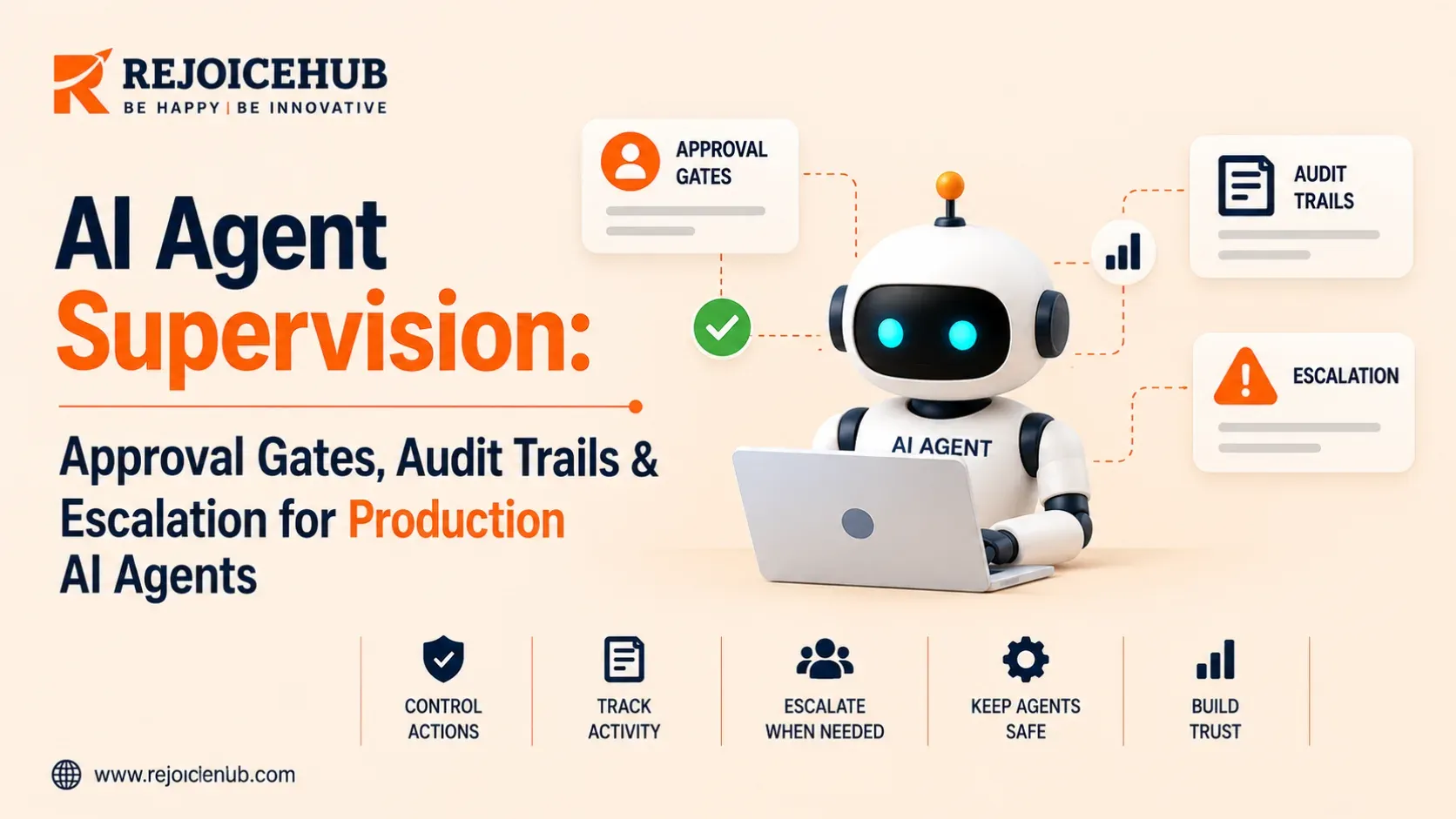
If you've deployed an AI agent from a demo environment into production, you've probably gained new respect for the ways an apparently competent agent can still do stupid things. A financial agent might approve the wrong refund, a customer support agent might send the wrong email, and/or your most junior dev might push some code that crashes the production system at 2 am.
AI agent supervision is the art of making the autonomous agents that serve in production systems actually accountable while they're doing their work. Getting this right often starts with a clear-eyed AI strategy consulting engagement so the risk framework is defined before the agent ever ships.
This guide provides an overview of what goes into building a robust system for monitoring and auditing production AI, including real-world architecture patterns, comparison tables, and common pitfalls to avoid.
What Is AI Agent Supervision?
AI agent supervision is the collection of policies, controls, and procedures that govern the actions of an autonomous AI agent, record its actions for the purposes of audit, and escalate questionable or unsafe acts to humans for review.
It is the combination of seatbelts and airbags for autonomous software agents. While the agent is driving, supervision is there to make sure that when it needs to slow down, it does so, and when it needs to ask the driver to take over, it does that too.
Unlike ordinary software monitoring, which concentrates on detecting and handling failures and errors, agent supervision has to deal with the more challenging case of an agent performing an act that was requested by the user, but which happens to be incorrect or dangerous in the context in which it is performed.
Why AI Agent Supervision Matters Now
Search intent for this topic splits into two camps, and most articles only answer one of them.
Primary intent: Teams already running AI agents in production want to know how to add approval gates, audit logs, and escalation without rebuilding everything.
Secondary intent: Teams evaluating AI agents want to understand what "safe" agent deployment actually looks like before they commit budget.
Pain points: Agents making irreversible mistakes, no visibility into why an agent did what it did, compliance teams blocking launches, and slow manual review bottlenecking every agent action.
Desired outcome: Agents that act autonomously on low-risk tasks, pause for approval on high-risk ones, and leave a clean audit trail either way.
If you're building or scaling production AI agents, supervision isn't an afterthought. It's the difference between a pilot that stalls at "looks cool in the demo" and a system your compliance and ops teams will actually sign off on.
Accelerate Your Workflows with Custom AI
Book a free consultation session with RejoiceHub. We'll map out a tailored automation roadmap for your company.
How Does AI Agent Supervision Architecture Work?
AI agent supervision architecture typically has four levels: a permissions layer defining what the agent can and cannot do, an approval-gate layer which temporarily pauses questionable operations for human review, a logging layer capturing all decisions for auditing, and an escalation layer that directs specific issues to the right humans for resolution.
Let me describe each layer in more detail, as this is where many teams make mistakes or, at a minimum, fail to fully utilize the capabilities of their agent systems.
Layer 1: Permissions and Guardrails
Before an agent ever takes an action, it should know its boundaries. This is the same principle as least-privilege access in traditional IT security, applied to autonomous decision-making. Teams building this layer from scratch often lean on AI integration work to connect the agent's permission logic cleanly with existing business systems.
Practical guardrail examples:
- A support agent can issue refunds up to $50 automatically, but anything above that requires sign-off.
- A sales agent can draft outbound emails freely, but cannot send to more than 20 contacts without review.
- A DevOps agent can restart non-production services on its own, but production deploys always require approval.
Expert tip: Set guardrails based on reversibility, not just dollar amount. An action that's easy to undo (drafting an email) deserves more autonomy than one that's hard to undo (deleting a database record), even if the dollar value is similar.
Layer 2: Approval Gates
Approval gates are checkpoints where an agent stops and waits for explicit human confirmation before completing an action that's flagged as high-risk, high-cost, or irreversible.
A well-designed AI agent approval workflow doesn't ask a human to review everything. That defeats the purpose of automation. It asks for review only where the risk profile justifies the friction.
Common approval gate triggers:
- Dollar thresholds (refunds, purchases, discounts)
- Irreversible actions (deleting records, sending to external parties, publishing content)
- Novel situations the agent hasn't handled before with high confidence
- Actions touching regulated data (health records, financial data, PII)
If you're looking to build a custom AI agent with approval workflows tailored to your risk thresholds, RejoiceHub's AI agent services can help design gates that match your actual business risk, not a generic template.
Layer 3: Audit Trails
Audit trails are timestamped, immutable records of every action an AI agent took, the reasoning or inputs behind it, and who approved or overrode it, creating a complete accountability record for compliance and debugging.
A good audit trail answers three questions for any agent action, months later if needed:
- What did the agent do?
- Why did it do it (what inputs, prompts, or data triggered the decision)?
- Who approved it, or did it run autonomously under existing guardrails?
Without this, "the agent made a mistake" becomes an unanswerable mystery instead of a fixable bug. This is often where solid API development practices matter most, since the audit layer usually depends on clean, well-documented endpoints between the agent and the logging system.
Layer 4: Escalation Paths
Escalation is the process of routing an agent's uncertain, blocked, or flagged decision to the correct human, not just any available person, but the one with the context and authority to make the call.
Escalation should follow a clear hierarchy, for example:
- Low ambiguity → routed to the on-shift operations team
- Medium risk → routed to a team lead with domain context
- High risk or regulatory exposure → routed to a compliance or legal reviewer
Key Takeaways
- Supervision architecture has four layers: permissions, approval gates, audit trails, and escalation.
- Guardrails should be based on reversibility of the action, not just its dollar value.
- Approval gates should only trigger on genuinely high-risk actions to preserve automation speed.
- Every action needs a "what, why, who" audit record.
- Escalation should route to the right expertise level, not just the nearest available person.
Approval Gates vs. Full Autonomy: What Should You Automate?
The short answer: automate reversible, low-cost, high-frequency actions fully, and gate irreversible, high-cost, or novel actions behind human approval.
| Action Type | Example | Recommended Supervision Level |
|---|---|---|
| Reversible, low cost | Drafting a marketing email | Full autonomy |
| Reversible, high frequency | Categorizing support tickets | Full autonomy with periodic audit |
| Irreversible, low cost | Sending a customer confirmation SMS | Autonomy with logging |
| Irreversible, high cost | Issuing a large refund | Approval gate required |
| Novel or low-confidence | Agent hasn't seen this scenario before | Escalation to human |
| Regulated data involved | Actions touching PII or financial records | Approval gate + audit trail |
This table itself is a useful decision tool. Bookmark it, or better yet, build it directly into your agent's decision logic so the classification happens automatically rather than case by case, an approach that's central to good automation services design.
What Does AI Agent Governance Look Like in Practice?
AI agent governance is the overarching policy layer that defines who owns agent decisions, how supervision rules get set and updated, and how the organization stays accountable for what its agents do. Supervision is how governance gets enforced day to day.
Governance typically involves:
- Ownership: A named team or role responsible for each agent's behavior, not "the AI."
- Review cadence: Regular audits of agent decisions, especially near-misses that were caught by approval gates.
- Change control: A process for updating an agent's permissions or guardrails, so changes aren't made ad hoc by whoever's online.
- Documentation: Written policy on what the agent is and isn't allowed to do, accessible to both technical and non-technical stakeholders.
A useful comparison that many teams overlook is financial controls. If you would never let a single employee authorize and carry out a company payment, you should also make sure that "agent proposes an action" and "human or a separate system approves it" for anything sufficiently high-stakes, particularly in sectors like fintech software development where regulatory scrutiny is highest.
Companies looking to explore this space further may want to look into broader frameworks for AI agent governance, which touches on many of these aspects from the perspective of policy, compliance, and organizational governance.
How Do You Monitor Production AI Agents?
AI agent monitoring means continuously tracking an agent's actions, decision confidence, error rates, and escalation frequency in real time, so issues surface before they become incidents rather than after.
Effective monitoring for production AI agents typically tracks:
- Action volume and type: what is the agent actually doing, at what frequency?
- Confidence scores: how often is the agent uncertain, and is that trending up or down?
- Escalation rate: what percentage of actions get routed to a human, and why?
- Override rate: how often do humans reject or change what the agent proposed?
- Time to resolution: how long does an escalated decision take to get resolved?
A rising override rate is one of the most valuable early indicators that your AI agent is out of alignment with the business's current realities, whether in its training data, prompts, or safety mechanisms. If your staff is designing such dashboards from scratch, RejoiceHub's DevOps consulting services prioritize early warning signals to avoid overwhelming operators with low-value alerts.
Human-in-the-Loop AI Agents: Where's the Line?
Human-in-the-loop AI agents are those that are designed such that a person evaluates or approves certain decisions before they are enacted, as opposed to allowing the agent to operate independently.
The error that many teams make when designing human-in-the-loop AI is thinking about it as a binary choice: whether to use human oversight or not. The best practices instead involve varying levels of human input:
- Human-in-the-loop: Human approves before the action happens (used for high-risk actions).
- Human-on-the-loop: Agent acts autonomously, human monitors and can intervene after the fact (used for medium-risk, high-frequency actions).
- Human-out-of-the-loop: Agent acts fully independently, with only periodic audit review (used for low-risk, high-volume actions).
Teams building this kind of tiered oversight into a conversational agent often start with generative AI development services to make sure the underlying model can actually support confidence scoring at each tier.
AI Agent Security: What Supervision Doesn't Cover
AI agent security protects the agent's infrastructure, credentials, and data access from external threats, a separate concern from supervision, which governs the agent's own decision-making.
Supervision and security work together but solve different problems:
- Supervision asks: "Should the agent be allowed to do this?"
- Security asks: "Can anyone tamper with the agent, its instructions, or its credentials to make it do something it shouldn't?"
Common security gaps that undermine even well-designed supervision:
- Agents with standing credentials broader than the tasks they perform
- No separation between the agent's "instructions" and untrusted external data it processes (a common vector for prompt injection)
- Audit logs stored in a system the agent itself has write access to (which means the agent, or an attacker controlling it, could tamper with its own trail)
Common implementation mistake: Storing logs in the same database that the agent runs in. If the agent is compromised, an attacker could modify the evidence. This is why logs should always be written to a separate, append-only system that the agent cannot modify.
If you're building out agent infrastructure for your team, RejoiceHub's open source consulting practices are built around this separation of duties from day 1, not as an afterthought.
Building an AI Agent Approval Workflow: Step-by-Step
Here's a practical sequence for teams implementing this for the first time.
- Map every action your agent can take. List them out, no matter how small.
- Score each action by risk and reversibility. Use a simple high/medium/low scale to start.
- Assign a supervision tier to each action. Full autonomy, monitored autonomy, or approval-gated.
- Define who approves gated actions. Name actual roles, not "someone on the team."
- Build the audit log first, before scaling autonomy. You want visibility before you need it, not after an incident.
- Set escalation SLAs. How long can an approval sit before it's a bottleneck? Define it explicitly.
- Review and adjust monthly. Supervision rules should evolve as your agent gets more reliable and as your business changes.
This sequence mirrors how RejoiceHub's AI AgentKit builder services approach new client builds. Supervision architecture gets designed alongside the agent, not added after launch.
AI Agent Management: Keeping Supervision Sustainable at Scale
AI agent management encompasses the ongoing maintenance and adjustment of supervision rules, performance evaluation, and permission modifications as an agent's performance record and business environment evolve.
The companies that reap the highest rewards from AI agents tend to take a dynamic approach to supervision regulation, rather than a static one. Specifically, they implement:
- As an agent proves reliable in a task category, autonomy expands, and approval gates loosen.
- As new edge cases emerge, new gates get added.
- As the business changes (new products, new regulations, new markets), guardrails get revisited.
Expert suggestion: Review your escalation and override rates at least once a quarter. If these numbers appear to be trending downwards, it can be a good sign that you can start delegating more autonomy to your agents in that category in order to improve their value. This kind of continuous recalibration is a core part of any serious digital transformation initiative built around AI agents.
For companies that have many agents across departments, an AI agent management platform can help you keep track of these reviews rather than having to do it department-by-department in spreadsheets.
Conclusion
AI agents can deliver real value in production, but autonomy without supervision creates unnecessary risk. A strong AI agent supervision architecture combines four essential layers: permissions and guardrails, approval gates, audit trails, and clear escalation paths. The goal is not to slow automation with constant human reviews.
Instead, teams should give agents more freedom for low-risk, reversible tasks while requiring approval for high-risk, irreversible, or uncertain actions. Continuous monitoring, regular reviews, and clear ownership also help supervision evolve as agents and business needs change. With the right controls in place, organizations can scale production AI agents with greater confidence, accountability, and operational safety.
FAQs
Frequently Asked Questions
What is AI agent supervision?
AI agent supervision is the set of rules and checks that control what an AI agent can do on its own. It covers permissions, approval gates, audit logs, and escalation paths for risky actions.
What are approval gates in AI agents?
Approval gates are checkpoints where an AI agent pauses and waits for a human to say yes before finishing a risky task. They're used for actions that are costly, irreversible, or unusual for the agent.
Why do AI agents need audit trails?
Audit trails record what an agent did, why it did it, and who approved the action. Without this record, mistakes become hard to trace, and compliance teams have no proof of how decisions were made.
What is human-in-the-loop in AI agents?
Human-in-the-loop means a person must approve an action before the AI agent carries it out. It's mainly used for high-risk tasks where a mistake could be costly or hard to undo.
How do you monitor AI agents in production?
You track action volume, confidence scores, escalation rate, override rate, and time to resolution. A rising override rate usually signals the agent needs updated rules or retraining.
What's the difference between AI agent supervision and AI agent security?
Supervision decides if an agent is allowed to take an action. Security stops outsiders from tampering with the agent's credentials or instructions. Both are needed, but they solve different problems.
What actions should require approval before an AI agent completes them?
Actions that are irreversible, involve large sums of money, touch regulated data like PII, or are situations the agent hasn't handled before with confidence should all need human approval first.
How do you build an approval workflow for AI agents?
Start by listing every action the agent can take, then score each one by risk and reversibility. Assign a supervision tier, name the actual approver, and build the audit log before scaling autonomy.
What is AI agent governance?
AI agent governance is the policy layer above supervision. It defines who owns the agent's decisions, how often rules get reviewed, and how permission changes are documented and controlled.
How often should AI agent supervision rules be reviewed?
Most teams review escalation and override rates at least once a quarter. As an agent proves reliable, gates can loosen; as new edge cases appear, new gates should be added.
