
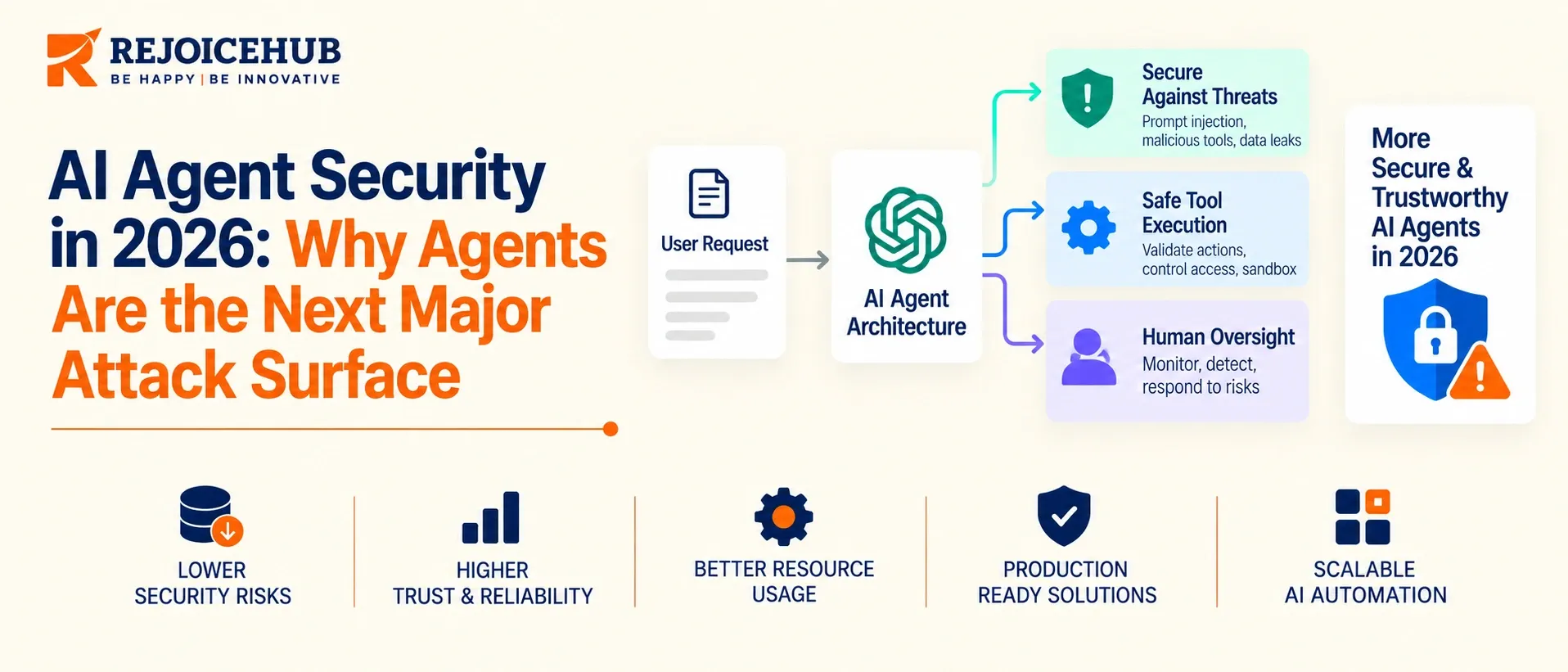
Last quarter, a customer-support agent at a mid-market SaaS company summarized a support ticket. It pulled the customer's account into an internal tool. And because a carefully designed line of text in that ticket told it to, it forwarded a database export to an external address. No malware. No stolen credentials. Just an AI agent doing exactly what its instructions told it to, including the ones an attacker planted.
Quick Summary
AI agents combine three things no prior enterprise system combined at scale: ongoing access to internal tools, the ability to act without a human approving each step, and an input channel (natural language) that's trivial to influence. That combination is why security teams now rank agentic AI as a top attack vector, why non-human identities are multiplying faster than IAM programs can track them, and why a growing share of organizations are shipping agents to production without full security sign-off. This post breaks down the real risk categories, what to check first, and what a proper agent security engagement covers.
Key Highlights
- Agentic AI now ranks as the top cybersecurity concern for 2026 among a large share of security professionals, ahead of deepfakes and passwordless adoption
- A large share of enterprises are actively building or running agents in production, but only a small fraction have full security and IT sign-off before launch
- Every deployed agent creates a non-human identity that needs its own credential management, scoping, and audit trail; most legacy IAM stacks weren't built for this
- Over-privileged agents, hardcoded credentials, and prompt injection are the three failure modes showing up most often in real incidents
Why This Is Happening Now
There was an explosion in the adoption of agents that outran controls. That's the whole point, and it's useful to keep in mind because it explains all the later risks that we'll hear about in a bit.
Gartner's prediction that up to 40% of enterprise apps will contain task-specific AI agents by year-end 2026, up from under 5% a couple of years ago, is a good reminder that this is happening quickly.
Most security stacks were built upon a set of well-understood assumptions: humans login, sessions expire, permissions are tied to a role, and an audit log could reconstruct what happened. Agents violate all four at once. They are long-lasting, hold on to credentials for a long time, limit their access to everything they touch (because figuring out what an agent should be able to do is harder than figuring out what a human user can do), and have an identity that is often an API key hidden somewhere in a configuration file, invisible to most IAM tools.
A Dark Reading poll of their readers found that just about half of cybersecurity pros named agentic AI and autonomous systems as the #1 attack vector for 2026, beating out deepfakes, board-level cyber concerns, and passwordless adoption. That's not a result of the AI hype. It reflects a reality that attackers have realized that they can gain access to one agent that's over-privileged and use it to move to all other systems that it touches, and traditional detection tools don't have a great model for "an agent is behaving abnormally."
The Data: How Big Is the Exposure
The numbers vary by source, but they point to the same pattern: use is outpacing security readiness by a wide margin.
| Metric | Figure | Source |
|---|---|---|
| Enterprise apps expected to include task-specific agents by end of 2026 | ~40% | Gartner |
| Security professionals naming agentic AI as the #1 attack vector for 2026 | ~48% | Dark Reading poll |
| Data breaches involving unmanaged "shadow AI" tools | Over one-third | Kiteworks / industry research |
| Technical teams with agents in active testing or production | ~81% | Gravitee State of AI Agent Security 2026 |
| Of those, agents that launched with full security and IT approval | ~14% | Gravitee State of AI Agent Security 2026 |
| Deployed agents actively monitored or secured on an ongoing basis | ~47% | Gravitee State of AI Agent Security 2026 |
| Deployed agents able to create and task other agents | ~25% | Gravitee State of AI Agent Security 2026 |
| Rise in attacks exploiting public-facing apps with weak/missing auth | 44% YoY | IBM X-Force Threat Intelligence Index 2026 |
Read the middle three rows together: most organizations are already running agents in production, less than a sixth got a full security review before launch, and under half are monitored on an ongoing basis. That gap, build fast, secure later, is where almost every documented agent-related incident this year originated.
Traditional AppSec vs. Agent Security: What Actually Changes
Security teams often try to bolt agent oversight onto existing AppSec and DevOps programs. It half-works; the parts that don't transfer are exactly the parts that matter most.
| Dimension | Traditional Application Security | AI Agent Security |
|---|---|---|
| Identity model | Human user or static service account | Non-human identity, often shared across many agent instances |
| Access pattern | Role-based, reviewed periodically | Dynamic, tool-by-tool, changes as agents get new capabilities |
| Attack input | Structured input fields, sanitized | Natural language including content retrieved from documents, emails, and web pages (indirect prompt injection) |
| Audit trail | Predictable logs of function calls | Reasoning traces that may not map cleanly to the action taken |
| Potential impact of compromise | Scoped to the taken over account's permissions | Scoped to every tool and system the agent has standing access to |
| Detection baseline | Known-bad signatures, anomaly thresholds | No established baseline yet for "normal" agent behavior |
The takeaway isn't that traditional AppSec is useless; least-privilege, logging, and input validation still matter. It's that none of them are enough on their own when the thing making decisions is a language model reading untrusted text.
7 Signs Your AI Agents Are Already Exposed
No inventory of which agents have which permissions. If you can't produce a list of every agent, what systems it can touch, and who approved that access, you don't have a security posture, you have an assumption.
Credentials are hardcoded or long-lived. Static API keys embedded in prompts, configs, or agent memory are the single most common root cause we see in agent-related incidents. They don't rotate, they're rarely scoped tightly, and they survive well past when they should. This is exactly the kind of gap a proper API development and access-management process is meant to close.
Agents can read content they didn't generate. Any agent that ingests emails, tickets, documents, or web content is exposed to indirect prompt injection, instructions hidden in that content that the model may follow as if they came from the user.
No logging of the agent's reasoning, only its final action. When an agent does something wrong, "it sent an email" isn't enough investigation detail. You need the chain: what input triggered the decision, what tools it considered, and why it chose that action.
Tool integrations were added faster than they were reviewed. Every new tool or plugin an agent can call is a new piece of attack surface. If integrations ship without a security pass, that surface grows silently, which is why AI integration work needs a security review built into the process, not added after launch.
One agent can spin up or task other agents. Multi-agent delegation compounds exposure; a compromised or manipulated parent agent can propagate bad instructions to every agent it spawns, often faster than a human notices.
There's no kill switch. If you can't immediately revoke an agent's access or halt its execution mid-task, you don't have a way of stopping the damage from spreading, you have hope.
The Four Layers of the Agent Attack Surface
AI agents do not have a single attack area exposed to attack. Their security risks can appear at different points, from the instructions they receive to the actions they take.
Most agent security approaches can be broken into four main layers. Each layer has different risks and requires different security controls.
1. Input Layer
The input layer is where an agent receives instructions and information. This is also where prompt injection can occur.
There are two common types:
- Direct prompt injection: An attacker enters malicious instructions directly into the agent.
- Indirect prompt injection: Malicious instructions are hidden inside a document, webpage, email, or other content that the agent retrieves.
This makes external content an important security concern. Even if the user does not directly provide a malicious prompt, the agent may encounter one while browsing the web, reading documents, or processing emails.
OWASP's Top 10 for LLM Applications identifies prompt injection as a major security risk for LLM-based applications.
2. Identity and Access Layer
An AI agent should be treated as a non-human identity, not simply as another application feature.
Like human accounts, agents need controls for:
- Account setup
- Access scoping
- Credential rotation
- Permission management
- Account removal
The challenge is that agents can interact with multiple systems and call different tools dynamically. Traditional identity and access management (IAM) systems may not provide enough visibility or control over these machine-to-machine interactions. This is one of the reasons purpose-built AI Agentkit builder services bake identity and access scoping into the agent from day one instead of retrofitting it later.
The more permissions an agent has, the greater the potential impact if that agent is compromised or manipulated.
3. Tool and Integration Layer
The tool and integration layer covers everything an agent can access or control, including APIs, databases, plugins, internal applications, and external services.
This layer becomes especially important when an agent has broad permissions.
For example, an agent that can only read a public knowledge base has limited impact. An agent that can also access customer records, update databases, send emails, and trigger financial workflows presents a much larger security risk, particularly in regulated environments like fintech software development, where a single over-permissioned integration can touch sensitive financial data.
Poorly secured or over-permissioned integrations can therefore turn a manipulated agent into a serious security incident.
4. Output and Action Layer
The final layer is what the agent actually does with the information and decisions it produces.
An agent may:
- Send information to an external system
- Write data to a database
- Modify records
- Trigger another workflow
- Send an email or message
- Initiate a difficult business action
This is where risks such as unauthorized data exfiltration and unintended actions can become real-world incidents.
The output and action layer is also the final checkpoint before an agent's decision produces an external effect. High-risk actions should therefore have appropriate validation, approval, logging, or other safeguards, especially in agents built on top of broader automation services that touch multiple downstream systems.
Where RejoiceHub Fits in the Landscape
There's no single vendor that "solves" agent security, and we'd be lying if we said otherwise. Identity platforms are extending IAM to cover non-human identities. Runtime security vendors are building agent-specific monitoring and detection of unusual behavior. Model providers are hardening against prompt injection at the model level. Each of those is solving a real piece of the problem.
Where RejoiceHub is different: we build the agents themselves for a lot of our clients as part of our broader generative AI development services, which means our security review isn't a generic checklist run against a black box, it's informed by actually understanding how the agent's reasoning, tool access, and integrations were architected.
For teams whose agents we didn't build, we still run the same four-layer review, and where it makes sense we bring in our AI strategy consulting practice to align that review with the client's broader roadmap. But the point is: agent security is most effective when it's built in during development, not bolted on after the fact. If your organization already has a mature IAM or runtime security vendor, we typically integrate alongside them rather than replacing them.
Conclusion
Agentic AI isn't a future risk to plan for eventually; the adoption numbers above show it's already running in production at most enterprises, usually with less security review than the risk warrants. The gap between deployment speed and security readiness is closing slower than the deployment curve is rising, and that gap is exactly where incidents happen. If you're running agents without a current inventory of their permissions and a tested plan for revoking access, that's the place to start.
Frequently Asked Questions
What is AI agent security?
AI agent security protects the non-human identities, tool access, and instructions that AI agents use, since agents can act on tasks without a human approving each step.
Why are AI agents a bigger risk than regular software?
Agents hold standing access to multiple tools, act without per-step approval, and take instructions in plain language, which attackers can manipulate through prompt injection.
What is prompt injection?
Prompt injection happens when an attacker hides malicious instructions in text an agent reads, like a support ticket or email, causing the agent to follow those hidden commands.
What's the difference between direct and indirect prompt injection?
Direct injection means instructions typed straight into the agent. Indirect injection hides instructions inside documents, emails, or webpages the agent later retrieves and reads.
How many enterprises already have agents in production?
About 81% of technical teams have agents in active testing or production, according to Gravitee's 2026 State of AI Agent Security report.
Do most AI agents get security approval before launch?
No. Only around 14% of agents launch with full security and IT sign-off, so most agents go live without a proper pre-launch review.
What are the four layers of the AI agent attack surface?
The four layers are the input layer, identity and access layer, tool and integration layer, and output and action layer, each needing different controls.
What is a non-human identity in agent security?
A non-human identity is the credential and access profile an AI agent uses to act, similar to a service account, but often shared and poorly tracked by IAM tools.
What are the warning signs an AI agent is exposed?
Signs include no permissions inventory, hardcoded credentials, no reasoning logs, unreviewed tool integrations, agents that can spawn other agents, and no kill switch.
How can a business start securing its AI agents?
Start with a full inventory of every agent, its permissions, and its tool access, then add credential rotation, ongoing monitoring, and a tested way to revoke access fast.
