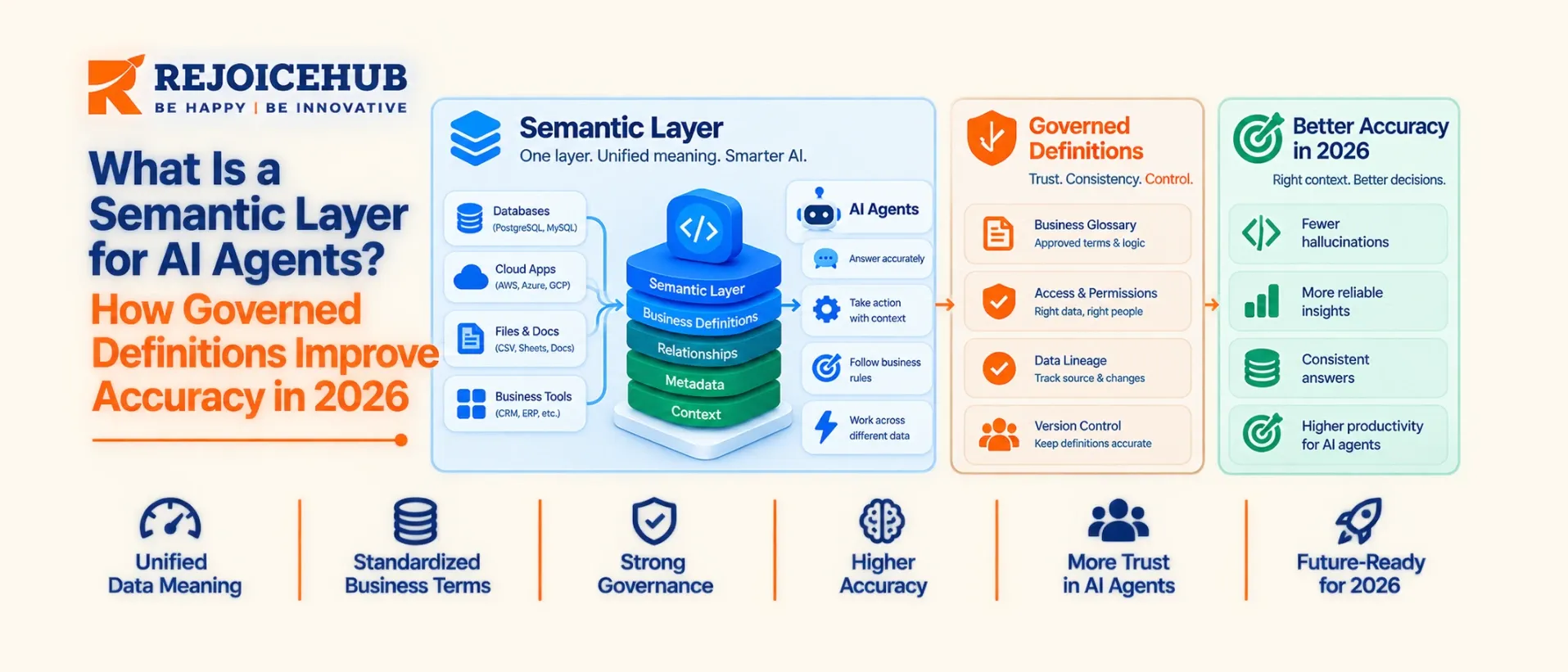
Ask three AI agents for "last quarter's revenue," and you can expect to get three different numbers
One might count gross bookings, one might net out refunds, and one might sum a snapshot table across every day of the quarter. Each agent is run; there are no errors, but each is wrong in different ways.
A semantic layer for AI agents removes this ambiguity by providing agents with a single, governed set of definitions and relationships to query against, rather than relying on raw column names
This guide explains what a semantic layer is, what 2026 benchmarks suggest about accuracy, how it compares to RAG and raw natural language to SQL, and how to roll one out
Key Highlights
- A semantic layer for AI agents is a governed translation layer that maps business terms (revenue, active customer, churn) to exact, version-controlled logic that agents query instead of raw tables.
- In dbt Labs' April 2026 benchmark, raw text-to-SQL scored 64.5% overall against 72.7% for a modeled semantic layer, and the semantic layer reached 100% on questions inside its modeled scope.
- Outside its scope, a semantic layer returns "cannot answer" rather than a wrong number. For finance, compliance, and board reporting, a visible error is a safer failure mode than a confident wrong answer.
- Snowflake reported a lift from 57% to 78% on the BIRD-SQL benchmark by adding a semantic model to the same LLM.
- A semantic layer is not a replacement for RAG. RAG retrieves unstructured knowledge; a semantic layer governs structured metrics. Production agents usually need both.
- AI agent data governance (row-level access, audit logs, certified joins) should live in or beside the semantic layer, not in each agent's prompt.
Why AI Agents Get Business Questions Wrong
The problem is rarely the model's SQL syntax. It is meaning.
A 2026 arXiv paper that benchmarked three frontier model families found that schema linking, meaning mapping a question to the right tables, columns, and joins, is the dominant failure mode in text-to-SQL. The paper cites prior work attributing over 80% of execution failures to it. The failures it observed in raw-schema prompting were specific and repeatable:
- Picking the wrong fact table
- Summing snapshot tables across time (adding Monday's inventory to Tuesday's)
- Filtering on string-typed booleans incorrectly
- Mishandling sentinel keys
- Misreading ambiguous time references like "last quarter"
None of that information is contained in the DDL. A frontier model cannot infer your fiscal calendar, your definition of "active user" or which of the two revenue columns finance signs off on. Agents further exacerbate this problem.
Gartner has already pointed out that ignoring semantics makes agents both inaccurate and inefficient and that chained sub-agents can exacerbate minor discrepancies into significant divergences in output.
This is what business context for AI agents means in practice: the agreed meaning of your data, available at query time.
What Is a Semantic Layer?
A semantic layer provides a business abstraction between your data stores and the tools querying them. It defines your measures (revenue, margin), dimensions (region, product tier), entities and their relationships, and transformation rules.
BI tools, dashboards, and apps rely on it to answer "revenue by region for Q3" and always get the same result.
That answers what is a semantic layer in the classic BI sense. An AI semantic layer extends the idea for machine consumers. It needs to be:
- Machine-readable. Agents consume it through APIs or protocols such as Model Context Protocol (MCP), not a dashboard UI.
- Queryable at runtime. Agents issue ad hoc, high-volume queries that a dashboard-oriented build cycle handles poorly.
- Governed. Every definition has an owner, a version, and an audit trail.
- Permission-aware. It enforces who may see which data, regardless of which agent is asking.
Semantic Models for AI Agents vs. Traditional BI Models
Semantic models for AI agents differ from BI models in a few concrete ways.
| Dimension | Traditional BI semantic layer | Semantic layer for agentic AI |
|---|---|---|
| Primary consumer | Dashboards and analysts | LLM agents, sub-agents, chatbots |
| Query pattern | Predefined, repeated | Dynamic, ad hoc, high volume |
| Interface | SQL/BI connectors | APIs, MCP servers, structured query specs |
| Failure mode | Stale metric | Wrong answer delivered with confidence, unless the layer refuses |
| Governance needs | Metric consistency | Metric consistency plus access control, audit, and action permissions |
| Context needs | Labels and hierarchies | Synonyms, disambiguation rules, example questions, caveats |
How a Semantic Layer for AI Analytics Improves Accuracy
The strongest public evidence comes from three sources, summarized below.
| Source | Setup | Result |
|---|---|---|
| dbt Labs, April 2026 (ACME Insurance benchmark, 11 questions, 15 tables) | Raw text-to-SQL vs. modeled semantic layer | 64.5% vs. 72.7% overall; modeled semantic layer reached 100% within scope |
| dbt Labs, same study | Text-to-SQL accuracy over time | Raw text-to-SQL roughly doubled from 32.7% (2023) to 64.5% (2026) |
| Snowflake BIRD-SQL benchmark | Same LLM, with and without a semantic model | 57% to 78% |
| arXiv paper (April 2026), paired benchmark across three frontier model families | Raw DDL vs. DDL plus a 4 KB semantic-layer document | Gains held across all three families; Claude Sonnet 4.6 with a semantic layer outperformed larger Claude Opus 4.7 on raw schema |
Three takeaways matter more than any single percentage.
- The gain is about the task, not the model: Better models improved raw text-to-SQL, but the semantic layer still wins on complex schemas. The arXiv study found that a smaller model with semantic context beat a larger one without it.
- Scope is the trade-off: In dbt's benchmark, some questions could not be answered through the semantic layer because the highly normalized source schema required too many entity hops. After adding just three extra models, every question became answerable. Plan for modeling effort, not just tooling.
- Failure mode matters: With raw SQL generation, failure looks like a plausible wrong number. With a semantic layer, failure looks like an error message. In regulated or board-facing workflows, that difference outweighs a few points of benchmark accuracy.
The 11-question ACME benchmark is small, so treat the exact numbers as directional. The consistent pattern across independent sources is what carries the argument.
Where RejoiceHub fits: If your agents are already writing SQL against production schemas, we can audit where they diverge from your finance and ops definitions. See our AI agent development services or our AI integration work.
Semantic Layer vs RAG vs Raw Natural Language to SQL
Teams often ask whether semantic layer vs RAG is an either/or decision. It is not. They solve different problems.
| Criteria | Raw NL-to-SQL* | RAG over schema/docs | Semantic layer |
|---|---|---|---|
| What it retrieves | Nothing; model guesses from DDL | Relevant text chunks (docs, column descriptions) | Governed metrics and relationships |
| Metric consistency | Low; drifts per query | Medium; depends on retrieved chunks | High; one definition per metric |
| Handles unstructured knowledge | No | Yes | No |
| Accuracy on in-scope structured questions | Lowest of the three | Middle | Highest (up to 100% within scope in dbt's test) |
| Out-of-scope behavior | Guesses | Guesses, sometimes with citations | Refuses or errors |
| Governance | Per-prompt, fragile | Per-index | Centralized |
| Best for | Exploratory analysis | Policies, contracts, tickets, wikis | KPIs, reporting, audit-sensitive answers |
A practical pattern: use the semantic layer for numbers, RAG for narrative context (policy documents, definitions of edge cases), and raw natural language to SQL for AI agents only for sandboxed exploration where a wrong answer has low cost.
7 Signs Your AI Agents Need a Semantic Layer
- Two agents return divergent values for the same metric query. This is metric drift and it scales with the number of agents
- Your prompts encode business rules. If the prompt says to "exclude test accounts and refunds", this is ungoverned and will diverge
- Analysts must spend time reviewing the work of agents. The cost of review undercuts any productivity gains.
- Agents query the wrong tables. If you have many tables with similar column names (e.g. orders, orders_snapshot, orders_v2), the agent will pick the wrong one
- You cannot explain how a particular number was produced. There is no audit trail if there is no metric path
- Chaining sub-agents produces drifting results at every hop. Every agent independently interprets the schema
- Compliance officers must determine who accessed what data via which agent. Prompt-based controls rarely answer this question
If three or more apply, a semantic layer will likely pay back faster than prompt tuning or a model upgrade.
Core Components of a Semantic Layer for Agentic AI
A semantic layer for agentic AI typically rests on five pillars. This is the part to get right.
1. Metric definitions
Each metric has one canonical formula, an owner, and a version. "Net revenue" is defined once, including refund handling, currency conversion, and time grain. Aggregation rules matter: snapshot or balance metrics must not be summed across time.
2. Entities and relationships
Certified join paths between customers, orders, products, and accounts. Agents choose from approved joins rather than inferring them from column names.
3. Business vocabulary and disambiguation
Synonyms ("sales," "revenue," "bookings"), fiscal calendar rules, and explicit handling of ambiguous terms like "last quarter" or "active."
4. Governance and access control
Row-level and column-level security applied at query time, with every agent request logged. This is the core of AI agent data governance.
5. Agent-facing interface
A query specification or MCP endpoint through which agents request measures, dimensions, and filters. The layer generates the SQL, so the model does not write joins or aggregations by hand.
Governed Business Definitions for AI: What to Include
Governed business definitions for AI are only useful if they are complete enough for an agent to act on without a human interpreter. At minimum, each definition should include:
- Name and synonyms the business actually uses
- Formula or SQL logic, with source tables and filters
- Grain (daily, monthly, per customer) and valid time dimensions
- Owner and approval date
- Known caveats, such as "excludes trial accounts" or "lags source by 24 hours"
- Example questions the metric should answer, which also double as regression tests
- Access policy, meaning who may query it and at what row or column granularity
Start with the 20 to 30 metrics that appear in executive reporting. Expanding coverage later is easier than cleaning up a sprawling first release.
Context Engineering for AI Agents: Where the Semantic Layer Fits
Context engineering for AI agents refers to the discipline of defining what information an agent observes, in which format, and at what point in time. A semantic layer is the structured-data component of a context stack.
Because the semantic definitions are static across many queries, they can be cached by the model provider. The arXiv study reported that latency for semantic-layer configurations stayed comparable to raw-schema prompts, roughly 8 to 15 seconds in its tests. Context cost is manageable.
For AI agent accuracy improvement, the order of operations that works best in our experience is:
- Fix definitions (semantic layer)
- Fix retrieval (RAG for unstructured context)
- Add evaluation (a golden set of questions with verified answers)
- Only then tune prompts or switch models
How to Roll Out a Semantic Layer for AI Agents
Timelines vary with the number of source systems, data quality, and how many metric owners must agree. The ranges below are planning estimates, not guarantees.
| Phase | Goal | Typical duration |
|---|---|---|
| 1. Discovery | Inventory metrics, owners, and conflicting definitions | 1 to 2 weeks |
| 2. Core modeling | Define 20 to 30 priority metrics and certified joins | 2 to 4 weeks |
| 3. Agent integration | Expose the layer via API or MCP; connect one agent | 1 to 3 weeks |
| 4. Evaluation | Build a golden question set; measure accuracy vs. baseline | 1 to 2 weeks |
| 5. Governance hardening | Access policies, audit logging, change control | 2 to 3 weeks |
| 6. Expansion | Add domains, retire ad hoc agent SQL | Ongoing |
Build the golden question set before you build the layer. It gives you the baseline that proves whether the work is paying off.
Build vs. Buy: The Semantic Layer Landscape
Your options fall into three groups:
- Warehouse-native: Snowflake Semantic Views and Databricks metric views keep definitions close to the data and inherit platform security. The trade-off is lock-in to that platform.
- Standalone semantic layers: dbt Semantic Layer (MetricFlow), Cube, AtScale, and Kyvos work across warehouses. They add infrastructure, and some were designed for dashboard cadence rather than agent-speed iteration.
- Lightweight or open-source: Projects such as SLayer let agents describe measures and dimensions and generate the SQL, with models editable at runtime. They suit fast iteration but need your own governance wrapper.
There is no single winner. If you have one warehouse and the definitions are already there, then native is probably the shortest path. If you have multiple systems, then a layer is more practical.
RejoiceHub is vendor neutral in this space: our work is the design of the definitions, evaluation harness and agent integration, whichever layer you pick.
Conclusion
A semantic layer for AI agents is the simplest way to turn their confident-sounding answers into correct, auditable ones. The 2026 evidence points to the same conclusion: governed definitions perform much better than raw schema guessing, particularly on complex multi-table data, and fail gracefully when a question is out of scope.
Start small. Choose the metrics that your executives actually read, define and build a golden question set, and evaluate your agents before and after. Then you'll be able to expand your coverage as the evaluation scores merit.
Frequently Asked Questions
What is a semantic layer for AI agents?
A semantic layer for AI agents is a shared set of business definitions that agents query instead of raw tables. It maps terms like revenue or churn to exact, tested logic, so every agent gives the same answer every time.
What is a semantic layer in simple words?
A semantic layer is a shared dictionary for your data. It defines what words like revenue or active customer mean once, so dashboards, apps, and AI tools all use the same calculation and show matching numbers across every single team.
How does a semantic layer improve AI agent accuracy?
It improves accuracy by removing guesswork about joins, filters, and metric math. In dbt Labs' 2026 benchmark, a modeled semantic layer reached 100% on in-scope questions, while raw text-to-SQL scored 64.5% overall. Fewer guesses mean far fewer confident wrong numbers.
Is a semantic layer the same as RAG?
No, they are two very different tools. RAG pulls up text from documents and wikis, while a semantic layer governs structured metrics and joins. Most production AI agents work best when they use both together, each for its own job.
Do AI agents need a semantic layer?
Yes, if they answer questions from company data. Without a semantic layer, agents guess what columns mean and which tables to join, so numbers drift between queries. For casual data analysis with low stakes, you can often safely skip it.