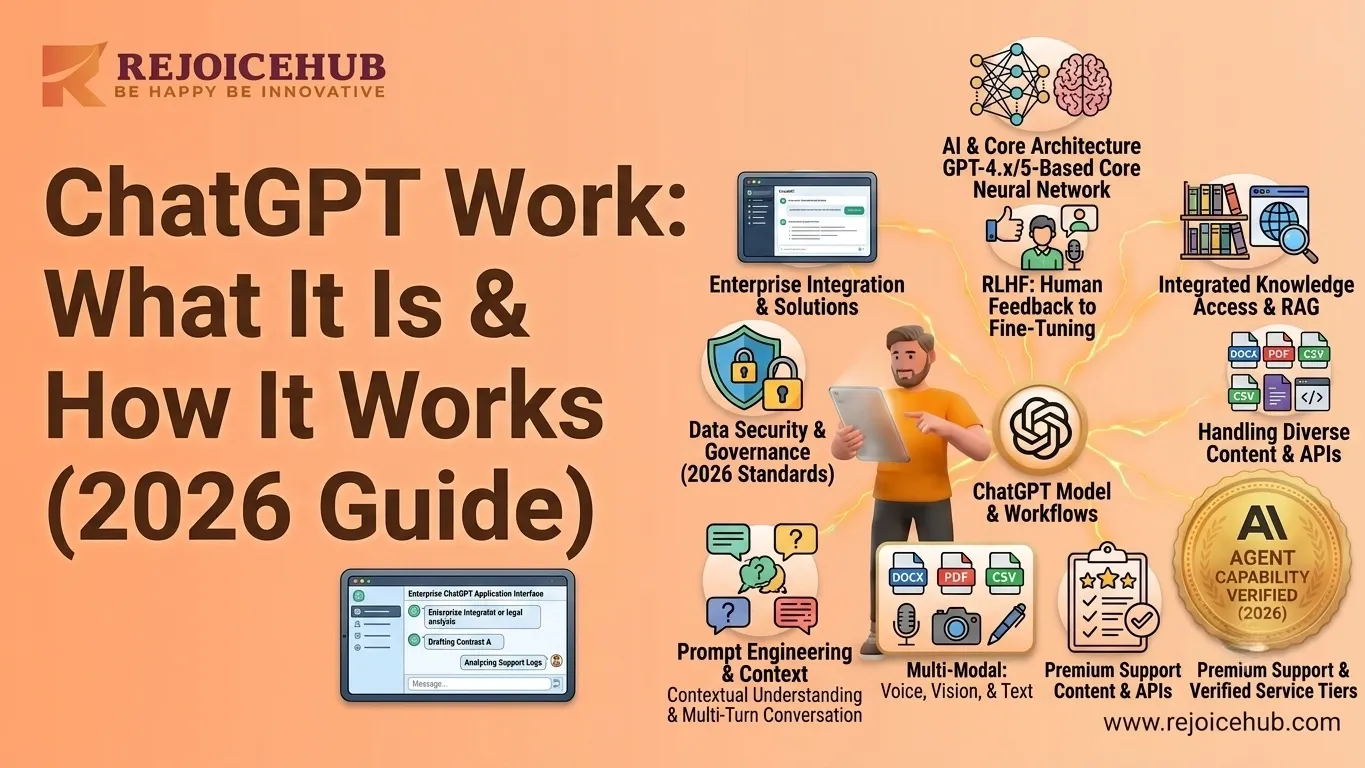
AI is set to evolve beyond simple chatbots that are capable of addressing queries and requests in natural language conversations. Modern companies are looking to create AI agents that can perform diverse knowledge-intensive tasks such as research, writing, data analysis, or planning, requiring reduced human input.
ChatGPT Work is the new agent designed by OpenAI and launched on July 9, 2026. It is available inside ChatGPT and represents a significant leap forward in the development of AI technologies. The agent takes the user's request and automatically breaks it down into smaller tasks and then completes them, providing the result, such as documents, spreadsheets, slide presentations, websites, and more.
This article will provide an overview of the features and benefits of ChatGPT Work, discuss its potential application in businesses, and evaluate its usefulness.
The article highlights the importance of introducing a new agent that will allow users to accomplish more in less time while reducing the need for complex manual operations.
What Is ChatGPT Work?
Definition
ChatGPT Work is OpenAI's AI-powered knowledge work assistant, built specifically for professionals rather than casual chatbot users.
Instead of just replying to a message, it:
- Automates research across your connected apps and files
- Performs multi-step analysis on data and documents
- Handles writing tasks like reports, briefs, and marketing copy
- Assists with planning and project breakdowns
- Supports decision-making by synthesizing information into usable formats
OpenAI refers to it as an agent that will "help you tackle more ambitious tasks by surfacing relevant context from the tools you already use." In other words, it compiles information, creates finished materials, such as sheets, slides, docs, and shareable web apps, and stays on task for hours at a time.
Overall, it's less of a chatbot and more of a task-forger for your digital co-pilot, blurring the line between an AI agent and a traditional AI chatbot.
Why OpenAI Built It
A few forces pushed OpenAI toward building ChatGPT Work:
- Productivity demand. Businesses want AI that saves hours, not just AI that sounds smart.
- Enterprise adoption. Companies are budgeting real money for AI tools that show measurable ROI, and OpenAI wanted a product built for that buyer.
- The rise of AI agents. The AI industry has shifted from "best chatbot" to "best digital coworker," with competitors like Anthropic's Claude Cowork and Microsoft's Copilot Cowork pushing the same direction.
- Workflow automation. OpenAI folded its Codex coding agent technology into ChatGPT Work, extending capabilities that were previously limited to developers into general business use as part of the broader shift toward agentic AI.
This is part of a broader trend: AI vendors are racing to own the "digital workplace," not just the chat window.
How Does ChatGPT Work?
Understanding the Workflow
When you give ChatGPT Work a task, it generally moves through this process:
- User prompt: You describe an outcome, not just a question (e.g., "Prepare a Q3 competitor analysis").
- Planning: The agent breaks the goal down into a sequence of steps.
- Reasoning: It works through each step logically, adjusting as new information comes in.
- Tool usage: It pulls in connected apps like Slack, Google Drive, Salesforce, or GitHub to gather relevant data.
- Document analysis: It reads and interprets files, spreadsheets, and other source material.
- Output generation: It produces a finished deliverable, such as a report, spreadsheet, or presentation, rather than just a text reply.
This is the core difference between a chatbot and a work agent: a chatbot gives you an answer, while a work agent gives you a finished asset, much like the broader category of LLM agents built for multi-step execution.
Technologies Behind ChatGPT Work
ChatGPT Work runs on a stack of underlying technologies:
- Large language models (LLMs): specifically OpenAI's GPT-5.6 family (Sol, Terra, and Luna), which power reasoning and content generation.
- Reasoning models: used for multi-step planning and complex problem-solving rather than single-turn responses.
- Memory: the agent can retain context across a project so it doesn't lose track of earlier decisions.
- File handling: native ability to read, analyze, and generate spreadsheets, documents, and slides.
- Multi-step planning: the agent sequences tasks instead of tackling everything in one shot, similar to how different types of AI agents are designed for different levels of autonomy.
- AI agents / Codex technology: the same agentic engine that powers OpenAI's coding tool, comparable in spirit to how Claude Code stacks up against GitHub Copilot, adapted here for general knowledge work.
Together, these components let ChatGPT Work operate less like a search box and more like an autonomous project executor.
Accelerate Your Workflows with Custom AI
Book a free consultation session with RejoiceHub. We'll map out a tailored automation roadmap for your company.
Key Features and Benefits of ChatGPT Work
What are the benefits of ChatGPT Work? In short: it saves time, improves output quality, and reduces the manual grunt work involved in knowledge-based tasks.
Here's a breakdown of its core capabilities:
- Research automation: Gathers and synthesizes information from multiple sources without manual searching, functioning much like dedicated AI tools for market research.
- Document summarization: Condenses long reports, contracts, or meeting notes into digestible summaries.
- Workflow automation: Chains together multi-step processes (e.g., research → draft → format → distribute).
- Writing assistance: Drafts reports, emails, marketing copy, and internal documentation, positioning it alongside other AI writing tools on the market.
- Data analysis: Reads spreadsheets and datasets to surface trends and insights, a capability shared with specialized AI tools for data analysis.
- Coding support: Leverages built-in Codex capabilities for technical tasks and light development work.
- Team collaboration: Outputs can be shared, reviewed, and reused across a team rather than staying locked in a single chat.
- Time savings: Reduces hours of manual work into tasks that run largely unattended.
For a business, this translates into fewer hours spent on repetitive knowledge work and more time spent on decisions that actually require human judgment.
ChatGPT Work Use Cases for Businesses
Different teams can put ChatGPT Work to use in different ways:
- Marketing teamsa; Turning customer research into campaign briefs and generating AI-driven social media marketing assets from it.
- HR; Drafting policy documents, summarizing candidate profiles, or building onboarding materials.
- Legal: Reviewing and summarizing contracts, flagging key clauses for human review.
- Finance: Preparing parts of month-end close, reconciliations, and variance analysis.
- Customer support: Drafting responses and summarizing recurring ticket themes, an area increasingly served by dedicated AI customer support agents.
- Product management: Synthesizing user feedback into structured product requirements.
- Sales: Building account research briefs and personalized outreach material with the help of AI SDR tools.
- Software development: Using the built-in Codex layer to assist with code review and lightweight technical tasks, an area where it will inevitably be measured against Claude Code, Cursor, and GitHub Copilot.
Why Businesses Need AI Work Agents
The main advantage of solutions like ChatGPT Work is the ability to reduce coordination and operating costs while ensuring high-speed processing. However, note that multi-functional agents are designed to solve average problems with average efficiency. The tools process various types of documents, presentations, spreadsheets, code, and research data universally.
For example, you can quickly generate a customer support message with the help of an AI. However, the tool cannot be integrated into your helpdesk system, assess the confidence level of its responses, and analyze past interactions.
By contrast, a custom agent can be specifically trained to work with the tools you already use. It can follow particular rules and have access to databases and external systems, which is the central distinction in any custom vs. off-the-shelf AI software decision.
In other words, you should build a solution around your own business processes rather than adapt them to a generic platform, following a deliberate approach to building an AI agent stack for your business. This is the primary advantage of custom AI agents, and it is the main specialization of Rejoicehub.
Is ChatGPT Work Worth It?
Like any enterprise AI tool, ChatGPT Work has real advantages and real trade-offs.
Pros
- Faster work: Multi-step tasks that used to take hours can run largely unattended.
- Better productivity: Teams spend less time on repetitive drafting and research.
- Saves costs: Usage-based pricing means you pay based on task complexity rather than a flat, always-on cost.
Cons
- Requires review: Outputs still need human oversight before they're used in high-stakes decisions.
- Privacy concerns: Sensitive company or client data flowing through a third-party hosted agent is a real consideration, especially for regulated industries.
- Subscription costs: Access is bundled into paid ChatGPT Business, Enterprise, and Pro plans, with usage-based credits on top, a pricing model worth weighing against the true cost to build an AI agent in-house.
Comparison Table
| Good For | May Not Be Ideal For |
|---|---|
| Enterprises with broad, cross-department needs | Casual users who just want quick answers |
| Teams running recurring, multi-step workflows | Very small, one-off tasks |
| Researchers synthesizing large volumes of information | One-time questions that don't need an agent |
If you need a horizontal solution, something that can be leveraged across departments, then ChatGPT Work can be a great fit, especially for organizations already mapping out their enterprise AI adoption roadmap. However, if you want something more focused and secure, something that would be embedded directly into a particular process, a custom agent is the way to go.
Conclusion
ChatGPT Work is a significant paradigm shift in the field of artificial intelligence as it transforms a chatbot that serves as an information source into an agent that can accomplish tasks.
Companies that are first to embrace such groundbreaking AI technologies stand to benefit from substantial gains in terms of employee productivity, reduced costs of operations, and increased agility in the workplace.
However, a generalist tool might not be suitable for some specialized applications that require access to restricted data, involve complex systems, or utilize unique business logic. In such cases, companies should consider investing in the development of custom AI, even without an in-house ML team, to meet their unique needs a path made increasingly accessible by modern approaches to deploying AI agents without an ML team.
Looking to build secure AI agents tailored to your business?
Explore RejoiceHub's AI Agent Development Services to create custom AI solutions that automate workflows, improve productivity, and integrate seamlessly with your existing systems.
Frequently Asked Questions
1. What is ChatGPT Work?
ChatGPT Work is OpenAI's AI agent built for professionals who need more than a chat reply. Launched on July 9, 2026, it takes a task, breaks it into steps, pulls in your connected apps, and hands back a finished document, spreadsheet, or presentation instead of just text.
2. How does ChatGPT actually work?
It follows a clear process: you describe the outcome you want, the agent plans the steps, works through each one logically, pulls data from tools like Slack or Google Drive, reads your files, and then builds a finished deliverable. It behaves more like a project executor than a chatbot.
3. How does ChatGPT work compared to ChatGPT Work?
Regular ChatGPT answers questions in a single conversation. ChatGPT Work goes further by staying on a task for hours, using memory to track earlier decisions, and calling on tools and files to produce a complete asset, like a report or slide deck, rather than a quick reply.
4. What are the benefits of ChatGPT Work?
It automates research, summarizes long documents, drafts reports and emails, analyzes spreadsheets, and even helps with light coding through its built-in Codex layer. For businesses, this means fewer hours on repetitive knowledge work and more time for decisions that actually need human judgment.
5. Is ChatGPT Work worth it?
It depends on your needs. For enterprises with broad, recurring workflows across departments, it saves real time and cost. But for casual users with one-off questions, or businesses needing tight data privacy and custom logic, a purpose-built agent may serve you better than a generalist tool.
6. How do you use ChatGPT Work?
You start by describing the outcome you want, not just a question, such as "prepare a Q3 competitor analysis." The agent plans the task, gathers data from your connected apps and files, works through the steps, and delivers a finished document, sheet, or slide for you to review.
7. Who should use ChatGPT Work?
It suits enterprises and teams running recurring, multi-step workflows, like marketing, HR, legal, finance, and sales, where research, drafting, and analysis happen often. It's less useful for small one-off tasks or businesses that need a secure, custom-built agent tied closely to their own systems and data.