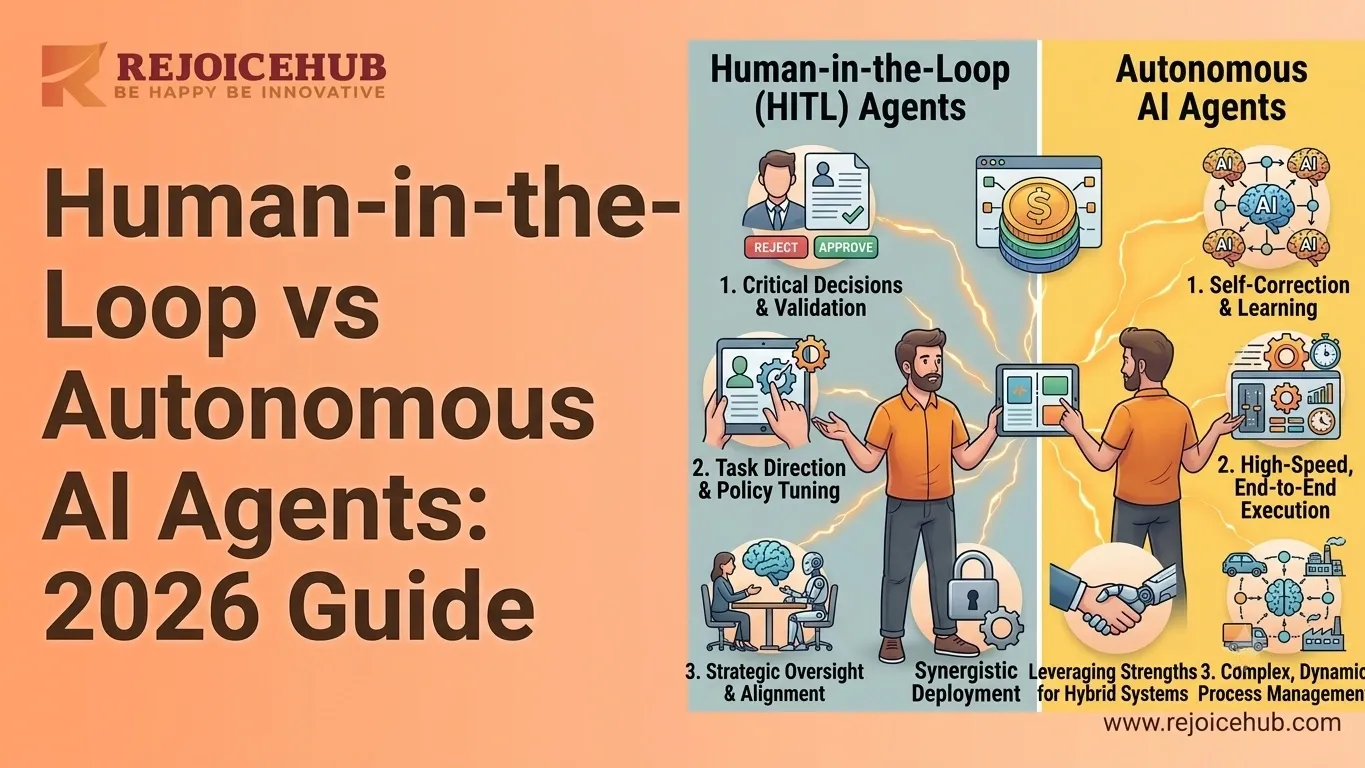
AI agents have become more advanced at a rate exceeding what most companies can manage. A year ago, the term "AI agent" typically referred to a chatbot. Nowadays, it refers to systems capable of planning, deciding, and executing multi-step processes autonomously, with minimal or zero human intervention.
But this raises a key question for all founders and operations managers: How autonomous should your AI be?
Get this wrong, and face exploding costs, potential compliance problems, or even an AI agent making decisions never agreed upon by any person. Get this right, and you get efficiency while maintaining control.
Here is everything you need to know about the key difference between human-in-the-loop and autonomous AI agents: their core distinctions, advantages, examples of applications in practice, and a decision framework you can use to choose the right architecture for your organization in 2026.
By the end, you'll know:
- The real differences between Human-in-the-Loop AI and autonomous AI agents
- The benefits and trade-offs of each approach
- Where enterprises are using each model today
- A simple framework to decide which one (or which mix) fits your business
What Is Human-in-the-Loop AI?
Human-in-the-Loop AI, or HITL, is basically how you design an AI system where a human reviews, approves, or fixes what the model produces before it actually counts or takes effect. The AI still does the big part, like the analysis, drafting, or the suggested next steps, but the human stays in control and keeps the final decision firmly in their hands.
So yeah, this is the core idea behind most Human-in-the-Loop AI setups that are used today, especially in regulated or high-stakes industries, where you can't just let the system run on autopilot.
How Human-in-the-Loop AI Works
Human-in-the-Loop AI usually runs on an approval-based workflow: the AI touches the data first, then it comes up with a recommendation or even a draft action; after that, it sends it off to a human for sign-off before anything actually runs. Now, if the human says no or rejects the output, the AI tweaks what it did and resubmits it again.
Benefits of Human Oversight
- Reduces the risk of costly or irreversible mistakes
- Builds trust with customers, regulators, and internal teams
- Keeps a "human judgment" layer on ambiguous or high-risk decisions
- Creates a natural audit trail for compliance
Common enterprise applications involve loan processing, medical diagnosis assistance, legal document review, and HR recruitment processes; basically, wherever there is an unacceptable risk for the organization if the wrong choice is made by AI.
What Are Autonomous AI Agents?
The AI agents work in a completely autonomous way where it plans and executes the actions independently without requiring any human intervention after every action. This is referred to as agentic AI in which the artificial intelligence is capable of achieving a goal, dividing it into smaller parts, and then working.
As opposed to automation scripts, an autonomous AI agent is capable of making judgments regarding how to accomplish a goal, modifying its course of action according to change in situations, and performing multiple actions at once.
Autonomous AI Architecture
Most autonomous agents end up on a planner executor vibe model: there's a reasoning layer (often an LLM) that sort of breaks a goal into a bunch of steps, an execution layer does the actual work for each bit using tools or APIs, and then a memory layer that keeps track of context all the way through the workflow. Usually guardrails get bolted on too, plus fallback rules, so the whole agent stays inside safe boundaries. In practice it can feel a little like stepwise orchestration, even if it's not always as clean as it sounds.
Benefits of Autonomous AI Agents
- Dramatically faster execution no waiting on human review queues
- Scales easily across high-volume, repetitive workflows
- Lowers operational costs by reducing manual touchpoints
- Frees up teams to focus on strategic, not repetitive, work
This is where enterprise automation really shines think 24/7 customer support agents, automated IT ticket triage, or lead qualification bots that never sleep.
Human-in-the-Loop vs Autonomous AI Agents
Picking between Human-in-the-Loop AI and autonomous AI mostly becomes a question of tradeoff, like control versus speed. In practice they go different ways and it shows up across the business factors that matter most. Here's a quick feel for how the two compare, based on what companies usually care about.
Accelerate Your Workflows with Custom AI
Book a free consultation session with RejoiceHub. We'll map out a tailored automation roadmap for your company.
| Factor | Human-in-the-Loop AI | Autonomous AI Agents |
|---|---|---|
| Decision Making | AI recommends, human decides | AI decides and acts independently |
| Speed | Slower depends on human review | Fast near real-time execution |
| Accuracy | High, thanks to human validation | High, but errors can compound if unchecked |
| Risk | Lower human catches mistakes | Higher no safety net unless built in |
| Governance | Built-in via approval steps | Requires explicit guardrails and monitoring |
| Compliance | Easier to demonstrate and audit | Harder without strong logging and controls |
| Scalability | Limited by human review capacity | Highly scalable, minimal human bottleneck |
| Human Involvement | High required at key checkpoints | Low only for exceptions or escalations |
| Cost | Higher labor cost, lower error risk | Lower labor cost, potential error cost |
| Business Suitability | Regulated, high-stakes decisions | High-volume, repetitive, low-risk tasks |
The bottom line: Human-in-the-loop AI trades a bit of speed for more control and accountability. Then autonomous AI agents trade some control for more speed and scale, like it's always faster when no one is waiting around.
Neither one is "better" in a strict, absolute way, it really just depends on what you're automating, and how much risk you can tolerate, day to day.
If you want to make your own AI agent stack that mixes quick action with the right kind of supervision, RejoiceHub can help you design it, and deploy it, around your specific risk profile.
When Should Businesses Choose Each Approach?
Choose Human-in-the-Loop AI for:
- Healthcare diagnosis support, treatment recommendations
- Finance credit decisions, fraud investigation, trading approvals
- Legal contract review, compliance filings
- HR hiring and recruitment decisions, performance reviews
- Compliance regulatory reporting, risk assessments
These are areas where a wrong decision has real legal, financial, or human consequences so Human-in-the-Loop AI for enterprises in these sectors isn't optional, it's essential.
Choose Autonomous AI for:
- Customer support automation answering FAQs, resolving common tickets
- Lead qualification and routing scoring and routing inbound leads
- IT Automation password resets, system monitoring, alert triage
- Marketing workflows content scheduling, campaign optimization, A/B testing
- Internal Operations data entry, reporting, workflow automation
These are high-volume, lower-risk tasks where speed and scale matter more than case-by-case human judgment a strong fit for autonomous AI agents for business.
When Hybrid AI Agents Make Sense
Most enterprises don't need to pick only one. A hybrid AI agent model where AI agents run autonomously for routine stuff but hand off to a human for the odd cases, or high-value decisions tends to bring a pretty solid balance.
Like, an autonomous agent could manage about 90% of customer support tickets on its own, then it would elevate refund requests above a specific dollar number for human approval. That way you get the fast motion of automation, with the safety net of human supervision right where it counts.
Best Practices for Enterprise AI Governance
Whether you go Human-in-the-Loop, autonomous, or hybrid, strong governance keeps your AI agents deployed safely and compliant:
- Set human approval thresholds define exactly which actions require sign-off (e.g., transactions over $10,000)
- Monitor AI decisions in real time to catch drift or errors early
- Maintain audit trails for every AI action, so you can trace and explain any decision
- Use role-based access to control who can approve, override, or configure agents
- Run continuous evaluation to test agent performance against real-world outcomes
- Build for compliance from day one don't bolt it on after deployment
- Prioritize security treat AI agents like any other system with access to sensitive data, especially given growing gaps in enterprise AI infrastructure
Strong AI agent governance isn't a blocker to automation it's what makes scaling automation safely possible.
Conclusion
Neither Human-in-the-Loop AI nor purely autonomous AI systems are always "better." It all depends on your corporate objectives, risk appetite, and regulations.
For most companies, the optimal solution is to go with hybrid AI systems built for business automation, where the AI system is autonomous and operates with human guidance when needed.
Frequently Asked Questions
1. What is the main difference between Human-in-the-Loop vs Autonomous AI Agents?
The main difference comes down to control. In Human-in-the-Loop AI, a person checks and approves the AI's work before it goes live. In autonomous AI agents, the system plans, decides, and acts on its own without waiting for human sign-off at every step.
2. Is Human-in-the-Loop AI slower than autonomous AI agents?
Yes, it usually is. Since a human has to review and approve the output before anything happens, there's a natural delay. Autonomous AI agents skip this waiting period and act right away, which makes them much faster for high-volume, repetitive tasks.
3. Which industries need Human-in-the-Loop AI the most?
Industries with high stakes need it most, like healthcare, finance, legal, and HR. In these fields, one wrong AI decision can cause real financial, legal, or personal harm, so having a human double-check the output before it counts really matters.
4. Can autonomous AI agents work without any human involvement at all?
Not really; even the best autonomous AI agents usually need a human somewhere in the process, especially for exceptions or unusual cases. Full autonomy works best in low-risk, repetitive tasks like customer support tickets or IT alert triage, not high-stakes decisions.
5. What is a hybrid AI agent model?
A hybrid model combines both approaches. The AI agent handles routine tasks on its own but hands off tricky or high-value decisions to a human for approval. This gives businesses the speed of automation along with the safety net of human oversight.
6. Which is more cost-effective, Human-in-the-Loop AI or autonomous AI agents?
Autonomous AI agents usually cost less to run since they need fewer people watching over them. But Human-in-the-Loop AI can save money long-term by catching costly mistakes early, so the real answer depends on how much risk your business can handle.
7. How do I decide between Human-in-the-Loop and autonomous AI for my business?
Look at how risky the task is. If a mistake could cause legal, financial, or safety issues, go with Human-in-the-Loop AI. If the task is repetitive and low-risk, like FAQs or lead scoring, autonomous AI agents are usually the better fit.