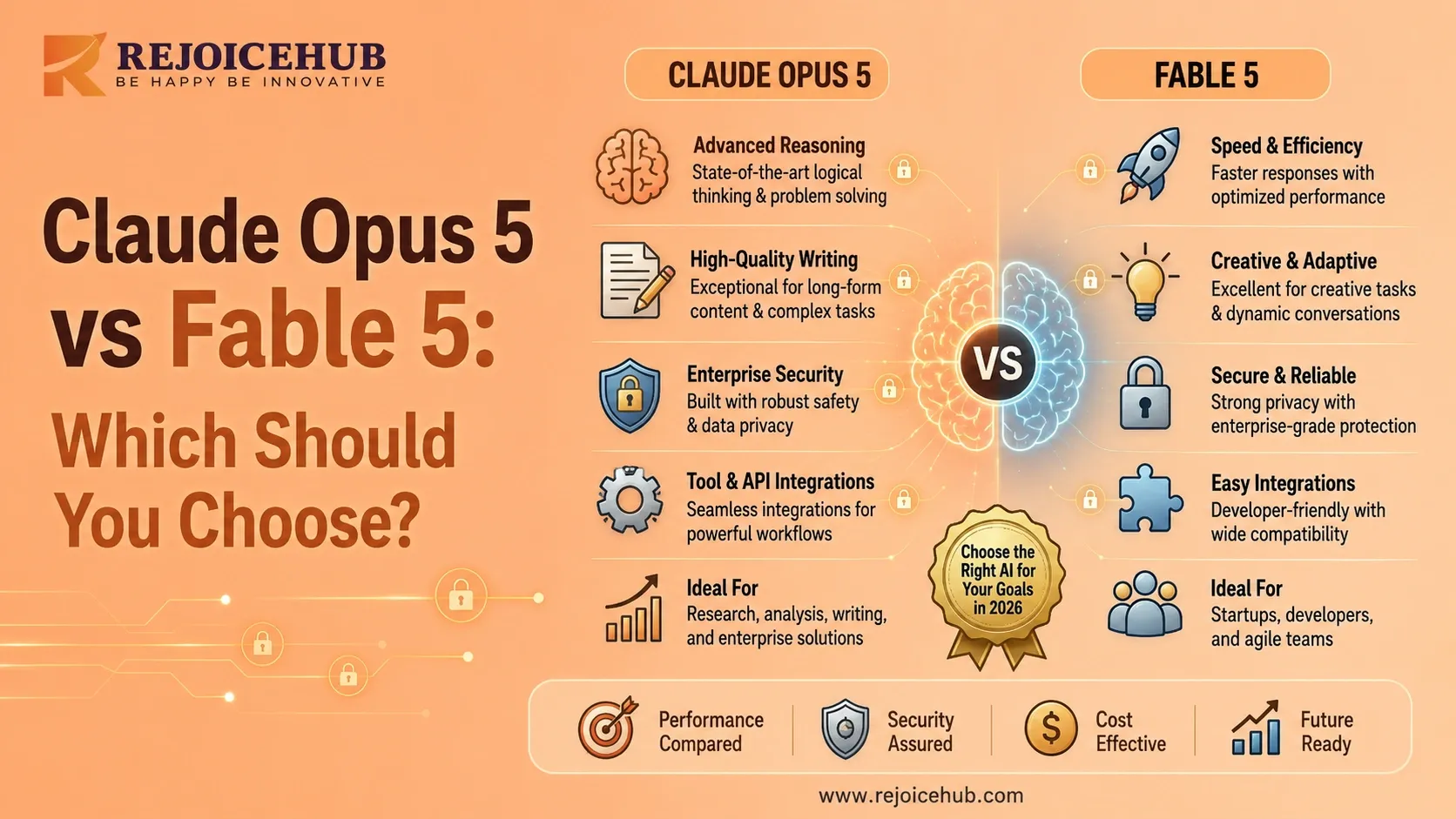
Anthropic shipped four new Claude models in roughly two months this summer: Mythos 5, Fable 5, Sonnet 5, and then Claude Opus 5, and that speed has a bunch of engineering teams all wondering the same thing: Claude Opus 5 vs Fable 5, which one is actually worth building on?
Choosing wrong here is not some "oops" moment. If you push too much traffic through Fable 5, your API spend can jump fast on work that didn't really require frontier-level reasoning. But if you lean on Opus 5 when the job really only needs Fable 5's depth, you can end up wasting engineering time redoing agent runs that failed or stalled, basically paying for complexity you didn't need.
So this guide walks through reasoning, coding, AI agents, RAG, pricing, and enterprise readiness for both models, in other words, so you can pair the model to the workload and stop just guessing based on vibes.
Who it's for: developers who need a default model for a fresh build, CTOs who are setting model rules across a team, and engineering leads trying to rein in API costs without sacrificing output quality.
Claude Opus 5 vs Claude Fable 5 at a Glance
| Claude Opus 5 | Claude Fable 5 | |
|---|---|---|
| Released | July 24, 2026 | June 9, 2026 (restored July 1 after a brief export-control suspension) |
| Best for | Everyday coding, office/document work, multi-agent coordination, cost-sensitive production use | The hardest long-horizon, ambiguous, multi-step reasoning and agentic coding tasks |
| Context window | 1M tokens (default and max), 128K max output | 1M tokens, 128K max output (300K on the Batch API) |
| API pricing | $5 / $25 per million input/output tokens | $10 / $50 per million input/output tokens |
| Speed | Fast by default; optional "Fast mode" runs ~2.5x quicker at $10/$50 | Built for long, autonomous runs rather than raw latency |
| Effort control | Yes, low, medium, high, xhigh, and max settings | Adaptive thinking, tuned for extended autonomous work |
| Enterprise readiness | Default model on Claude Max, top model on Claude Pro; positioned as the daily-use enterprise workhorse | Positioned as Anthropic's most capable widely released model, with added safeguards for cyber, bio, and LLM R&D risk areas |
Quick answer: Claude Opus 5 is the better default choice for most teams, as it approaches Fable 5's competence on general coding/reasoning benchmarks at about half the price. You should choose Fable 5 when you have a genuinely senior engineer-level task to tackle (long-horizon, ill-defined, or unusually high-stakes) that is worth the double payment to get an extra level of reasoning ability.
Claude Opus 5 vs Claude Fable 5: Feature-by-Feature Comparison
1. Architecture Overview
Both models are part of the Anthropic Claude 5 generation, but are fine-tuned for different purposes.
Claude Opus 5 is the evolved version of Claude Opus 4.8, which is optimized for efficiency. Claude Opus 5 is designed to be used on a daily basis, as it provides similar pricing to its predecessor while producing better results. It is now the default model for Claude Max and the strongest Claude Pro option.
Claude Fable 5, on the other hand, is a Mythos-class model that shares its architecture with Claude Mythos 5, which is a limited-capability frontier model available to a select group of developers. Claude Fable 5 is equipped with additional safety measures related to biology, cybersecurity, and LLM research and development. It is built to perform autonomous, extended workloads that previously required human supervision.
In short, while Claude Opus 5 is optimized for everyday use cases, Claude Fable 5 is a specialist model that can be applied to the most challenging tasks.
2. Reasoning Performance
-
Math and logic: Fable 5 is still ahead of many of the most challenging reasoning benchmarks, making it Anthropic's highest-performing broadly capable model, but it has a much bigger leap over its predecessor, Opus 4.8, than the latter had over the previous model, Minimax 3.9. Fable 5 scores more than double the score that Opus 4.8 achieved on Anthropic's Frontier-Bench benchmark.
-
Complex workflows: This is where the distinction matters most. Fable 5 is built to handle problems that are long-running, ambiguous, or highly multi-step without frequent guidance. Opus 5 handles complex tasks well too, but Anthropic positions it for work an intermediate-to-strong teammate could complete, not the multi-day, self-correcting research or engineering runs Fable 5 is designed for.
Practical rule of thumb: if the task would normally go to a senior engineer, senior analyst, or research scientist on your team, Fable 5 usually earns its price. If it's the kind of task a solid mid-level teammate could finish in under 30 minutes, Opus 5 is the smarter default.
3. Coding Performance: Best Anthropic Model for Coding
This is the question most teams actually care about, and the honest answer is it depends on the ticket, like yeah… kinda.
-
Bug fixing and code review: Opus 5 is strong here. Anthropic highlights it as particularly efficient for software engineering tasks, and it's optimized for exactly this kind of bounded, well-scoped work.
-
Code generation: Both models perform well, but Opus 5's per-token cost advantage makes it the more economical choice for high-volume code generation, PR reviews, and CI-integrated coding assistants.
-
Agent coding: For autonomous, multi-hour coding agents the kind that plan, write, test, and self-correct across an entire repository, Fable 5's long-horizon design and larger reasoning depth still lead. If your coding assistant needs to work independently for extended stretches without a human in the loop, that's Fable 5 territory.
So: is Opus 5 or Fable 5 the best Anthropic model for coding? For the majority of day-to-day software development, bug fixes, feature PRs, code review, and refactors, Opus 5 delivers near-Fable-5 quality at half the cost. Reserve Fable 5 for your hardest, most autonomous coding workflows.
Accelerate Your Workflows with Custom AI
Book a free consultation session with RejoiceHub. We'll map out a tailored automation roadmap for your company.
4. Context Window
Both models ship a 1M-token context window with 128K max output tokens, so this isn't really a differentiator anymore, a change from earlier Claude generations where Opus and Fable-tier models had noticeably different limits.
-
Long documents and enterprise knowledge: With 1M tokens, both models can hold a mid-sized codebase, years of contracts, or dozens of research papers in a single request. Neither charges a premium for using the full window; a 900K-token request bills at the same per-token rate as a 9K-token one.
-
RAG: For retrieval-augmented generation pipelines, the context window size matters less than reasoning quality over retrieved chunks. Opus 5's lower cost makes it attractive for high-volume RAG applications like enterprise search or support copilots, where you're running thousands of queries a day against a knowledge base.
5. API & Tool Calling
Both models are available through Claude API, Claude Code, Amazon Bedrock, Google Cloud Vertex AI, and Microsoft Foundry. Both support Model Context Protocol (MCP) tool integration, function calling, vision, and memory/compaction for long conversations.
Opus 5 offers a few developer facing improvements, including mid-conversation tool changes (adding or removing tools in between turns without losing context) and an adjustable "effort" parameter ("low", "medium", "high", "xhigh", "max") which allows modulating the amount of computation done per turn/request, as opposed to using a single model tier for all turns in a conversation.
If you're building an agent that does tool calling and has to make choices about which functions or MCP servers to use, this can be extremely useful: you can have some of the thinking done at low effort (fast inference) and defer more complicated steps to higher levels.
Which Claude Model Is Best for AI Agents and Enterprise AI?
Agent workflows are where the Opus 5 vs Fable 5 decision has the biggest financial impact, because agents make many model calls per task, not just one.
-
Multi-agent systems: Opus 5 is specifically built for coordinating teams of subagents. Anthropic reports it handles writer-verifier patterns well, with fewer cases of agents overwriting each other's work. For orchestrator-style architectures where one model manages several worker agents, Opus 5's lower per-token cost compounds fast across hundreds of subagent calls.
-
MCP compatibility: Both models support MCP tool calling, so connecting either one to your CRM, ticketing system, or internal databases works the same way. The choice comes down to how much reasoning each step in the workflow actually needs.
-
RAG and enterprise search: High-volume, latency-sensitive RAG applications, internal copilots, document Q&A, customer-facing search, generally favor Opus 5's pricing and speed. Reserve Fable 5 for RAG use cases where the retrieved context is ambiguous or contradictory, and the model needs to reason carefully about conflicting sources.
-
Customer support automation: Most support workflows are high-volume and repetitive enough that Opus 5 handles them well, with Fable 5 as an escalation tier for complex, multi-turn cases a Tier 2 agent would normally handle.
-
Autonomous agents: For long-horizon autonomous agents that run for hours without human review, deep research tasks, complex data migrations, long-horizon coding runs, Fable 5's design for extended, self-correcting autonomy is the safer bet, even at double the token cost, because a failed multi-hour run costs more in wasted compute and engineering time than the price difference ever would.
This is exactly the kind of routing decision that's easy to get wrong without hands-on experience running production agents on both models. If you're looking to build a custom AI agent, RejoiceHub can help our team design multi-agent architectures that route each task to the right Claude model automatically, so you're never overpaying for simple work or underpowering the hard stuff.
Pricing, Speed, and Total Cost of Ownership
API pricing. Claude Opus 5 is priced at $5 per million input tokens and $25 per million output tokens, same as Opus 4.8. Claude Fable 5 is $10 per million input tokens and $50 per million output tokens, so about double. But if you can use the Batch API (which is designed for long-running autonomous tasks), the price drops by half per model: $5/$25 per million tokens for Fable 5 on the Batch API, which is the same as interactive Opus 5. So for long tasks, Fable 5 is comparable in price to Opus 5.
A token cost example: a single request using Fable 5's maximum context size of 1M tokens would cost $10 in input alone before the model writes a word. The same request on Opus 5 costs $5. That adds up quickly across thousands of daily requests.
Latency. Opus 5 has a default Fast mode which makes it about 2.5x faster than usual (for a price of $10/$25 per million output tokens), comparable to Fable 5's price per token. Fable 5 is generally not optimized for speed; it is designed to do longer autonomous reasoning tasks.
Monthly cost example. A team running 500,000 coding-assistant requests a month, averaging 2K input / 1K output tokens per request, would spend roughly:
- Opus 5: ~$5,000/month at standard pricing
- Fable 5: ~$10,000/month at standard pricing
If only 20% of those requests genuinely need Fable 5-level reasoning, a mixed routing strategy (Opus 5 as default, Fable 5 for escalations) brings the bill close to $6,000 without sacrificing quality on the tasks that need it.
ROI and scalability. The real ROI conversation isn't "which model is cheaper"; it's "which model finishes the task correctly on the first try." An underpowered model that fails a long-horizon agent task and needs a manual re-run costs more in engineering time than the token savings were worth. Right-sizing the model to the task, not defaulting to the cheapest or the most powerful option across the board, is what actually controls cost at scale.
Which Claude Model Should You Choose?
| If you are a... | Recommended model | Why |
|---|---|---|
| Solo developer / indie hacker | Opus 5 | Near-frontier quality at half the price; budget-friendly for iteration |
| Startup building an MVP | Opus 5 (default), Fable 5 for hard edge cases | Keeps burn rate low while still handling complex features |
| Enterprise with mixed workloads | Both, routed by task | Opus 5 for daily operations, Fable 5 for high-stakes or long-horizon work |
| Research team | Fable 5 | Deeper reasoning matters more than cost for research-grade output |
| Coding assistant/dev tools | Opus 5 | Best cost-to-quality ratio for day-to-day software engineering |
| Customer support automation | Opus 5 | High volume, cost-sensitive, mostly bounded tasks |
| Autonomous AI agents | Fable 5 (with Opus 5 for subagents) | Long-horizon reliability justifies the premium; Opus 5 handles orchestration cheaply |
Conclusion
Claude Opus 5 and Claude Fable 5 are not competing products but rather purpose-built models optimized for different use cases. Claude Opus 5 is ideal for day-to-day coding, office productivity, documentation, and other high-volume, low-cost-per-token applications while still approaching frontier-level reasoning capabilities at only 50% of the cost of Claude's highest performance model.
Meanwhile, Claude Fable 5 is positioned to handle the most demanding and complex reasoning and agentic coding scenarios where investment of additional resources is warranted.
The optimal approach for most organizations is to evaluate individual workflows and send requests to whichever model is best suited to handle them rather than adopting a one-size-fits-all strategy. This allows teams to reduce overall API costs while simultaneously improving quality versus using a single model across their workflows.
Need help building enterprise AI agents with Claude? Explore RejoiceHub's AI Agent Development services to design secure, scalable AI solutions with model routing, MCP integrations, and RAG pipelines built around the Claude model that actually fits each task.
Frequently Asked Questions
1. Is Claude Opus 5 better than Claude Fable 5?
It depends on the job. Claude Opus 5 is cheaper and fast enough for daily coding, RAG, and support tasks. Claude Fable 5 handles harder, longer, and messier problems better. For most teams, Opus 5 works fine, and Fable 5 comes in only for tough cases.
2. Which Claude model is best for coding?
For the best Anthropic model for coding, Opus 5 wins for everyday bug fixes, code reviews, and feature PRs since it costs half as much. Fable 5 is better for coding agents that run for hours on their own across a full codebase without much supervision.
3. What is the price difference between Claude Opus 5 and Fable 5?
Opus 5 costs $5 per million input tokens and $25 per million output tokens. Fable 5 costs double that, at $10 and $50. On the Batch API, Fable 5 drops to Opus 5 pricing, which makes it a fair deal for long, autonomous tasks.
4. Can Claude Fable 5 be used for AI agents?
Yes, Fable 5 is built for AI agents that run for hours without a human checking in, like deep research or long coding runs. It handles ambiguous, multi-step work well. For simpler agent tasks or subagent coordination, Opus 5 is usually the cheaper and smarter pick.
5. What is the context window size of Claude Opus 5 and Fable 5?
Both models offer a 1 million token context window with a 128K max output. This means both can handle large codebases, long contracts, or many research papers in one request, and neither model charges extra for using the full window size.
6. Is Claude Opus 5 good for RAG and enterprise AI?
Yes, Opus 5 fits well with RAG and enterprise AI setups since it's cheaper and fast, which matters when running thousands of daily queries. Use Fable 5 instead when the retrieved data is unclear or conflicting and the model needs to reason more carefully through it.
7. Which Claude model should I choose for my team?
Most teams should default to Opus 5 for daily work like coding, documentation, and support, since it saves money without losing much quality. Bring in Fable 5 only for harder, high-stakes, or long-running tasks. This mixed approach keeps costs low without cutting corners on quality.