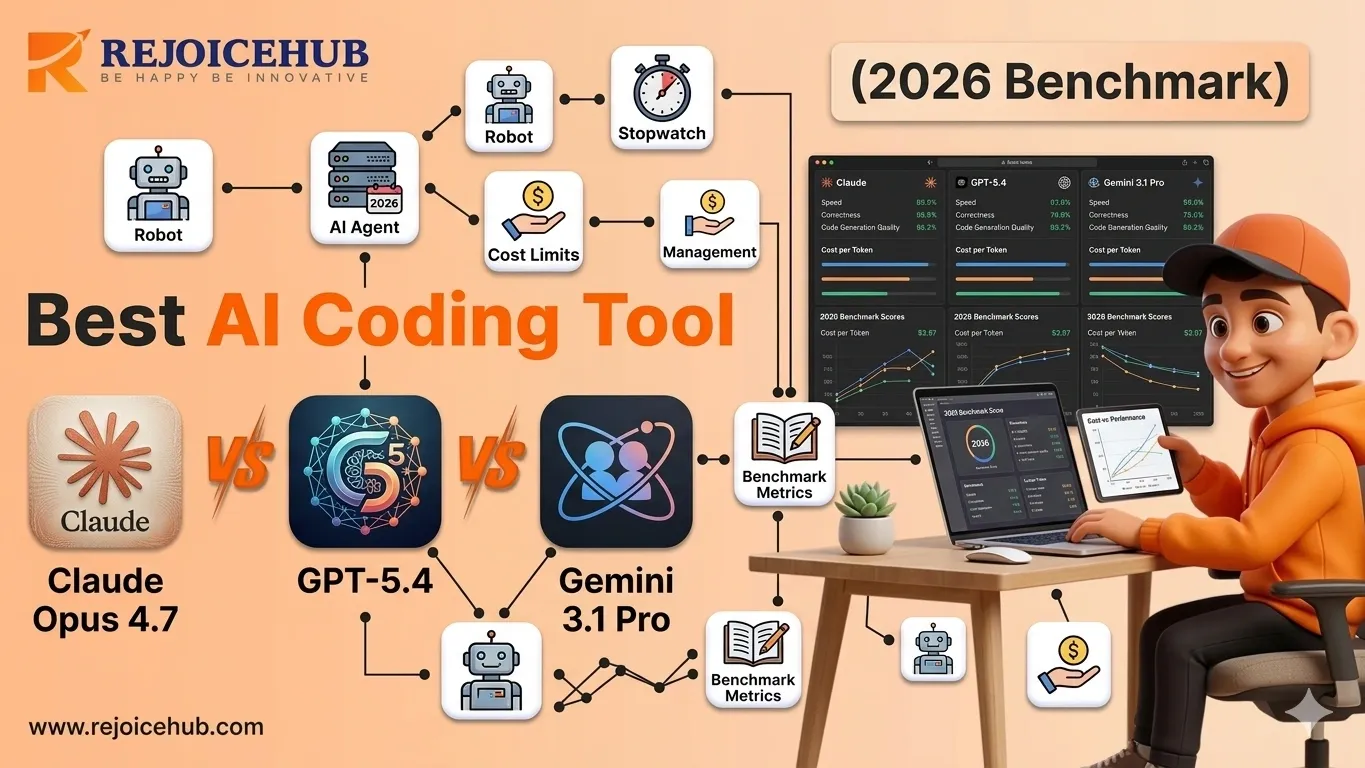
The search term "Claude Opus 4.7 vs GPT-5.4 vs Gemini 3.1 pro" has been entered into Google by many users during recent times. Developers, CTOs, and startup founders throughout the United States want to know which AI model will provide actual results in 2026.
The AI field has experienced rapid development. The industry sees new model releases every three months, while benchmark data gets reused inappropriately, and excessive promotion creates confusion. It becomes challenging to identify which tool brings advantages to your engineering team and which one will exhaust your API expenses.
This guide provides a clear solution to the problem. We conducted benchmarks that focused on developers and analyzed actual pricing data to create a direct comparison, which helps you make an informed business decision for your SaaS development, workflow automation needs, and your AI agent implementation projects.
Quick Comparison Table: Claude Opus 4.7 vs GPT-5.4 vs Gemini 3.1 Pro
| Model | Best For | Coding Score | Speed | Price (Input/1M) | Context Window |
|---|---|---|---|---|---|
| Claude Opus 4.7 | Long context & analysis | SWE-bench ~72% | Moderate | ~$15 | 200K tokens |
| GPT-5.4 | Backend coding & APIs | SWE-bench ~78% | Fast | ~$10 | 128K tokens |
| Gemini 3.1 Pro | Multimodal + Google stack | SWE-bench ~69% | Very Fast | ~$7 | 1M tokens |
Note: SWE-bench scores are based on publicly available evals as of Q1 2026. Pricing is approximate and may vary by tier.
Model Overview: Who Built What and Why It Matters
-
Claude Opus 4.7 — Anthropic
The main model of Anthropic prioritizes safety features and user understanding capabilities. Claude Opus 4.7 demonstrates its superior abilities through advanced reasoning skills, document assessment capabilities, and its capacity to manage extensive contextual information that reaches 200,000 tokens. The solution functions as the primary tool for legal technology and research automation, and any situation that requires a model to maintain extensive contextual knowledge while preserving logical flow.
Ideal users: Legal tech startups, research teams, enterprise document processing, and developers building RAG-based AI agents.
-
GPT-5.4 — OpenAI
OpenAI's GPT-5.4 is the most developer-friendly model on this list. The system offers its best performance to backend engineering work because it combines advanced API tools with complete function calling capabilities and its ability to produce reliable code. The system uses a 128K context window, which provides reduced capacity compared to Claude's system but delivers faster performance and dependable results for production-level work.
Ideal users: SaaS developers, API-first teams, backend engineers, and companies building real-time AI-powered products.
-
Gemini 3.1 Pro — Google DeepMind
Google Gemini 3.1 Pro offers the largest context window of its three competing systems, which extends to a maximum capacity of one million tokens, while it delivers superior multimodal capabilities for handling image, video, and audio tasks. If your stack operates within Google Cloud services, which include BigQuery, Vertex AI, and Workspace, Gemini provides better integration than any other available solution.
Ideal users: Google Cloud-native teams, product teams working with rich media, and developers building document and image pipelines.
Benchmark Performance: Where Each Model Wins
1. Coding Performance (SWE-bench Style Tasks)
The best AI performance for software engineering tasks, which include debugging, function development, and legacy code refactoring, exists in the GPT-5.4 system. The system achieves a 78% score in SWE-bench evaluations, which outperforms Claude Opus 4.7 with a ~72% score and Gemini 3.1 Pro, which has a ~69% score.
What does that mean in practice? GPT-5.4 is more likely to write working code on the first pass because it can handle complex tasks which need multiple files. Claude shows better results through his second-place position because he handles documentation-based coding tasks better than his opponent.
Gemini lags slightly on pure code tasks but catches up when the task involves interpreting images of codebases or UI mockups.
- GPT-5.4: Best for writing new features and API integrations
- Claude Opus 4.7: Best for reviewing and refactoring large codebases
- Gemini 3.1 Pro: Best when code tasks include visual or multimodal input
2. Reasoning & Logic
Claude Opus 4.7 reaches its highest performance level at this point. The system shows better performance on multi-step reasoning and chain-of-thought tasks and long-form logical analysis compared to both GPT-5.4 and Gemini 3.1 Pro. The company developed Constitutional AI training, which enables users to create more understandable, traceable reasoning pathways that function effectively for business applications.
The reasoning abilities of GPT-5.4 show strong performance according to various metrics. The system maintains its competitive edge through its MMLU and HellaSwag scores while demonstrating better performance on logic-intensive tasks that require structured output generation. Gemini 3.1 Pro demonstrates strong mathematical reasoning skills because it utilizes research developed by Google's DeepMind organization.
- Best overall reasoner: Claude Opus 4.7
- Best for fast structured reasoning outputs: GPT-5.4
- Best for mathematical reasoning: Gemini 3.1 Pro
3. Multimodal Capabilities
The application requires Gemini 3.1 Pro because it handles image, PDF, chart, and video content. The system achieves better visual data processing results because it understands visual content better than both Claude and GPT. Gemini provides the solution for organizations that need to extract data from invoices and examine UI screenshots and create summaries of product demonstration videos.
The Vision API of GPT-5.4 allows users to input images, but it falls short of Gemini's ability to handle intricate visual reasoning tasks. The document understanding capabilities of Claude Opus 4.7 extend to PDF documents, but its ability to process multiple modes of content remains less advanced than Gemini.
Which AI Model is Best for Developers? (Use-Case Breakdown)
There is no exact model it all comes down to what you are doing. So a programmer will be able to tell you plainly:
-
Best for Backend Coding: GPT-5.4
The GPT-5.4 model serves your needs when you create APIs and develop microservices and solve complicated problems and deploy production software. The system provides dependable code generation which uses proven function-calling capabilities and allows users to implement the system into their continuous integration and continuous delivery processes through the OpenAI API.
Real-world example: A SaaS startup building a customer data pipeline would benefit from GPT-5.4's ability to generate clean Python or Node.js code with minimal hallucinations and strong error handling.
-
Best for Long Context & Deep Analysis: Claude Opus 4.7
When your use case demands reading and reasoning over entire codebases, legal contracts, research papers, or long conversation threads, Claude Opus 4.7 is unmatched. The system maintains complete awareness of three different documents, which include a product specification and a 100-page PDF file, and user dialogue history because it has a 200K token context window.
Real-world example: A legal tech company processing compliance documents or a research firm summarizing hundreds of papers would see massive productivity gains with Claude.
-
Best for Multimodal + Google Ecosystem: Gemini 3.1 Pro
Teams running on Google Cloud who need to process images, videos, or mixed-media inputs should default to Gemini 3.1 Pro. The system becomes the easiest option for Google-native stacks because it integrates with Vertex AI, BigQuery ML, and Google Workspace.
Real-world example: An e-commerce company using AI in their ecommerce business to analyze product photos for catalog automation, or a marketing team summarizing video content, would get the best ROI from Gemini.
Pricing & API Comparison
Developer costs are real costs. Here's what you need to know before committing to a model:
- GPT-5.4: The cost of processing input tokens amounts to approximately $10 for each million tokens processed while the output tokens cost approximately $30 for each million tokens produced.
- Claude Opus 4.7: The service charges $15 for every million input tokens and $75 for each million output tokens. The premium pricing displays the system's ability to handle extended contextual information.
- Gemini 3.1 Pro: The pricing structure begins with a charge of seven dollars for every one million input tokens, while output tokens cost twenty-one dollars per million tokens. GCP customers can use Google Cloud credits to achieve an additional reduction in their expenses.
- Cost efficiency takeaway: The best solution for high-volume, expensive work tasks is Gemini 3.1 Pro. The value of GPT-5.4 becomes apparent through its ability to deliver exact coding results that exceed cost-based requirements. Claude serves as the top-tier choice when users require extensive contextual understanding and deep analytical capabilities.
Pros & Cons at a Glance
Claude Opus 4.7
| Pros | Cons |
|---|---|
| Industry-leading 200K context window | Higher output token cost |
| Excellent multi-step reasoning | Slower response latency vs GPT |
| Strong document & PDF analysis | Smaller third-party integrations ecosystem |
| Safety-focused, low hallucination rate | Narrower multimodal support |
| Great for long-form writing & analysis |
GPT-5.4
| Pros | Cons |
|---|---|
| Best-in-class coding performance | Smaller context window (128K) |
| Fast response times | Higher output costs at scale |
| Mature, battle-tested API | Slightly more prone to verbose responses |
| Widest third-party tool support | Less transparent about reasoning |
| Strong function calling & structured output |
Gemini 3.1 Pro
| Pros | Cons |
|---|---|
| Largest context window (1M tokens) | Weaker pure-code generation vs GPT |
| Best multimodal capabilities | Less mature enterprise API tooling |
| Most cost-effective pricing | Best value locked in the Google ecosystem |
| Native Google Cloud integration | Reasoning slightly behind Claude on complex tasks |
Conclusion
The AI success in 2026 requires organizations to control multiple AI systems instead of using one AI platform. The most effective teams use GPT-5.4 to develop precise outcomes while matching model capabilities to particular operational needs and using Claude Opus 4.7 and Gemini 3.1 Pro for their respective deep analysis and flexible multiple data type processing needs.
The modular system improves performance while reducing operational expenses and increasing operational efficiency throughout the entire system. Companies that implement multi-model AI agent systems acquire substantial business advantages, which allow them to develop new products at a quicker pace and build more dependable operational frameworks.
The future will belong to organizations that use AI as a flexible system that develops together with their products, data, and user requirements.
Frequently Asked Questions
1. Which is the best AI model for developers in 2026?
GPT-5.4 leads for backend coding and API work. Claude Opus 4.7 is better for long context and deep analysis. Gemini 3.1 Pro fits teams on Google Cloud or handling images and video. The best AI model for developers in 2026 really depends on your specific project needs.
2. How does Claude Opus 4.7 compare to GPT-5.4 for coding tasks?
In the claude vs gpt vs gemini comparison 2026, GPT-5.4 scores around 78% on SWE-bench while Claude Opus 4.7 scores about 72%. GPT-5.4 writes cleaner code on the first try. Claude does better when reviewing large codebases or working with heavy documentation alongside the code.
3. Is Gemini 3.1 Pro good for programming compared to GPT-5.4?
In the Gemini 3.1 Pro vs GPT-5.4 vs Claude benchmark, Gemini scores around 69% on coding tasks. It is the weakest of the three for pure code generation. However, it catches up when coding tasks involve reading UI screenshots or visual inputs, making it useful for multimodal development work.
4. What is the context window difference between these three AI models?
Claude Opus 4.7 offers 200K tokens, GPT-5.4 gives 128K tokens, and Gemini 3.1 Pro leads with 1 million tokens. For reading full codebases, legal documents, or long research papers, Gemini or Claude Opus 4.7 will handle more content in a single request than GPT-5.4.
5. Which AI model is the cheapest for high-volume API usage in 2026?
Gemini 3.1 Pro is the most cost-effective at around $7 per million input tokens. GPT-5.4 costs about $10 per million input tokens. Claude Opus 4.7 is the most expensive at $15 per million input tokens. For budget-conscious teams running high volumes, Gemini gives the best value overall.
6. Which model is better for reasoning and logic tasks, Claude or GPT?
In the GPT-5.4 vs Claude Opus 4.7 benchmark for reasoning, Claude leads. It handles multi-step problems and long-form logical thinking better. GPT-5.4 is close and produces faster, structured outputs. For math-heavy reasoning, Gemini 3.1 Pro also performs well thanks to Google DeepMind research.
7. Can I use multiple AI models together instead of picking just one?
Yes, and top tech teams already do this. You can use GPT-5.4 for coding, Claude Opus 4.7 for deep document analysis, and Gemini 3.1 Pro for image or video tasks. A multi-model setup improves performance, cuts costs, and gives you the best AI model for programming comparison across different use cases.