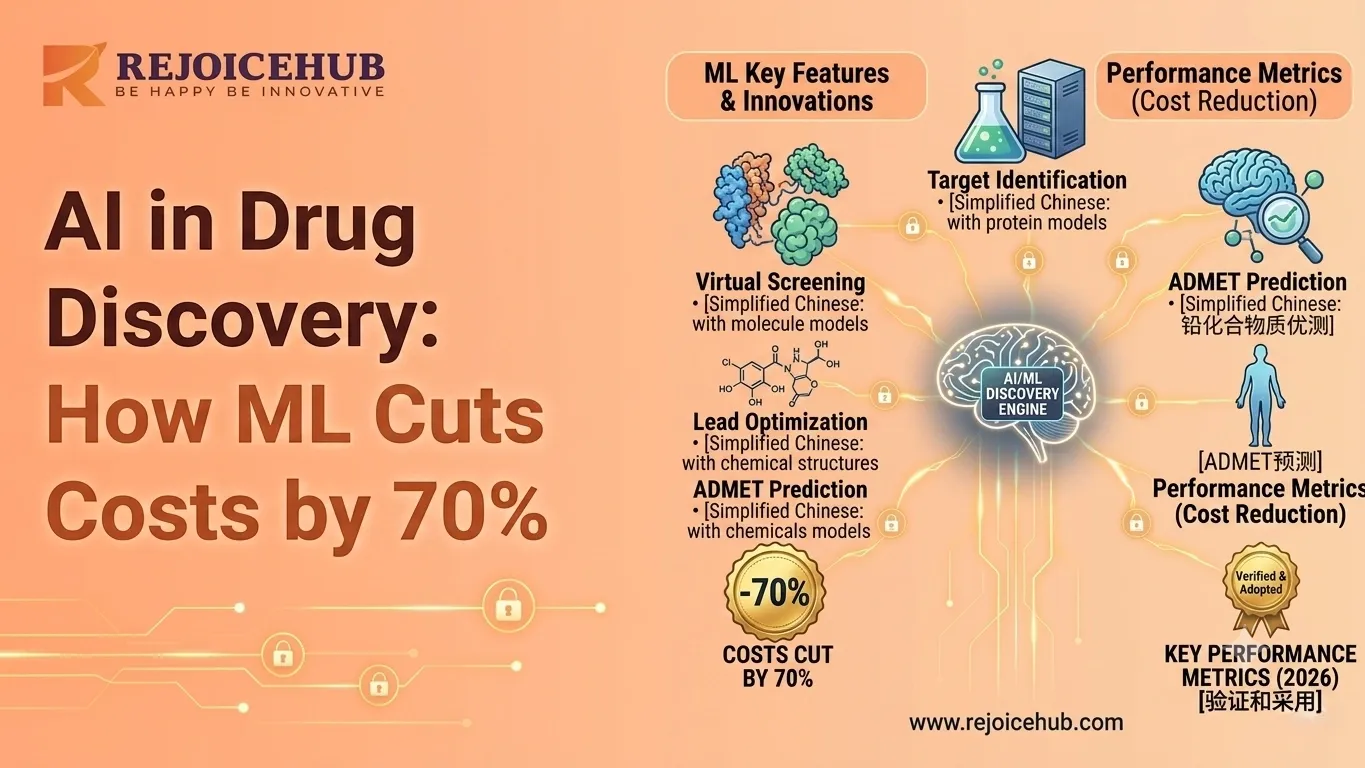
Bringing a new drug to market traditionally costs over 2.6 billion dollars and takes 10-15 years to develop. Of this, most of the time and money is spent on preclinical research testing thousands of molecules that never make it out of the lab.
Using machine learning and generative AI for predictive modeling, big pharma is drastically reducing the amount of time needed in the drug discovery process.
The reason why traditional drug discovery is so expensive is that it relies on old-school trial-and-error methodology. Researchers have to laboriously create and test many thousands of different molecules before finding a few that might have desirable properties.
However, each step of the process is extremely expensive and time-consuming, and the majority of these candidate molecules "fail" either due to poor therapeutic efficacy or unacceptable side effects.
Because of this, businesses utilizing AI for preclinical research are reporting upwards of a 70% decrease in preclinical expenditures, according to several industry reports analyzing AI-native biotech firms.
For business leaders and health-tech innovators hoping to disrupt the status quo of pharma, this is an illustrative case of how leveraging intelligent automation can turn an entire industry's business model on its head. And this is the kind of intelligent disruption RejoiceHub helps organizations achieve, be it in the field of health-tech or beyond.
What Is AI in Drug Discovery?
AI in drug discovery is basically the use of machine learning, deep learning, and generative AI models to spot, design, and fine-tune new drug candidates faster, and often more accurately than old-school lab approaches.
Rather than leaning only on manual experimentation, these AI models chew through huge biological, chemical, and clinical datasets, and then they try to forecast which molecules are most likely to work, before any real physical trial ever gets started.
Traditional vs. AI-Driven Discovery
| Factor | Traditional Discovery | AI-Driven Discovery |
|---|---|---|
| Timeline | 10–15 years | 3–6 years (in leading pipelines) |
| Cost | $2.6B+ average | Up to 70% lower preclinical cost |
| Method | Manual trial-and-error | Predictive modeling + simulation |
| Molecule screening | Thousands tested physically | Millions screened computationally |
| Success rate | ~10% reach approval | Improved hit rates via prediction |
Traditional discovery is kind of linear and sequential, like target identification then screening, then synthesis then testing, one move at a time. With AI-driven discovery, a bunch of these steps run at the same time, in parallel, because the models are trained on prior experimental data and they try to dodge dead ends early, or at least shortcut them sooner.
It still doesn't remove lab work. It just changes where the effort lands, basically pointing scientists toward the molecules that are most likely to work, so fewer resources get spent on candidates that are heading for failure.
-
Target Identification
AI models scan genomics, proteomics, and clinical datasets to spot which biological targets like genes, proteins, or pathways are connected to a disease. This used to mean researchers spent months doing careful literature review, though now the AI can bring up hopeful targets in just a few days.
-
Molecule Generation
Generative AI models can design entirely new molecular structures, with certain desired properties, instead of just screening the compound collections already on hand. It basically widens the chemical universe researchers get to look through, in a pretty dramatic way.
-
Lead Optimization
Once a promising molecule is spotted, AI helps refine it somewhat making it more potent, more stable, and more soluble, while also reducing unwelcome side effects. This is done using iterative predictive modeling instead of going back and forth with repeated physical synthesis every time.
-
Toxicity Prediction
Machine learning models that are trained on old toxicity records can catch potentially harmful compounds early, before they even get near animal or human trials. This ends up being one of the main reasons for that 70% reduction in preclinical costs, because toxicity failures are among the most expensive late-stage surprises in the usual pipeline.
-
Clinical Trial Optimization
AI doesn't just stay in the lab either. Predictive models can help point to those ideal trial candidates, they can forecast how the enrollment timelines will go, and they can even catch early safety signals before things get too far along, so you get fewer expensive delays during trials and overall success rates that feel more reliable.
Business takeaway: Every one of these steps mirrors a broader automation principle using intelligent systems to filter out low-value work early, so human experts focus only on the highest-potential opportunities. That's the same logic behind well-designed AI agents in any industry, from healthcare to sales operations.
Accelerate Your Workflows with Custom AI
Book a free consultation session with RejoiceHub. We'll map out a tailored automation roadmap for your company.
Role of Machine Learning & Generative AI in Drug Discovery
1. Predictive Models
Predictive ML models are trained on existing biological and chemical data to forecast a compound's behavior (e.g., binding to a target, toxicity, or metabolism).
2. Foundation Models
Big, large-scale foundation models trained on huge biological and chemical datasets now basically work like general-purpose engines, and they can be fine-tuned for certain tasks, kinda like how large language models get tuned for specific business use cases.
3. Generative AI for Molecular Design
Generative AI models can predict new molecules that may serve as potential drugs. These models are trained on data from molecules known to have desirable properties, allowing them to generate new molecules with similar characteristics one of the clearer benefits of generative AI applied to a scientific domain.
4. Protein Structure Prediction
Trying to predict how a protein folds, meaning its 3D shape, used to be this long slog of lab work for each protein, and it could take years. Now AI models are able to predict protein structures with pretty remarkable accuracy, but in a much smaller time window. That seems to unlock a deeper look at how diseases actually work, at a molecular level.
And in a way, these new technologies together show a turn from AI being just a helper tool to AI acting like a real research engine, capable of hypothesis-making, rather than only doing data analysis.
AI in Drug Discovery: Real-World Examples
-
AlphaFold (DeepMind)
AlphaFold made the news by cracking one of biology's hardest problems: predicting protein shapes from the amino acid strings with near experimental precision. This kind of breakthrough now sits underneath a lot of modern computer-aided drug discovery workflows in healthcare, like it's quietly running the whole show.
-
Isomorphic Labs
Coming out of DeepMind, Isomorphic Labs sort of takes AI straight into drug design, partnering with big pharmaceutical companies to speed up candidate discovery using technology that's derived from AlphaFold.
-
Insilico Medicine
Insilico Medicine uses generative AI to design drug candidates end-to-end from target identification to molecule generation and has advanced AI-discovered drugs into human clinical trials.
-
Recursion Pharmaceuticals
Recursion merges robotics, imaging, and machine learning so it can run huge biological experiments and chart these connections between disease genes and drug compounds, pretty much at scale.
-
Atomwise
Atomwise applies deep learning to structure-based drug design, screening billions of molecules computationally to predict which will bind effectively to disease-relevant proteins.
-
BenevolentAI
BenevolentAI meshes biomedical knowledge graphs with machine learning to spot new purposes for existing drugs and uncover fresh treatment targets quicker than the older sort of research approaches usually do.
These companies show a recurring pattern, where AI doesn't really replace scientific expertise; it multiplies it somehow, so smaller, more focused teams can take on pipelines that once needed huge R&D budgets, just to move at all.
Benefits & Challenges of AI in Drug Discovery
Benefits
- Faster research: computational screening replaces months of manual lab testing
- Lower costs: early filtering of poor candidates reduces wasted R&D spend
- Better success rates: predictive toxicity and efficacy modeling reduces late-stage failures
- Personalized medicine: AI enables modeling of patient-specific responses, supporting more targeted therapies, echoing what's already happening with generative AI in healthcare
Challenges
- Data quality: AI models are only as good as the biological and chemical data they're trained on
- Regulatory compliance: agencies like the FDA are still developing clear frameworks for AI-derived drug candidates
- Explainability: "black box" models can be hard to justify to regulators and clinicians
- Bias: training data that underrepresents certain populations can skew predictions
- Validation: AI predictions still require rigorous experimental confirmation before human trials
The honest picture: AI accelerates discovery, but it doesn't eliminate the need for careful validation, regulatory diligence, and human scientific judgment. Companies that treat AI as a co-pilot, not an autopilot, see the best outcomes.
The Future of AI in Drug Discovery (2026 and Beyond)
1. Autonomous AI Agents
Pharma teams are starting to roll out autonomous AI agents that kind of run pieces of the discovery pipeline on their own, like suggesting hypotheses, arranging experiments, and then interpreting the outcomes with very little human touch. They are doing it mostly independently and with less handholding than before.
2. Digital Laboratories
"Self-driving labs" mixing robotics with AI decision-making are now automating physical experiments, closing that loop between prediction and validation, quicker than ever before. You get this kind of faster turnaround, like it's continually calibrating itself.
3. AI Co-Scientists
Rather than replacing researchers, AI is increasingly positioned as a collaborative partner, generating hypotheses, flagging anomalies, and suggesting next experiments alongside human scientific teams a dynamic worth understanding through the lens of AI agents versus AI chatbots.
4. Multi-Agent Drug Discovery
Rather than one model trying to do everything, you'll see specialized AI agents like one that focuses on target identification, another tasked with toxicity prediction, and yet another handling trial design starting to work side by side in coordinated agentic AI workflows.
Kinda like this, it also echoes a wider change that's happening across industries: those heavier, more complex workflows are getting split up and then automated using multi-agent systems, instead of relying on one single, monolithic tool.
5. Regulatory Trends
Expect regulatory bodies to roll out clearer frameworks for validating AI-derived drug candidates, and do it in a way that still balances innovation speed with patient safety a trend that has been showing up already in FDA guidance discussions through 2025 and into 2026.
The bigger pattern here is: what's happening in pharma with task-specific AI agents that collaborate across complex workflows is pretty much the same design idea businesses everywhere are now using to automate operations, reduce costs, and move faster than manual work ever could.
Conclusion
AI in drug discovery is no longer a distant vision but an imminent reality. By driving down the time and cost of traditional R&D processes, machine learning and generative AI have the potential to make an enormous impact on the pharmaceutical industry.
A few key insights:
- The traditional drug discovery process is slow and extremely costly due to the reliance on manual trial-and-error
- AI can accelerate each step of the way, from target identification to molecule design to clinical trial optimization
- There are already successful business models being built around this approach by companies such as Insilico Medicine, Recursion Pharmaceuticals, and Isomorphic Labs
- Notwithstanding the enormous opportunities, there are also challenges around data quality, model interpretability, and regulatory oversight
- The future likely involves intelligent agents and entire ecosystems of collaborative autonomous AI systems
The most important lessons from this report extend far beyond the pharmaceutical industry into other domains involving large-scale project management and R&D. Intelligent agents can fundamentally change the economics of any repetitive, rule-based human activity, whether it's molecule screening or lead optimization, clinical trial design or customer service automation.
If you're interested in building an AI agent for your business to streamline operations at your company, whether in healthcare or elsewhere in the commercial sector, RejoiceHub specializes in AI agent development and generative AI solutions that seek to dramatically reduce costs and accelerate decision-making.
Frequently Asked Questions
1. What is AI in drug discovery?
AI in drug discovery means using machine learning and generative AI to find, design, and improve new medicines faster than old lab methods. Instead of testing thousands of molecules by hand, AI studies huge amounts of data to guess which ones might actually work before real testing starts.
2. How is AI transforming drug discovery?
AI is changing drug discovery by running many research steps at the same time instead of one after another. It looks at genetic, chemical, and clinical data quickly, points out promising drug targets, and helps scientists skip dead ends early, saving both time and research money.
3. What is the role of generative AI in drug discovery?
Generative AI creates brand new molecule designs instead of only checking existing ones. It learns from molecules that already work well and then suggests fresh options with similar helpful properties. This gives scientists a much bigger range of possible drug candidates to study and test.
4. How is AI used in drug discovery today?
AI is used to identify disease-related targets, design new molecules, predict toxicity early, and pick better candidates for clinical trials. Companies like Insilico Medicine and Isomorphic Labs already use these tools daily, which has helped cut preclinical research costs by up to 70%.
5. Can you give examples of AI in drug discovery?
Yes, some well-known examples are AlphaFold for protein structure prediction, Isomorphic Labs for AI-based drug design, Insilico Medicine for generative molecule creation, and Atomwise for screening billions of compounds. These companies show how AI is already being used in real pharma research.
6. What does AI in drug discovery and development look like in 2026?
By 2026, AI in drug discovery includes self-driving labs, AI co-scientists, and multiple AI agents working together on different tasks like toxicity checks and trial design. Regulators are also building clearer rules so these AI-driven drug candidates can be reviewed and approved safely.
7. Can you explain machine learning in drug discovery simply?
Machine learning in drug discovery means training computer models on old chemical and biological data so they can predict how a new molecule might behave, like whether it's toxic or effective. This helps scientists filter out weak candidates early, before spending money on physical lab testing.