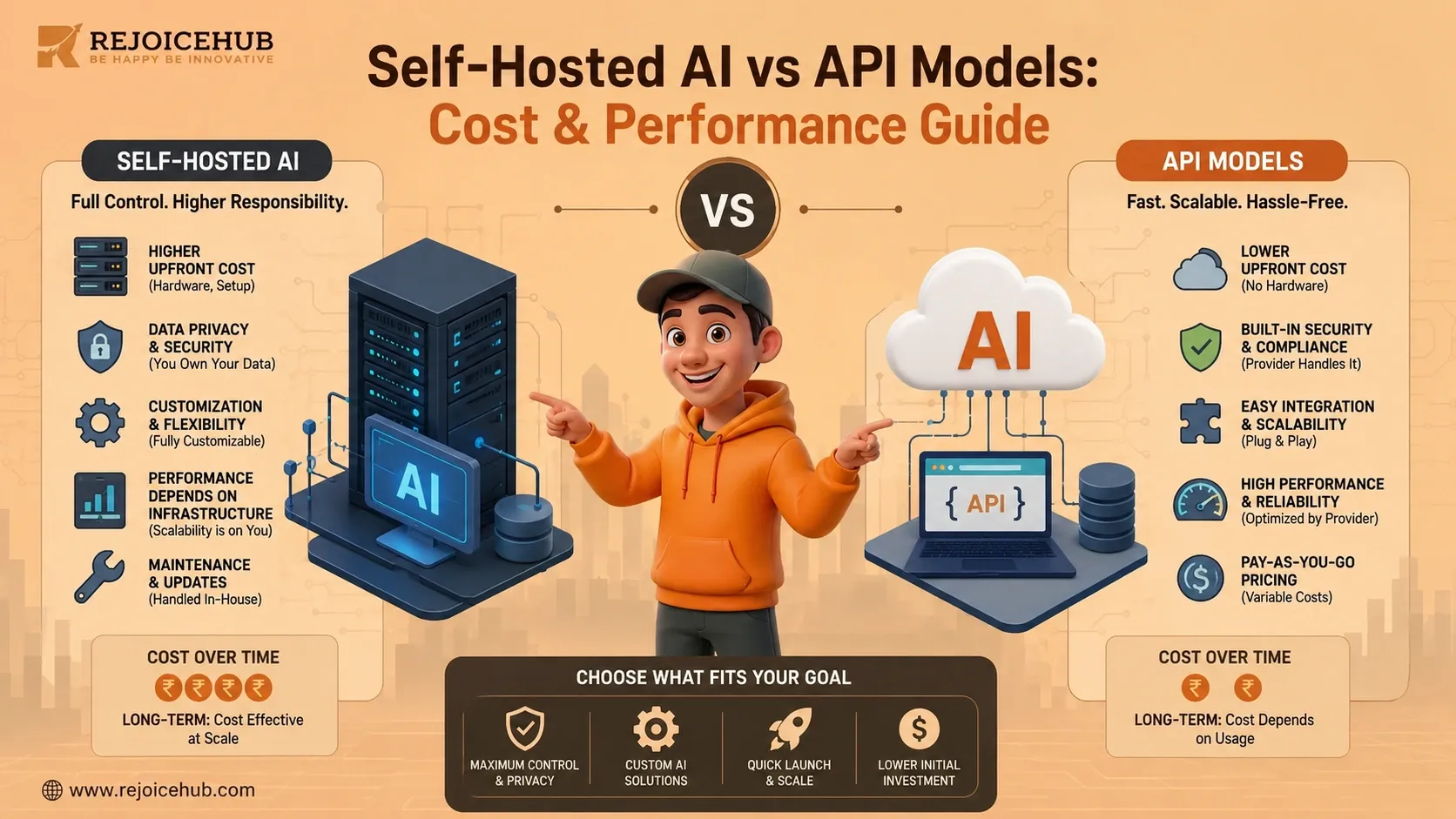
Most AI-powered startups eventually face a fundamental infrastructure decision: should they self-host their models or use third-party APIs? Do you host your own GPU infrastructure and bear the costs of maintenance and expansion, or do you rely on a third party, such as OpenAI or Anthropic, to provide you with language models as a service? This decision has ramifications for the financial sustainability of the business and its technical capabilities in terms of responsiveness and scalability. As part of a broader business AI readiness assessment, it's critical to understand these tradeoffs in order to make the correct choice.
The article will explore the financial and technical differences between the two approaches, providing you with enough information to make an informed decision.
Key Takeaways
-
API models win on speed-to-market, low upfront cost, and zero infrastructure burden.
-
Self-hosted LLMs can become more cost-effective for high, predictable workloads when GPU utilization is consistently high, and infrastructure overhead is controlled.
-
Self-hosting AI inference gives you more control over data privacy, latency, and model customization.
-
Hybrid architectures can combine APIs for complex workloads with self-hosted models for high-volume, sensitive, or predictable workloads.
-
The right choice depends on volume, compliance needs, and in-house ML infrastructure capability, not just price per token.
What Does "Self-Hosting AI Inference" Actually Mean?
Self-hosting AI inference means deploying and operating an open-weight or licensed model on infrastructure you control, such as cloud GPUs, dedicated servers, or on-premises hardware, rather than sending inference requests to a third-party API.
With the API models (GPT-4, Claude, Gemini, etc.), you're simply making requests to their endpoint. You have much less control over the model weights, serving infrastructure, scaling, and uptime.
Common self-hosting options include:
-
Open-weight models like Llama 3, Mistral, or Qwen
-
Serving frameworks like vLLM, TGI (Text Generation Inference), or Triton
-
Deployment on your own GPU cluster or rented cloud GPU instances (AWS, Lambda Labs, RunPod)
If you'd rather run models on your own hardware entirely, our guide to running LLMs locally walks through the setup in more depth.
Self-Hosted LLM vs API: Cost Breakdown
API costs primarily depend on token consumption, model pricing, request volume, and the mix of input and output tokens. Self-hosted inference shifts those costs toward GPU capacity, infrastructure, engineering, and operations.
Here's how the two models typically compare:
| Cost Factor | API Models | Self-Hosted Inference |
|---|---|---|
| Upfront cost | Near zero | GPU/cloud instance setup, engineering time |
| Pricing structure | Pay-per-token | Fixed hourly/monthly (GPU rental) or capex (owned hardware) |
| Scaling cost | Grows linearly with usage | Flat until you exceed capacity, then a step-cost jump |
| Idle cost | $0 when unused | You pay for GPU uptime even during low traffic (unless auto-scaled) |
| Maintenance | Handled by provider | Your team owns patching, scaling, monitoring |
| Best for | Variable or low-to-moderate volume | High, predictable, sustained volume |
A pragmatic way to think about the economics of AI inference is to ask yourself if the amount you spend on an API service for a certain workload is larger than what you'd pay to rent a GPU instance which can run it 24/7.
If API spending consistently exceeds the estimated total cost of operating comparable GPU capacity, self-hosting may be worth evaluating. However, the calculation should also include engineering, monitoring, redundancy, networking, and idle capacity.
The choice between an API and a self-hosted GPU depends on the use case. If you're a SaaS company processing a high volume of short, predictable requests, such as support classification or structured extraction, self-hosting a smaller model may become economically attractive.
On the other hand, a small start-up which only uses AI features sporadically, for a minor feature and a couple of hundred users, would be better off using an API, as to not wasting GPU time on capacity which would go unused most of the time. For a deeper cost comparison specific to agent-based products, see our breakdown of AI agent costs, pricing models, and ROI.
Accelerate Your Workflows with Custom AI
Book a free consultation session with RejoiceHub. We'll map out a tailored automation roadmap for your company.
AI Inference Cost: What Actually Drives the Price?
AI inference costs are determined by the model size, the number of requests, the length of the requests (in tokens), the utilization of the hardware, and the fact that you might be paying somebody's margin if you're using a third party. The same factors apply to both self-hosting and API-based solutions, just bundled in different ways.
Key cost drivers to understand:
-
Model size: Larger models need more VRAM and compute, raising both API price-per-token and GPU requirements for self-hosting.
-
Context length: Longer prompts and outputs cost more whether billed per token or measured in GPU-seconds. Techniques like prompt caching can meaningfully reduce these AI API costs for repetitive workloads.
-
Concurrency: API providers absorb the complexity of parallel requests; self-hosters must engineer for it (batching, queuing) or pay for underutilized GPUs.
-
Provider margin: API pricing includes the provider's infrastructure, R&D, and profit margin; self-hosting removes this markup but adds your own operational overhead instead. If you're specifically weighing Anthropic's pricing, our guide to Anthropic's per-token pricing breaks down what drives the numbers.
LLM API vs Self Hosting: Performance and Latency
API providers typically offer optimized inference infrastructure without requiring your team to manage model serving. Self-hosted inference can achieve lower latency for some workloads when GPUs are deployed close to users, and the serving stack is properly optimized. However, queueing, poor GPU utilization, network distance, and inefficient batching can increase latency.
Performance considerations:
-
Latency: Self-hosting near your application servers can cut network round-trip time, which matters for real-time voice agents or chat UIs.
-
Throughput: APIs handle traffic spikes automatically; self-hosted systems need autoscaling logic built in-house.
-
Model customization: Self-hosting allows fine-tuning, quantization, and prompt caching tailored to your exact workload, something API providers control on their end.
-
Reliability: Major API providers offer high uptime SLAs backed by redundant infrastructure; matching that in-house takes real DevOps investment.
A typical mistake that start-ups make is that they want to host their model themselves to avoid latency introduced by an external API, but then fail to batch requests or optimize for GPU, and thus end up with something worse in terms of latency and cost.
Self-Hosted AI vs API: Scalability Compared
There are significant differences between these two approaches in terms of scalability, control, and cost predictability. API models scale easily with increased demand as the provider hosts and manages the underlying infrastructure, whereas self-hosted AI requires capacity planning but offers greater control and cost predictability at scale.
| Scalability Factor | API Models | Self-Hosted Inference |
|---|---|---|
| Traffic spikes | Auto-handled by provider | Requires autoscaling setup (K8s, GPU pools) |
| Multi-region deployment | Often built-in | You architect and manage it |
| Rate limits | Provider-imposed caps | Limited only by your hardware |
| Long-term cost at scale | Increases with volume | Flattens once infrastructure is amortized |
| Engineering overhead | Minimal | Significant, ongoing |
For young companies testing out their product, the ability to scale up on the API is essential, because it takes the pressure off them to have to plan their capacities. But for companies whose products have found a decent market-fitness and are now at the takeoff point, the value of self-hosting outweighs the risk of having to provision the capacity themselves. Teams weighing infrastructure strategy at this stage often benefit from comparing multi-cloud vs hybrid cloud approaches before committing.
AI API Pricing vs GPU Cost: A Practical Comparison
The comparison of the cost of an API to the cost of using GPUs requires expressing them in terms of one variable, for instance, the number of tokens per million processed by a model. In addition, the cost of using GPUs is conditional on utilization rates, where a 30% utilization rate may be significantly higher than the price of an API in the same range.
Steps to run this comparison for your own business:
-
Estimate your monthly token volume across all AI features (input + output tokens).
-
Calculate your current or projected API cost using the provider's published per-token pricing.
-
Estimate GPU rental cost for a comparable open-weight model comparing chip options like AMD vs Nvidia for AI workloads is a useful starting point (check current rates from providers like Lambda Labs, RunPod, or AWS).
-
Factor in utilization rate: a GPU sitting idle 70% of the day is not a 70% cost saving.
-
Add engineering and maintenance time, valued at your team's loaded hourly cost.
-
Compare the true total cost per million tokens across both models.
If you plan to build your custom AI agent and need assistance with the aforementioned analysis to determine whether you should go with self-hosting or not, you can rely on RejoiceHub to model both scenarios for you ahead of time to help you with your infrastructure budget planning.
When Should You Self-Host vs Use an API? A Decision Framework
Stick with API models when:
-
You're pre-product-market-fit, and traffic is unpredictable
-
Your team is small and lacks dedicated ML/DevOps engineers in which case, it's worth reading how to deploy AI agents without an in-house ML team
-
You need access to frontier models or capabilities that may not be available in your self-hosted model stack
-
Speed to market matters more than marginal cost savings
Consider self-hosting when:
-
You process very high, consistent request volumes
-
Data privacy or compliance (HIPAA, finance, government) requires on-premise processing
-
You need heavy fine-tuning or a highly customized model
-
You have the engineering bandwidth to manage infrastructure reliably
Consider a hybrid approach when:
-
You want API models for complex reasoning tasks and self-hosted smaller models for high-volume, simple tasks (classification, extraction, routing) this is essentially what LLM routing is designed to automate
-
You're scaling fast and want to de-risk vendor dependency gradually
If you're still deciding between building this in-house or partnering out, our build vs buy guide for AI platforms covers that decision in more detail.
Common Mistakes Businesses Make in This Decision
-
Underestimating DevOps overhead of running self-hosted inference reliably at scale.
-
Ignoring idle GPU cost when calculating self-hosting savings.
-
Over-indexing on per-token price without factoring in engineering time and opportunity cost a fuller picture comes from measuring AI ROI through a token-to-outcome framework.
-
Self-hosting too early, before traffic volume justifies the fixed cost.
-
Staying on APIs too long after volume has made self-hosting clearly cheaper.
Expert recommendation: Revisit this decision quarterly as your usage grows. The right answer at 10,000 monthly requests is often wrong at 10 million.
For SaaS teams scaling AI features, this is often the point to step back and revisit your broader AI automation strategy.
Conclusion
There is no universal winner between self-hosted inference and API models. The right choice depends on workload volume, utilization, latency requirements, compliance, model requirements, and engineering capacity.
For most early-stage companies, APIs provide the fastest path to production with minimal infrastructure overhead. As workloads become larger and more predictable, self-hosting may become attractive if GPU utilization and operational efficiency justify the additional complexity.
For many growing SaaS companies, the best answer is neither approach alone. A hybrid architecture can combine external APIs for complex workloads with self-hosted models for predictable, high-volume tasks.
The key is to treat inference architecture as an economic and engineering decision, not simply a choice between API pricing and GPU costs.
Frequently Asked Questions
1. What is the difference between self-hosted AI vs API models?
Self-hosted AI means you run the model on your own servers or GPUs, so you control everything. API models mean you send requests to a provider like OpenAI or Anthropic and pay per token. Self-hosting needs engineering effort, while API models are ready to use instantly.
2. Is self-hosting AI inference cheaper than using an API?
It depends on your usage. Self-hosting AI inference can be cheaper if you have high, steady traffic and can keep your GPUs busy most of the time. But if your usage is low or unpredictable, API models usually cost less overall.
3. When should I choose self hosted LLM vs API?
Choose a self hosted LLM when you have steady high volume, strict data privacy needs, or want full control over customization. Choose an API when you're just starting out, have unpredictable traffic, or don't have a dedicated engineering team to manage servers.
4. How is AI inference cost calculated?
AI inference cost depends on model size, request length, and how often you use it. For APIs, it's priced per token. For self-hosting, it's based on GPU rental or hardware cost, plus the electricity and engineering time needed to keep it running.
5. What is a good self hosted LLM cost estimate?
A rough self hosted LLM cost estimate should include GPU rental fees, storage, networking, and engineering hours for setup and maintenance. Many teams forget idle GPU time, which can quietly increase costs even when traffic is low or inconsistent throughout the month.
6. How does AI API pricing vs GPU cost compare?
AI API pricing charges you per token used, so cost grows with usage. GPU cost for self-hosting is usually a fixed monthly or hourly rate, no matter how much you use it. The cheaper option depends on your utilization rate and volume.
7. What is LLM inference cost and why does it matter?
LLM inference cost is the total money spent running a language model, whether through an API or your own servers. It matters because it directly affects your profit margins, and small pricing mistakes can add up fast as your usage grows.