AI investment is not an experimental initiative anymore; it is the fundamental component of a company's budget regardless of its domain. However, with increasing investments, boards demand increasing accountability.
It is not an issue of the usefulness of AI systems any longer. Instead, it is an issue of the ability to demonstrate their utility in tangible business results.
And while many companies fail to answer this challenge, conventional methods of calculating ROI were designed without taking into account the peculiarities of AI agents operating autonomously and adding value at multiple levels simultaneously.
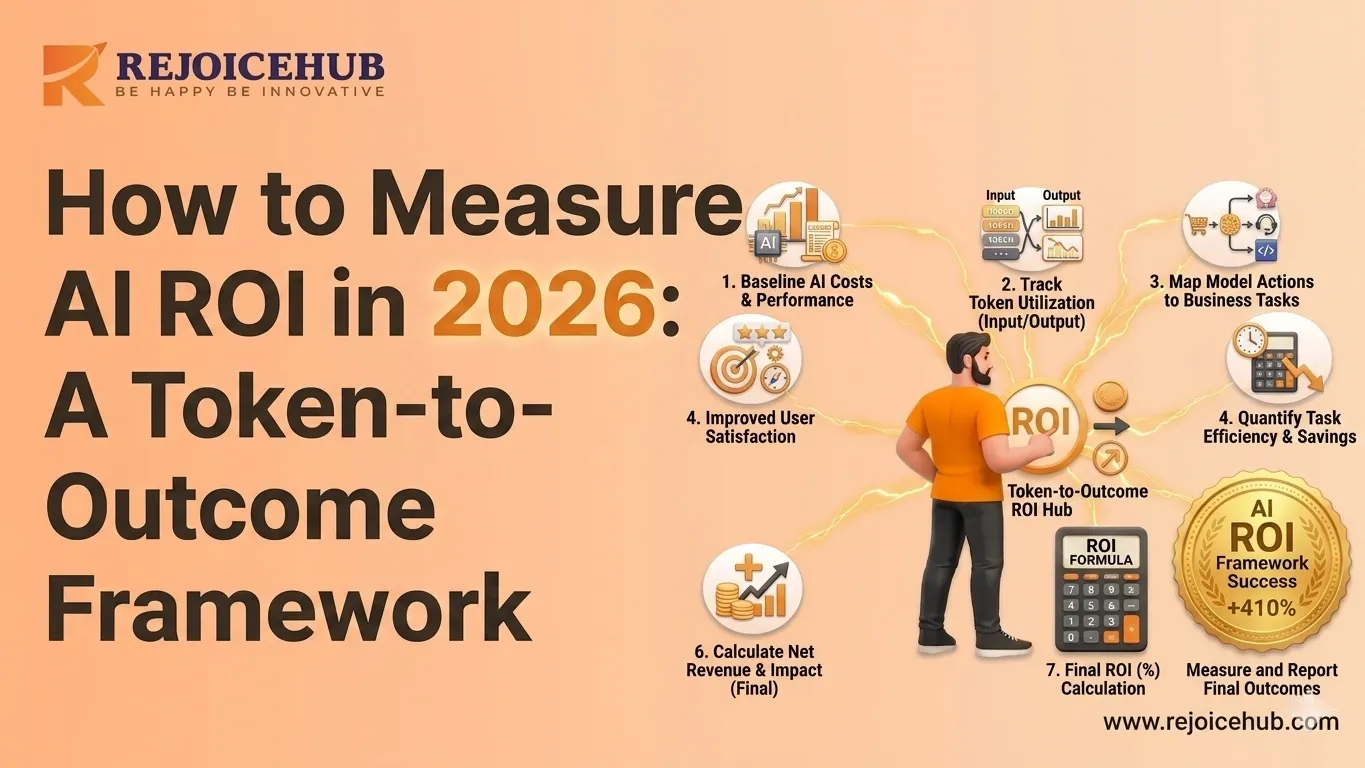
That is precisely why we came up with the Token-to-Outcome Framework concept.
In this guide, you'll learn:
- Why legacy ROI models fall short for modern AI
- How to calculate AI ROI the right way
- Which metrics should enterprise teams track in 2026
- A real-world example with full ROI breakdown
- Best practices for maximizing your AI investment
Why Measuring AI ROI Is More Important Than Ever in 2026
Executives are no longer willing to approve AI budgets on faith. They want data, accountability, and a clear path from AI investment to business outcome.
Rising Enterprise AI Investments
Enterprise AI spending has been increasing at an unprecedented pace. Companies are using AI to manage customer service, sales, content creation, analytics, and logistics – all at once.
There is a lot of weight behind this expenditure. Executives want to see AI performance reported within their board meetings. Investors are expecting to see ROI from AI projects in terms of bottom-line numbers.
"We're testing AI," will not cut it anymore. For the year 2026, AI is one of the business functions, and all business functions should show measurable success.
The Challenge of Proving AI Value
The vast majority of organizations understand that AI does work, but they do not know by how much. Here is why:
First, the value created by AI comes from many business functions at once, so tracing it is not an easy task. Second, current ROI calculation methodologies are designed around one-time payments, not ongoing subscription fees. Third, the price of AI is flexible (based on API usage). Fourth, tangible benefits such as better decision-making and faster processes are quite hard to measure.
Without the proper framework, financial officers will inevitably rely on intuition, which is never a good practice.
Understanding the Core Components of AI ROI
Before you can calculate AI ROI, you need to understand what goes into it. There are two sides to the equation: what you spend, and what you get back.
1. AI Costs
Total AI cost includes more than just your monthly API bill. Enterprises should account for:
- Model usage costs: API calls, token consumption, inference costs
- Infrastructure: cloud compute, storage, GPUs for self-hosted models
- Development: engineering hours to build, integrate, and deploy AI systems
- Maintenance: ongoing monitoring, bug fixes, model updates
- Training & fine-tuning: custom datasets, labeling costs, domain adaptation
Missing any of these leads to an underestimated cost baseline and an inflated (and misleading) ROI number. For a deeper look at how per-token pricing affects enterprise AI costs, it's worth reviewing your model tier carefully before budgeting.
2. AI Business Outcomes
The other side of the equation is value generated. The most common categories include:
- Revenue growth: AI-assisted sales, personalized marketing, faster deal cycles
- Cost reduction: automation replacing manual processes, fewer support headcount
- Efficiency gains: faster task completion, reduced error rates, 24/7 operations
- Customer experience improvements: faster response times, personalized interactions, reduced churn
Featured Snippet: The AI ROI Formula
AI ROI = ((Business Value Generated – AI Costs) ÷ AI Costs) × 100
Example: If AI generates $20,000 in value and costs $5,000 to run, your ROI is 300%.
The Token-to-Outcome Framework Explained
The Token-to-Outcome Framework is a structured methodology for connecting granular AI usage data starting at the token level, all the way to measurable business results.
Step 1 – Measure Token Consumption
Every AI interaction starts with tokens, the units of text your model processes. Tracking token-level usage gives you the most granular view of AI cost and activity.
What to track:
- Input tokens the prompt or context sent to the model
- Output tokens the AI's response
- API costs cost per 1,000 tokens by model and tier
Most AI platforms (OpenAI, Anthropic, Google) provide token-level usage logs. Export these into a centralized dashboard and tag each call with a use case category (e.g., support, sales, analytics). One proven technique to reduce costs at this stage is prompt caching for LLMs, which can significantly lower your token spend over time.
Step 2 – Connect Tokens to Actions
Token consumption alone doesn't mean much. The next step is mapping token usage to specific AI actions the discrete tasks your AI system performs.
Examples:
- Customer support: 1 support ticket response = avg. 800 input tokens + 300 output tokens
- Sales outreach: 1 personalized email = avg. 400 input tokens + 200 output tokens
- Data analysis: 1 summary report = avg. 2,000 input tokens + 600 output tokens
Once you have this mapping, you know the average cost per action a critical building block for ROI calculation.
Step 3 – Connect Actions to Outcomes
The final step is connecting those actions to the business outcomes they produce.
Examples:
- 1 support ticket resolved → $40 in labor cost saved
- 1 qualified lead from AI outreach → $200 pipeline value generated
- 1 data analysis report → 3 hours of analyst time saved
When you multiply actions by outcomes, you get the total business value generated in the numerator of your ROI formula.
Why This Matters
Token-to-Outcome changes the nature of AI investment from a black box into an open-ended value creator. Each token maps directly back to a business outcome, which means every dollar spent on AI can be defended, optimized, or rerouted.
AI ROI Metrics Every Enterprise Should Track
Here's a consolidated view of the metrics your team should monitor:
| Financial Metrics | Operational Metrics | AI-Specific Metrics |
|---|---|---|
| Cost Savings | Process Automation Rate | Cost per Outcome |
| Revenue Impact | Time Saved per Task | Cost per Task |
| Profit Contribution | Productivity Improvement | Token Efficiency |
| Budget Variance | Error Rate Reduction | Agent Success Rate |
1. Financial Metrics
These are the metrics your CFO and board care most about. Track them monthly and quarter-over-quarter:
- Cost savings: direct reduction in labor, operational, or vendor costs attributable to AI
- Revenue impact: incremental revenue from AI-assisted sales, marketing, or product
- Profit contribution: net margin improvement after AI costs
2. Operational Metrics
Operational metrics show how AI is changing the way your team works:
- Process automation rate: percentage of tasks now handled by AI vs. humans
- Time saved: average hours recaptured per employee per week
- Productivity improvement: output per employee before vs. after AI deployment
Understanding how AI agents help automate workflows is essential context for interpreting these operational gains accurately.
3. AI-Specific Metrics
These metrics are unique to AI systems and critical for ongoing optimization:
- Cost per outcome: total AI cost ÷ number of successful outcomes
- Cost per task: average API cost to complete one defined task
- Token efficiency: outputs generated per dollar of token spend
- Agent success rate: percentage of AI agent runs that complete without human intervention
Real-World Example of AI ROI Calculation
Let's walk through a concrete scenario to see the Token-to-Outcome Framework in action.
Scenario: Customer Support AI Agent
An intermediate SaaS company uses an AI-powered customer support agent for their Tier-1 tickets. They work on 2,000 tickets monthly. Before AI usage, each ticket would take a support agent 15 minutes ($40/hour) of effort, amounting to $20,000 a month.
Once an AI assistant is used, it can automatically solve 500 tickets monthly that is 25% and it would cost around $0.50 per ticket to process. The AI system will additionally require $4,750 for infrastructure each month, making the total cost $5,000 a month.
| Metric | Value |
|---|---|
| Monthly AI Spend | $5,000 |
| Support Hours Saved | 500 hours/month |
| Avg. Labor Cost/Hour | $40/hour |
| Total Labor Savings | $20,000 |
| Net Business Gain | $15,000 |
| AI ROI | 300% |
This means a return on investment of 300 percent and this is only one application in one department. Consider the impact when we apply this across sales, marketing, information management, and analytics.
RejoiceHub Insight: If you're looking to build a custom AI agent that delivers this kind of measurable impact, RejoiceHub specializes in AI agent development and automation solutions tailored for enterprise and SMB teams with ROI tracking built in from day one.
Best Practices for Improving AI ROI
Getting a positive ROI from AI isn't automatic. Here's what high-performing teams do differently:
1. Start with High-Impact Use Cases
Do not attempt to automate everything all at once; rather, pick the 2–3 processes with the greatest volumes, the most defined outcomes, and the easiest-to-measure values. Processes such as customer support automation, lead qualification, and content generation tend to be the first candidates due to the above reasons.
2. Monitor Token Efficiency
The token price can skyrocket when prompts are not optimized. It is always advisable to optimize your prompts regularly by removing redundant context, reducing verbosity in outputs, and using smaller models whenever possible instead of large language models. Even a 20% decrease in tokens used can mean huge savings on token prices.
3. Define KPIs Before Deployment
The most common mistake that organizations make is to assess the ROI after deployment, when by then the benchmark is no longer clear. The organization should know exactly what their success indicators would be before they deploy such as the number of tickets solved per hour.
4. Continuously Optimize AI Workflows
The return on investment for AI is not constant. Use AI systems with agency, which are able to self-correct and learn via feedback mechanisms, prompt testing, and periodic re-training. The most effective use of AI compounds in value while the investment level remains stable.
Another tip for increasing the success rate is to use multi-agent systems for business automation in which specific agents perform separate tasks, passing tasks back and forth for workflow optimization. This would increase automation levels considerably.
Conclusion
AI technology can be considered one of the most advanced tools available to organizations today; however, it requires clarity of purpose and a proper method of analysis for organizations to capitalize on its power.
The Token-to-Outcome Framework provides a process from detailed AI usage metrics to high-level impacts on business for enterprise teams. This helps address the missing link between "We're leveraging AI" and "This is precisely the value we are getting from AI."
Those organizations successfully leveraging AI technology do not just rely on advanced algorithms alone; rather, they focus on measurement and have a defined set of KPIs before deploying the technology. If you're still evaluating where to start, reviewing the benefits of AI for business can help you identify the highest-value entry points for your organization.
The process is not merely an exercise but an ongoing approach that will enable you to make full use of the value from your investments in AI technology.
Frequently Asked Questions
1. How to measure AI ROI in 2026 for a small or mid-size business?
Start by tracking your AI costs, API usage, setup, and maintenance. Then measure what value it creates, like hours saved or tickets resolved. Divide net gain by total cost and multiply by 100. Even small teams can follow this formula without needing a data science background.
2. What is the Token-to-Outcome Framework and how does it help calculate AI ROI?
The Token-to-Outcome Framework connects raw AI usage — like token consumption directly to real business results. It helps you see exactly what each AI action costs and what it returns, making your AI ROI metrics for enterprises much easier to track, report, and improve over time.
3. Which AI ROI metrics should enterprise teams actually track in 2026?
Focus on cost savings, revenue impact, time saved per task, cost per outcome, and agent success rate. These cover both financial and operational sides. The best AI ROI measurement framework always includes AI-specific metrics like token efficiency alongside standard business KPIs your CFO already understands.
4. How do businesses calculate AI ROI when benefits are hard to measure?
Map each AI action to a concrete outcome first. For example, one resolved support ticket equals $40 in labor saved. Once you build this action-to-outcome connection, how businesses calculate AI ROI becomes much clearer, even for soft benefits like faster decisions or fewer errors.
5. What costs should be included when calculating total AI investment?
Don't just count your API bill. Include infrastructure, developer hours, model fine-tuning, maintenance, and monitoring. Missing these gives you a falsely high ROI number. A proper AI cost savings and ROI calculation always starts with an honest, complete picture of what you're actually spending each month.
6. What is a good AI ROI percentage for enterprise AI projects in 2026?
There's no fixed number, but 200–400% ROI is achievable for well-scoped use cases like customer support automation. The key is starting with high-volume, easily measurable processes. A 300% ROI, like in the support ticket example, means you get $3 back for every $1 spent on AI.
7. How can companies improve their AI ROI over time without increasing their budget?
Optimize your prompts to reduce token usage, automate more tasks using multi-agent systems, and set clear KPIs before deploying anything. Regularly review your cost per outcome. Small improvements in token efficiency and workflow design can compound into major AI cost savings without needing to spend more.